The Iron Cross (Belgium)

The Iron Cross was established in 1833 after the end of the Belgian Revolution and awarded for wounds or bravery in battle.

The Iron Cross (Croix de fer / IJzeren Kruis) was established by law in 1833 after the end of the Belgian Revolution and awarded to those who had received serious wounds and for bravery in battle between 25 August 1830 and 4 February 1831. Recipients were also honored with the right to bear arms and received ever-increasing pensions.

On 22 August 1834, a royal decree created a second class to the Iron Cross for award to all wounded combatants, although it was short-lived and amalgamated to the Iron Cross first class by decree of 21 February 1835.

The award was bestowed to members of the provisional government and to other citizens who were wounded in battle and who elected to stay at their post and keep fighting or who returned to the fight, to the maimed and mutilated, as well as to those who displayed acts of courage in combat and eminent services to the country.

The estimated number of decorated was 1635 in 1835, and 463 decorated living in 1860.

The Iron Cross Design

First Class

The Iron Cross first class is a black Maltese Cross struck from iron with a gold central medallion. The cross is outlined in gold and small gilt orbs were affixed to the eight tips of the cross arms. The obverse bears the gilt relief image of the Belgian lion, a heraldic “lion rampant” and a golden disc. The reverse bears the gilt relief inscription “1830” and is also surrounded by a golden disc.

The cross is suspended by a ring and the ribbon is a 31mm wide red silk moiré with 1.3mm wide yellow edge stripes bordered on the inside by 2.7mm wide black stripes.

Second Class

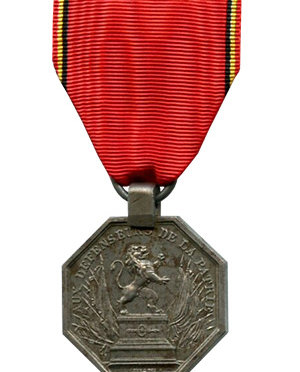
The Iron Cross second class is an octagonal medal struck from iron. The obverse bears the relief image of the Belgian lion, a heraldic “lion rampant” but with banners to the left and right. Along the edge there’s a circular inscription in relief that reads “AUX DEFENSEURS DE LA PATRIE” (TO THE DEFENDERS OF THE COUNTRY“) and the coats of arms of the nine Belgian provinces arranged in a circle around a sun. The reverse bears the year “1830” is superimposed over it, and it’s all surrounded by a relief circular inscription reading “INDEPENDANCE DE LA BELGIQUE” (INDEPENDENCE OF BELGIUM“).

The award is topped by a pivot mounted crown, with the same ribbon as the cross first class.
The Medal of Merit of the Civil Guard

The Medal of Merit of the Civil Guard (Médaille du Mérite de la Garde Civique) was established on 19 November 1830 by the Provisional Government to reward the services rendered by the members of the Civic Guard.

Only five medals of this type were awarded. Among the receivers were:

  • General Baron Emmanuel Vanderlinden d’Hoogvorst,
    Colonel-Commandant Chevalier Van Coeckelberghe de Dudzele,
  • Major François Michiels,
  • An unknown sergeant,
  • And unknown guard.

The Medal of Merit of the Civil Guard Design

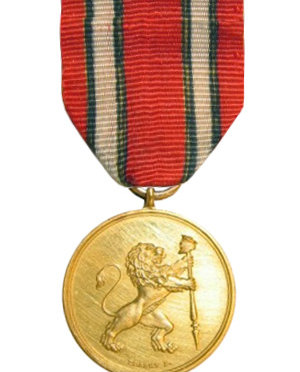
This gold medal’s engraving was designed by Braemt F, and his name is inscribed along the lower rim.

The obverse shows a standing lion holding a lance surmounted by a phrenic cap, a symbol of freedom. The reverse has a crown composed of laurel on the left and oak on the right and the words “RECOMPENSE / CIVIQUE” (Civil reward).

The 1830 Star of Honor

The 1830 Star of Honor (Étoile d’Honneur 1830) was established on 14 January 1831 by the provisional government in favor of the patriots who had distinguished themselves during the events of the Revolution.

The award was given to the patriots “who ensured the independence of the country” and for acts of bravery “leading to triumphant freedom“. Only services rendered before September 1, 1830 counted.

Right after being established, it was determined that the Provisional Government did not have the legal authority to create such a reward, and a law passed on May 28 of the same year preventing its award.

The 1830 Star of Honor Design

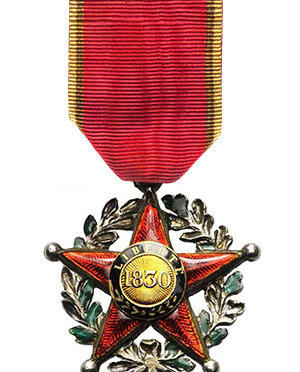
The badge is a red enameled star with 5 arms, placed on a laurel and oak crown in green. The obverse has, in the center, two circles: one black with the words PATRIE and laurel leaves the second smallest golden with a lion. The reverse is composed of two circles, one black marked LIBERTE and laurel leaves, the second smaller gilded with 1830.

The award was given in three classes:

  • 1st class: In gold, it had a diameter of 40mm.
  • 2nd class: Identical but 30mm in diameter.
  • 3rd class: In silver and 30mm in diameter.

The ribbon is red, with a yellow and black border on each side.

The Royal Order of the Lion

The Royal Order of the Lion was established in 1891 by King Leopold II of Belgium and awarded for services to the Congo and its ruler.

The Royal Order of the Lion (Ordre Royal du Lion / Koninklijke orde van de Leeuw) was established on 9 April 1891 by King Leopold II of Belgium in his capacity as ruler of the Congo Free State. It was awarded for services to the Congo and its ruler that did not deserve the award of the Order of the African Star and were not necessarily performed from within Belgian Congo.

The Order was incorporated into the Belgian honors system following the annexation of the Congo Free State by Belgium. The motto of the Order is “Labour and progress”.Following the independence of Congo-Léopoldville in 1960, the Royal Order of the Lion is no longer awarded.

The Royal Order of the Lion Design

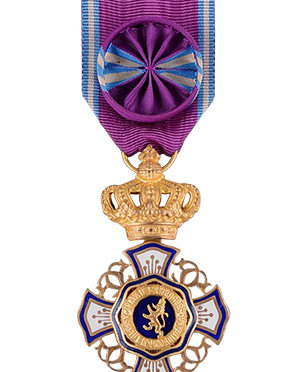
The badge is a white enamel Rupert cross with a perimeter channel of blue enamel and the angles filled with filigree. The central disc depicts the crowned Belgian lion on a blue enamel background surrounded by a silver ring with the motto of the Congo Travail et Progrès and a scalloped channel of blue enamel. The reverse is similar to the obverse but with a red central disca and the crowned royal monogram “L/S/L”. The suspension is a pivoting royal crown and ring.

The medal is round, with a suspension in the form of a royal crown with two pendilia and a ribbon ring. The obverse bears a finely ribbed central area with bead surround and a royal lion, plus the motto of the Belgian Congo: Travail et Progrès (work and progress). The reverse is a stylized ‘double L’ crowned Leopold II monogram within a palm wreath.

The ribbon is amaranth purple, with narrow pale yellow edge stripes bordered with pale blue. It may be adorned with a silver or gold palm when awarded in wartime.

The Order of the African Star

The Order of the African Star (Orde van de Afrikaanse Ster / Ordre de l’Étoile africaine) was established on 30 December 1888 by Leopold II of Belgium and awarded for services to Congo and for the “promotion of African civilization in general”.

The Order was incorporated into the Belgian honors system on 10 October 1908 following the annexation of the Congo Free State by Belgium. The motto of the Order is “Labour and progress”. The Grand Master is the King of the Belgians, and although the Congo is no longer a Belgian colony, it is still considered to be a Belgian Order by tradition.

The Order of the African Star Design

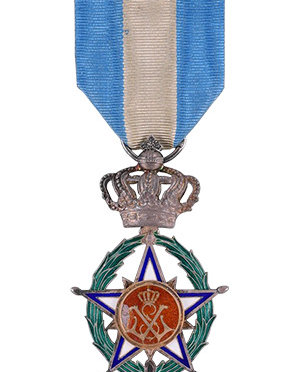
The Badge is a white enameled five-pointed star with blue borders, surrounded by a crown of green enameled palm leaves. The central disk shows a gold star on blue enameled background surrounded by a gold ring displaying the motto of the order: Travail et Progrès (work and progress). The reverse is similar but with a red central disc and a stylized ‘double L’ crowned Leopold II monogram superimposed. The badge is topped by a royal crown.

The medal of the order is round with a suspension in the form of a royal crown with two pendelia and a ribbon ring. The obverse bears a finely ribbed central area with bead surround and a star superimposed and the motto of the order: Travail et Progrès (work and progress).

The ribbon is azure blue with a large central pale yellow stripe. When awarded in wartime, it may be adorned with a silver of gold palm.

The Order of Leopold II

The Order of Leopold II is an order of Belgium established in 1900 and named in honor of King Leopold II and awarded for meritorious service.

The Order of Leopold II is an order of Belgium established on 24 August 1900 and named in honor of King Leopold II. It’s awarded for meritorious service to the sovereign of Belgium, and as a token of his personal goodwill to both Belgians and foreigners, as well as a diplomatic gift of merit.

The order (awarded by royal decree) has become a long service order for people in the civil service and is awarded alternatively with the Order of the Crown, as the Order of Leopold is awarded under rarer circumstances.

The Order of Leopold II is issued in five classes and three medals (gold, silver and bronze):

  • Grand Cross.
  • Grand Officer.
  • Commander.
  • Officer.
  • Knight.

The Order of Leopold II Design

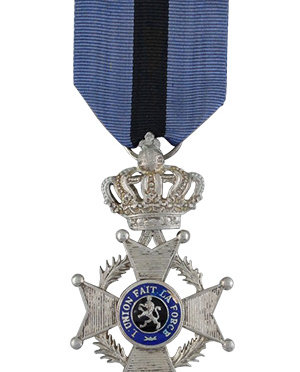
The badge is a silver or gold metal Maltese Cross with a wreath of laurel leaves between the arms of the cross. The obverse bears a lion on a black enamel background surrounded by a blue enamel ring with the motto “Unity Is Strength” in French and Dutch. The badge is topped by a crown.

The medal shows the shape of the Order badge imprinted in a metal shape that is vaguely octagonal and looks like a closed florian cross.

The ribbon is blue with a central black stripe, but there have been variations for special circumstances such as crossed swords added when awarded in wartime and a vertical gold border on both sides for a special act of valor.

The Order of the Crown

The Order of the Crown (Ordre de la Couronne / Kroonorde) is a national order of the Kingdom of Belgium established on 15 October 1897. It’s one of Belgium’s highest honors.

The Order was established by King Leopold II and initially intended to recognize heroic deeds and distinguished service achieved for service in the Congo Free State. In 1908, the Order of the Crown was made a national honor of Belgium, junior to the Order of Leopold.

Currently, the Order is awarded (by Royal Decree) for meritorious service in public employment and for distinguished artistic, literary or scientific achievements, as well as for commercial or industrial services in Belgium or Africa.

The Order of the Crown is awarded in five classes, plus two palms (golden and silver) and three medals (gold, silver and bronze):

  • Grand Cross.
  • Grand Officer.
  • Commander.
  • Officer.
  • Knight.

The Order of the Crown Design

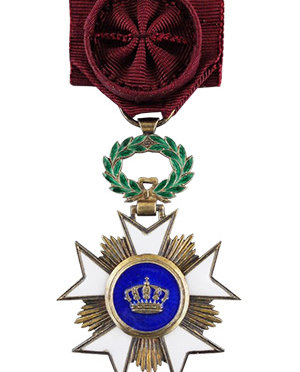
The badge is a white-enameled Maltese cross with silver or gold straight rays. The obverse bears a gold crown on a blue enameled background and the reverse the monogram “L” (for King Leopold II) on a blue enameled background. It’s suspended from a green-enameled wreath of laurel and oak leaves.

The medal is round with a suspension in the form of a royal crown with two pendelia and a ribbon ring. The obverse shows a finely ribbed central area with bead surround, with the royal crown superimposed and the motto of the Belgian Congo: Travail et Progrès (work and progress). The reverse is a stylized ‘double L’ crowned Leopold II monogram within a palm wreath.

The ribbon is plain maroon, although some exceptions have been made such as added crossed swords when awarded in wartime and a vertical gold border on both sides for a special act of valor.

The Order of Leopold (Belgium)

The Order of Leopold (Leopoldsorde / Ordre de Léopold / Leopoldsorden) is the oldest and highest order of Belgium (and one of the three current Belgian national honorary orders of knighthood). Leopold I, first King of the Belgians, is the Founder and First Grand Master of the Order. No membership can be granted to a person before the age of 42, except in the military division.

Established on 11 July 1832 and named in honor of its founder; King Leopold I, it consists of a military, a maritime and a civil division. The Order of Leopold is awarded by Royal order. The Belgian court often used the Grand Cordon as a valuable diplomatic gift, although towards the second half of the 19th century, it was also used as a dynastic order to bestow on family members during major family celebrations such as the wedding of Prince Albert in 1900 (where 15 Grand Cordons were sent to the Bavarian Court). Those who fought in the Belgian revolution became members in great numbers, and King Leopold II bestowed the order upon notable Belgian artists, generals and clergy.

The Order of Leopold is issued in five classes, each coming in three divisions (civil, military and maritime):

  • Grand Cordon; who wears the badge on a collar (chain) or on a sash on the right shoulder, plus the star on the left side of the chest;
  • Grand Officer; who wears a badge on a necklace, plus a star on the left side of the chest (created on 31 December 1838);
  • Commander; who wears the badge on a necklace;
  • Officer; who wears the badge on a ribbon with rosette on the left side of the chest;
  • Knight; who wears the badge on a ribbon on the left side of the chest.

The Order of Leopold Design

The Order of Leopold is based on the French honor tradition with 5 classes. In 1832 Felix de Merode had a design approved by the Chambers for military and civil merit, with the exact colors being defined later the same year. The king approved both the color and grades both civil and military, as well as the official motto L’Union fait la Force/Eendracht maakt Macht.

The collar of the order has nine crowns, nine face-to-face monograms “LR” (“Leopoldus Rex” for King Leopold I), and eighteen lions.

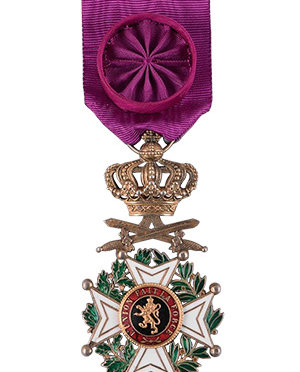
The badge is a white-enameled Maltese Cross (in silver for the Knight class and in gold for the higher classes), with a green-enameled wreath of laurel and oak leaves between the arms of the cross. The obverse features a lion on a black background and the reverse the monogram “LR”. Both discs are surrounded by a red enamel ring with the motto “Unity Is Strength“. The cross is topped by a crown with crossed swords or anchors (or without either) depending on the division.

The ribbon is usually plain purple, although some variations have been noted, such as swords for when awarded in wartime, a vertical gold border on both sides for a special act of valor at war and others.

The Inter Allied Victory Medal (Belgium)

The Belgian Victory Medal was established by royal decree on 15 July 1919 and awarded to all members of the Belgian Armed Forces.

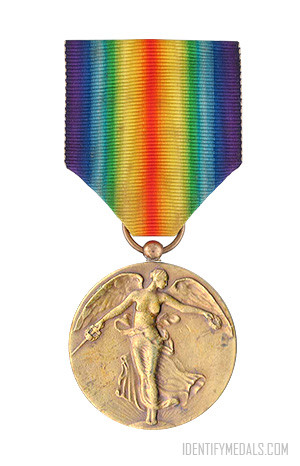
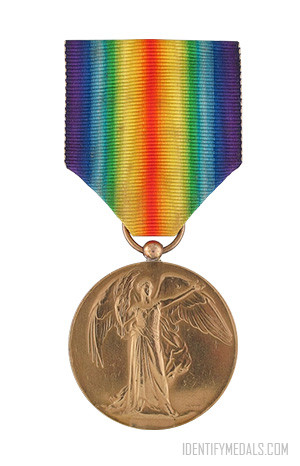
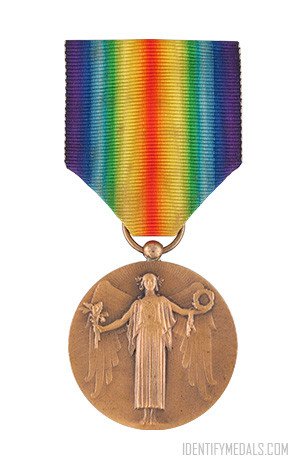
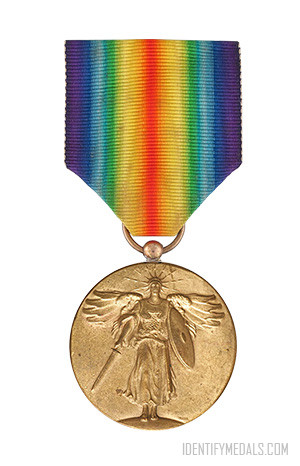
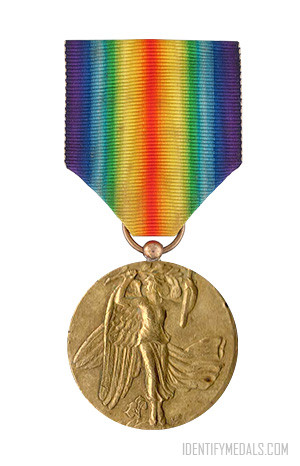
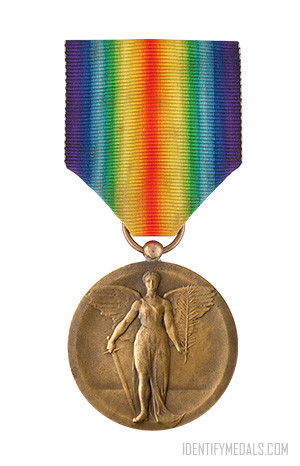
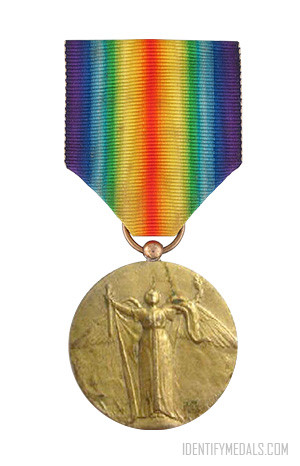
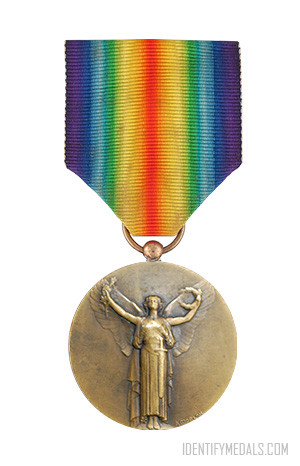
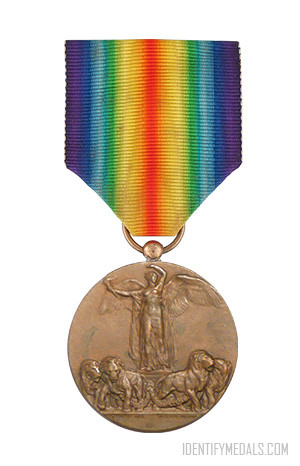
The Allied Victory Medal was recommended by an inter-allied committee in March 1919. Fourteen victorious countries finally awarded the medal after World War I, and each allied nation would design a ‘Victory Medal’ for award to their own nationals. Certain features were to be shared: a winged figure of Victory on the obverse and the same ribbon.

The Belgian Victory Medal was established by royal decree on 15 July 1919 and awarded to all members of the Belgian Armed Forces.

The Belgium Inter Allied Victory Medal Design

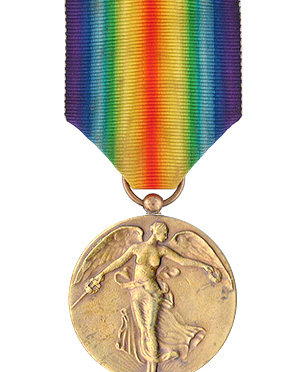
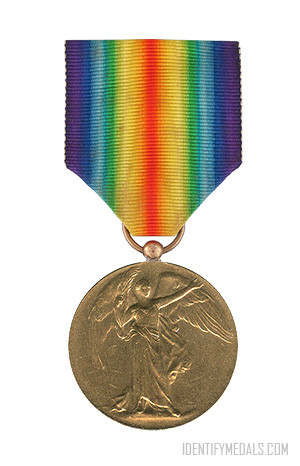
The Victory Medal measures 36 millimetres (1.4 in) in diameter and was designed by William McMillan. The design and ribbon was also adopted by Belgium, Brazil, Cuba, Czechoslovakia, France, Greece, Italy, Japan, Portugal, Romania, Siam, Union of South Africa and the USA. Each allied nation would design a ‘Victory Medal’ for award to their own nationals, all issues having certain common features, including a winged figure of victory on the obverse and the same ribbon.

The obverse of the medal was designed by Belgian sculptor Paul Du Bois.

The reverse shows the words ‘THE GREAT / WAR FOR / CIVILISATION / 1914-1919’ surrounded by a laurel wreath.

The 39 millimeters (1.5 in) wide watered ribbon has an iridescent color scheme, with the violet moving through to a central red stripe where both schemes meet. It attaches to the medal through a ring suspender. The recipient’s name, rank, service number and unit were impressed on the edge of the medal. The name of the regiment or corps was omitted on medals awarded to Army officers.

All the Inter-Allied Victory Medal Variations

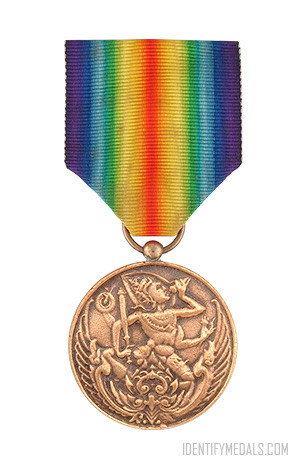
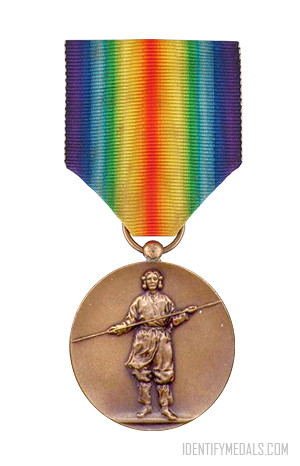
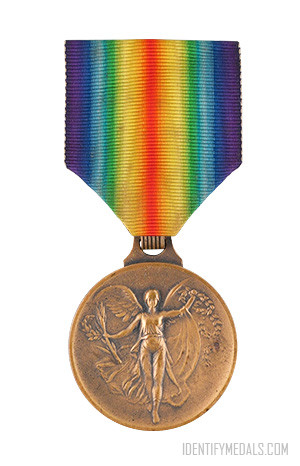
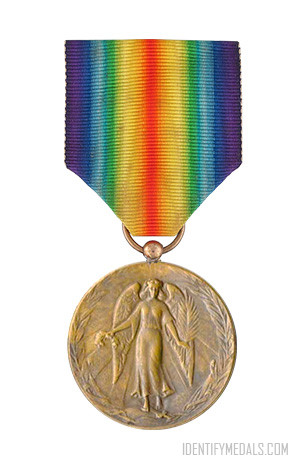
Although each country designed its own version of the Inter-Allied Victory Medal, all of them shared some common elements, such as a winged victory figure on the obverse and a similar ribbon with rainbow colors symbolizing unity among the Allies. Here are the versions for all countries:

Find an Inter-Allied Victory Medal Online

Right Now on eBay 
Clicking a link to eBay may result in a referral commission being paid if a purchase is made.
Loading...