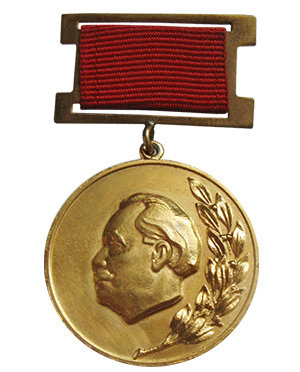
The Laureate Of The Dimitrov Prize

The Honored Honorary Title is a Bulgarian medal awarded to people for their achievements in science, technology, and culture. It was established on 23 May 1949 and founded by the Presidium of the Great National Assembly.

The award was named after the communist leader Georgi Dimitrov, who was the Bulgarian Prime Minister from 1946-1949. Recipients of this prize were given the label “Laureate”.

From 1960 onwards this class was the only class awarded as the 2nd and 3rd class awards ceased to be issued after 1959. The reverse inscription includes the year in which the recipient attained the Title.

There were approximately 1285 prizes awarded in total.
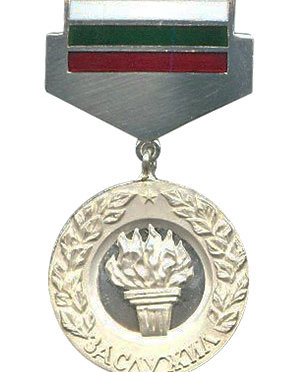
The Honored Honorary Title (Bulgaria)

The Honored Honorary Title is a Bulgarian medal awarded to people for their exceptional merits in the field of arts, culture, science, education and health. It was established by decree No. 960 of the Presidium of the 6th Grand National Assembly on 15 June 1948.

Initially, it was awarded by the Presidium of the National Assembly, and after 1971 by the National Council of the People’s Republic of Bulgaria. Those honored with the title of “Honored” receive a diploma from the National Council of the People’s Republic of Bulgaria, the mark of the title, and a supplement to the monthly salary or pension. 4753 people are honored with the title of “Honored”.

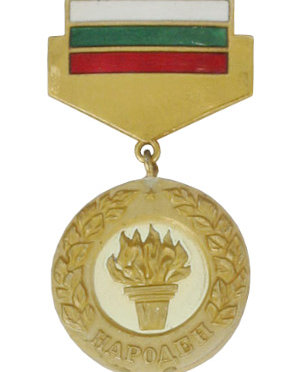
The People’s Honorary Title (Bulgaria)

The People’s Honorary Title is a Bulgarian medal awarded to Bulgarian citizens already recognized with the Honoured title for their exceptional merits in the field of arts, culture, science, education and health. It was established by decree No. 960 of the Presidium of the 6th Grand National Assembly on June 15, 1948.

This title is the third-highest honorary title in the prize system of the People’s Republic of Bulgaria. Initially, it was awarded by the Presidium of the National Assembly, and after 1971 by the National Council of the People’s Republic of Bulgaria.

People with the title “People’s” receive a diploma from the National Council of the People’s Republic of Bulgaria and a supplement to the monthly salary or pension of 100 BGN.

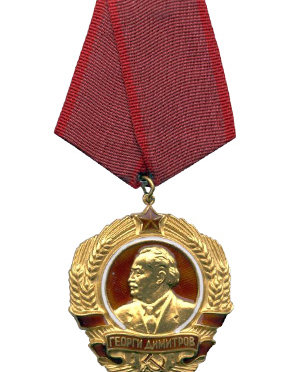
The Order of Georgi Dimitrov

The Order of Georgi Dimitrov is a Bulgarian Order established on 17 June 1950 (re-established 5 April 1991) and awarded to national and foreign citizens for exceptional merit. It was also automatically awarded to recipients of The Hero Of The People’s Republic Of Bulgaria and The Hero Of Socialist Labour titles.

It was originally designed by K. Lazarov and modified by O. Odabashyan.

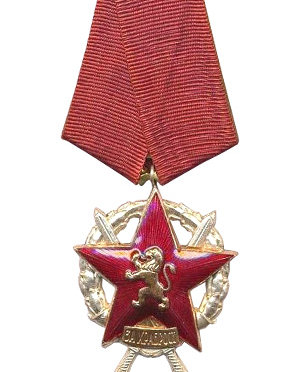
The Order Of Bravery (Bulgaria)

The Order Of Bravery is a Bulgarian medal awarded to Military Personnel and Civilians for bravery and courage in battle or for strengthening the integrity of the country and public safety.

Foreign soldiers of allied armies could also be awarded this order for participation in joint combat operations. There are two variations of this award, originally one which is numbered and then issued later, one which is unnumbered.

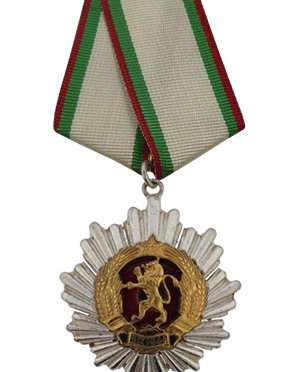
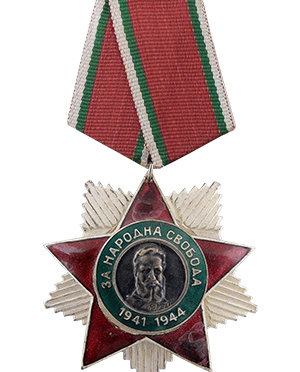
The Order of People’s Liberty

The Order of People’s Liberty is a Bulgarian Order established in 1945 and awarded to Bulgarian and foreign citizens for the participation in the revolutionary fight of Bulgarian people.

The Order of People’s Liberty Design

The medal was designed by B. Angelushev and was worn as a screw-back badge until 1960 (and from then on worn on a 5 sided soviet style suspension).It’s made of silvered bronze with red and green enamels, and measures 49.5 mm x 51.5 mm.

There are 4 variations of this award’s construction: A five-piece breast star (1945-1949), a four-piece breast star (1949-1958), a four-piece on a ribbon (1958-c1970) and a single piece on a ribbon (c1970 onwards).

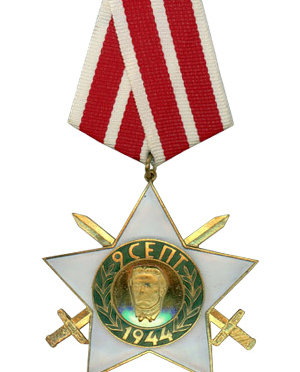
The Order of The 9 September 1944

The Order of The 9 September 1944 is a Bulgarian Order awarded to Bulgarian and foreign citizens who took part in the armed insurrection of 9 September 1944 and later to participants in the founding and consolidating of the people’s authority.

The Order was created on the first anniversary of the seizure of power by the Bulgarian Communists backed by the Soviet Russian Red Army and awarded to those who had participated actively in the fight against Nazi German forces and had worked actively to establish a Communist regime in Bulgaria.

There are 2 variations of this award for civilians and for military personnel, the military variation having additional swords. The Order was canceled in 1991.

The Order of The 9 September 1944 Design

The medal was designed by B. Angelushev and produced initially by the Strahil Miloshev workshops, later by the State Mint, Sofia. It was worn on a plain red neck ribbon until 1958, and from then on worn on a 5 sided soviet style suspension on the chest.

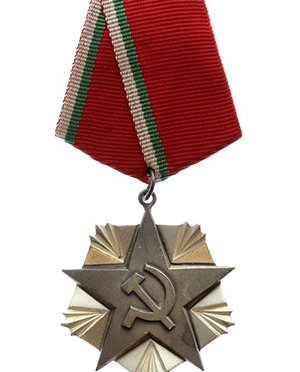
The National Order Of Labour

Time Period: Post-WW2
Year of Institution: 1945
Country: Bulgaria

The National Order of Labour was an Order of Merit awarded to Bulgarian and foreign citizens for excellence of outstanding achievements or innovations or excellence in organisation, as well as to artists and scientists for long service to the nation. It was established during the Kingdom of Bulgaria from 1945 to 1946, and continued through the People’s Republic of Bulgaria from 1946 to 1990.

The Order existed in three grades:

  • Knight/Dame Commander,
  • Knight/Dame Officer, and
  • Knight/Dame.

The National Order of Labour Design

Awarded until 1955 with either a tri-fold ribbon for males or a bow for females, after which the ribbon device was a 5 sided soviet design. The original design was created by D. Uzunov And L. Dimitrov. From 1977 the order was redesigned by B. Kozarevym and M. Markovym to a 5 sided star shape. The ribbon was red with a thin green stripe and a thin white stripe on the edge (the colors of the Bulgarian flag).

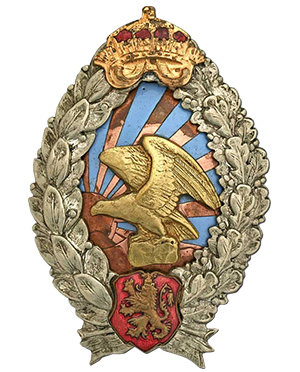
The Royal Bulgarian Observer’s Badge

The Royal Bulgarian Observer’s Badge was instituted in 1935 and worn by Bulgarian observers during WWII as well as awarded to German Luftwaffe observers serving with Bulgarian airmen.

The badge is made in silvered bronze, white metal, and enamels. It measures 36 millimeters by 52 millimeters and is made of multiple pieces with a backing plate and fastening screw on the reverse. It was manufactured by Bulgarian and German manufacturers.

The Royal Bulgarian Observer’s Badge was discontinued in 1944.