The Schalburg Cross

The Schalburg Cross was a military decoration for members of the Danish Schalburg Corps during World War II.

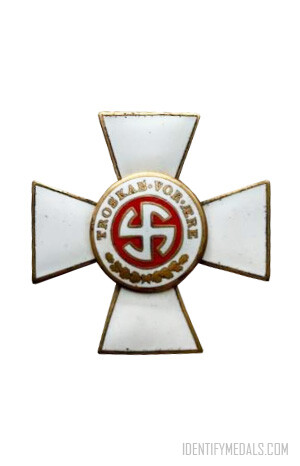
The Schalburg Cross, or Schalburgkors in Danish, was a military decoration for members of the Danish Schalburg Corps during World War II.

Named after Christian Frederik von Schalburg, the cross was produced by Heimbürger in Copenhagen. Although many were made, there is only one confirmed instance of it being awarded, posthumously. Instituted possibly after 1943, the cross recognized service against the Danish resistance and on the Eastern Front.

The cross was meant to be worn on the left breast pocket. Some unissued crosses were found at the Schalburg Corps HQ after the German retreat in May 1945 and were kept as souvenirs. They were even distributed to the public during the liberation celebrations in Copenhagen. Only a few enamelled versions are known to exist today.

The Schalburg Cross Design

The cross came in two classes: one for officers and NCOs, and another for enlisted men. Both versions measured 50mm x 50mm and featured a central medallion.

The enlisted version was off-white with golden edges and had the inscription “Our Honor is Loyalty” along with golden oak leaves.

The officer’s version was enameled with the same design but more intricate, with gilded oak leaves and enameled red background.
The Royal Life Guard’s 350th Anniversary Medal

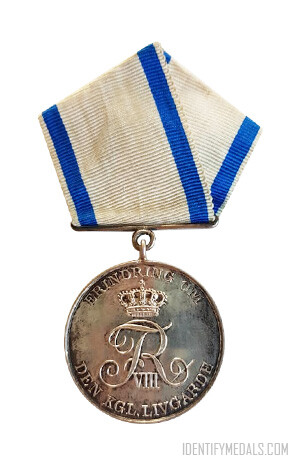
The Royal Life Guards Medal 350th anniversary medal was awarded to members of the mechanized infantry regiment of the Danish Army.

The Royal Life Guards 350th Anniversary Commemorative Medal was created in 2008 to celebrate the 350th anniversary of the Danish Royal Life Guards. This prestigious medal honors the long-standing history and distinguished service of the Royal Life Guards, who have been a vital part of Denmark’s military and royal protection since their establishment in 1658.

This commemorative medal was awarded to members of the Royal Life Guards, recognizing their dedication, loyalty, and service to the Danish monarchy. It serves as a token of appreciation for the guards’ unwavering commitment to protecting the royal family and the nation over three and a half centuries.

The Medal Design

The medal typically features symbols associated with the Royal Life Guards and Denmark, such as the Danish crown and the regiment’s emblem.

The reverse side often commemorates the anniversary with the years “1658-2008” prominently displayed.

The Defense Medal for Bravery

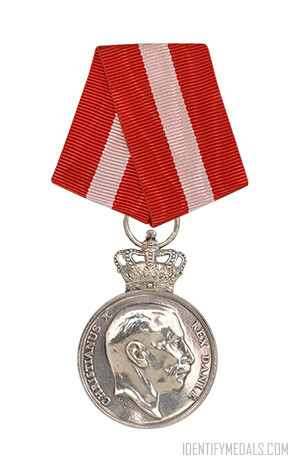
The King Christian X’s Liberty Medal was a commemorative decoration awarded for special services to Denmark during the Second World War.

King Christian X’s Liberty Medal (or Kong Christian den Tiendes frihedsmedaille in Danish) was a commemorative decoration established by King Christian X of Denmark. It was awarded to individuals who provided exceptional services to Denmark during World War II, reflecting their significant contributions to the nation’s resistance and liberation efforts.

The medal honored those who displayed outstanding bravery, dedication, and service in support of Denmark’s fight against occupation. It symbolized national gratitude and recognition of the sacrifices made by these individuals to ensure Denmark’s freedom and sovereignty.

The Defense Medal for Bravery Design

The medal typically featured the likeness of King Christian X and was suspended from a ribbon representing Denmark’s national colors.

The design elements highlighted the valor and dedication of the recipients, serving as a lasting tribute to their heroic actions during a critical period in Danish history.

The Order of Christian VII

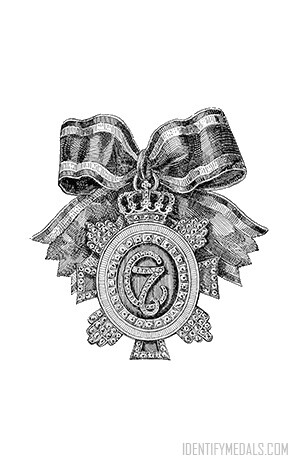
The Order of Christian VII was a Danish order of knighthood established in 1774 and designed to replace the Order of Mathilde.

The Order of Christian VII, also known as “Tessera Concordiæ” or “Christian VIIs Orden” in Danish, was a knighthood order established on October 21, 1774, by King Christian VII of Denmark. It was created to replace the Order of Mathilde after Queen Caroline Mathilde’s banishment in 1772.

This order was exclusively for the Danish royal family, awarded to both men and women.  The order fell into disuse after the death of Queen-Dowager Juliana Maria in 1796.

The Order of Christian VII Design

Men wore the insignia on the left breast, while women wore it on a bow on their left shoulder. Notably, Danish Princess Louise Augusta was depicted wearing it in a 1784 portrait by Jens Juel.

The Order of Mathilde

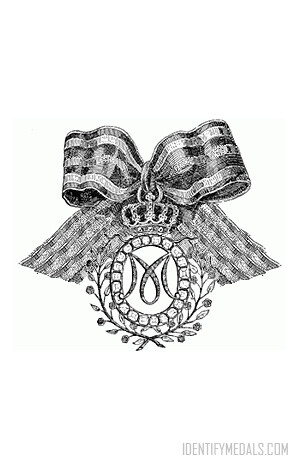
The Order of Mathilde was created in 1771 by the queen of Denmark-Norway, Caroline Matilda, on the birthday of Christian VII of Denmark.

The Order of Mathilde (or Mathildeordenen in Danish) was a Danish royal order established by Queen Caroline Matilda of Denmark-Norway on January 29, 1771, coinciding with King Christian VII’s birthday.

Named after the queen, the order ceased to be used following her banishment the next year. It was awarded to members of the royal family and close associates, including followers of the queen and her lover Johann Friedrich Struensee.

Eleven of the twelve recipients received it on the day of its creation, with Louise von Plessen being awarded in her absence while in exile at Celle.

The Ordre de l’Union Parfaite

The Ordre de l’Union Parfaite was established in 1732 and given to women to celebrate the tenth anniversary of Sophie Magdalene’s marriage.

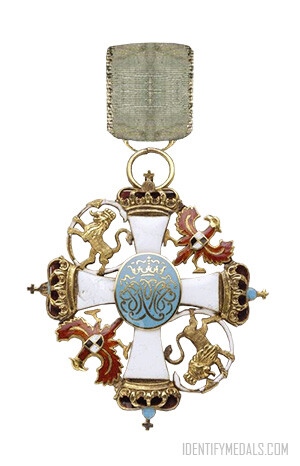
The Ordre de l’Union Parfaite was established by Queen consort Sophie Magdalene of Denmark and Norway on 7 August 1732 to mark the tenth anniversary of her marriage to King Christian VI. 

The French name translates to the Order of the Perfect Union or Order of Friendship, reflecting the common use of French in royal courts of the time.

This order, awarded to both men and women, bore the motto “In felicissimæ Unionis Memoriam” (“In Commemoration of the Happiest [Marital] Union”). Conferral of the Order ceased after the Queen’s death on 7 May 1770.

The Ordre de l’Union Parfaite Design

The badge or “jewel” of the Order was a white enamelled cross with each arm capped by a golden crown. Between the arms were alternating golden Norwegian lions holding a halberd and red-enamelled, golden-headed Brandenburg eagles.

The center featured a blue oval medallion, encircled by diamonds, displaying the crowned intertwined monograms of Sophie Magdalene and Christian VI.

The dark blue silk ribbon, edged with silver, was worn differently by gender: gentlemen wore the cross in a left buttonhole of their coats, while ladies wore it on their left breasts.

The Order of the Armed Arm

The Order of the Armed Arm was an order of chivalry of Denmark established in 1616 and later merged with the Order of the Elephant.

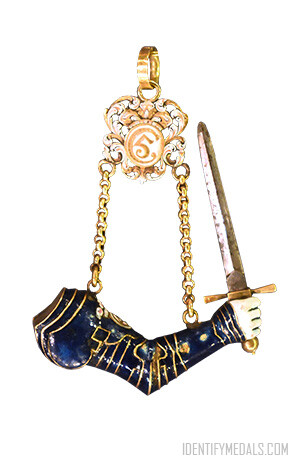
The Danish Order of the Armed Arm (or den Væbnede Arms Orden in Danish) was a chivalric order established by Christian IV of Denmark in 1616, with the knighting of twelve noblemen.

It was created to honor those who had distinguished themselves in the Kalmar War and was first and only bestowed on 2 December 1616 during celebrations in Kolding for the enfeoffment of Slesvig to Frederick III, Duke of Holstein-Gottorp.

The order was later merged with the Order of the Elephant in 1633-1634 and is considered a predecessor of the Order of the Dannebrog. The badges of the Order of the Elephant issued in 1633 were augmented on the reverse with the badge of the Order of the Armed Arm. This addition was removed in the following year’s issue. In 1634, Christian IV offered the two surviving knights, Christen Friis and Albret Skeel, the option to exchange their Armed Arm badges for the Elephant. There exists a specimen with the monogram of Christian V, indicating he considered reviving the order, but he ultimately established the Order of the Dannebrog in 1671.

The Order of the Armed Arm Design

The badge of the Order was worn around the neck on a blue ribbon and featured two chains hanging from a clasp. At the ends of the chains was a diamond-studded, armor-plated arm holding a drawn sword, earning the order the names “Order of the Drawn Sword” or “Order of the Sword.”

It bears the year 1617, marking the centenary of Martin Luther’s 95 Theses, symbolizing the struggle for Protestantism. 

The Peace Prize Medal (Denmark)

The Peace Prize Medal was established in 1995 by Queen Margrethe II and is awarded Danes who completed a tour of duty on a UN mission.

The Peace Prize Medal (or De Blå Beretters Fredsprismedalje in Danish) was established in 1995 by Queen Margrethe II. It is awarded to Danish individuals who have completed a UN mission tour and received a corresponding medal.

Unique among Danish medals, recipients can apply for it themselves. The medal honors the United Nations Department of Peacekeeping Operations personnel who received the 1988 Nobel Peace Prize. Those who served before 1988 can attach a silver laurel branch to the ribbon, marking their early contributions.

The Peace Prize Medal Design

The Peace Prize Medal features a distinguished design to honor Danish UN peacekeepers. The medal itself is typically circular, displaying relevant imagery such as the emblem of the United Nations or other peacekeeping symbols.

The obverse side often includes a representation of the Nobel Peace Prize, reflecting the 1988 award given to UN peacekeeping forces. The reverse side may carry inscriptions denoting the medal’s purpose and the recipient’s service details.

The ribbon is adorned with a silver laurel branch for those who served before 1988, symbolizing their early contributions to peacekeeping efforts.

The Rescue Preparedness Medal

The Rescue Preparedness Medal was instituted in 1994 by Queen Margrethe II for participation in international humanitarian operations.

The Rescue Preparedness Medal (or Redningsberedskabets Medalje in Danish) was established in 1994 by Queen Margrethe II.

It honors members of the Danish Emergency Management Agency who have participated in international humanitarian missions beyond Denmark’s borders.

Although the medal was instituted in 1994, it retroactively acknowledges contributions to international operations starting from April 1, 1991. This award recognizes the dedication and bravery of individuals engaged in global humanitarian efforts, highlighting Denmark’s commitment to international aid and emergency response.

The Badge of Honor of the League of Civil Defense

The Badge of Honor of the League of Civil Defense was instituted in 1956 by King Frederik IX and is awarded for noteworthy deeds.

Instituted in 1956 by King Frederik IX, the Badge of Honor of the League of Civil Defense (or Beredskabsforbundets Hæderstegn in Danish) recognizes individuals who have made significant contributions to civil defense over at least 15 years.

Awarded by the President of the Danish Civil Defense Association, the badge honors noteworthy service, volunteer efforts, and exceptional support for civil defense initiatives.

The idea for the medal originated in 1953 from the Association of Police Chiefs. The Civil Defense Association finalized the award, which was first bestowed on June 17, 1957. The association, originally named CivilforsvarsForbundet, rebranded in the mid-2000s, and in 2007, the medal’s name was updated to Beredskabsforbundets Hæderstegn.

The medal is awarded in three categories:

  1. Individuals with at least 15 years of exemplary service within civil defense.
  2. Those who have made significant contributions to civil defense initiatives, such as fire chiefs.
  3. Politicians and public figures who have notably supported civil defense.

Annually, up to 12 medals are awarded, ensuring the recognition of outstanding dedication to civil defense efforts.

The Badge of Honor Design

The medallion is suspended from a ribbon, the colors and patterns of which denote the specific award category.