The 1939-1940 Finnish Middle-Isthmus Battle Cross

The 1939-1940 Finnish Middle-Isthmus Battle Cross was instituted in 1940 and awarded to participants of the defence of the Karelian Isthmus.

The 1939-1940 Finnish Middle-Isthmus Battle Cross (or Keski-Kannaksen Risti in Finnish) was instituted in 1940 and awarded to participants of the defence of the Karelian Isthmus.

The Karelian Isthmus (Karjalankannas in Finnish) is the approximately 45–110-kilometre-wide (30–70 mi) stretch of land that is situated between the Gulf of Finland and Lake Ladoga in northwestern Russia, to the north of the River Neva. The Vyborg–Petrozavodsk offensive or Karelian offensive was a strategic operation by the Soviet Leningrad and Karelian Fronts against Finland on the Karelian Isthmus and East Karelia fronts of the Continuation War, on the Eastern Front of World War II.

The 1939-1940 Finnish Middle-Isthmus Battle Cross Design

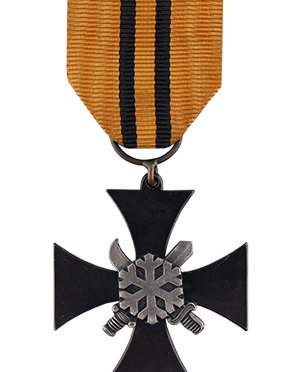
The medal is a two-piece construction in blackened bronze with a silvered centrepiece and measures 39 mm wide.

The Cross of the Central Karelian Isthmus Battle has an eyelet and a loop for ribbon suspension, as well as silvered crossed swords on the obverse. On top is a central snowflake. The reverse is plain.

The ribbon is orange with two black stripes in the middle.
The Order of the Lion of Finland

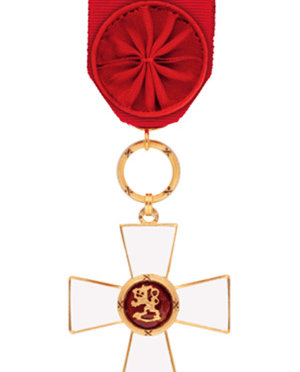
The Order of the Lion of Finland (Suomen Leijonan ritarikunta) is one of three official Orders in Finland, established on September 11, 1942.

The Order of the Lion of Finland (or Suomen Leijonan ritarikunta in Finnish) is one of three official orders in Finland, along with the Order of the Cross of Liberty and the Order of the White Rose of Finland. It was established on September 11, 1942.

The Order of the Lion of Finland was established to allow the continuation of decorating foreigners with high ranks in Finnish orders, although it can also be awarded to Finnish nationals. This was because the existing Finnish orders could not keep up with the decorations and their highest grades were in danger to become inflated due to too many holders. 

The President of the country is the Grand Master of all three orders, which are administered by boards consisting of a chancellor, a vice-chancellor and at least four members. The orders of the White Rose of Finland and the Lion of Finland have a joint board. The President of Finland wears the Star of the Order of the Lion of Finland.

The classes of the Order of the Lion of Finland are:

  • FIN Order of the Lion of Finland 1Class BAR.png Commander Grand Cross of the Order of the Lion of Finland
  • FIN Order of the Lion of Finland 2Class BAR.png Commander, First Class, of the Order of the Lion of Finland
  • FIN Order of the Lion of Finland 3Class BAR.png Commander of the Order of the Lion of Finland
  • FIN Order of the Lion of Finland Pro-Finlandia BAR.png Pro Finlandia Medal of the Order of the Lion of Finland (awarded to artists and writers)
  • FIN Order of the Lion of Finland 4Class BAR.png Knight, First Class, of the Order of the Lion of Finland
  • FIN Order of the Lion of Finland 5Class BAR.png Knight of the Order of the Lion of Finland
  • FIN Order of the Lion of Finland 5Class BAR.png Cross of Merit of the Order of the Lion of Finland

The Order of the Lion of Finland Design

The ribbon for all classes of insignia is dark red. The cross size and ribbon width are at their greatest for the Grand Cross and are reduced for the Commander First Class and Commander. The ribbon width for Knights is narrower still, but remains at this width for all decorations down to Medals.

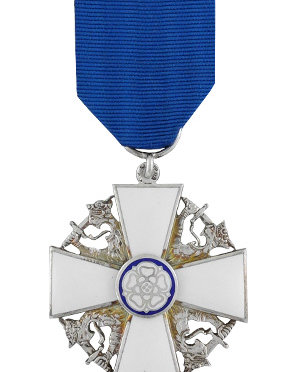
The Order of the White Rose

The Order of the White Rose of Finland was established by Gustaf Mannerheim on January 28, 1919 and is one of Finland’s three Orders.

The Order of the White Rose of Finland (or Suomen Valkoisen Ruusun ritarikunta in Finnish) is, along with the Order of the Cross of Liberty, and the Order of the Lion of Finland, one of Finland’s three Orders. The President is the Grand Master of all three. The order’s rules and regulations were confirmed on May 16, 1919, and its present rules date from June 1, 1940.

The Order of the White Rose of Finland was established by Gustaf Mannerheim on January 28, 1919. The name comes from the nine roses argent in the coat of arms of the country. Generally, the Grand Cross with Collar is awarded only to foreign heads of state, e.g. to King Fuad I of Egypt (1935), Charles de Gaulle (1962), Josip Broz Tito (1963) and King Birendra of Nepal (1988).

The honor can be granted for military as well as civilian merit.

The classes of the Order of the White Rose are:

  • FIN Order of the White Rose Grand Cross BAR.png Grand Cross of the White Rose of Finland with Collar
  • FIN Order of the White Rose Grand Cross BAR.png Grand Cross of the White Rose of Finland
  • FIN Order of the White Rose Commander 1st Class BAR.png First Class Commander of the White Rose of Finland
  • FIN Order of the White Rose Commander BAR.png Commander of the White Rose of Finland
  • FIN Order of the White Rose Knight 1st Class BAR.png First Class Knight of the White Rose of Finland
  • Order of the White Rose Ribbon.PNG Knight (Chevalier) of the White Rose of Finland
  • FIN Cross of Merit of the Order of the White Rose BAR.png Cross of Merit of the White Rose of Finland
  • FIN Medal 1st Class of the Order of the White Rose BAR.png First Class Medal of the White Rose of Finland with golden cross
  • FIN Medal 2nd Class of the Order of the White Rose BAR.png First Class Medal of the White Rose of Finland
  • FIN Medal 3rd Class of the Order of the White Rose BAR.png Medal of the White Rose of Finland

The Order of the White Rose Design

The original decorations were designed by Akseli Gallen-Kallela. The swastikas of the collar were replaced by fir crosses in 1963, which were designed by heraldic artist Gustaf von Numers. The ribbon for all classes is ultramarine. The motto of the Order appears on the medallion and is Isänmaan hyväksi, which means “For [the well-being or benefit or advantage of] the Fatherland“.

The President of Finland wears the Grand Cross of the White Rose of Finland with a Collar or neck chain. The Collar is worn four centimetres from either side and hangs at equal distances at the front and back. The Grand Cross and Commander marks are awarded with a breast star.

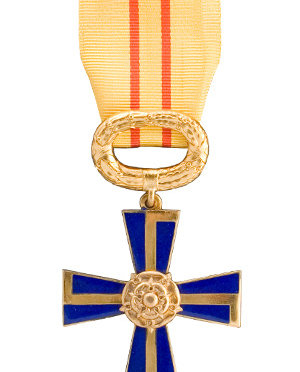
The Order of the Cross of Liberty

The Order of the Cross of Liberty or Vapaudenristin Ritarikunta was established in 1918 and is one of three official state orders in Finland.

The Order of the Cross of Liberty or Vapaudenristin Ritarikunta was established on March 4, 1918 and is one of three official state orders in Finland.

The Grand Master of the Order of the Cross of Liberty is the President of Finland (he is also the Grand Master of the Order of the White Rose of Finland and of the Order of the Lion of Finland. All of these orders are administered by boards consisting of a chancellor, a vice-chancellor and at least four members.

At its foundation there were seven classes:

  • Grand cross
  • Cross of liberty (1st to 4th class)
  • Medal of liberty (1st and 2nd class).

The decorations of the Order of the Cross of Liberty were initially conferred only in times of war. A decree was issued on 18 August 1944 enabling the decorations to be awarded in peacetime. Decorations of the order were awarded in great numbers during World War II, partly due to Marshal Mannerheim having issued an order that wounded soldiers were to be awarded for their sacrifice, and Finland has no separate decoration for wounded.

The Order of the Cross of Liberty Design

The Finnish artist Akseli Gallen-Kallela was commissioned to design the Order’s insignia with the Old-Scandinavian Fylfot, a cross with perpendicular extensions, usually at 90° or close angles, radiating in the same direction.

The awards given for civilian accomplishments are signaled by the color blue in the 3rd and 4th classes. In peacetime, by a yellow ribbon. Awards for military accomplishments in the 3rd and 4th classes have a dark gray color replacing the blue, and are awarded with a red ribbon in wartime.