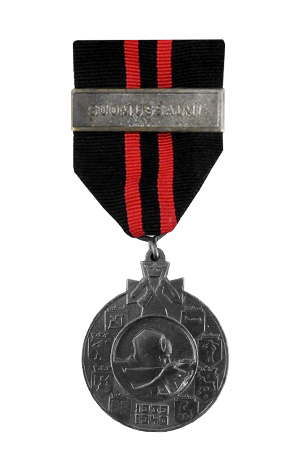
The Winter War 1939-1940 Medal

The Winter War 1939-1940 Medal was established on 2 August 1940 and awarded to soldiers and civilians for serving the Nation’s best interests. In particular, to honour those who had helped to keep Finland’s independence.

The 1939-1940 War Service Medal was created through Number 418 Finnish Code of Regulations 1940 by President Kyösti Kallio and the Minister of Defense Rudolf Walden. The first medals were presented in September of the same year.

The criteria was as follows: The medal was ‘established to commemorate the war of 1939–1940 and the unanimous will to defend it and the deeds done for the benefit of the motherland.’ The medal was generally very liberally granted to those engaged in some form of war work. This could range from those who cooked and baked in canteens to soldiers and young boys and girls who helped pass messages and washed uniforms.

Over 700,000 of all versions of the 1939-1940 War Service Medal were awarded.

The Winter War 1939-1940 Medal Design

The medal was designed by Major Aarno Karimo, who had helped found the Voimaliitto (Power League) in 1906. He was a well-known and respected poet and artist who had spent the Winter War designing propaganda posters.

The medal is made from blackened iron and measures 35 mm wide. The obverse is divided in two: An 18mm diameter circular centerpiece and a 17mm wide border. The centerpiece displays a silhouette of a snow-covered rifleman surrounded by eight provincial coats of arms of Finland. At the bottom is a stylized text reading 1939–1940. The reverse has an embossed conifer wreath around the border and the inscription ‘KUNNIA ISÄNMAA’ meaning ‘Honour Fatherland’. 
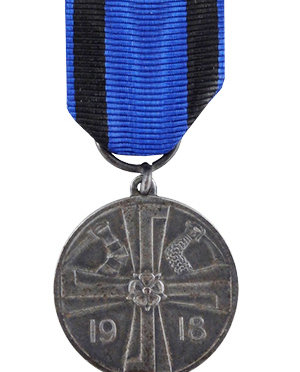
The Finnish Liberation War Medal 1918

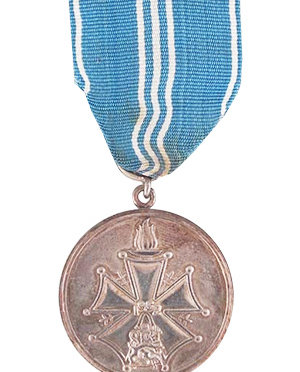
The Finnish Liberation War Medal 1918 is a Finnish medal from WW1. The medal was instituted 1918 for participants in the Liberation War, fighting against the Finnish and Soviet Bolsheviks. It was awarded to Soldiers of the Finnish Army, as well to German soldiers of the Baltic Division and foreign volunteers (Polish, Swedish, and Estonian).

The Finnish Liberation War Medal 1918 Design

The medal is struck in silver and measures 30 mm.

The Lorenz Lindelöf Scientific Award Medal

Time Period: Pre-WW1
Institution: Pre-WW1
Country: Finland

The Lorenz Lindelöf Scientific Award Medal is a finish medal established before WW1.

Finland had been ceded to Russia in 1809. At the time that time, Leonard Lorenz Lindelöf (November 13, 1827 – March 3, 1908)’s father was appointed professor of mathematics at the university, the main building of the university on Senate Square had recently been completed. Lindelöf spent the year 1891 in Stockholm, and the years 1893-94 in Paris returning to Helsingfors where he graduated in 1895. He then taught there as a docent, visiting Göttingen in 1901. Helsinki was still under Russian control and indeed the Russians had implemented a policy of Russification, in reply to the national movements which had arisen.

Lindelöf remained as a professor of mathematics in Helsinki until he retired in 1938. It was a time of rapid economic growth for the new country and the university flourished and rapidly expanded. Lindelöf supported his new country undertaking his university duties with great enthusiasm. Later in his life, Lindelöf gave up research to devote himself to teaching and writing textbooks.

For his outstanding contributions to Scandinavian mathematics, he was honoured by the universities of Uppsala, Oslo, Stockholm, and Helsinki.

The Lorenz Lindelöf Scientific Award Medal Design

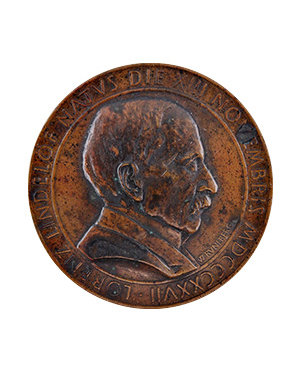
The medal is struck in bronze and measures 56.5 mm. The obverse illustrates the right-facing bust of Lorenz Lindelöf, surrounded by the inscription “LORENZ LINDELÖF NATVS DIE XII NOVEMBRIS MDCCCXXVII” (1827).

The reverse illustrates a branch of laurel leaves at the left and a branch of oak leaves at the right, inscribed in the centre is “SECRETARIO SVO QVADRAGENARIO SOCIETAS SCIENTIAS FENNIAE / DIE XIII NOVEMBRIS MCMVII” (1907).

The 1952 Helsinki Olympic Merit Medal

The 1952 Helsinki Olympic Merit Medal is a Finnish medal created by Executive Order on July 21st 1952. The medal was conferred by the President of the Republic for distinguished services in the XV Olympic Games.

The medal was awarded in three classes:

  • Cross of Merit I Class: To members of the I.O.C., Chairmans of a National Olympic Committee, Presidents of an International Sporting Federation or otherwise deserving Chief Secretary or member, members of the Games leadership who has distinguished himself in the organization of the Games or persons who had performed specially valuable services to the Games or the Olympic ideal.
  • Cross of Merit II Class: To members of National Olympic Committees, Chief Secretaries of a National Olympic Committee or an International Sporting Federation, members of the Boards of International Sporting Federations, persons of intermediate rank in the Games leadership who have distinguished themselves in the organization of the Games, deserving Chairmen of domestic inter-federation committees and chief competition directors, and Olympic Attaches.
  • Medal of Merit: To coaches, trainers and persons who have zealously promoted the training of Finland’s team, officials of the Organizing Committee who have distinguished themselves in the organization of the games, Managers of a Finnish Sporting Federation, officials employed in the Games, or other persons who have helped forward the work of the organization.

The 1952 Helsinki Olympic Merit Medal Design

The medal is a one-piece construction struck in solver and measures 31.11 mm. It shows a five-armed cross and the Finnish Lion. In the middle of the cross on the obverse are the Olympic rings, and on the reverse the year 1952.

The ribbon is striped blue and white.

The 1941-1944 Finish Eastern Isthmus Campaign Cross

The 1941-1944 Finish Eastern Isthmus Campaign Cross is a military medal from Finland. The Finnish reconquest of the Karelian Isthmus (1941) refers to a military campaign carried out by Finland in 1941, which was part of what is commonly referred to as the Continuation War.

The 1941-1944 Finish Eastern Isthmus Campaign Cross Design

The medal is struck in silver and measures 34.2 mm by 39 mm.

The Kindred Nations War Cross 1918-1922

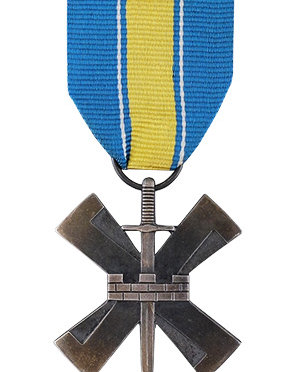
The Kindred Nations War Cross 1918-1922 (Heimosotaristi) is a Finnish medal established in 1922 to reward Finnish volunteer participants in the campaigns in Estonia, Eastern Karelia, Aunus and Ingria (Kindred Nations) against Soviet Russia in the years from 1918 to 1922.

The number of volunteers involved in the nine campaigns was small, making the cross rare. These were campaigns by the Finnish volunteers  in the War of Independence in Estonia and during various campaigns in Karelia and other border areas in Russia.

The Kindred Nations War Cross 1918-1922 Design

The medal is struck in bronze and measures 39.8 mm x 40 mm. A sword device on the ribbon was awarded for participation in one campaign.

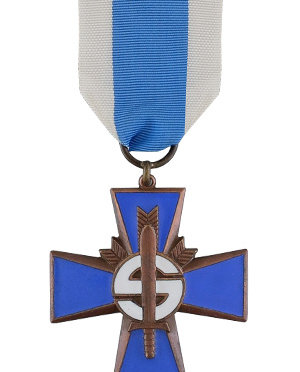
The Finnish Homeguard Volunteer Service Cross

The Finnish Homeguard Volunteer Service Cross was first established after WW1 and used also during WW2.[/vc_column_text][vc_column_text]

The Finnish Homeguard Volunteer Service Cross Design

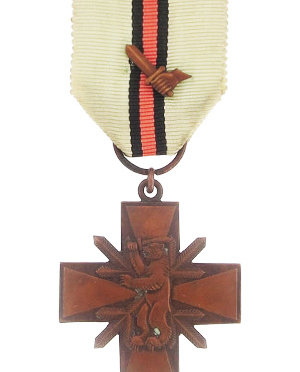
The medal is struck in bronze gilt with white and blue enamels and measures 41.7 mm wide. The obverse of the medal shows a white S with a sword superimposed over it, over a blue cross, with some fern leaves.

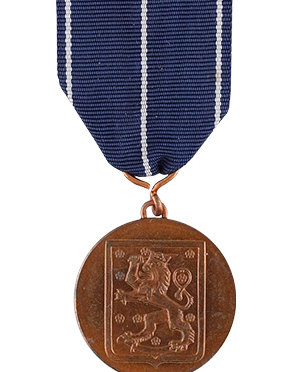
The Finish Continuation War Commemorative Medal 1941-1945

The Finish Continuation War Commemorative Medal 1941-1945 is a Finnish medal awarded to participants in the Continuation War (1941-1945). It was established on 24 May 1957, 12 years after the end of the war.

The Continuation War supported the view that it was a continuation of the Winter War of 1939-1940  in which Soviet forces invaded Finland. It was an attempt by Finland to regain territory lost at the end of the Winter War and to occupy Russian territory, taking advantage of the German invasion of Russia and acting as a defensive buffer against future incursions.

The Finish Continuation War Commemorative Medal 1941-1945 Design

The medal is a one-piece construction and measures 31 mm wide. The ribbon is dark blue with three thin white strips on the sides and middle.

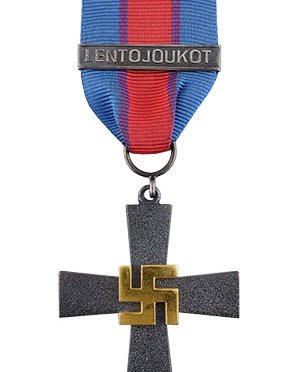
The Finnish Air Force Cross 1941-1945

The Finnish Air Force Cross 1941-1945 (or Commemorative Cross of the Finnish Air Force) is a Finnish medal awarded to participants in the Continuation War (1941-1945).

The Finnish Air Force Cross 1941-1945 Design

The medal is a two-piece construction with a brass swastika overlaying a blackened bronze cross. It measures 39.5 mm wide.

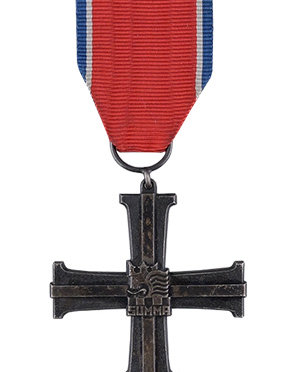
The 1939-1940 Finish Summa Cross

The 1939-1940 Finish Summa Cross was instituted on the 27th of October 1940 and awarded to participants of the Battle of Summa.

The 1939-1940 Finish Summa Cross (or Summan Risti in Finnish) was instituted on the 27th of October 1940 and awarded to participants of the Battle of Summa during the Winter War (the defense against the Soviet invasion 1939-1940).

Summa was a key Finnish defence position in the Mannerheim Line. The village of Summa was a gateway to the city of Viipuri. The Finns had built 41 reinforced concrete bunkers in the area, making the defense line stronger than elsewhere in the Karelian Isthmus. However, mistakes in planning were made, resulting in a kilometer wide gap in the line, nearby the Munasuo swamp.

The 1939-1940 Finish Summa Cross Design

The medal is struck in silvered white metal and measures 45.5 mm wide.