The Commemorative Medal of the 1862 Mexico Expedition

The Commemorative medal of the Mexico Expedition is a commemorative campaign medal established by French emperor Napoleon III.

The Commemorative medal of the Mexico Expedition (or Médaille commémorative de l’expédition du Mexique in French) is a commemorative campaign medal established by decree on 29 August 1863 by French emperor Napoleon III. The medal recognizes military service during the 1862-1863 French intervention in Mexico.

On 30 April 1863, sixty two legionnaires resisted for nine hours against over two thousand Mexicans, allowing for the capture of the city of Puebla on 17 May 1863 thus paving the way to Mexico. In the capital, an assembly of notables recognized Archduke Maximilian of Habsburg as Emperor of Mexico. However, even with the support of 20,000 Mexicans who embraced the new emperor, Maximilian’s forces were harassed in their work of pacification by the troops of President Benito Juárez, who had the support of the United States. In February 1867, Emperor Napoleon III ordered the repatriation of all remaining French troops from Mexico.

No minimum time of service was mentioned in the award statute.

The Commemorative Medal of the 1862 Mexico Expedition Design

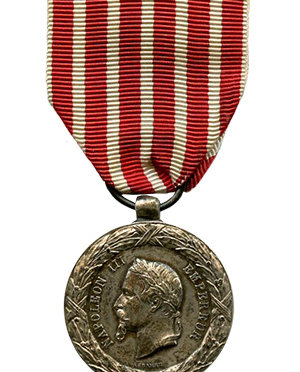
The medal measures 30 mm in diameter, is circular and struck in silver.

The obverse bears the left profile of Emperor Napoleon III crowned with a laurel wreath surrounded by the relief inscription “NAPOLEON III” “EMPEREUR“. A 4 mm wide relief laurel wreath ran along the entire circumference of both the obverse and reverse of the medal.

On the reverse and within the laurel wreath, a circular relief inscription reads “*EXPEDITION DU MEXIQUE * 1862-1863“, with two small five pointed stars separating the text from the dates. At the center, the relief inscription on five lines of the campaign’s major battles “CUMBRES” “CERRO-BORREGO” “SAN-LORENZO” “PUEBLA” “MEXICO”.

The medal hangs from a 36 mm wide white silk moiré ribbon bearing 5 mm red and green stripes arranged at a 45 degree angle forming a cross, over which was superimposed a black eagle, its wings spread and holding a green snake in its beak and talons, a design inspired by the coat of arms of Mexico.
The Commemorative Medal of the 1860 China Expedition

The Commemorative medal of the 1860 China Expedition is a military award of the Second French Empire awarded to soldiers and sailors.

  • Time Period: Pre-WW1
  • Institution: 23 January 1861
  • Country: France

The Commemorative medal of the 1860 China Expedition (or Médaille commémorative de l’expédition de Chine de 1860 in French) is a military award of the Second French Empire awarded to soldiers and sailors who had participated in the Anglo-French expedition to China during the Second Opium War.

The medal was created by imperial decree on 23 January 1861, by Napoleon IIIThe British Empire had been engaged in an ongoing conflict with the Qing Dynasty since 1856. Following the 1857 general election in the United Kingdom, the new parliament decided to seek redress from China. The French Empire, the United States, and the Russian Empire received requests from Britain to form an alliance. France joined the British action against China, prompted by the execution of a French missionary, Father August Chapdelaine. The conflict concluded with the 1858 Treaty of Tianjin in the Convention of Peking on 18 October 1860.

The medal was awarded by the Emperor to all who served in the China Expedition on propositions of the minister overseeing the service in which the potential recipient served. All recipients also received a certificate of award.

The Commemorative Medal of the 1860 China Expedition Design

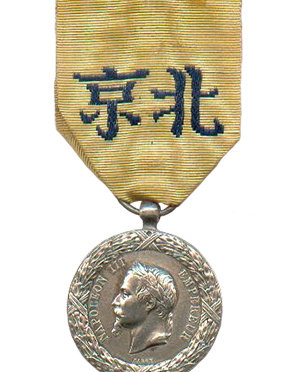
The medal measures 30 mm in diameter, is circular and struck in silver. It was designed and engraved by Albert Désiré Barre.

The obverse bears the left profile of Emperor Napoleon III crowned with a laurel wreath surrounded by the relief inscription “NAPOLEON III” “EMPEREUR”. A 4 mm wide relief laurel wreath runs along the entire circumference of both the obverse and reverse of the medal.

On the reverse, within the laurel wreath, there’s the circular relief inscription EXPÉDITION DE CHINE 1860. At the center, the relief inscription on four lines of the campaign’s major battles TA-KOU, CHANG-KIA-WAN, PA-LI-KIAO, PE-KING.

The medal is suspended from a 36 mm wide silk moiré yellow ribbon, at its center, the name of the city of Peking woven in blue Chinese characters.

The Commemorative Medal of the 1859 Italian Campaign

The Commemorative medal of the 1859 Italian Campaign is a French commemorative medal established by Napoleon III in 1859.

The Commemorative medal of the 1859 Italian Campaign (or Médaille commémorative de la campagne d’Italie de 1859 in French) is a French commemorative medal established by Napoleon III in 1859 following the French campaign in Italy during the Second Italian War of Independence.

In Europe, Italian unification was only supported by Emperor Napoleon III of France who, on 28 January 1859, based on the clauses of the Treaty of Turin, decided to bring aid and support from France. France declared war on the Austrian Empire on May 3, 1859. In spite of the lack of preparation of the French army, the soldiers and allies were to illustrate themselves in several famous battles, including that of Magenta on June 4th, which allowed Napoleon III and Victor Emmanuel II to enter triumphantly in Milan on 8 June. An armistice was signed at Villafranca on July 12.

During the three-month campaign, French losses amounted to 8,000 dead and 40,000 wounded. To reward all participants and ensure the memory of this glorious military campaign, the Medal was created by Imperial Decree on August 11, 1859.

Nearly 120,000 medals were awarded to reward all soldiers and sailors who participated in the Italian campaign of 1859. All recipients also received a certificate of award.

The Commemorative Medal of the 1859 Italian Campaign Design

The medal was designed by Albert Désiré Barre. It measures 30 mm in diameter and is circular and struck in silver.

The obverse bears the left profile of Emperor Napoleon III crowned with a laurel wreath surrounded by the relief inscription “NAPOLEON III” “EMPEREUR” (English: “NAPOLEON III” “EMPEROR”). A 4 mm wide relief laurel wreath ran along the entire circumference of both the obverse and reverse of the medal.

On the reverse, within the laurel wreath, the circular relief inscription CAMPAGNE D’ITALIE 1859 (English: ITALIAN CAMPAIGN 1859). At the centre, the relief inscription on six lines of the campaign’s major battles MONTEBELLO, PALESTRO, TURBIGO, MAGENTA, MARIGNAN, SOLFERINO.

The medal hangs from a 36 mm wide silk moiré ribbon bearing six 4 mm wide red stripes and five 2 mm wide white stripes.

The Saint Helena Medal

The Saint Helena Medal (or Médaille de Sainte-Hélène in French) is the first French campaign medal, established in 1857 by a decree of emperor Napoleon III. The medal recognizes participation in the campaigns led by emperor Napoleon I, creator of the Legion of Honour and various other orders (who never instituted commemorative campaign medals for his soldiers).

In time, many veterans of these campaigns, sometimes called the “débris de la Grande Armée” (“remnants of the Great Army”), began meeting within various new veterans’ associations. Keeping alive their war memories and the myth of Napoleon in popular culture, they issued many unofficial commemorative and associative medals. It would be forty two years after the exile of the emperor to the island of Saint Helena called for the need to adequately and officially recognize the service of these combat veterans.

The Saint Helena Medal was awarded to all French and foreign soldiers, from the land armies or naval fleets, who served the Republic or the Empire between the years 1792 and 1815 inclusive. It was awarded with no condition of minimum time of service, however, it was necessary to prove one’s right with a record of service or leave record. The Saint Helena Medal could be revoked following a condemnation to a fixed prison term of one year or more for a crime committed by the recipient.

The medal was accompanied by an award certificate from the Grand Chancery of the Legion of Honour and came in a white cardboard box with intricate ornamentation on the lid in the form of an embossed imperial eagle over the inscription on seven lines “AUX COMPAGNONS DE GLOIRE DE NAPOLÉON I DÉCRET IMPÉRIAL DU 12 AOÛT 1857” (English: “TO NAPOLEON I COMPANIONS IN GLORY IMPERIAL DECREE OF 12 AUGUST 1857”).

The Saint Helena Medal Design

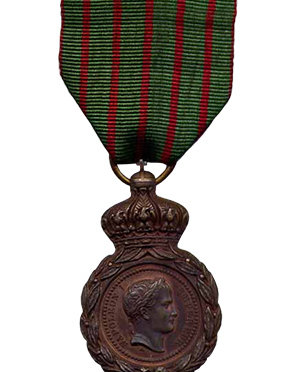
The Saint Helena Medal is of irregular (round) shape and struck in bronze. It measures 2 cm in diameter and its medallion is surrounded by a 50mm wide laurel wreath tied with a bow at the bottom.

Atop the medal there is a 2 cm wide Imperial Crown. The obverse bears the relief image of the right profile of Emperor Napoleon I surrounded by the relief inscription “NAPOLEON I EMPEREUR” (English: “NAPOLEON I EMPEROR”). A ring or small orbs separates the central medallion from the wreath. Just below the image of the emperor, a small anchor, the privy mark of the award’s designer, Désiré-Albert Barre.

The reverse is identical except for the medallion which bears the relief circular inscription within a narrow 20mm band “CAMPAGNES DE 1792 A 1815” (English: “CAMPAIGNS OF 1792 TO 1815”). In the centre, the relief inscription on nine lines “A” “SES” “COMPAGNONS” “DE GLOIRE” “SA DERNIÈRE” “PENSÉE” “STE HÉLÈNE” “5 MAI” “1821” (English: “TO HIS COMPANIONS IN GLORY HIS LAST THOUGHT ST HELENA 5 MAY 1821”).

The medal hangs from a 38mm wide green silk moiré ribbon bearing five 1,8mm wide red vertical stripes spaced 4,5mm apart and 1mm red edge stripes.

The National Order of Merit (France)

The National Order of Merit (or Ordre national du Mérite in French) is an order of merit with membership established to replace the large number of ministerial orders previously awarded by the ministries and to create an award that can be given at a lower level than the Legion of Honour, which is generally reserved for French citizens.

The National Order of Merit was awarded by the President of the French Republic, founded on 3 December 1963 by President Charles de Gaulle. It comprises about 187,000 members worldwide. The President of the French Republic is the Grand Master of the order and appoints all its members by convention on the advice of the Government of France.

The order has a common Chancellor and Chancery with the Legion of Honour. Every Prime Minister of France is made a Grand cross of the order after 24 months of service.

The National Order of Merit Design

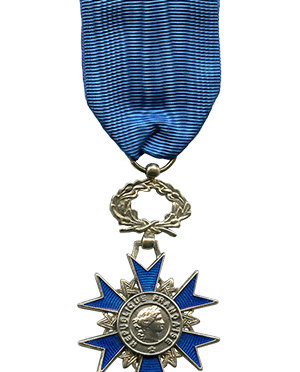
The medal of the order is a six-armed Maltese asterisk in gilt enamelled blue, with laurel leaves between the arms.

The obverse central disc of the National Order of Merit medal features the head of Marianne, surrounded by the legend République française (French Republic). The reverse central disc has a set of crossed tricolores, surrounded by the name of the order and its foundation date. The badge is suspended by a laurel wreath.

The Order has five classes:

  • Three ranks:
    • Knight (Chevalier): to be of a minimum age of 35, minimum of 10 years of public service and “distinguished merits”;
    • Officer (Officier): minimum of 5 years in the rank of Knight;
    • Commander (Commandeur): minimum of 5 years in the rank of Officer;
  • Two dignities:
    • Grand Officer (Grand Officier): minimum 3 years in the rank of Commander; and
    • Grand Cross (Grand-Croix): minimum 3 years in the rank of Grand Officer.

The Order of Liberation

The Order of Liberation (or “Ordre de la Libération” in French) is a high honor Order awarded to heroes of the Liberation of France during World War II. It is second only after the Légion d’Honneur (Legion of Honour). The Order of Liberation was established by General de Gaulle in order n° 7, signed in Brazzaville on November 16, 1940 to “reward people, of the military or civilian communities, who will have distinguished themselves in the task of liberating France and her Empire”.

Very few people, military units and communes were ever awarded it, and only for their deeds during World War II. There were no restrictions as to age, sex, rank, origin or nationality; nor about the nature of the deeds, other than their exceptional quality.

The Order has a single rank, the title of Compagnon de la Libération (“Companion of the Liberation”). General de Gaulle, founder of the Order, was the only Grand Maître (“Grand Master”) of the Order.

The Order of Liberation Design

The medal of the Order or Croix de la Libération (“Cross of Liberation”), measures 31 mm wide by 33 mm high and is made of a rectangular bronze shield bearing a 60 mm high vertical gladius on its obverse.

On the blade of the gladius: a black enamelled Cross of Lorraine. On the reverse, a relief inscription in bold letters and in Latin reads, on four rows, “PATRIAM SERVANDO VICTORIAM TULIT” (“By serving the Fatherland, he/she achieved Victory”).

A total of 1061 Crosses of Liberation were awarded: 1038 to individuals, 18 to units of the Army, Air Force and Navy and five to cities: Nantes, Grenoble, Paris, Vassieux-en-Vercors, and l’Île de Sein.

The Legion of Honor

The Legion of Honor (or Ordre national de la Légion d’honneur in French) is the highest French order of merit for military and civil merits.

The Legion of Honour (National Order of the Legion of Honour; or Ordre national de la Légion d’honneur in French) is the highest French order of merit for military and civil merits. The Legion of Honour was established in 1802 by Napoleon Bonaparte and retained by all the divergent governments and regimes later holding power in France.

The Légion d’honneur is a body of men and not an order of chivalry, for Napoleon believed that France wanted a recognition of merit rather than a new system of nobility. The order’s motto is Honneur et Patrie (“Honour and Fatherland”), and its seat is the Palais de la Légion d’Honneur on the left bank of the River Seine in Paris.

Since the establishment of the Legion, the Grand Master of the order has always been the Emperor, King or President of France. 

The Legion of Honor Degrees or Classes

The order is divided into five degrees of increasing distinction: ChevalierOfficierCommandeur, Grand-officier, and Grand-croix.

  • Chevalier (Knight): The lowest rank of the Legion of Honor is awarded to individuals who have made notable contributions to French society or who have shown exceptional dedication and service to their profession. Recipients are entitled to wear the insignia badge.
  • Officier (Officer): The next rank is bestowed upon individuals who have demonstrated significant achievements or leadership in their field of expertise. Officers wear the same insignia but with a small rosette on the ribbon.
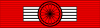
  • Commandeur (Commander): The third degree is awarded to individuals who have distinguished themselves through exceptional contributions to French society, culture, or the nation. Commanders wear the same insignia with the addition of a larger rosette on the ribbon.

  • Grand Officier (Grand Officer): This higher degree is reserved for individuals who have achieved extraordinary accomplishments or held high-ranking positions of responsibility. Recipients wear a badge with a silver star suspended from the ribbon.
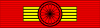
  • Grand Croix (Grand Cross): The highest and most prestigious degree of the Legion of Honor, this rank is reserved for heads of state, senior government officials, and individuals who have rendered exceptional services to France or humanity. Grand Cross recipients wear a badge with a silver star and a sash over the right shoulder.

The Legion of Honor Design

The badge of the Légion is a five-armed “Maltese Asterisk” in gilt (made in silver for chevalier) enameled white, with an enameled laurel and oak wreath between the arms.

The obverse of the Legion of Honour medal central disc is in gilt, featuring the head of Marianne, surrounded by the legend République Française on a blue enamel ring. The reverse central disc is also in gilt, with a set of crossed tricolores, surrounded by the Légion’s motto Honneur et Patrie (Honour and Fatherland) and its foundation date on a blue enamel ring. The badge is suspended by an enameled laurel and oak wreath.

The star (or plaque) is worn by the Grand Cross (in gilt on the left chest) and the Grand Officer (in silver on the right chest) respectively; it is similar to the badge, but without enamel, and with the wreath replaced by a cluster of rays in between each arm. 

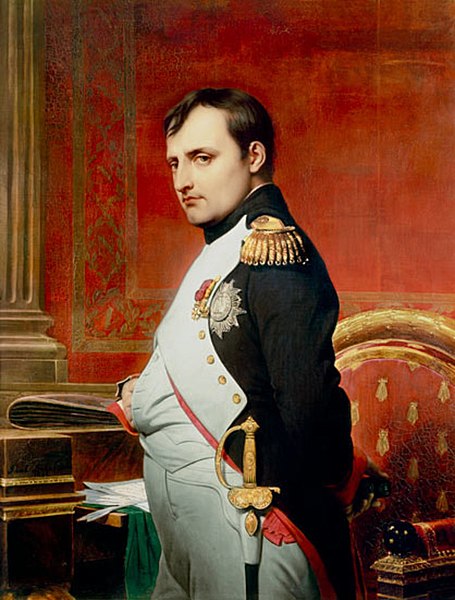
As Emperor, Napoleon always wore the Cross and Grand Eagle of the Legion of Honor.

Find This Medal

Right Now on eBay 
Clicking a link to eBay may result in a referral commission being paid if a purchase is made.
Loading...

The Recusants Insignia

The Recusant’s Insignia is a French medal to honor French citizens who had evaded the Compulsory Work Service in Germany.

The Recusant’s Insignia is a French medal to honour French citizens who had evaded the Compulsory Work Service (S.T.O.) in Germany and who had therefore participated in the fight against the invader.

The law of August 22, 1950, establishing the status of “recusant”, stated in its first article: “The Republic, grateful to those who accepted all the risks in their fight against the enemy’s war potential, considering the suffering and the prejudice that this courageous and patriotic attitude caused them, proclaimed and determined the right to reparation for recusants and their successors“.

The Recusant’s Insignia Design

The design of the Recusant’s Insignia was decided by a contest opened by a decree of 17 July 1961 and won by artist engraver M. Hollebecq.

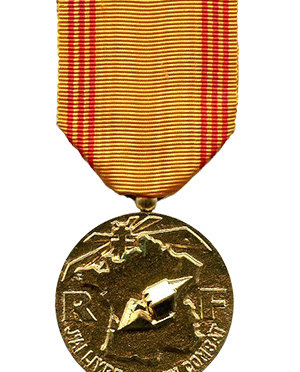
The Recusant’s Insignia measures 36 mm in diameter, is circular and struck from bronze or gilt bronze. Its obverse bears the relief image of a map of France, a broken anvil at its center symbolizes the refusal to work. Above the map, a Cross of Lorraine symbolizing hope and support for the oppressed. On either side, the relief initials “R” and “F” for République Française, and at the bottom the relief semi-circular inscription J’AI LIVRÉ UN BON COMBAT. On the reverse, the circular relief inscription along the top ¾ of the medal circumference AUX RÉFRACTAIRES GUERRE 1939 – 1945.

See also:

The Political Internment Medal

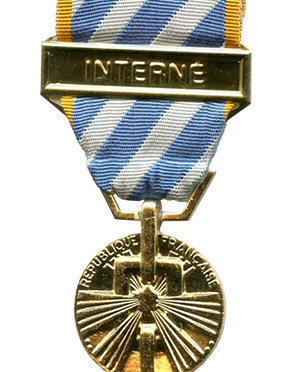
The Political deportation and internment medal is a commemorative medal awarded by the Ministry for veterans and war victims.

The Political deportation and internment medal (or Médaille de la déportation et de l’internement politique) is a commemorative medal awarded by the Ministry for veterans and war victims of the French Republic to its citizens who were deported or interned by the German occupation forces during World War 2.

Created by a law on 9 September 1948, the medal defines the status of political deportees and internees, declaring in its opening article “The Republic, grateful to those who contributed to the salvation of the country, bowed before them and before their families, determined the status of political deportees and internees, proclaim their rights and those of their successors”.

The title of political internee giving the right to wear the Political deportation and internment medal with political internee ribbon was bestowed to French citizens living in France or abroad, interned by the enemy or the Vichy government, for any reason other than for common or criminal offenses. These were interned for a legitimate act accomplished for the cause of the liberation of France; for an administrative or judicial measure resulting in deprivation of freedom; and French citizens living in France or abroad, who were executed by the enemy for any reason other than for common or criminal offenses.

The Political Deportation and Internment Medal Design

Designed by French artist engraver Arthus Bertrand, the medal measures 30 mm in diameter, is circular and struck from bronze or gilt bronze.

Its obverse bears the relief image of four vertical chain links protruding from the medal circumference. It also shows a small relief image of the map of France with six rays of light protruding out to the medal’s outer edges and the inscription RÉPUBLIQUE FRANÇAISE. The reverse bears the same chain links but without the map of France or the rays, and the years “1940” and “1945” in relief instead. Along the circumference it says MÉDAILLE DE LA DÉPORTATION ET DE L’INTERNEMENT).

The Political Deportation Medal

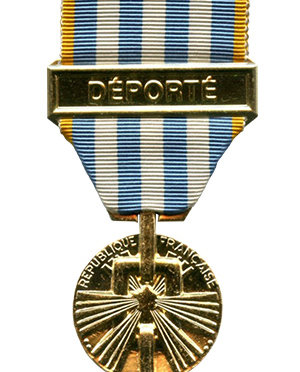
The Political deportation and internment medal is a commemorative medal awarded by the Ministry for veterans and war victims.

The Political deportation and internment medal (or Médaille de la déportation et de l’internement politique) is a commemorative medal awarded by the Ministry for veterans and war victims of the French Republic to its citizens who were deported or interned by the German occupation forces during World War 2.

Created by law on 9 September 1948, the medal defines the status of political deportees and internees, declaring in its opening article “The Republic, grateful to those who contributed to the salvation of the country, bowed before them and before their families, determined the status of political deportees and internees, proclaim their rights and those of their successors”.

The Title of political deportee was bestowed to French citizens living in France or abroad, who were, apart from being interned for common or criminal offenses and for a period of at least three months: Transferred by the enemy from the national territory and then incarcerated or interned in a prison or concentration camp; incarcerated or interned by the enemy in the camps or prisons of Bas-RhinHaut-Rhin and Moselle; incarcerated or interned by the enemy in any other territories exclusively administered by the enemy, in particular Indochina. 

The three-month minimum period was waived for persons having successfully escaped or that contracted an illness or infirmity during their internment arising in particular from torture.

The Political Deportation and Internment Medal Design

Designed by French artist engraver Arthus Bertrand, the medal measures 30 mm in diameter, is circular and struck from bronze or gilt bronze. Its obverse bears the relief image of four vertical chain links protruding from the medal circumference. It also shows a small relief image of the map of France with six rays of light protruding out to the medal’s outer edges and the inscription RÉPUBLIQUE FRANÇAISE. The reverse bears the same chain links but without the map of France or the rays, and the years “1940” and “1945” in relief instead. Along the circumference it says MÉDAILLE DE LA DÉPORTATION ET DE L’INTERNEMENT).