The Medal of a Liberated France

The Medal of a Liberated France was a decoration of the French Republic awarded for contributions to the liberation from German occupation.

The Medal of a liberated France (or “Médaille de la France libérée”) was a decoration of the French Republic awarded to French and foreign nationals that had made a notable contribution to the liberation of France from the German occupation. It was originally named the “Medal of Gratitude of a Liberated France”.

The Medal of a liberated France was created by decree on 12 September 1947. It could be awarded to soldiers of the allied armies who had participated in war operations on the soil of Metropolitan France, soldiers of allied armies who served as liaison with the French forces or to French nationals who made a notable contribution to the liberation of Metropolitan France or soil under French mandate between 18 June 1940 and 20 August 1945.

The Medal of a liberated France Design

The Medal of a liberated France measures 35mm in diameter and it’s a circular medal struck from bronze.

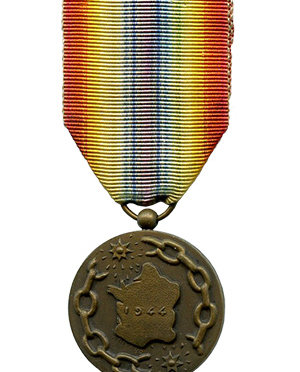
The obverse bears the relief image of France with the relief date “1944” at its center. A relief chain encircles the image of France with two breaks in its links, one North-east, the other South-west, symbolizing the allied landings. The reverse bears the relief image of a Fasces below a Phrygian cap bisecting the initials “R.F.” and the relief inscription “LA FRANCE A SES LIBERATEURS” along the upper and lower circumference.

The medal hangs from a 36mm wide rainbow coloured silk moiré ribbon with the purple at center.

The Commemorative Medal for Voluntary Service in Free France

The Commemorative Medal for Voluntary Service in Free France is a French commemorative war medal and awarded during WW2.

The Commemorative medal for voluntary service in Free France (or Médaille commémorative des services volontaires dans la France libre in French) is a French commemorative war medal awarded to members of the Free French Forces who fought the Axis forces on most fronts during World War II. It was established by decree on 4 April 1946.

The Free French Forces were especially active in North Africa where they particularly distinguished themselves during the Battle of Bir Hakeim. Also part of the whole, the Free French Naval Forces and Free French Air Force, although limited in numbers and equipment nonetheless took part in most major engagements alongside allied forces including in the Soviet Union.

The Commemorative medal for voluntary service in Free France was awarded to all persons, civilian or military, French or foreign nationals who had voluntarily contracted in the Free French Forces prior to 1 August 1943 (for soldiers), or who had effectively served Free France on the territories controlled by the National Committee in London and in foreign countries prior to 1 August 1943 (for civil servants).

The Commemorative medal for voluntary service in Free France Design

The Commemorative medal for voluntary service in Free France was struck from silvered bronze in the shape of a Cross of Lorraine. Its obverse bears the relief inscription on two lines “FRANCE” on the upper horizontal arm and “LIBRE” on the lower arm. Its reverse bears the dates “18 JUIN 1940” on the upper arm and “8 MAI 1945” on the lower arm.

The Commemorative medal for voluntary service in Free France hangs from a dark blue silk moiré ribbon adorned with 2 mm wide red oblique stripes separated by 4 mm.

The 1943-1944 Italian Campaign Medal (France)

The 1943–1944 Italian campaign medal is a campaign medal awarded to soldiers and sailors of the French Expeditionary Corps of Italy.

The 1943–1944 Italian campaign medal (or Médaille commémorative de la campagne d’Italie 1943-1944 in French) is a French commemorative campaign medal awarded to soldiers and sailors who served on Italian soil or Italian waters as part of the “French Expeditionary Corps of Italy”. The corps participated in the allied amphibious landing and the ensuing campaign in Italy in 1943 and 1944.

Composed in part of Frenchmen from North Africa and in part with colonial troops, the CEF covered itself with glory during this long campaign and especially during the battle of the GariglianoIn January 1953, Parliament approved the creation of a distinct medal to adequately recognize the valour in combat and the sacrifice of the men of the CEF – who lost more than 7,000 members.

The 1943–1944 Italian Campaign Medal Design

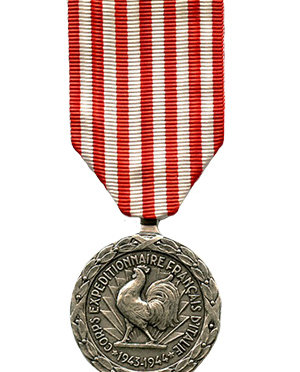
The 1943–1944 Italian Campaign Medal measures 36mm in diameter and is made of silvered bronze medal.

Its obverse bore the left profile view of a Gallic rooster in front of Sun rays surrounded by the relief circular inscription “CORPS EXPÉDITIONAIRE FRANÇAIS D’ITALIE * 1943-1944 *” within a relief laurel wreath along the entire medal circumference. On the reverse, within the same relief laurel wreath, the circular inscription “RÉPUBLIQUE FRANÇAISE” at the bottom a relief five-pointed star, in the center, the relief inscription “CEF”.

The 1943–1944 Italian Campaign Medal hangs from a ribbon passing through a suspension ring. The 36mm wide silk moiré ribbon is composed of seven red and six white alternating vertical stripes of equal width.

The 1939–1945 Commemorative War Medal (France)

The 1939–1945 Commemorative War Medal is a medal of France established in 1946 to recognize individual participation in the Second World War.

The 1939–1945 Commemorative War Medal (or “Médaille commémorative de la guerre 1939–1945” in French) is a commemorative medal of France established in 1946 to recognize individual participation in the Second World War.

The medal was awarded to all soldiers serving under French authority or under a French government in a state of war against the Axis nations, as well as present on board a warship or armed merchant vessel, to French citizens, military or civilian, who fought against the Axis forces or their representatives, and to foreign military who served as Frenchmen in formations at war against the Axis forces.

The 1939–1945 Commemorative War Medal Design

The 1939–1945 Commemorative war medal is hexagonal in shape and struck from bronze. It measures 28mm wide and 38mm high excluding the suspension loop.

The obverse of the medal bears the relief image of a rooster superimposed in front of a Cross of Lorraine. The reverse shows a relief semi circular inscription “RÉPUBLIQUE FRANÇAISE” over a sprig of laurel leaves and the inscription on three lines “GUERRE” “1939” “1945”.

The Orient Campaign Medal

The Orient Campaign Medal was a French military medal awarded for participation in the battles against the Central Powers 1915-1918.

The Orient Campaign Medal (“Médaille commémorative d’Orient” in French) was a French military medal awarded for participation in the battles against the Central Powers by the Allied Eastern Army between 1915 and 1918.

The Orient Campaign Medal was awarded to both military and civilian personnel embarked prior to 11 November 1918 for service with the French Army of the Orient; to French personnel who had served in the headquarters staff of the commandant of the Allied Eastern Army and to French sailors that had served East of the 21st degree of longitude in operations related to those of the Allied Eastern Army.

No minimum time of service is mentioned in the award statute.

The Orient Campaign Medal Design

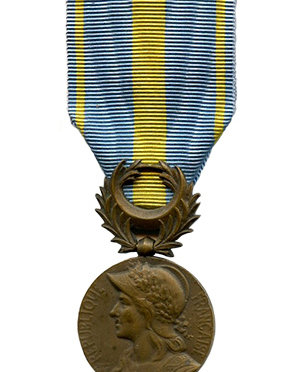
The Orient campaign medal measures 30mm in diameter, is circular and struck from bronze.

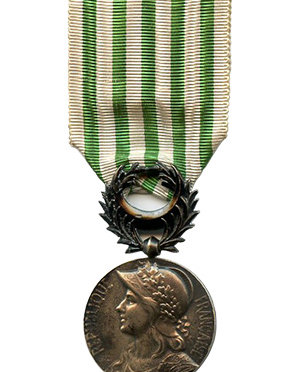
The obverse shows the relief image of the “warrior republic” as a left profile of a helmeted woman’s bust. The helmet is adorned by a crown of oak leaves. The relief inscription along the circumference reads “RÉPUBLIQUE FRANÇAISE”. The reverse represents both the army and navy, with a relief image of an infantry rifle crossed with a naval anchor below two military banners and lances surmounted. The relief reads “ORIENT” or, on some variants, “HONNEUR ET PATRIE 1915 1918” written on the banners.

The Orient campaign medal hangs from a ribbon through a ring and is adorned by a 24mm in diameter bronze laurel wreath and half crescent. The ribbon is 37mm wide and is light blue with a yellow central 7mm wide and 2mm wide stripes 2mm from the edges.

The Medal of French Gratitude

The Medal of French Gratitude is a French honour medal only awarded to civilians to express gratitude by the French government.

The Medal of French Gratitude (or “Médaille de la Reconnaissance française” in French) is a French honor medal awarded only to civilians as a manner of expressing gratitude by the French government to all those who, without legal or military obligation, had come to the aid of the injured, disabled, refugees, or to those who had performed an act of exceptional dedication in the presence of the enemy during the First World War.

The Medal of French Gratitude was awarded to six French and eight foreign cities.

The Medal of French Gratitude Design

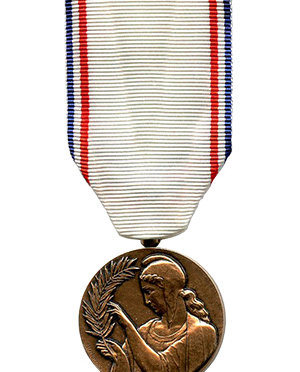
The first model of the Medal of French Gratitude measured 30 mm in diameter, was circular and made of bronze, silver or gilded medal, with a design by the engraver Jules Desbois.

The obverse bears charity personified by France supporting a wounded soldier. On the reverse can be read a circular inscription “RECONNAISSANCE FRANCAISE” with a palm leaf on the right.

The second model of this medal measured 32 mm and was designed by engraver Maurice Delannoy. Its obverse bears a woman wearing a Phrygian cap representing France offering a palm. On the reverse there is a relief inscription RECONNAISSANCE FRANCAISE around a wreath of roses and an escutcheon bearing the initials “RF”.

The medal hags from a 37 mm wide white silk moiré ribbon with tricolour 2 mm wide edge stripes of blue, white and red.

The Medal for Victims of the Invasion

The Medal for Victims of the Invasion was a military decoration awarded to civilians who suffered during the German invasion of France.

The Medal for Victims of the Invasion is a French medal that intended to thank and distinguish the war hostages and persons deported outside of France, who had been imprisoned by the enemy or condemned to forced labour.

At the end of the Great War, it seemed necessary to pay tribute to the courage of the populations of the invaded and occupied regions of France by rewarding them with several medals, among them the Medal for Victims of the Invasion.

Two categories of persons were recognized to have the right to special recognition by the country: Political prisoners condemned by the German authorities to severe punishment for their attachment to France, and hostages of war who for sometimes years, remained in retaliation camps in Poland and Lithuania.

The Medal for victims of the invasion was awarded in three classes: The 1st class in silver gilt, the 2nd class in silver and the 3rd class in bronze.

Medal for Victims of the Invasion Design

The medal measures 30 mm in diameter, is circular and struck in bronze, silvered bronze, silver or gilt silver.

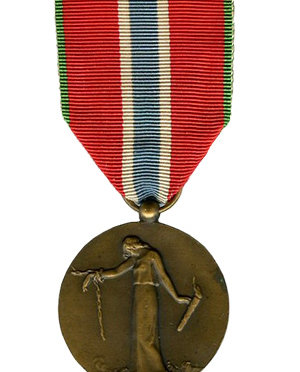
The obverse of the medal was done by engraver Pierre Dautel and bears the relief image of the right profile of a woman wearing a scarf. She has her hands bound in front of her and is looking skywards. The reverse has a relief inscription that reads “AUX” ”VICTIMES” ”DE” ”L’INVASION” ”LA FRANCE” ”RECONNAISSANTE” surrounded by a laurel wreath.

Two clasps could be worn on the ribbon: OTAGES DE GUERRE (WAR HOSTAGES) and PRISONNIERS POLITIQUES (POLITICAL PRISONERS).

The Medal for Civilian Prisoners, Deportees and Hostages

The Medal for Civilian Prisoners, Deportees and Hostages of the 1914-1918 Great War is a commemorative medal awarded to French civilians.

  • Time PeriodThe Great War
  • Institution: 14 March 1936
  • Country: France

The Medal for civilian prisoners, deportees and hostages of the 1914-1918 Great War (or Médaille des prisonniers civils, déportés et otages de la Grande Guerre 1914-1918) is a commemorative medal awarded to French civilians who were interned in camps during World War I after being deported from the German occupied French territories.

The medal was created by law on 14 March 1936, officially recognizing the sacrifices and patriotism of the French civilians that were forced to leave their homes to be detained or serve as hostages. The medal could also be awarded posthumously for civilian prisoners that were killed or that died of wounds product of their internment.

The Medal for civilian prisoners, deportees and hostages of the 1914-1918 Great War Design

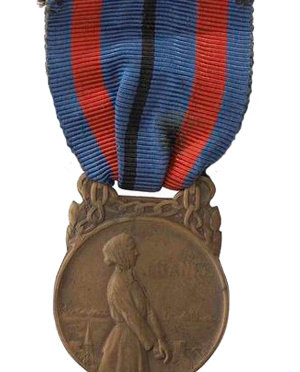
The medal measures 32 mm in diameter, is circular and is struck from bronze.

Its obverse shows a relief image of a woman walking slowly, with her head lowered and her right wrist chained. Her left hand drops a torch symbolizing the home she must abandon. The reverse bore the relief inscription “PRISONNIERS” “CIVILS” “DÉPORTÉS” “ET” “OTAGES” “DE LA” “GRANDE GUERRE” over two closed flowers and surrounded by the circular relief image of a chain along the medal’s circumference.

The Dardanelles Campaign Medal

The Dardanelles campaign medal is a French military medal awarded for participation in the Battle of the Dardanelles or Gallipoli campaign.

The Dardanelles campaign medal (or “Médaille commémorative des Dardanelles”  in French) is a French military medal awarded between 25 April 1915 and 9 January 1916 for participation in the Battle of the Dardanelles, also known as the Gallipoli campaign (which was held against the Central Powers by the Corps expéditionnaire d’Orient and supported by the Royal Navy and French Navy).

The Dardanelles campaign medal was awarded to military and civilian personnel and no minimum time of service is mentioned in the award statute.

The Dardanelles Campaign Medal Design

The Dardanelles campaign medal is circular, measures 30mm in diameter and is struck from bronze.

The obverse of the medal shows a relief image of the “warrior republic” in the form of the left profile of a helmeted woman’s bust. The relief inscription along the circumference “FRENCH REPUBLIC”. The reverse represents both the army and navy, with a relief image of an infantry rifle crossed with a naval anchor. There are two military banners and lances below, surmounted by the inscription “DARDANELLES” (or sometimes “HONNEUR ET PATRIE 1915 1918”).

The medal hung from a ribbon through a ring adorned by a 24mm in diameter bronze laurel wreath and half crescent. The silk moiré ribbon is 37mm wide and is white with four equidistant 3mm wide green stripes beginning 3mm from the edges. A gilt clasp with oriental ornamentation and the inscription “DARDANELLES” is sometimes worn on it, although it is a privately purchased item and unofficial.

The 1914–1918 Commemorative War Medal

The 1914–1918 Commemorative war medal was awarded to soldiers, sailors, and some civilians for service in World War I.

The 1914–1918 Commemorative war medal (or “Médaille commémorative de la guerre 1914–1918” in French) was awarded to soldiers and sailors for service in World War I, and to civilians who met certain requirements, for service between 2 August 1914 and November 11, 1918.

The 1914–1918 Commemorative War Medal Design

The design of the medals was decided by an open contest that had invited many engravers of the time. A total of 73 models were presented to the jury, and Pierre-Alexandre Morlon’s was ultimately adopted.

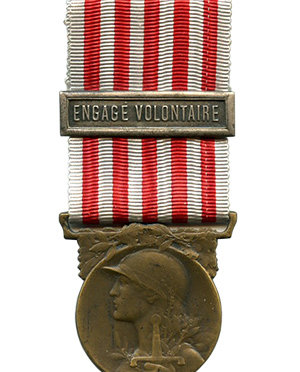
The medal is made of bronze, round and measures 33 mm in diameter. The obverse shows an effigy of a youthful Minerva in profile, wearing the helmet of 1914 which represents France. She is crowned with laurels and holds a sword in her left hand. On the reverse is the legend: GRANDE GUERRE 1914-1918, surrounded by the inscription REPUBLIQUE FRANÇAISE.