The War Commemorative Medal of 1813-15

The War Commemorative Medal for 1813–1815 was established in 1813 by King Friedrich Wilhelm III of Prussia for the Wars of Liberation.

The War Commemorative Medal of 1813/15 (or Kriegsdenkmünze für 1813/15 in German) was a Prussian war commemorative medal  established on 24 December 1813 by King Friedrich Wilhelm III of Prussia to honour members of the Prussian Army who fought in the Wars of Liberation against Napoleonic France during 1813–1815.

It recognised those who served throughout the conflict, which included campaigns that eventually led to the defeat of Napoleon and the decisive Battle of Waterloo.

A later related piece, the Erinnerungs‑Kriegs‑Denkmünze, was instituted on 17 March 1863 by King Wilhelm I on the 50th anniversary of the original campaigns. This anniversary issue featured portraits of Friedrich Wilhelm III and inscriptions marking the years 1813–1815, and was intended as a keepsake for legitimate holders of the original medal and their families.

The War Commemorative Medal Design

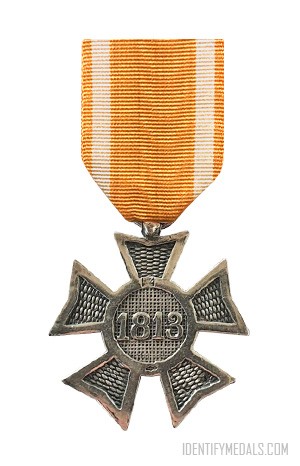
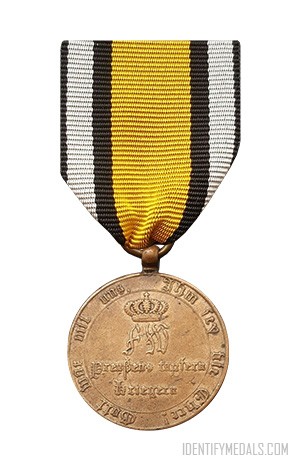
The medal is about 29 mm in diameter and features a cross on the obverse with rays between its arms and a wreath of laurel and oak leaves encircling the year or years of service (such as 1813, 1814, or 1815). The reverse bears the crowned monogram “F. W.” for Friedrich Wilhelm and the inscription Preußens tapferen Kriegern, Gott war mit uns, Ihm sey die Ehre (“To Prussia’s brave warriors, God was with us, to Him be the glory”).

There were two versions of the medal: a combatant version struck in bronze made from captured artillery, often with the edge inscription Aus erobertem Geschütz (“From captured cannon”), and a non‑combatant version cast in iron and oval in shape, which was awarded to those who did not see active combat or who supported the war effort. The iron variant became informally known as the “Eiserne Pflaume” (“Iron Plum”) due to its shape.

Both versions were worn on the left breast suspended from distinctive ribbons: combatants on an orange ribbon edged in black and white, and non‑combatants on a white ribbon edged in black, orange, and white.

The Different Waterloo Medals

The Waterloo medal was issued by the British Government to all soldiers present during action. Seven nations of the Seventh Coalition struck differently designed medals for soldiers who took part in the campaign. These are:

The Waterloo Medal - British Medals Pre-WW1

The Waterloo Medal

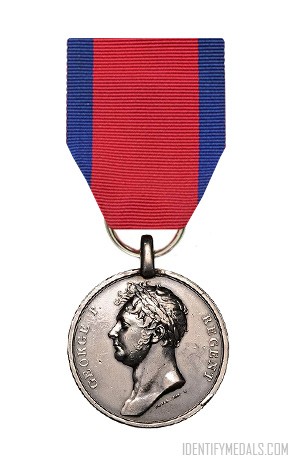
The Waterloo Medal is a British military medal established in 1816-17 and struck for all those who participated in the Waterloo campaign.
British Campaign Medals: The Brunswick Waterloo Medal

The Brunswick Waterloo Medal

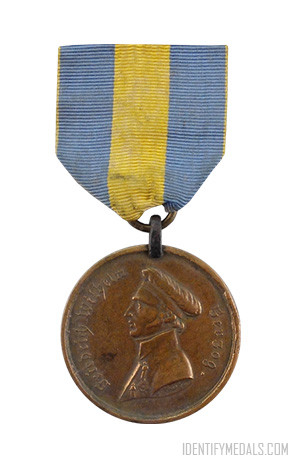
The Brunswick Waterloo Medal was a campaign medal awarded to those who participated in the Battles of Quatre Bras and Waterloo.
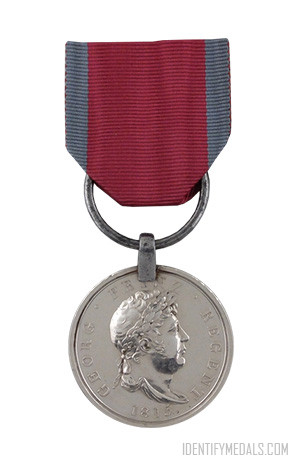
British Campaign Medals: The Hanoverian Waterloo Medal

The Hanoverian Waterloo Medal

The Hanoverian Waterloo Medal was issued to all members of the Hanoverian army who fought in the battles of Quatre Bras and Waterloo.
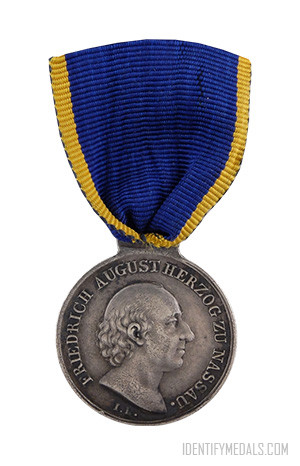
British Campaign Medals: The Nassau Medal for Waterloo

The Nassau Waterloo Medal

The Waterloo Medal is a campaign of the Duchy of Nassau established by Frederick Augustus, Duke of Nassau on 23 December 1815.
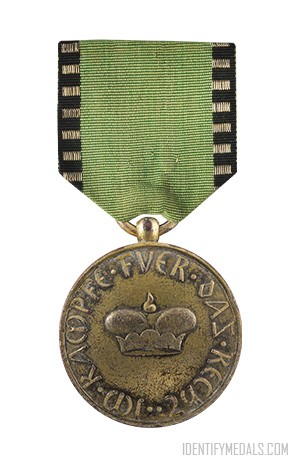
Where to Find Waterloo Medals

Right Now on eBay 
Clicking a link to eBay may result in a referral commission being paid if a purchase is made.
Loading...

The Württemberg Charlotte Cross

The Württemberg Charlotte Cross was established on January 5, 1916, by King William II of Württemberg. It was named in honor of his wife.

The Charlottenkreuz (“Charlotte Cross“) was established on January 5, 1916, by King William II of Württemberg. It was named in honor of his wife, Queen Charlotte, who was born Princess Charlotte of Schaumburg-Lippe.

This decoration was intended to recognize individuals who demonstrated exceptional merit, either on the battlefield or on the home front, in caring for the wounded and ill, or in providing general war-related aid.

The Charlotte Cross Design

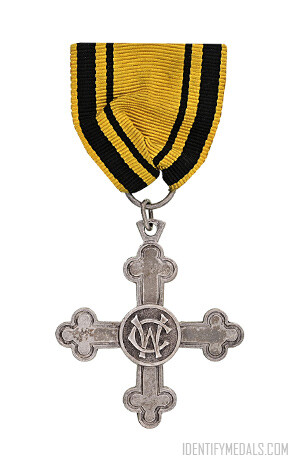
The decoration consists of a silvered white metal cross botonny with a central medallion. The front of the medallion features the intertwined initials C and W (for Charlotte and Wilhelm), while the reverse displays the year 1916.

Recipients wore the decoration on the left breast, suspended from a yellow ribbon with one narrow and one wide black stripe on each side.

Buy This Medal Online

Right Now on eBay 
Clicking a link to eBay may result in a referral commission being paid if a purchase is made.
Loading...

The Württemberg Order of Olga

The Württemberg Order of Olga was established by King Karl I of Württemberg on June 27, 1871, in honor of his queen consort.

The Order of Olga (or Olga-Orden in German) was established by King Karl I of Württemberg on June 27, 1871, in honor of his queen consort, Grand Duchess Olga Nikolaevna of Russia.

The order was primarily intended to recognize women who provided care for wounded soldiers during the Franco-Prussian War of 1870-1871. Although it was occasionally awarded to men, it predominantly remained an order for women.

The Order of Olga Design

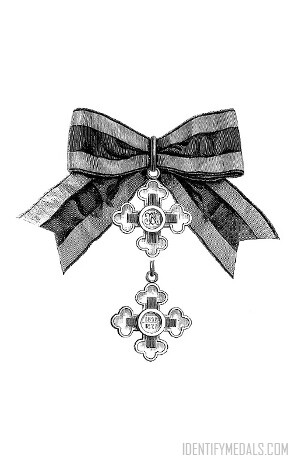
The insignia of the Order of Olga featured a silver cross with the interlocking ciphers of King Karl and Queen Olga on the obverse and the years 1870-71 on the reverse.

This emblem was suspended from a red and black ribbon. 

The Friedrich Order

The Friedrich Order was a prestigious order of merit in the German Kingdom of Württemberg. It was instituted on January 1, 1830.

The Friedrich Order (or Friedrichs-Orden or Friedrichsorden in German) was a prestigious order of merit in the German Kingdom of Württemberg. It was instituted on January 1, 1830, by King Wilhelm I in honor of his father, King Friedrich I. The order was abolished in 1918 with the end of the monarchy.

The Friedrich Order Classes

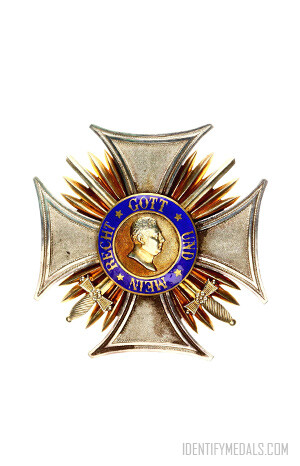
Initially created as a single-class order that conferred nobility, the Friedrich Order was restructured on January 3, 1856, into four classes. On September 29, 1870, a Knight 1st Class and a military division with swords were added, with existing Knights being appointed to the new 1st Class. In 1892, the “Medal of the Order of Frederick” was introduced. An additional rank, the Grand Cross with Crown, was established on March 6, 1899.

The classes were:

  1. Grand Cross with Crown
  2. Grand Cross
  3. Commander 1st Class
  4. Commander 2nd Class
  5. Knight 1st Class
  6. Knight 2nd Class
  7. Medal

Buy This Medal Online

Right Now on eBay 
Clicking a link to eBay may result in a referral commission being paid if a purchase is made.
Loading...

The Württemberg Order of the Crown

The Order of the Crown was initially established in 1702 as the St.-Hubertus-Jagdorden (Hunting Order of St Hubert) but renamed in 1807.

The Order of the Württemberg Crown (or Orden der Württembergischen Krone in German) was a prestigious chivalric order in the Kingdom of Württemberg.

Initially established in 1702 as the St.-Hubertus-Jagdorden (Hunting Order of St Hubert), it was renamed the Ritterorden vom Goldenen Adler (Knightly Order of the Golden Eagle) by Frederick I in 1807.

On September 23, 1818, King William I renewed and restructured the order, naming it the Order of the Württemberg Crown and initially organizing it into three classes: Grand Cross, Commander, and Knight. The order underwent further expansions and modifications in 1889 and 1892.

The Order of the Crown Criteria and Classes

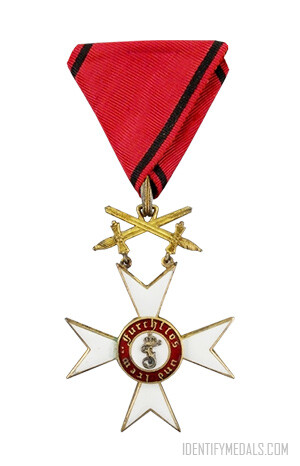
The motto of the order was ‘Furchtlos und treu’ (‘Fearless and Loyal’). Until 1913, the higher ranks of the order were restricted to the nobility. The ranks, in descending order, were:

  1. Knight Grand Cross, Special Class (for sovereigns)
  2. Knight Grand Cross
  3. Knight Commander (since 1889)
  4. Commander
  5. Cross of Honour (Ehrenkreuz; since 1892)
  6. Knight (since 1892 with golden lions, and since 1864 also with a crown, as a special honour)
  7. Gold service medal (Verdienstmedaille)
  8. Silver service medal (Verdienstmedaille, abolished in 1892)

The Order of the Crown Design

The order’s cross was a white enameled Maltese cross with gold lions in its four angles. The lions were standard for the Grand Cross and Commander but were a special honor on the Knight’s crosses. A golden crown was secured on the upper arm by two gold bands, from which the cross hung, except in the case of the Honor Cross in its fixed form. The medallion featured the golden initials of King Frederick I and a crown on the front, and a golden crown on red on the back. Since 1866, all grades could be awarded with swords, and after 1890, swords were only granted in awards of a higher class. From 1892, the lowest grades also featured the special honors of a golden lion and, since 1864, a lion added.

The Grand Cross featured a silver 8-pointed star with a reduced cross in a medallion at its center, surrounded by the circular motto. Sovereigns received the star in gold. The Commander had a 4-pointed silver star with rays extending through the cross angles.

The ribbon was carmine red with black stripes and carmine borders. Members of reigning houses received the Grand Cross insignia with a scarlet ribbon.

Buy This Medal Online

Right Now on eBay 
Clicking a link to eBay may result in a referral commission being paid if a purchase is made.
Loading...

The Germanic Proficiency Runes

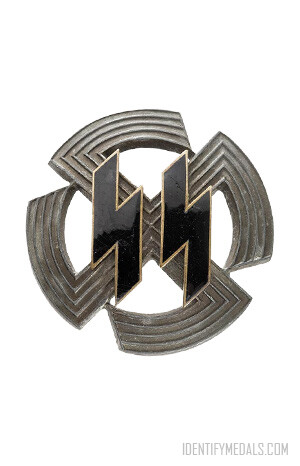
The Nazi regime introduced a sports badge for non-Germans who were part of the Germanic-SS and Waffen-SS, known as the runes.

The Germanic Proficiency Runes Badge, established on August 15, 1943, was awarded to non-German members of the Germanic-SS and Waffen-SS who demonstrated exceptional physical fitness and adherence to Nazi ideology.

The Germanic Proficiency Runes were awarded in two grades: bronze and silver. The distinction between these grades was based on the level of physical achievement demonstrated by the recipients.

The tests for these awards were similar to those required for the SA Sports Badge, ensuring a standardized measure of physical fitness across both German and non-German SS members.

The creation of the Germanic Proficiency Runes served several purposes. It was a tool for promoting physical fitness and readiness among non-German SS members. Additionally, it reinforced the ideology of the Germanic-SS, which sought to include ethnically Germanic volunteers from occupied and neutral countries in Europe.

The Germanic Proficiency Runes Tests

Recipients of the Germanic Proficiency Runes had to undergo rigorous physical tests that were on par with the requirements for the SA Sports Badge. These tests included a variety of athletic and endurance challenges designed to assess overall physical fitness, agility, strength, and stamina. The aim was to maintain a high level of physical preparedness among the SS troops, irrespective of their nationality.

The SS Zivilabzeichen Badge

The SS Zivilabzeichen Badge, also known as the SS Civil Badge, was a lapel pin issued to SS members between 1933 and 1938.

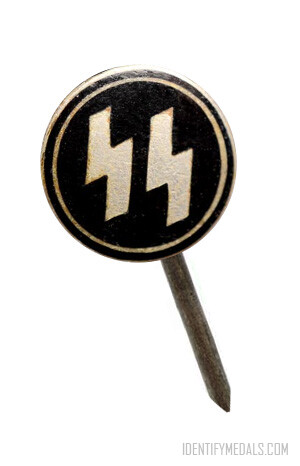
The SS Zivilabzeichen, also known as the SS Civil Badge, was a lapel pin issued to SS members between 1933 and 1938. This badge, displaying the SS runes, was worn on civilian clothing to signify membership in the SS.

The badge was predominantly awarded to veteran SS members within the Sicherheitspolizei, though there was no strict criteria for its issuance. Members simply had to apply to the SS-Hauptamt to receive it.

Known Badge Numbers

  • Adolf Hitler: Honorary SS number “1”. His badge was kept in his Munich apartment and later taken by 1st Lieutenant Philip Ben Lieber in 1945. This badge, along with other items owned by Hitler, was sold through Mohawk Arms to collectors Stephen Wolfe and Neil Hardin, and eventually acquired by collector Craig Gottlieb in 2013.
  • Heinrich Himmler: Badge number 2.
  • Adolf Eichmann: Badge number 6,375.
  • Gustav Lombard: Badge number 72,723.
  • Karl Freiherr Michel von Tüßling: Badge number 106,983.
  • Ernst Kaltenbrunner: Badge number 160,180.
  • Hermann Senkowsky: Badge number 169,582.

The SS Membership Runes for Order Police

The SS Membership Runes for Order Police was a badge worn by members of the Ordnungspolizei who were also full members of the SS.

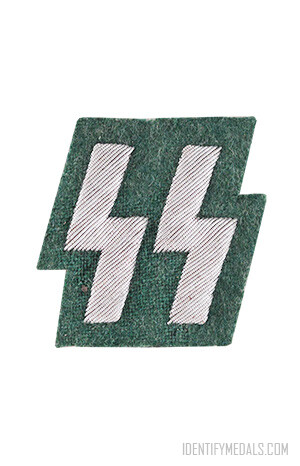
The SS Membership Runes for Order Police was a badge worn by members of the Ordnungspolizei (Orpo) who were also full members of the Schutzstaffel (SS). This badge featured two white Sig Runes, the symbol of the SS, and was centered on the lower left-hand pocket of the jacket.

This badge marked the initial step towards merging the Order Police with the SS, a process supported by Kurt Daluege and Heinrich Himmler. The integration advanced further in 1942, when all Orpo Police Generals were granted equivalent SS ranks and began wearing modified SS-Police rank insignia.

The SS Membership Runes for Order Police Design

The badge was centered on the lower left-hand jacket pocket. It prominently featured two white Sig Runes, which are the iconic symbol of the SS, signifying the wearer’s dual membership in both the Order Police and the SS.

The two white Sig Runes were centrally placed, symbolizing the SS. The runes are in a stylized font typical of Nazi iconography.

The background of the badge is a dark green color, creating a strong contrast with the white runes and ensuring the symbol is easily recognizable from a distance.

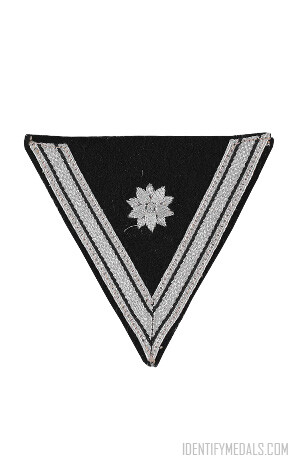
The SS Chevron for Former Police and Military

The SS Chevron for Former Police and Military was a service badge awarded to members of the Nazi Party Schutzstaffel (SS) for service.

The SS Chevron for Former Police and Military (or SS-Ehrenwinkel mit Stern für ehemalige Polizei- und Wehrmachtsangehörige in German) was a service badge awarded to members of the Nazi Party Schutzstaffel (SS) who had previously served in law enforcement, the Reichswehr, or Der Stahlhelm, Bund der Frontsoldaten (“The Steel Helmet, League of Front-Line Soldiers”).

Notable recipients included Arthur Nebe, recognized for his service as a detective with the Berlin Police Department, and Franz Josef Huber, who had served as a police inspector with the Munich Police Department.

The SS Chevron for Former Police and Military Design

This badge signified prior professional service and was visually similar to the Honor Chevron for the Old Guard, distinguished by a darkened center and a silver service pip.

The average price for an authentic SS Chevron for Former Police and Military typically ranges from $300 to $600 USD, depending on its condition and provenance.

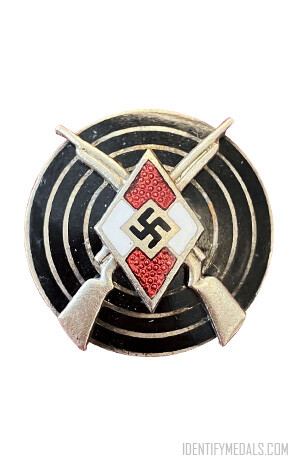
The Hitler Youth Shooting Badge

The Hitler Youth Shooting Badge was awarded in three grades to recognize proficiency in marksmanship within the Hitler Youth.

The Hitler Youth Shooting Badges (or Hitler Jugend Schiessauszeichnungen in German) were awarded in three grades to recognize proficiency in marksmanship within the Hitler Youth.

Each badge was worn on the left breast pocket of the Hitler Youth uniform and had specific design elements to denote the level of proficiency.

The Hitler Youth Shooting Badge Grades and Design

Proficient Shooters (Für Schützen)

    • Instituted: 1936
    • Design: Circular silver and enamel badge shaped like a target, featuring the Hitler Youth emblem in the center, flanked by two crossed rifles.
    • Awards: By the end of 1943, a total of 273,545 badges had been awarded.

Sharpshooters (Für Scharfschützen)

    • Instituted: 1938
    • Design: Similar to the proficient shooters badge but edged with a silver wreath.
    • Awards: By the end of 1943, 31,904 badges had been awarded.

Champion Shots (Für Meisterschützen)

    • Instituted: 1938
    • Design: Similar to the sharpshooters badge but edged with a gilt wreath.
    • Awards: By the end of 1943, only 852 badges had been awarded.

Jungvolk Shooting Badge (Schiessauszeichnunge des Deutsches Jungvolks)

    • Design: Similar to the proficient shooters badge but includes the Jungvolk emblem in front of crossed rifles, with the letters ‘D’ ‘J’ flanking the design.
    • Awards: By the end of 1943, 580,872 badges had been awarded.

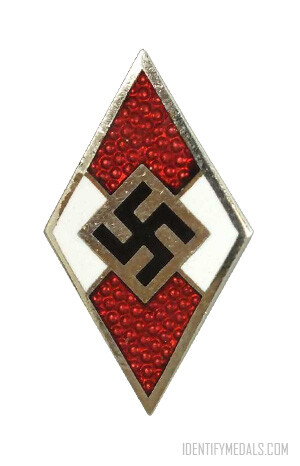
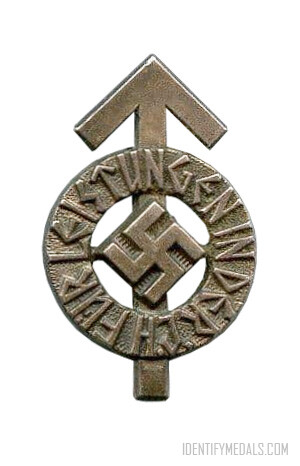
Other Hitler Youth Badges

The variety of Hitler Youth badges arose from the organization’s desire to recognize different levels of achievement, service, and merit among its members. These included:

Hitler Youth Information

Right Now on eBay 
Clicking a link to eBay may result in a referral commission being paid if a purchase is made.
Loading…