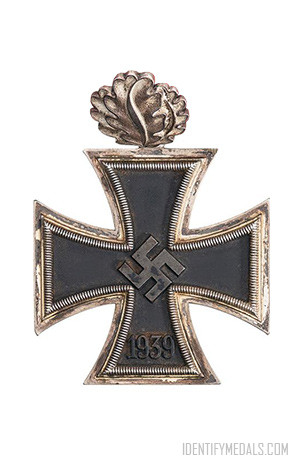
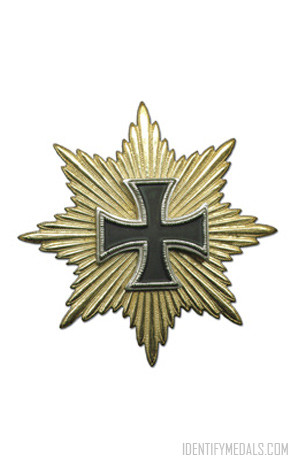
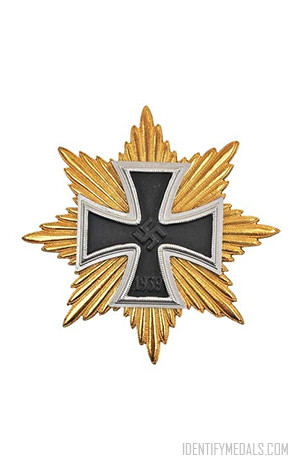
The German Cross (Post-WW2 Version)

The German Cross (or Deutsches Kreuz in German) was instituted by Adolf Hitler on 28 September 1941 and awarded in gold and silver.

The German Cross (also known as The War Order of the German Cross, or Der Kriegsorden Deutsches Kreuz in German) was instituted by Adolf Hitler on 28 September 1941 and awarded in gold and silver, depending on the division.

The German Cross in Gold (ranked higher than the Iron Cross First Class but below the Knight’s Cross of the Iron Cross) was awarded for repeated acts of bravery or achievement in combat. The German Cross in Silver, on the other hand (which ranked higher than the War Merit Cross First Class with Swords but below the Knight’s Cross of the War Merit Cross with Swords) was awarded for distinguished non-combat war service.

The German Cross Eligibility

In order to qualify for the German Cross, the recipient had to be a holder of the Iron Cross or the War Merit Cross.

Civilians were not eligible for this medal, although awards could be made to specific members of uniformed formations, such as railway workers or the police. In 1942, eligibility for the German Cross in Gold was also extended to the armed forces of allied countries.

The German Cross Design

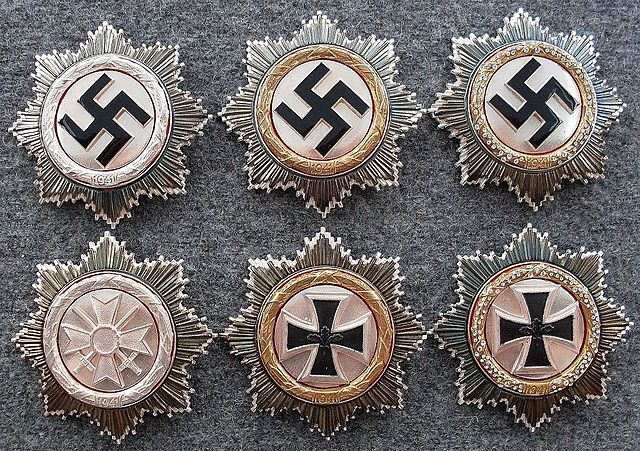
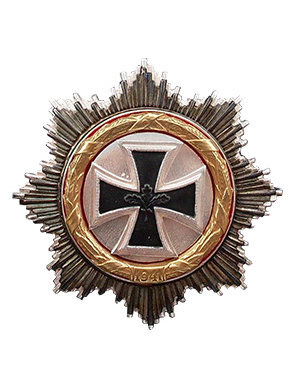
The original order consisted of a star badge with a swastika (in German a Hakenkreuz or “hooked cross”, hence the medal’s name). In 1957, however, alternative de-nazified replacement versions of the German Cross were authorized for wear by the Federal Republic of Germany. These medals replaced the swastika with a representation of the Iron Cross for the gold division, and the War Merit Cross with Swords for the silver division.

The German Cross has a diameter of 6.5 cm and was worn on the right-hand side of the tunic. If a recipient had been awarded both the silver and gold divisions, the gold division should be worn only.

German Cross in Silver, Gold, and with Diamonds. Post-war denazified versions shown below.

Find a German Cross 

Right Now on eBay 
Clicking a link to eBay may result in a referral commission being paid if a purchase is made.
Loading...

The German Cross (Nazi-Germany)

The German Cross (Deutsches Kreuz) was instituted by Adolf Hitler on 28 September 1941 and awarded in gold and silver.

The German Cross (or Deutsches Kreuz in German) was instituted by Adolf Hitler on 28 September 1941 and awarded in gold and silver.

The German Cross in Gold (ranked higher than the Iron Cross First Class but below the Knight’s Cross of the Iron Cross), was awarded for repeated acts of bravery or achievement in combat. The German Cross in Silver (ranked higher than the War Merit Cross First Class with Swords but below the Knight’s Cross of the War Merit Cross with Swords) was awarded for distinguished non-combat war service.

The German Cross Classes

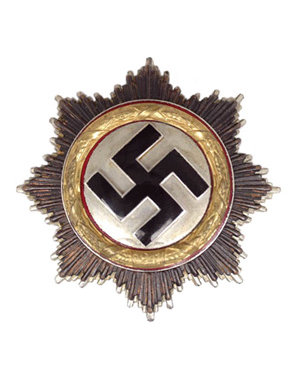
The German Cross was available in two versions: gold and silver, distinguished by the color of the laurel wreath surrounding the swastika.

  • The Gold German Cross: The gold version was conferred upon military personnel for repeated acts of bravery in combat or for exceptional military leadership, typically requiring 6–8 such acts.
  • The Silver German Cross: The silver version was awarded for multiple distinguished services to the war effort and served as a continuation of the War Merit Cross with swords. When a recipient was awarded both versions, only the gold version was authorized for wear.

The German Cross Design

The order consists of a star badge with a swastika (in German a Hakenkreuz or “hooked cross”, hence the medal’s name). The German Cross has a diameter of 6.5 cm and was worn on the right-hand side of the tunic. If a recipient had been awarded both the silver and gold divisions, the gold division should be worn only.

In 1957 alternative de-nazified replacement versions of the German Cross were authorized for wear by the Federal Republic of Germany. These medals replaced the swastika with a representation of the Iron Cross for the gold division, and the War Merit Cross with Swords for the silver division.

Colonel Hans von Luck called the German Cross “Hitler’s fried egg“, in response to its gaudiness.

German Cross in Silver, Gold, and with Diamonds. Post-war denazified versions shown below.

Find a German Cross 

Note: As an eBay partner, I earn from qualifying purchases. This is all done automatically when you use a link and at no extra cost to you.

Right Now on eBay 
Clicking a link to eBay may result in a referral commission being paid if a purchase is made.
Loading...

The Anschluss Commemorative Medal

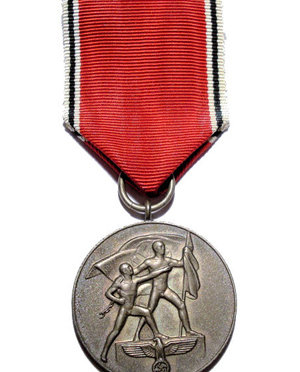
The Anschluss Commemorative Medal was a decoration of Nazi Germany instituted on 1 May 1938 and awarded during the interwar period. 

The Anschluss Commemorative Medal (or Die Medaille zur Erinnerung an den 13. März 1938 in German) was a decoration of Nazi Germany instituted on 1 May 1938 and awarded during the interwar period.

The medal commemorated the annexation of Austria to the German Reich, or Anschluss. The move was the first in Hitler’s quest for Lebensraum, and it strengthened German flanks while weakening those of Czechoslovakia.

The medal, known as the “Anschluss medal“, was awarded to all those Austrians who contributed to or participated in the annexation as well as the members of the Austrian National Socialism movement. It was also awarded to German State officials and members of the German Wehrmacht and SS who marched into Austria.

The Anschluss Commemorative Medal Design

The Anschluss Commemorative medal is round, highly detailed, die-struck and based on the 1938 Party Day Badge and designed by Professor Richard Klein.

On the obverse of the medal, symbolic of Austrian adhesion to the German realm, a man holding the Nazi flag stands on a dais bearing the emblem of the “Third Reich”; he assists onto the dais a second man, on whose right hand a broken shackle still may be seen. On the reverse is the inscription “13. März 1938” (13 March 1938), the date of the Anschluss; the date is surrounded by the words, “Ein Volk, Ein Reich, Ein Führer” (“One People, One Empire, One Leader”).

The Anschluss Commemorative Medal was awarded until 31 December 1940, and a total of 318,689 medals were awarded.

The Order of Merit of the Federal Republic of Germany

The Order of Merit of the Federal Republic of Germany was created by the first President of the Federal Republic of Germany in 1951.

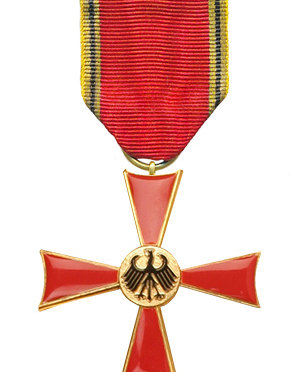
The Order of Merit of the Federal Republic of Germany (or Verdienstorden der Bundesrepublik Deutschland ni German) was created by the first President of the Federal Republic of Germany, Theodor Heuss, on 7 September 1951, and has been awarded to over 200,000 individuals in total, both Germans and foreigners. It’s the only federal decoration of Germany.

The creation decree, which was co-signed by the President Heuss and Chancellor Konrad Adenauer as well as the Minister of the Interior, Robert Lehr, signed, states: “Desiring to visibly express recognition and gratitude to deserving men and women of the German people and of foreign countries, on the second Anniversary of the Federal Republic of Germany, I establish the Order of Merit of the Federal Republic of Germany. It is awarded for achievements that served the rebuilding of the country in the fields of political, socio-economic and intellectual activity, and is intended to mean an award of all those whose work contributes to the peaceful rise of the Federal Republic of Germany.”

The Order of Merit of the Federal Republic of Germany Design

Except for the lowest class, the badge is the same for all classes, with slightly different versions for men and women (the badge and ribbon are smaller for women): The badge’s obverse is a golden cross enameled in red, with a central disc bearing a black eagle. The star is a golden star with straight rays, its size and points vary according to class, with the badge superimposed upon it.

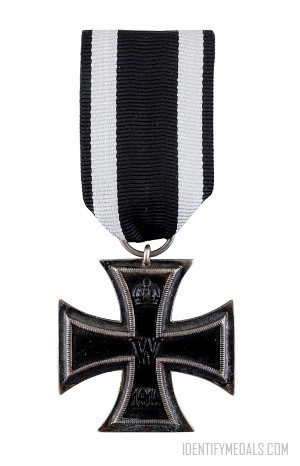
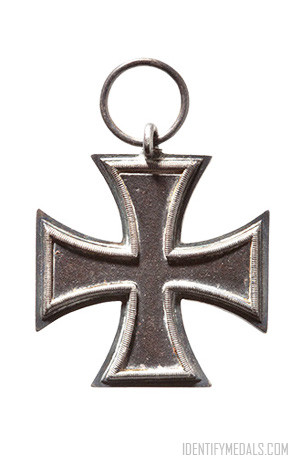
The Iron Cross (EK 1914)

The Iron Cross (Eisernes Kreuz or EK) is a military decoration established by King Friedrich Wilhelm III of Prussia in March 1813.
Time PeriodWorld War I
Institution: March 1813 (Iron Cross EK 1813)
Country: Germany

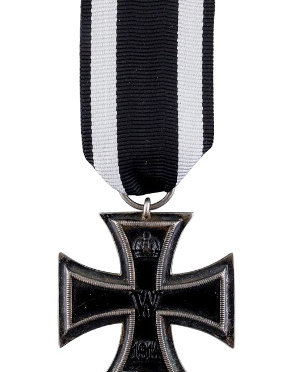
The Iron Cross (also known as Eisernes Kreuz or EK) is a military decoration established by King Friedrich Wilhelm III of Prussia in March 1813 normally awarded to military or to civilians for performing military functions.

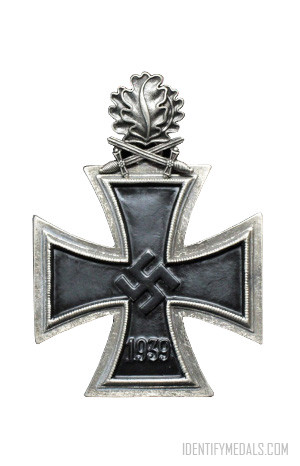
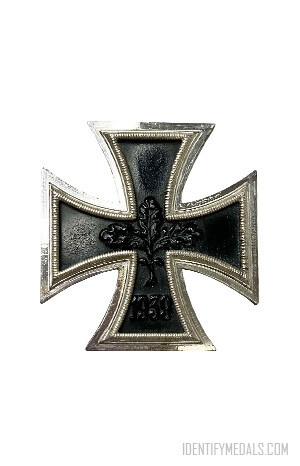
Friedrich’s late wife Queen Louise was the first person to receive (posthumously) this award. The recommissioned medal was awarded during the Franco-Prussian War (EK 1870), World War I (EK 1914), and World War II (EK 1939, re-introduced with a swastika added in the center).

Emperor Wilhelm II reauthorized the Iron Cross on 5 August 1914, at the start of World War I. The Grand Cross was intended for senior generals of the Prussian or (later) the German Army. The Iron Cross 1st Class and the Iron Cross 2nd Class were awarded without regard to rank. 

The Iron Cross 1914 Design

The design of the cross symbol is black with a white or silver outline, a derivation from the cross pattée of the Teutonic Order, which was sometimes used from the 13th century by knights.

The ribbon was black with two thin white bands, the colors of Prussia. The Iron Cross 1st Class employed a pin or screw posts on the back of the medal and was worn on the left side of the recipient’s uniform, like the original 1813 version. The Grand Cross was suspended from a neck ribbon and the 2nd Class from a ribbon on the chest.

During World War I, approximately 218,000 EKIs, 5,196,000 EKIIs and 13,000 non-combatant EKIIs were awarded.

What's the Meaning of The Iron Cross?

The Iron Cross held significant symbolism for the German armed forces and other German military personnel, as well as the nation as a whole.

It represented bravery, sacrifice, and loyalty to the Fatherland, serving as a powerful emblem of national pride and military prowess. You can learn more about the Iron Cross’ meaning here.

Iron Cross 1914 Recipients During WW1

Recipients of the Iron Cross were esteemed for their courage and dedication to the defense of Germany during World War I.

Here are ten famous individuals who received the Iron Cross EK 1914 during World War I:

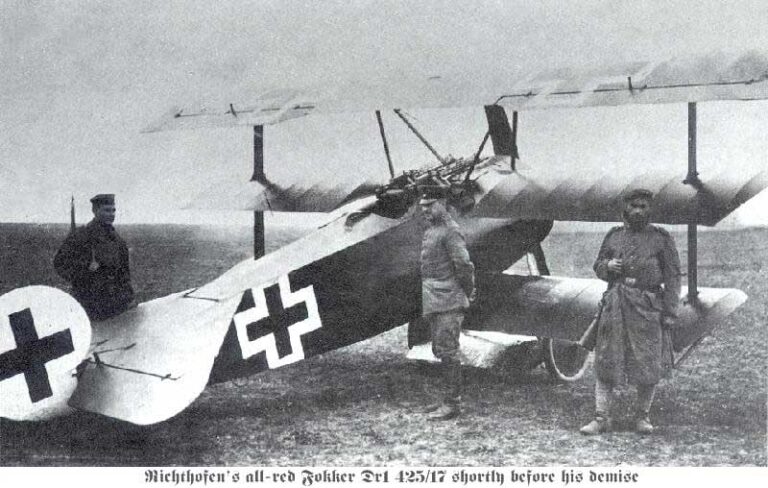
The red Fokker Dr1 of Manfred von Richthofen on the ground.
  1. Erwin Rommel – German field marshal: Rommel received the Iron Cross for his exceptional leadership and bravery during various battles, particularly in the Argonne Forest and at Caporetto.
  2. Manfred von Richthofen – German fighter pilot known as the “Red Baron”: Known as the “Red Baron,” Richthofen was awarded the Iron Cross for his remarkable success as a fighter pilot, credited with 80 aerial victories.
  3. Paul von Hindenburg – German military officer and later President of Germany: Hindenburg received the Iron Cross for his strategic brilliance in the Battle of Tannenberg, which resulted in a decisive victory over Russian forces.
  4. Hermann Göring – German politician and military leader: Göring earned the Iron Cross for his aerial combat achievements as a fighter pilot, including numerous successful engagements and his leadership of Jagdgeschwader 1.
  5. Ernst Jünger – German writer and soldier: Jünger was awarded the Iron Cross for his valor and resilience as an infantry officer, particularly noted in his memoir “Storm of Steel” which details his front-line experiences.
  6. Max Immelmann – German fighter pilot: Immelmann received the Iron Cross for his pioneering aerial combat tactics and his success as a fighter ace, with 15 confirmed kills.
  7. Erich Ludendorff – German general and politician: Ludendorff was awarded the Iron Cross for his critical role in various battles, including his strategic planning and execution during the Spring Offensive.
  8. Fritz Haber – German chemist and Nobel laureate: Haber received the Iron Cross for his contributions to the war effort, specifically his development of chemical weapons used during the conflict.
  9. Oswald Boelcke – German fighter pilot: Boelcke earned the Iron Cross for his extraordinary skills as a fighter pilot and his development of air combat tactics that became standard practice.
  10. August von Mackensen – German field marshal: Mackensen received the Iron Cross for his distinguished service as a field marshal, leading successful campaigns on the Eastern Front.

More Variations of the Iron Cross

The Iron Cross, a prestigious German military decoration, has undergone several variations since its inception. For example, the Iron Cross 1813 was instituted during the Napoleonic Wars by King Frederick William III of Prussia, the Iron Cross 1914 was awarded during World War I, it was reinstated by Kaiser Wilhelm II, and the Iron Cross 1939 was revived by Adolf Hitler for World War II, with modifications including a swastika.

Find the Iron Cross Medal Online

Right Now on eBay 
Clicking a link to eBay may result in a referral commission being paid if a purchase is made.
Loading...

Further Reading About the Iron Cross

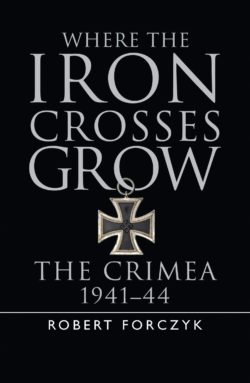
Discover the stories behind the Iron Cross with these compelling books and delve into the rich history and significance of this prestigious military decoration.

The Honor Cross of the World War 1914/1918 (Hindenburg Cross)

The Honour Cross of the World War 1914/1918 or Hindenburg Cross was established by Field Marshal Paul von Hindenburg after WW1.

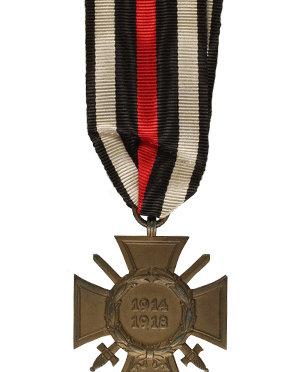
The Honour Cross of the World War 1914/1918 (or Das Ehrenkreuz des Weltkriegs 1914/1918 in german) was established by Field Marshal Paul von Hindenburg, President of the German Republic, in 1934. The medal is commonly and incorrectly known as the Hindenburg Cross, and it commemorates service of the German people during the First World War.

This was Germany’s first official service medal for soldiers of Imperial Germany who had taken part in the war.

The Honour Cross was awarded in three forms: With swords, for front-line veterans, without swords, for non-combatant veterans; and without swords for surviving widows and parents of fallen participants in the war.

The Honour Cross of the World War 1914/1918 Design

The medal awarded to combatants displays a laurel wreath encircling a medallion on the obverse, with the dates “1914 1918” and crossed swords between the arms. The reverse side is plain, and bears only the manufacturer’s logo.

The Honour Cross for non-combatants has no swords and a wreath of oak leaves, and both medals were made of bronze. A total of 8,041,414 medals were awarded.

The Wound Badge (1918)

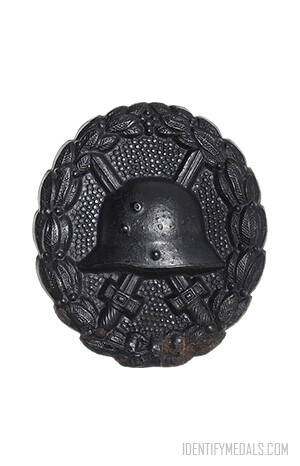
The Wound Badge (Verwundetenabzeichen) is a military decoration awarded to wounded or frostbitten soldiers during World War I.
The Wound Badge (or Verwundetenabzeichen in German) is a military decoration initially awarded to wounded or frostbitten soldiers of the Imperial German Army during World War I and first promulgated by Wilhelm II, German Emperor on 3 March 1918.

The badge was a tangible acknowledgment of the physical sacrifices made by soldiers. By awarding the Wound Badge, the German military aimed to honor those who had been injured while performing their duties on the battlefield.

Given the stringent criteria, obtaining a Wound Badge required the soldier to have been in active combat and sustained verifiable injuries directly from enemy action. For the higher classes of the badge (silver and gold), multiple wounds were required. Surviving and continuing to fight after receiving multiple serious injuries was a testament to the soldier’s resilience and the harsh conditions of the war.

The Wound Badge Classes and Criteria for Awarding

The badge had three classes:

  • Black (3rd class, representing Iron), awarded for those wounded once or twice by hostile action;
  • Silver (2nd class) for being wounded three or four times; and
  • Gold (1st class, could be awarded posthumously) for five or more times wounded.

To be eligible for the Wound Badge, a soldier had to sustain injuries in combat or as a result of hostile action. This included:

  • Gunshot wounds
  • Shrapnel injuries
  • Chemical burns from gas attacks
  • Severe frostbite injuries
  • Injuries from close combat

The injuries had to be verified and documented by medical personnel. This often involved official medical reports and the approval of the soldier’s commanding officer. The documentation process ensured that only genuine and significant injuries were recognized. When a severe wound occurred, such as loss of a limb or eyesight, the silver badge was awarded.

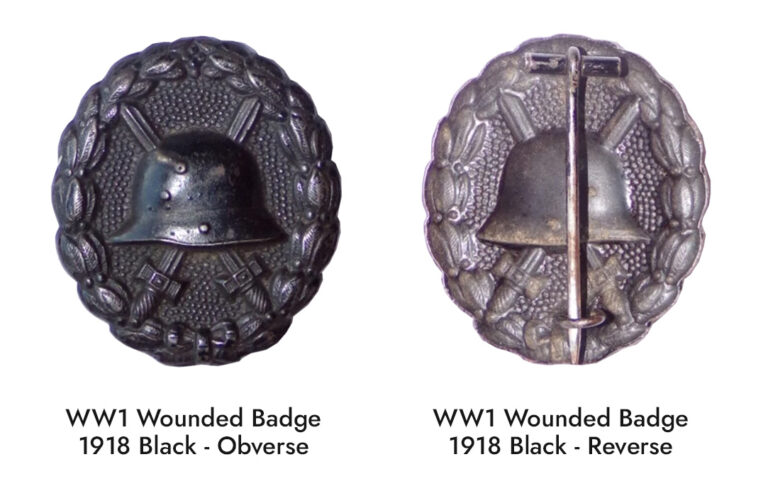
The obverse and reverse of the Black WW1 Wound Badge decoration.

The WW1 Wound Badge Design

All Wound Badges were made of pressed steel, brass and zinc, and were worn on the lower left breast of the uniform or tunic.

There were 24 approved manufacturers of the Wound Badge. The first Wound Badge is Black and was stamped from sheet brass, painted semi-matte black with a hollow reverse pin back attachment or of solid construction. From 1942 onwards, steel was used to make the badges (Wound Badge 1945). The Wound Badge in silver was made from silver-plated brass and/or lacquered zinc.

The Wound Badge in Gold was a gilded version of the Wound Badge in Silver. In 1957, a revised version of the Wound Badge was authorized for wear; however, the previous type could still be worn if the swastika were removed (for example by grinding).

Find this Decoration

Right Now on eBay 
Clicking a link to eBay may result in a referral commission being paid if a purchase is made.
Loading...