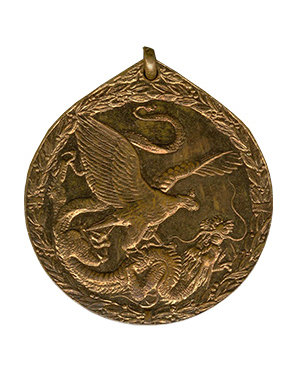
The China Medal (German Empire)

The China Medal is a medal of the German Empire established in 1901 by Kaiser Wilhelm II as King of Prussia and German Kaiser. 

The China Medal (or China-Denkmünze in German) is a medal of the German Empire established on 10 May 1901 by Kaiser Wilhelm II, in his capacity as King of Prussia and German Kaiser.

There were 14 medal clips awarded for involvement in battles.

The China Medal Design

There were two versions of the China Medal: one in bronze and a variant in steel. Both measure 32.7 mm in diameter.

The bronze medal was rewarded for service by German troops and civilians during the Boxer Rebellion. The steel medal was awarded to those contributing to the war effort at home and the sailors of the merchant fleet transporting the soldiers to China.

The initial design came from Wilhelm II himself and was executed by professor Walter Schott. The medals were produced by the company Mayer & Wilhelm in Stuttgart.

The Colonial Medal (German Empire)

The Colonial Medal is a medal of the German Empire established in 1912 by Kaiser Wilhelm II and awarded retroactively.

The Colonial Medal (or Kolonial-Denkmünze in German) is a medal of the German Empire established on 13 June 1912 by Kaiser Wilhelm II and awarded retroactively for participation in military operations in the German colonies.

There were some exceptions: Those who had participated in the Boxer Rebellion 1900-01, and German South-West Africa in the years 1904-08. These operations were eligible for their own unique commemorative medal.

The medal was awarded with claps which were manufactured of gold plated brass. Claps were mounted on the ribbon of the medal.

The Colonial Medal Design

The Colonial medal is made of bronze. The obverse depicts the right-facing bust of Wilhelm II in uniform, with the initials W II. The reverse shows oak leaves on the right and a laurel branch on the left. In the center is the imperial crown which sits above the inscription “DEN TAPFEREN STREITERN FÜR DEUTSCHLANDS EHRE” (“The brave warriors for Germany’s honor”).

The ribbon is white with four thin red lines in the center and black stripes on the edges.

The War Commemorative Medal of 1870/71

The War Commemorative Medal of 1870/71 was a campaign medal presented by Kaiser William I in his capacity as King of Prussia.

The War Commemorative Medal of 1870/71 (or Kriegsdenkmünze für die Feldzüge 1870–71 in German) is a campaign medal presented by Kaiser William I in his capacity as King of Prussia to commemorate service in the Franco Prussian War.

The medal was presented to members of the united German armies. For combat service the medal was bronze, and non-combat service was steel. Each version bore minor differences in inscription and design. The war medal was presented to officers, military physicians, civil servants and men of the German armies who took part in the Franco-Prussian war through 2 March 1871. It was also awarded to the crew of the SMS Augusta for service from 11 December 1870 to 2 March 1871.

Clasps were authorized on the 25th anniversary of the German victory, to commemorate selected battles. The clasps were only allowed to be worn on combatant medals by front line soldiers. They are 6 mm high and 32–39 mm wide and were made of gilt bronze or brass.

The War Commemorative Medal Design

The medal for combatants was manufactured from captured bronze cannon barrels.

The obverse shows the crowned Royal cypher of William I over the inscription Dem siegreichen Heere (To the victorious army). Inscribed around the edge is Gott war mit uns, Ihm sei die Ehre (God was with us, to Him be the glory).

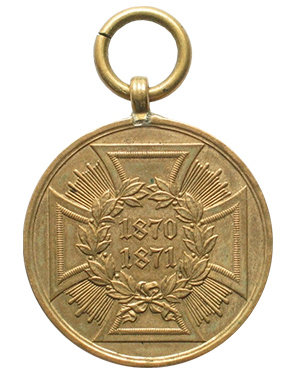
The reverse shows a cross with rays between the four arms. In the center of the cross is a laurel wreath surrounding the dates 1870 and 1871. On the edge of the coin is inscribed AUS EROBERTEM GESCHUETZ (From conquered cannon).

The medal for non-combatants is made of steel. It follows a similar design with only minor deviations. The center inscription on the obverse is Für Pflichttreue im Kriege (For devotion to duty in the war). On the reverse the wreath on the cross is of oak leaves.

The Warrior Merit Medal (Prussia)

The Warrior Merit Medal is a military decoration of Prussia established by Friedrich Wilhelm III and awarded primarily to troops.

  • Time Period: Pre-WW1
  • Institution: 1835
  • Country: Germany (Kingdom of Prussia)

The Warrior Merit Medal (or Krieger-Verdienstmedaille in German) is a military decoration of Prussia established by Friedrich Wilhelm III and awarded primarily to troops not in Prussian service.

The first recipients of the Warrior Merit Medal were members of the Imperial Guard grenadier company guarding the Russian imperial residence during Friedrich Whilhelm’s visit to St. Petersburg in 1835.

The Warrior Merit Medal Design

There are two versions of the Warrior Merit Medal. Both versions are circular and struck in silver, and measure 25 mm in diameter.

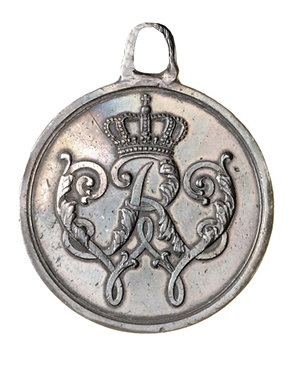
The first version depicts the crowned cypher of Friedrich Wilhelm III on the obverse of the medal. The reverse bears the inscription KRIEGER VERDIENST (Warrior Merit) surrounded by a wreath of two laurel sprigs, tied at its base with a bow. The medal is suspended by a ring suspension and hangs from the ribbon of the Order of the Red Eagle.

The later version of the medal depicts the crowned cipher of King Wilhelm I on the obverse. The reverse is also inscribed KRIEGER VERDIENST and surrounded by a thicker laurel wreath than the early version.

The medal is suspended by a ring and hangs from the black with white stripes kämpferband (combatants ribbon) or the white with black stripe nichtkämpferband (non-combatants ribbon).

The Merit Cross for War Aid

The Merit Cross for War Aid is a war decoration of Prussia awarded during World War I. The medal was instituted on 5 December 1916.

  • Time Period: Pre-WW1WW1
  • Institution: 5 December 1916
  • Country: Germany (Kingdom of Prussia)

The Merit Cross for War Aid (or Verdienstkreuz für Kriegshilfe in German) is a war decoration of Prussia awarded during World War I. The medal was instituted on 5 December 1916 and awarded for patriotic war aid service, without regard to status or rank.

An order was placed with the Nürnberg-based company Lauer as soon as Wilhelm II approved the floating sketch. Specimen crosses were submitted for imperial approval on December 26, 1915 and first 200 pieces were then ordered for immediate production and further distribution among distinguished Prussians. A special emphasis was made on luxury casing (brown leather boxes) for half of that lot reserved for dignitaries.

The very first recipients of Verdienstkreuz für Kriegshilfe were Wilhelm II himself and Generalfeldmarschall Paul von Hindenburg. Altogether 500,000 crosses and 167,643 m of ribbon worth 857,000 Marks were ordered.

The Merit Cross for War Aid Design

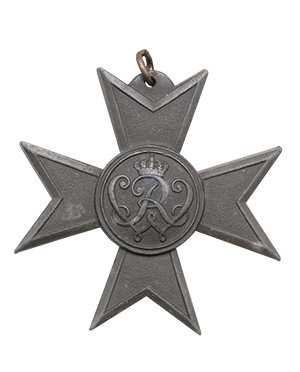
The Merit Cross for War Aid is in the shape of a Maltese cross, typically found made of blackened Kriegsmetall alloy.

The obverse of the Merit Cross for War Aid bears a circular central medallion with the crowned cipher of King Wilhelm II. On the reverse the central medallion is inscribed FÜR KRIEGS-HILFSDIENST (For War Aid Merit) above an oak wreath.

The upper arm is attached to a loop for suspension from its ribbon. The ribbon is red, white and black. Design of a new decoration was based on a Silver Merits Cross with an exception of central medallion on reverse (both sides of the latter were identical) and ribbon color.

The Military Honor Medal

The Military Honor Medal (Militär-Ehrenzeichen) is a military decoration awarded by the Kingdom of Prussia to military personnel.

  • Time Period: Pre-WW1
  • Institution: 1814
  • Country: Germany (Kingdom of Prussia)

The Military Honor Medal (or Militär-Ehrenzeichen in German) is a two-class military decoration awarded by the Kingdom of Prussia to military personnel from the rank of sergeant and below. The Military Honor Medal could also be awarded to foreign troops, an example being 52 awards to Russian soldiers for service in China in 1902.

The Military Honor Medal was typically awarded during wars when the Iron Cross was not. These conflicts included the wars of German Unification such as the Revolutions of 1848 in the German states, the Second Schleswig War in 1864, and the Austro-Prussian War in 1866. 

In 1864, King Wilhelm I reauthorized the Military Honor Medal for award with a redesign of the 1st class cross and a 2nd class medal. This new authorization also changed the criteria of the medal, meaning it was no longer necessary to be awarded the 2nd class medal before the 1st class cross.

The Military Honor Medal Design

The 1814 version shares the same design as the Honor Decoration, the only difference between the awards at that time was the color of ribbon suspending the cross.

The 1st class medal is struck in silver and measures 36 mm. The design is a cross pattée with a center medallion. The obverse of the medallion bore the inscription VERDIENST UM DEN STAAT (Merit for the State) in three lines, while the reverse bore the crowned cypher of Friedrich Wilhelm III. The 2nd class is a 39 mm circular silver medal also bearing the inscription VERDIENST UM DEN STAAT on its obverse, surrounded by a laurel wreath, with the reverse depicting a large crowned cypher of Friedrich Wilhelm III.

In 1830, the General Honor Decoration, 1st class, became the Fourth Class of the Order of the Red Eagle, with the medallion in the center of the cross being replaced by an enamelled insignia of the Order of the Red Eagle.

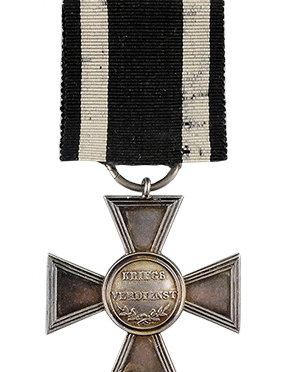
The 1st class cross from 1864 is still in the form of a silver cross pattée, but the obverse now bore the inscription KRIEGS VERDIENST (War Merit) above a spray of laurel leaves. The reverse bore the crowned cypher of King Wilhelm. The 2nd class medal was still in the form of a circular medal but also gained the updated obverse inscription KRIEGS VERDIENST, with its obverse bearing the crowned cypher of King Wilhelm.

The Military Merit Cross (Prussia)

The Military Merit Cross was the highest bravery award of the Kingdom of Prussia for non-commissioned officers and enlisted soldiers.

  • Time Period: Pre-WW1
  • Institution: February 27, 1864
  • Country: Germany (Kingdom of Prussia)

The Military Merit Cross (or Militär-Verdienstkreuz in German, also known as Golden Military Merit Cross or Goldenes Militär-Verdienstkreuz) was the highest bravery award of the Kingdom of Prussia for non-commissioned officers and enlisted soldiers.

The Military Merit Cross was founded by King Wilhelm I of Prussia on February 27, 1864 and originally reserved for those in the rank of Feldwebel (the highest NCO grade) and below. Eligibility was later extended to soldiers in the rank of Offizier-Stellvertreter, comparable to a warrant officer-type rank.

The first 16 awards were made for the Austro-Prussian War of 1866. No awards were made for the Franco-Prussian War of 1870-71. The next group of awards were 17 made in 1879 to Russian soldiers for bravery in the Russo-Turkish War of 1877-78. Only five more awards were made before World War I: four for colonial conflicts and one for the Boxer Rebellion.

The first Military Merit Cross was awarded in October 1916, followed by 54 more awards in 1917. Despite the much larger number of awards in 1918, the decoration remained extremely rare. Recipients received a monthly stipend, which was maintained even after the end of the Prussian monarchy in November 1918 through the Third Reich era.

The Military Merit Cross Design

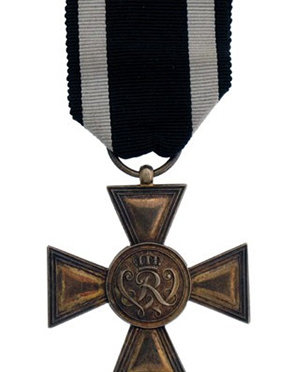
The design of the Military Merit Cross medal is a gold cross pattée with a center medallion. It measures 37.96 mm (wide) x 37.82 mm (high) and weighs 16.0 grams.

In the obverse is inscribed “Kriegsverdienst” (Military Merit). The reverse bears the crowned Royal Monogram of Wilhelm Rex.

The medal hangs from a double loop suspension.

The Iron Cross (EK 1813)

The Iron Cross (Eisernes Kreuz) is a military decoration of the Kingdom of Prussia and later the German Empire and Nazi Germany.

  • Time Period: Pre-WW1
  • Institution: March 1813
  • Country: Germany (Kingdom of Prussia)

The Iron Cross (or Eisernes Kreuz, EK, in German) is a military decoration of the Kingdom of Prussia (and later the German Empire 1871–1918 and Nazi Germany 1933–1945.

It was established by King Friedrich Wilhelm III of Prussia in March 1813 and backdated to the birthday of his late wife Queen Louise on 10 March 1813 during the Napoleonic Wars. Louise was the first person to receive this decoration (posthumous).

The Iron Cross was normally a military decoration only, though there were instances of it being awarded to civilians for performing military functions.

The Iron Cross Design

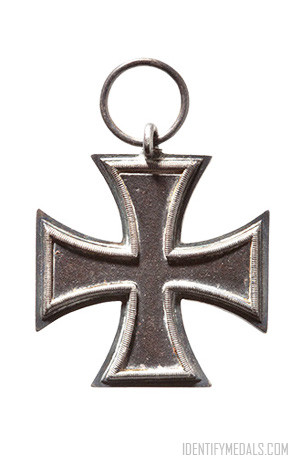
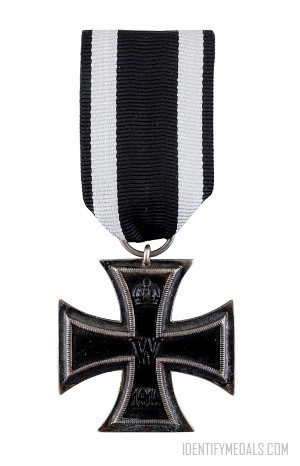
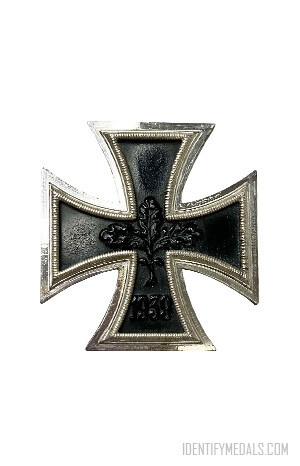
The design of the cross symbol is black with a white or silver outline, and was ultimately derived from the cross pattée of the Teutonic Order, used by knights on occasions from the 13th century.

It was designed by neoclassical architect Karl Friedrich Schinkel, based on a sketch by Frederick William. This heraldic cross took various forms throughout the order’s history, including a simple Latin cross, a cross potent, cross fleury and occasionally also a cross pattée.

The ribbon for the 1813 EK was black with two thin white bands, the colors of Prussia. The non-combatant version of this award had the same medal, but the black and white colors on the ribbon were reversed.

More Variations of the Iron Cross

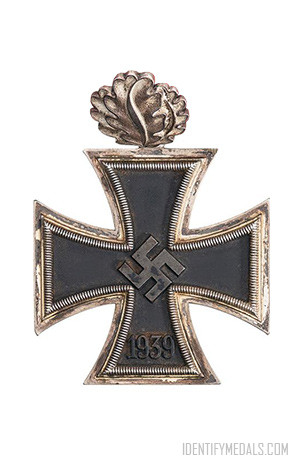
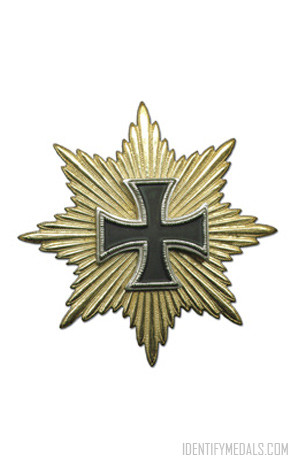
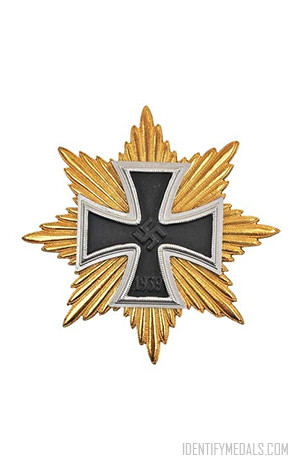
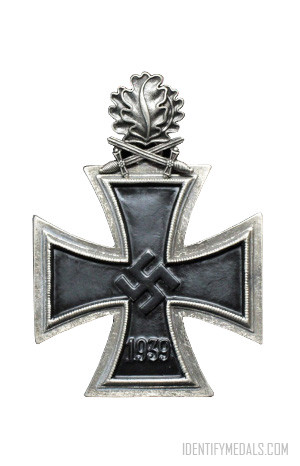
The Iron Cross, a prestigious German military decoration, has undergone several variations since its inception. For example, the Iron Cross 1813 was instituted during the Napoleonic Wars by King Frederick William III of Prussia, the Iron Cross 1914 was awarded during World War I, it was reinstated by Kaiser Wilhelm II, and the Iron Cross 1939 was revived by Adolf Hitler for World War II, with modifications including a swastika.

Find the Iron Cross Medal Online

Right Now on eBay 
Clicking a link to eBay may result in a referral commission being paid if a purchase is made.
Loading...

Further Reading About the Iron Cross

Discover the stories behind the Iron Cross with these compelling books and delve into the rich history and significance of this prestigious military decoration.

The Wilhelm Orden

The Wilhelm-Orden was instituted on 18 January 1896 by the German Emperor and King of Prussia Willhelm II as a high civilian award.

The Wilhelm-Orden (or “William-Order” in English) was instituted on 18 January 1896 by the German Emperor and King of Prussia Willhelm II as a high civilian award. The order was dedicated to the memory of his grandfather Emperor William I “the Great”.

The order was very exclusive. One of the first to be decorated was Otto von Bismarck.

The Wilhelm Order Design

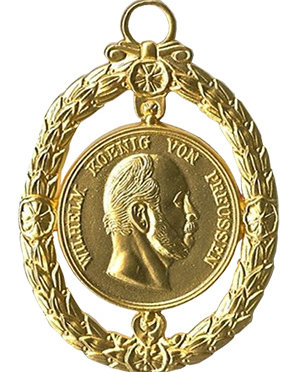
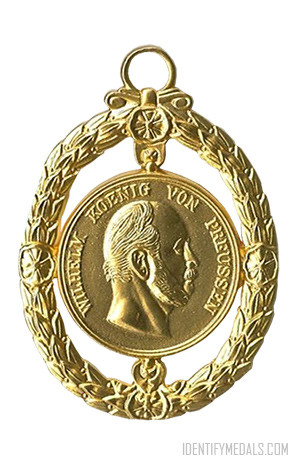
The insignia of the Order consists of a golden medal with the portrait of William I, surrounded by a golden wreath and suspended from a heavy golden collar. It was designed by the jewellers Emil Weigand en Otto Schultz.

The collar weights 222 grams and bears the words “WIRKE IM ANDENKEN AN KAISER WILHELM DEN GROSSEN” (“Work in the memory of Emperor William the Great”).

More Prussian Orders

Throughout Prussian history, these orders played a significant role in the social hierarchy and served as tangible expressions of royal favor and recognition. They continued to be awarded even after the dissolution of the Kingdom of Prussia, remaining as enduring symbols of valor, service, and honor in German society. Here are some more about Prussian Orders:

The Order of Louise

The Order of Louise was founded on 3 August 1814 by Frederick William III of Prussia to honor his late wife, the beloved Queen Louise.

The Order of Louise (or Luisen-Orden in German) was founded on 3 August 1814 by Frederick William III of Prussia to honor his late wife, the beloved Queen Louise. It was intended strictly for women whose service to Prussia was worthy of such high national recognition. Its dame companion members were limited to 100 in number, and were intended to be drawn from all classes.

The Chief of the Order of Louise was the reigning queen. Daughters in the royal family were invested with this order in lieu of the Order of the Black EagleOrder of the Red Eagle Grand Cross, Prussian Crown Order First Class, and Royal House Order of Hohenzollern that were reserved for the sons.

The Order of Louise was renewed with each successive monarch. At its initial creation in 1814, the Order was only available in one class. A second class was added during the reign of Wilhelm I.

The Order of Louise Design

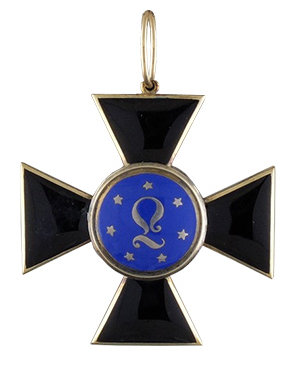
Dames, First Class, wore the black-enameled cross with its blue-enameled, medallion centerpiece, suspended from a predominantly white ribbon, with three black stripes, as tied in a bow. Though the statutes indicate that the badge was to be worn on the left breast, many period portraits show the members wearing the badge on or at the left shoulder of their dresses.

Dames, Second Class, wore a similarly-designed silver cross, minus the black enamel, which was also worn suspended from the white and black bow. The Prussian State Handbook of 1907 indicates further variants and subsets of the Second Class of the order: II.1 with silver crown, II.1 (without crown), and II.2.

More Prussian Orders

Throughout Prussian history, these orders played a significant role in the social hierarchy and served as tangible expressions of royal favor and recognition. They continued to be awarded even after the dissolution of the Kingdom of Prussia, remaining as enduring symbols of valor, service, and honor in German society. Here are some more about Prussian Orders: