The Royal Order of Victoria and Albert

The Royal Order of Victoria and Albert was a British Royal Family Order instituted in1862 by Queen Victoria and granted to female members.

The Royal Order of Victoria and Albert was a British Royal Family Order instituted on 10 February 1862 by Queen Victoria and only granted to female members of the British Royal Family and female courtiers. It was personally awarded by the Queen.

The honor conferred no rank or title upon the recipient, but recipients were entitled to use the post-nominal letters “VA”.

The order had four classes:

  • First Class
  • Second Class
  • Third Class
  • Fourth Class

No award was made after the death of Queen Victoria and the last holder of the Order, Princess Alice, Countess of Athlone (and the last surviving grandchild of the Queen), died in 1981.

The Royal Order of Victoria and Albert Design

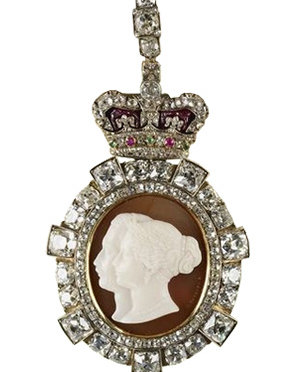
For the first three classes, the badge consisted of an upright oval onyx cameo of Queen Victoria and Albert, The Prince Consort, differing in the width and jewelling of the border as the classes descend, whilst the fourth substitutes a jeweled cipher. The badges of the First and Second Classes are set in diamonds and surmounted by an imperial crown. The badge of the Second Class is similar but smaller. The badge for the Third Class is set in pearls and that for the Fourth Class takes the form of a monogram “V&A” set with pearls.

All four were surmounted by a crown, which was attached to a bow of white silk moiré ribbon 38 millimeters in diameter. The bow was worn on the left shoulder.

The Order of the Star of India

The Most Exalted Order of the Star of India is an order of chivalry founded by Queen Victoria to honor Indian Princes who served in India. 

The Most Exalted Order of the Star of India is an order of chivalry founded by Queen Victoria in 1861 to honor Indian Princes and Chiefs, as well as British officers and administrators who served in India. Former viceroys and other high officials, as well as those who served in the Department of the Secretary of State for India at least thirty years were eligible for appointment. Rulers of Indian Princely States were also eligible.

The order is the fifth most senior British order of chivalry, following the Order of the GarterOrder of the ThistleOrder of St Patrick, and the Order of the Bath. With the death in 2009 of the last surviving knight, the Maharaja of Alwar, the order became dormant (but still exists). The British Sovereign was, and still is, Sovereign of the Order.

The Order included members of three classes:

  • Knight Grand Commander (GCSI)
  • Knight Commander (KCSI)
  • Companion (CSI)

The Order of the Star of India Design

The mantle was made of light blue satin lined with white silk and was worn only by Knights Grand Commanders. The collar was made of gold and was composed of alternating figures of lotuses, red and white roses, and palm branches, with an imperial crown in the center. It was worn only by Knights Grand Commanders over their military uniform, formal day dress, or evening wear.

The star featured a sunburst, with twenty-six large rays alternating with twenty-six small rays and worn only by Knights Grand Commanders and Knights Commanders. It was in gold and circular for Knights Grand Commanders, and in silver and eight-pointed for Knights Commanders. In the center of the sunburst was a light blue ring bearing the motto of the Order. Within the ribbon was a five-pointed star, decorated with diamonds for Knights Grand Commanders.

The badge was worn on a white-edged light blue riband, or sash, passing from the right shoulder to the left hip by Knights Grand Commanders, and by Knights Commanders and Companions from a white-edged light blue ribbon around the neck. It included an oval, containing the effigy of the Sovereign, surrounded by a light blue ring bearing the motto of the Order. The oval was suspended from a five-pointed star, which may be decorated with diamonds depending on the class.

The Order of St Michael and St George

The Order of Saint Michael and Saint George is an order of chivalry founded in 1818 in honor of military saints St. Michael and St. George.

The Most Distinguished Order of Saint Michael and Saint George is a British order of chivalry founded on 28 April 1818 in honor of two military saints, St. Michael the Archangel, and St. George, patron saint of England. The Order was established by George, Prince Regent (later King George IV) as acting as regent for his father, King George III.

The Order was originally awarded to those holding commands or high position in the Mediterranean territories acquired in the Napoleonic Wars. It was later extended to holders of similar office or position in other territories of the British Empire. Today, it’s awarded (or rather, people are appointed to it) to men and women who hold high office or who render extraordinary or important non-military service in a foreign country and can also be conferred for important or loyal service in relation to foreign and Commonwealth affairs.

The Order includes three classes:

  • Knight Grand Cross or Dame Grand Cross (GCMG)
  • Knight Commander (KCMG) or Dame Commander (DCMG)
  • Companion (CMG)

The Order of St Michael and St George Design

The mantle is made of Saxon blue satin lined with crimson silk and bound with two large tassels. It’s worn only by Knights and Dames Grand Cross. The collar is made of gold, with alternating crowned lions, Maltese Crosses, and the ciphers “SM” and “SG”. In the center are two winged lions, each holding a book and seven arrows. The collar is worn only by Knights and Dames Grand Cross.

The star is worn pinned to the left breast only by Knights and Dames Grand Cross and Knights and Dames Commanders. The Knight and Dame Grand Cross’ star includes seven-armed, silver-rayed ‘Maltese Asterisk’, with a gold ray in between each pair of arms. The Knight and Dame Commander’s star is a slightly smaller eight-pointed silver figure formed by two Maltese Crosses and no gold rays. In all cases, the star bears a red cross of St George with a dark blue ring bearing the motto of the Order and a representation of St Michael trampling on Satan.

The badge is used by all members of the Order and is suspended on a blue-crimson-blue ribbon. It’s a seven-armed, white-enameled ‘Maltese Asterisk’. Its obverse shows St Michael trampling on Satan, while its reverse shows St George on horseback killing a dragon, both within a dark blue ring bearing the motto of the Order.

The Royal Guelphic Order

The Royal Guelphic Order (or the Hanoverian Guelphic Order), is a Hanoverian order of chivalry instituted on 28 April 1815 by King George IV. 

The Royal Guelphic Order (or the Hanoverian Guelphic Order), is a Hanoverian order of chivalry instituted on 28 April 1815 by King George IV. It takes its name from the House of Guelph, of which the Hanoverians were a branch.

Because Hanover and the United Kingdom shared a monarch until 1837, the order was frequently bestowed upon British subjects, usually to officers in the British Navy and Army. However, it was still classed as a foreign order, with British members of the order not entitled to style themselves as “Sir”. When Hanover was annexed by the Kingdom of Prussia in 1866, the order continued as a house order of the Royal House of Hanover.

The Order includes two divisions: Civil and Military. From 1815 to 1841, the classes were:

  • Knight Grand Cross (GCH)
  • Knight Commander (KCH)
  • Knight (KH).

After 1841, the classes became:

  • Grand Cross
  • Commander 1st Class
  • Commander 2nd Class
  • Knight
  • Cross of Merit.

The Royal Guelphic Order Design

The collar chain is made in gold, with alternating lions and crowns linked by scrolled royal ciphers. The collar badge is an eight-pointed Maltese cross with balls on each point and a lion in each angle. The obverse bears, in the center, a white horse of Hanover on a red enamel background, surrounded by a blue enameled circle reading “NEC ASPERA TERRENT” (or “Difficulties do not terrify” in Latin). The reverse has the monogram GR in gold letters, surmounted by the British crown and surrounded by a gold circle with the date of institution inscribed: MDCCCXV. The Military Division is indicated by crossed swords on both the badge and star.

The star has rays grouped into eight points and shares the same design in the center as the badge. The ribbon measures 44 millimeters and is made of light blue watered silk.

The Order of St. Patrick

The Order of St. Patrick is a dormant British order of chivalry created in 1783 to reward the Irish during the American War of Independence.

The Order of St. Patrick (or The Most Illustrious Order of Saint Patrick) is a dormant British order of chivalry created in 1783 by George III to reward the loyalty of Irish peers during the American War of Independence. The knights of Saint Patrick lasted until 1922, when most of Ireland gained independence as the Irish Free State.

The patron of the Order is St Patrick, and its motto is “Quis separabit?” or “Who will separate [us]?” in Latin, an allusion to the Vulgate translation of Romans 8:35, “Who shall separate us from the love of Christ?

No knight of St Patrick has been created since 1936, and the last surviving knight, Prince Henry, Duke of Gloucester, died in 1974. The Queen, however, remains the Sovereign of the Order. Its equivalent in England is The Most Noble Order of the Garter, dating to the middle fourteenth century, and in Scotland it’s The Most Ancient and Most Noble Order of the Thistle, in its modern form to 1687.

The Order of St. Patrick Design

The star of the Order is an eight-pointed figure, with the four cardinal points longer than the intermediate points. Each point is a cluster of rays. In the center is the same motto, year, and the saltire cross of St Patrick in red enamel. The star was worn pinned to the left breast. The chain is made of gold and composed of six harps and six roses, the last alternating with white and red petals. The badge is pinned to the riband at the left hip. Made of gold, it depicts a shamrock bearing three crowns, on top of a cross of St Patrick and surrounded by a blue circle bearing the motto as well as the date of the Order’s foundation in Roman numerals (“MDCCLXXXIII“). The broad riband is a celestial blue sash worn across the body, from the right shoulder to the left hip.

For important occasions, such as Coronations, Knights of St Patrick wore elaborate vestments consisting of: The mantle, a celestial blue robe lined with white silk and a blue hood, the hat of the Order, changed from white satin to black velvet by George IV, plumed with three falls of feathers, one red, one white and one blue, and the collar, made of gold and consisting of Tudor roses and harps attached with knots and a central harp, from which the badge of the Order is suspended, surmounted by a crown.

Unlike the other two great orders, the sash is worn in the manner of the lesser orders, over the right shoulder.

The Order of the Thistle

The Order of the Thistle is an order of chivalry revived by King James VII of Scotland (James II) in 1687 and re-established in 1703.

The Order of the Thistle (or The Most Ancient and Most Noble Order of the Thistle) is an order of chivalry revived in 1687 by King James VII of Scotland (James II of England and Ireland). It’s believed the original Order dates back to 787 AD and alludes to .barefoot enemy soldiers who cried out when they trode on thistles, alerting the Scots of an imminent attack. The Order was re-established again by Queen Anne in December 1703.

It consists of the Sovereign and sixteen Knights and Ladies, as well as “extra” knights among which are members of the British Royal Family and foreign monarchs.

The Sovereign alone grants membership of the Order. The Order of the Thistle, which pertains to Scotland, is the second most senior in precedence in the United Kingdom. Its equivalent in England is The Most Noble Order of the Garter, dating to the middle fourteenth century. At death, the official insignia is returned to the Central Chancery.

The Order of the Thistle Design

The Order’s primary emblem is the thistle, the national flower of Scotland. Its motto is Nemo me impune lacessit (or “No one provokes me with impunity” in Latin).

The star of the Order is a silver St Andrew’s saltire, with clusters of rays between the arms thereof. In the center is depicted a green circle bearing the motto of the Order in gold; within the circle, there is depicted a thistle on a goldfield. The star is worn pinned to the left breast. The badge of the Order depicts St Andrew in the same form as the badge-appendant, surrounded by an oval collar bearing the Order’s motto, and surmounted by a gold cord fitted with a ring for suspension. There are examples of it in plain gold, or with enameling and set with jewels. 

For the Order’s great occasions, as well for coronations, the Knights and Ladies wear an elaborate costume consisting of: The mantle, a green robe worn over suits or military uniforms and lined with white taffeta, tied with green and gold tassels. The hat, made of black velvet and plumed with white feathers with a black egret’s or heron’s top in the middle, the collar, made of gold and depicting thistles and sprigs of rue, and the St Andrew, or badge-appendant, worn suspended from the collar.

The ribbon is plain dark green.

Find This Medal

Right Now on eBay 
Clicking a link to eBay may result in a referral commission being paid if a purchase is made.
Loading...

The Voluntary Medical Service Medal

The Voluntary Medical Service Medal is a medal instituted in 1932 by George V and awarded by the British Red Cross and St Andrew’s First Aid. 

The Voluntary Medical Service Medal is a medal instituted in 1932 at the direction of George V and awarded by the British Red Cross and St Andrew’s First Aid.

To qualify for the medal, a member has to accrue fifteen years’ continuous efficient service as a first aid volunteer in either the Red Cross or St Andrew’s. They also need to provide a minimum of ten hours field service per year.

The Voluntary Medical Service Medal Design

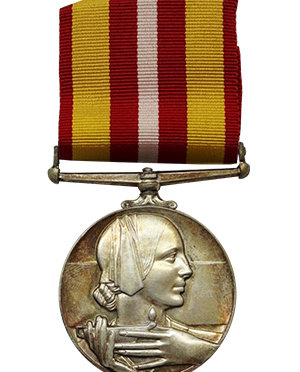
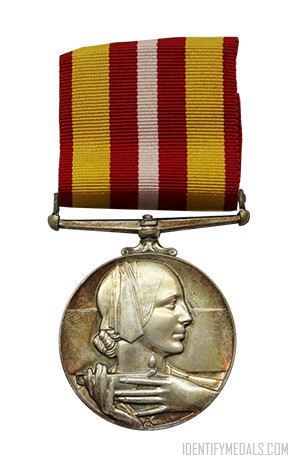
The medal measures 36 millimeters (1.4 inches) in diameter and was designed by Percy Metcalfe, an English artist sculptor and designer recognized mostly for his coin designs and his contribution to the Ashtead Pottery Collection.

The obverse of the medal bears a symbolic representation of Florence Nightingale carrying a lamp. The reverse features a design of both the Geneva and St Andrew’s crosses to denote the two qualifying organizations. Between the upper arms of the St Andrew’s Cross is the text “LONG AND EFFICIENT SERVICE”.

The medal was originally made of silver, later of silver plated copper, and since the 1960’s of copper-nickel. It is suspended from a straight swivel bar and hangs from a ribbon of red with yellow stripes at the edges and a thin white stripe in the centre. On the suspension ribbon of the medal, clasps embellished with the Geneva cross (St Andrew’s cross in Scotland) are worn to denote five additional years of qualifying service. Up to four silver-gilt emblems can replace the silver type to denote 25, 30, and 35 years of service in the applicable voluntary organisation.

Find Red Cross Medals Online

More Red Cross Medals

The British Red Cross Medal for Proficiency

Members of the Red Cross had to have three successive certificates in appropriate subjects (nursing, first aid, hygiene and sanitation).

Members of the Red Cross had to have three successive certificates in appropriate subjects (nursing, first aid, hygiene and sanitation) with an interval of at least 12 months between the dates of each certificate gained.

A proficiency badge was awarded after the third successful examination, and after the 4th and subsequent examinations the Red Cross members would be given proficiency bars. Each proficiency badge had the relevant subject on the ornamental brooch and a different ribbon for each subject.

The British Red Cross Society and the Order of St John formed the Joint War Organisation, offering extensive services for the sick and wounded, for prisoners of war, and for civilians needing relief as a result of enemy action, at home and abroad. The joint organization created ambulance departments for the transportation of the wounded, established convalescent homes and auxiliary hospitals, sometimes in private properties across the UK.

The British Red Cross Medal for Proficiency Badge Design

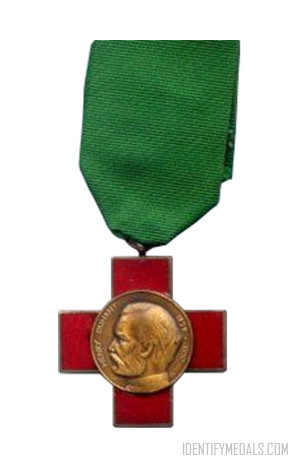
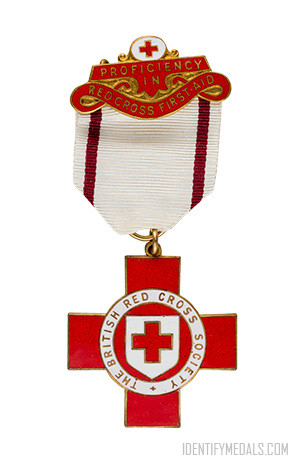
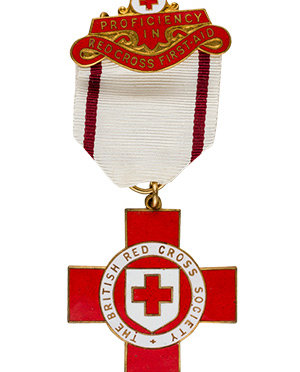
On the obverse of the medal is a red cross enamel medal with a central white shield and another red cross in the center surrounded by a circular white band with the following inscription in gold: “THE BRITISH RED CROSS SOCIETY”.

Suspended to the white with two thin purple striped ribbon is a metal clasp with inscription in gold on red enamel background “PROFICIENT IN RED CROSS FIRST AID” and a red cross on the white circular background.

On the reverse is engraved the ID and the full name of the person awarded the badge. The badge measures approximately 3.7”x 1.6” at its widest points.

Find Red Cross Medals Online

More Red Cross Medals

The Most Noble Order of the Garter

The Order of the Garter is an order of chivalry founded by Edward III in 1348 and regarded as the most prestigious British order of chivalry.

The Order of the Garter (also known as the “Most Noble Order of the Garter”) is an order of chivalry founded by Edward III in 1348 and regarded as the most prestigious British order of chivalry (though in precedence inferior to the military Victoria Cross and George Cross) in England and later the United Kingdom. It is dedicated to the image and arms of Saint George, England’s patron saint.

Membership of the Order is limited to the Sovereign, the Prince of Wales, and no more than 24 living members, or Companions. The order also includes supernumerary knights and ladies (for example, members of the British royal family and foreign monarchs). New appointments to the Order of the Garter are often announced on St George’s Day (23 April), as Saint George is the order’s patron saint.

In addition to the 25 Knights, there have been occasionally extra non-Christian Knights, such as the Sultans of Turkey or the Emperor of Japan. Emperor Hirohito was actually awarded the Garter twice: in 1922 and again in 1971 (he had forfeited the first as a result of Japan entering the Second World War in 1941). Soon after the founding of the Order, women were appointed “Ladies of the Garter“, but were not made companions. King Henry VII discontinued the practice in 1488; his mother, Margaret Beaufort, was the last Lady of the Garter before Queen Alexandra. Ladies (other than royalty) are now eligible for the Order.

All official insignia is returnable to the Central Chancery of Knighthood on the death of the holder.

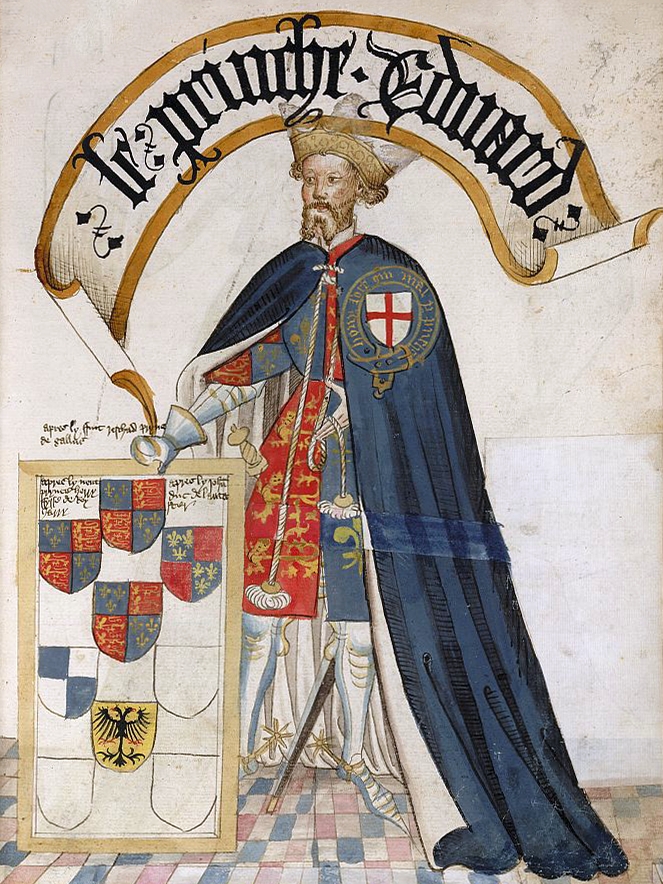
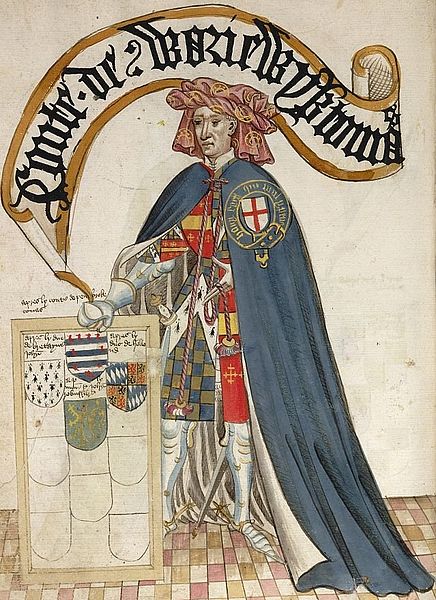
Edward, The Black Prince
Edward, The Black Prince.
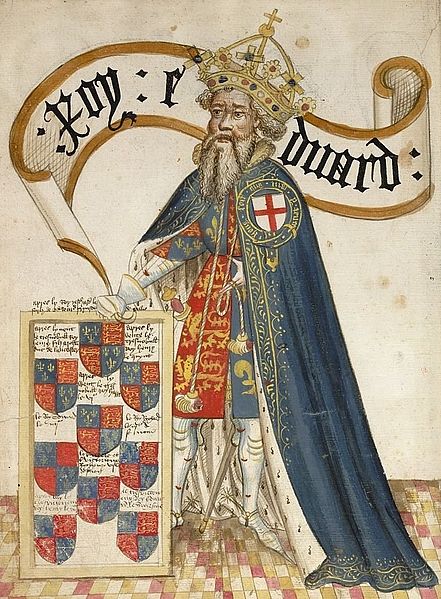
King Edward III
King Edward III.
The 11th Earl of Wawick
The 11th Earl of Wawick.

The Order of the Garter Design

The Star

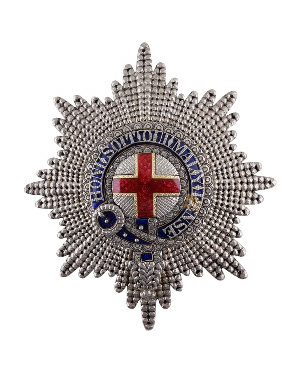
The star was originally embroidered in a metal thread and was introduced in the 17th century by King Charles I (before 1858, knights often purchased metal stars). It depicts the heraldic shield of St. George’s Cross, encircled by the Garter and the motto “HONI SOIT QUI MAL Y PENSE” (or “Evil be to who evil thinks“), which is itself encircled by an eight-point silver badge. Each point is depicted as a cluster of rays, with the four points of the cardinal directions longer than the intermediate ones. Since the Order of the Garter is the senior order of the United Kingdom, a member will wear their star above the others (up to three) that he or she holds.

The Ribbon

The ribbon measures 100 millimeters and is plain dark blue. It’s not worn in undress uniform.

The Emblem

The order’s emblem is a dark blue velvet garter with the motto “Honi soit qui mal y pense” (or “Shame on him who thinks ill of it” in Middle French) in embroidered lettering and details, or with gold lettering, buckle and tab. Members of the order wear it on ceremonial occasions. The collar chain is made of gold and consists of alternate buckled garters, each encircling a red enamelled rose. The collar badge is an enamelled three-dimensional figure of St. George the Martyr on horseback slaying a dragon.

If you want to learn more about the Order of the Garter’s mantle, hat, collar, Great George and garter, please check our sibling site Medieval Britain

More About The Order

Right Now on eBay 
Clicking a link to eBay may result in a referral commission being paid if a purchase is made.
Loading...

The Order of the Indian Empire

The Most Eminent Order of the Indian Empire is a British order of chivalry founded by Queen Victoria in 1878.

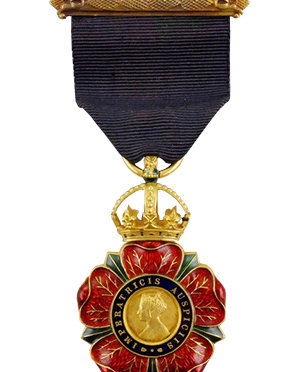
The Most Eminent Order of the Indian Empire is an order of chivalry founded by Queen Victoria in 1878. The motto of the Order is Imperatricis auspiciis, (Latin for “Under the auspices of the Empress“), a reference to Queen Victoria, the first Empress of India. The Order is the junior British order of chivalry associated with the British Indian Empire; the senior one is The Most Exalted Order of the Star of India.

The British founded the Order in 1878 to reward British and native officials who served in India. The Order originally had only one class (Companion), but expanded to comprise two classes in 1887. On 15 February 1887, the Order of the Indian Empire formally became “The Most Eminent Order of the Indian Empire” and was divided into two classes: Knights Commander and Companions, with the following first Knights Commander.

The British Sovereign serves as the Sovereign of the Order. The Grand Master held the next-most senior rank; the position was held, ex officio, by the Viceroy of India. Members of the first class were known as “Knights Grand Commanders” rather than “Knights Grand Cross” so as not to offend the non-Christian Indians appointed to the Order.

No appointments have been made since 1947, the year that India and Pakistan became independent from the British Raj. With the death of the last surviving knight, the Maharaja of Dhrangadhra, the order became dormant in 2010.

The Order of the Indian Empire Design

Members of the Order wore elaborate costumes on important ceremonial occasions:

  • The mantle, worn only by Knights Grand Commanders, comprised dark blue satin lined with white silk. On the left side was a representation of the star (see photo at right).
  • The collar, also worn only by Knights Grand Commanders, was made of gold. It was composed of alternating golden elephants, Indian roses and peacocks.

At less important occasions, simpler insignia were used:

  • The star, worn only by Knights Grand Commanders and Knights Commanders, had ten points, including rays of gold and silver for Knights Grand Commanders, and of plain silver for Knights Commanders. In the center was an image of Victoria surrounded by a dark blue ring with the motto and surmounted by a crown.
  • The badge was worn by Knights Grand Commanders on a dark blue riband, or sash, passing from the right shoulder to the left hip, and by Knights Commanders and Companions from a dark blue ribbon around the neck. It included a five-petaled crown-surmounted red flower, with the image of Victoria surrounded by a dark blue ring with the motto at the center.

The insignia of most other British chivalry orders incorporates a cross: the Order of the Indian Empire does not in deference to India’s non-Christian tradition.