The Air Force Cross and Medal (United Kingdom)

The Air Force Cross is a British military decoration awarded to officers for “acts of exemplary gallantry while flying against the enemy”

Time Period: WW1 The Great War
Year of Institution: 3 June 1918
Country: Great Britain

The Air Force Cross (or AFC) is a military decoration awarded to officers for “an act or acts of exemplary gallantry while flying, though not in active operations against the enemy“. Since 1993 it’s also given to other ranks, of the United Kingdom Armed Forces, and formerly also to officers of the other Commonwealth countries.

The award was established on 3 June 1918, shortly after the formation of the Royal Air Force (RAF). It was originally awarded to RAF commissioned officers and Warrant Officers, but was later expanded to include Royal Navy and army aviation officers. Recipients of the Air Force Cross are entitled to use the post-nominal letters “AFC”.

Between 1919 and 1932 the AFC was also awarded to civilians, on the same basis as for RAF personnel. The AFC had also been awarded by Commonwealth countries but by 1990’s most, including Canada, Australia, and New Zealand, had established their own honors systems and no longer recommended British honors.

The Air Force Cross and Medal Design

The Cross

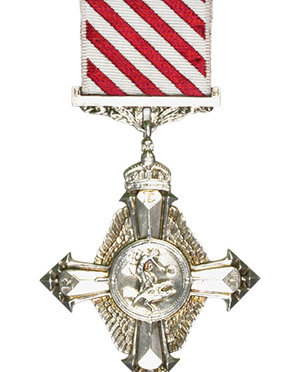
The Air Force Cross is a silver cross measuring 60 millimeters (2.4 in) in height and 54 millimeters (2.1 in) in width, representing aircraft propeller blades, with wings between the arms. It was design by Edward Carter Preston.

The obverse depicts Hermes, riding on the wings of a hawk holding a laurel wreath. At the top of the upper arm is the royal crown, while the other three arms bear the royal cipher of the reigning monarch at the time of issue. The reverse is plain, except for a central roundel bearing the reigning monarch’s cipher and the date ‘1918’. Originally awarded unnamed, from 1939 the year of issue was engraved on the reverse lower limb of cross, and since 1984 it has been awarded named to the recipient.

The suspender is straight and decorated with laurel wreaths. The ribbon bar denoting a further award is silver, with the Royal Air Force eagle in its centre. Bars awarded during World War II have the year of award engraved on the reverse. The 32 mm (1.25 inch) ribbon was originally white with red broad horizontal stripes, but changed in July 1919 to the current white with red broad diagonal stripes at a 45-degree angle.

The Medal

The Air Force Medal is an oval struck in silver and measures 42 mm tall and 32 mm wide. It has a laurel border and features, on the obverse, the sovereign’s effigy. The reverse Hermes mounted on a hawk bestowing a laurel wreath.

The medal is suspended by a pair of wings from a straight bar. The ribbon, originally with horizontal narrow stripes or white and crimson, changed in 1919 to diagonal ones of the same colors.

The Scottish Territorial Red Cross Brigade Badge

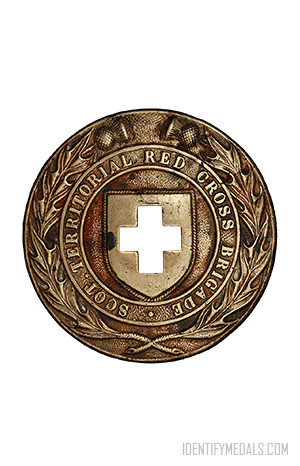
The Scottish Territorial Red Cross Brigade Badge is a WW1 cap badge made in brass-metal with a red felt backing to the central Geneva Cross.

The Scottish Territorial Red Cross Brigade Badge is a WW1 die-stamped cap badge to the Scottish Territorial Red Cross Brigade in brass metal with a red felt backing to the central Geneva Cross.

This organization was originally founded in 1908. The badge was approved by the War Office as the Scottish Branch of the British Red Cross Society and was intended as a formation of voluntary aid detachments for service in the event of war. It was only issued to registered members of detachments and had to be purchased by the member.

The Scottish Territorial Brigade was mobilized immediately after the proclamation of War in 1914. Sadly, there are no mentions of the Brigade after that – whether it changed name/structure – is not known. The Royal Scots (The Royal Regiment), once known as the Royal Regiment of Foot, was the oldest and most senior infantry regiment of the line of the British Army, having been raised in 1633 during the reign of Charles I of Scotland.

The Scottish Territorial Red Cross Brigade Badge Design

The Badge is made of brass with loops (lugs) and pin measuring 56mm in diameter. The back is red.

Find Red Cross Medals Online

More Red Cross Medals

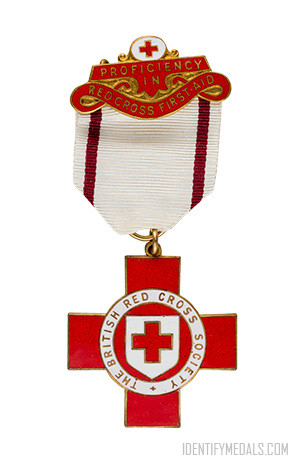
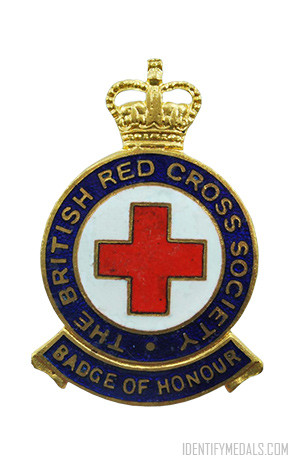
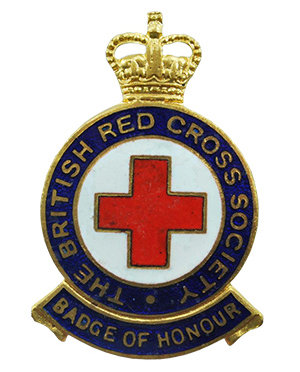
The British Red Cross Badge of Honor

The British Red Cross Badge of Honor was instituted in 1958 and given to people who show exceptional service to the British Red Cross.

The British Red Cross Badge of Honour was instituted in 1958. It’s an award badge given to people who show exceptional service to the British Red Cross.

The Badge has 3 classes:

  • Class 1 “Badge of Honour for Devoted Service”
  • Class 2 “Badge of Honour for Distinguished Service”
  • Class 3 “Queens Badge of Honour”

Badge of Honour for Devoted Service

The award is given to volunteers and staff who have given devoted service to the Society. The Badge is accompanied by a Certificate, which is signed by the Chairman of the Board. The criteria for this award will include the demonstration of service above and beyond the call of duty and actions showing the nominee’s personal involvement and commitment over a longer period of time, furthermore, the recipient’s actions should include devoted and consistent service, showing loyalty and dependability, as well as a certain amount of self-sacrifice and determination.

As a general rule, a minimum period of five years of service should have been completed before receiving this award. Exceptional circumstances may arise when it would be acceptable to make the award sooner.

Badge of Honour for Distinguished Service

The award is given to volunteers and staff for distinguished or exceptional service to the Society. The Badge is accompanied by a Certificate, which is signed by the Chairman of the Board. The recipient should have shown an element of self-sacrifice in time and effort, and should also have demonstrated the ability to initiate innovative ideas, maintain enthusiasm and expand training and service to the community.

Queen’s Badge of Honour

This award may be awarded to any person by the Trustees, with the approval of The President of the Society, His Royal Highness The Prince of Wales, for exceptional service of the highest order to the Society or to the International Red Cross and Red Crescent Movement. The award is accompanied by a certificate, which is signed by The President. The award is limited to thirty holders at any one time.

Find Red Cross Medals Online

More Red Cross Medals

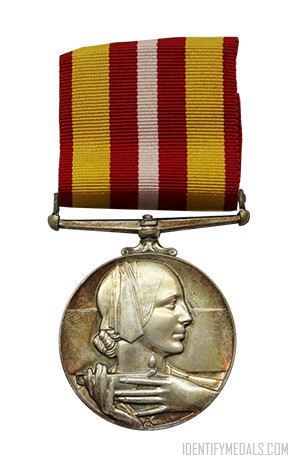
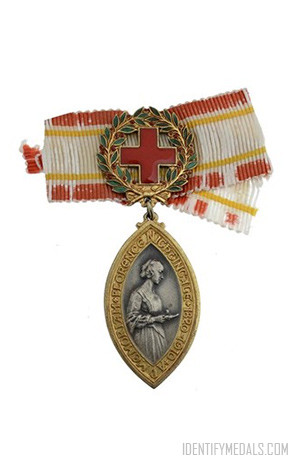
The Florence Nightingale Medal

The Florence Nightingale Medal was instituted in 1912 by the Red Cross as the highest distinction a nurse can achieve.

The Florence Nightingale Medal was instituted in 1912 by the International Committee of the Red Cross. It is the highest international distinction a nurse can achieve and is awarded to nurses or nursing aides for “exceptional courage and devotion to the wounded, sick or disabled or to civilian victims of a conflict or disaster” or “exemplary services or a creative and pioneering spirit in the areas of public health or nursing education“.

The assembled delegates of the Eighth International Conference of Red Cross Societies in London in 1907 decided to create a commemorative International Nightingale Medal to be awarded to those distinguished in the nursing field. It was initially set up to be awarded to six nurses annually, although the first 42 awards were only made in 1920 due to the disruption of the First World War. Among the first recipients were six American nurses: Florence Merriam JohnsonHelen Scott HayLinda K. MeirsMartha M. RussellMary E. Gladwin, and Alma E. Foerster.

The medal was restricted to female nurses until regulation changes in 1991. Under the new regulations, it is open to both women and men and is awarded every two years to a maximum number of fifty recipients worldwide. 

In 2007, the 41st set of medals were awarded to 35 recipients from 18 countries. In 2009, the 42nd set of medals were awarded to 28 recipients from 15 countries, including one for the first time to a nurse in Afghanistan. In 2011, the 43rd set of medals were awarded to 39 recipients from 19 countries, (including for the first time to two Kenyan nurses). In 2013, the 44th set of medals were awarded to 32 recipients from 16 countries, including one posthumously to a delegate from the British Red Cross. In 2015, the 45th set of medals were awarded to 36 recipients from 18 countries, including one posthumously to a Sierra Leonian nurse who had worked in an Ebola treatment center.

In 2017, the 46th set of medals were awarded to 39 recipients from 22 countries, including one to Rear Admiral Sylvia Trent-Adams, the Acting Surgeon General of the United States.

The medal and a diploma are usually presented by the Head of State at a ceremony in their own country, which is required to have “a formal character, in keeping with the founders’ wishes“.

The Florence Nightingale Medal Design

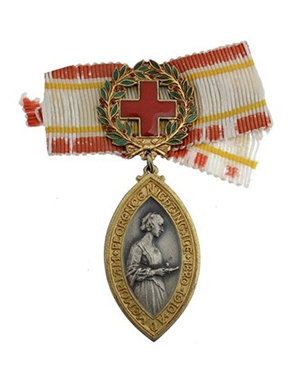
The vesica piscis-shaped medal is composed of gold and silver-gilt and bears, on the obverse, a portrait of Florence Nightingale surrounded by the words ‘Ad memoriam Florence Nightingale 1820-1910‘.

On the reverse, the name of the recipient and the date of the award are engraved, surrounded by the inscription ‘Pro vera misericordia et cara humanitate perennis décor universalis‘ (‘true and loving humanitarianism – a lasting general propriety‘).

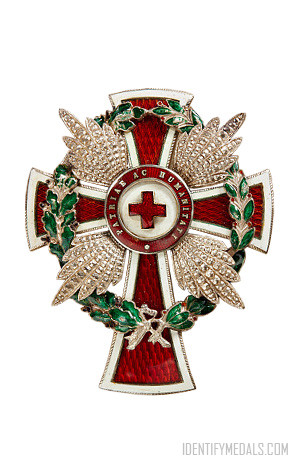
The medal is attached to a white and red ribbon by a clasp featuring a red enamel cross encircled by a green laurel crown.

Recipients are also presented with a parchment diploma of the award and, from 1927, a miniature version of the medal that could be more easily worn. 

Find Red Cross Medals Online

More Red Cross Medals

The George Cross (Great Britain)

The George Cross is the second highest award of the UK honors system and it’s awarded for acts of the greatest heroism or courage.

The George Cross (also known as GC) is the second highest award of the United Kingdom honors system and it’s awarded “for acts of the greatest heroism or for most conspicuous courage in circumstance of extreme danger“, not in the presence of the enemy, to members of the British armed forces and to British civilians.

The medal may be awarded to a person of any military rank in any service and to civilians including police, emergency services and merchant seamen. Many of the awards have been personally presented by the British monarch to both recipients and in the case of posthumous awards to next of kin. These investitures are usually held at Buckingham Palace.

The George Cross was instituted on 24 September 1940 by King George VI. At this time, during the height of the Blitz, there was a strong desire to reward the many acts of civilian courage. The existing awards open to civilians were not judged suitable to meet the new situation, therefore it was decided that the George Cross and the George Medal would be instituted to recognize both civilian gallantry in the face of enemy action and brave deeds more generally.

Posthumous awards have been allowed since it was instituted.

The George Cross Criteria

The George Cross is awarded for acts of the greatest heroism or the most conspicuous courage in circumstances of extreme danger. It is intended to recognize acts that exemplify selfless bravery

It can be awarded to both military personnel and civilians and is the highest gallantry award for civilians, as well as for military personnel in situations where military honors would not typically be granted. The GC may also be awarded posthumously.

The cross has been awarded to several foreigners for their acts of exceptional bravery. Examples include:

  1. Malta: Awarded to the entire island of Malta in 1942 for the collective bravery of its citizens during sustained aerial bombardment in World War II.
  2. Rustum Sohrabji Ghandhi: An Indian naval officer awarded in 1952 for his gallantry during a rescue operation.
  3. Michael Pratt: An Australian police officer awarded in 1978 for his actions during a bank robbery.

The George Cross Design

The medal was designed by Percy Metcalfe. The Warrant for the GC (along with that of the George Medal), dated 24 September 1940, was published in The London Gazette on 31 January 1941.

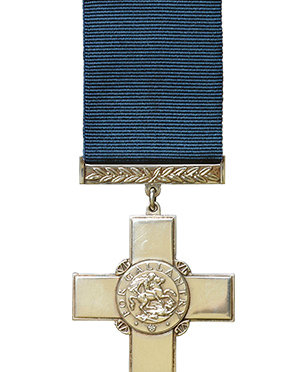
It measures 48 mm in height, with a maximum width of 45 mm. The obverse is a plain silver cross with circular medallion in the center depicting the effigy of St. George and the Dragon, surrounded by the words “FOR GALLANTRY“. In the angle of each limb is the Royal Cypher GVI.

The reverse is plain, with a center engraved with the name of recipient and date of award. The cross is attached by ring to bar ornamented with laurel leaves, through which the ribbon passes.

Find a George Cross

Right Now on eBay 
Clicking a link to eBay may result in a referral commission being paid if a purchase is made.
Loading...

The Operational Service Medal Iraq and Syria

The Operational Service Medal Iraq and Syria is a British armed forces campaign medal awarded mostly to military personnel.

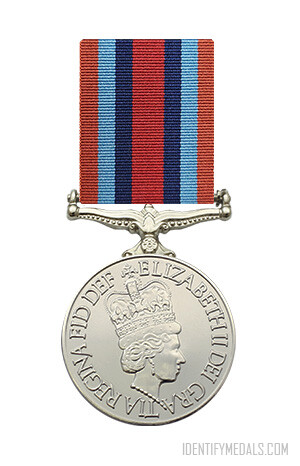
The Operational Service Medal Iraq and Syria (also known as Operation Shader Medal) is a British armed forces campaign medal awarded mostly to military personnel who served in the operational area of, or in support of Operation Shader.

The Operational Service Medal (Iraq and Syria) was first announced by former Defence Secretary, Sir Michael Fallon on 19 September 2017 and was first awarded in July 2018 in London by Defence Secretary Gavin Williamson. The medal is awarded either for 30 days continuous, or 45 days cumulative, service in theatre.

The Operational Service Medal Iraq and Syria Qualifying Criteria

This Operational Service Medal is the first to be awarded to individuals who served outside of the operational area, reflecting the changing nature of warfare. The Operational Service Medal (OSM) was established in 1999 to replace the General Service Medal (1962) for all new operations.

Clasp: Iraq & Syria clasp awarded to those recipients who served in the operational area. A silver rosette denotes the clasp when worn on the ribbon bar.

The Operational Service Medal Iraq and Syria Design

The Operational Service Medal for Iraq and Syria is struck in silver and circular in shape.

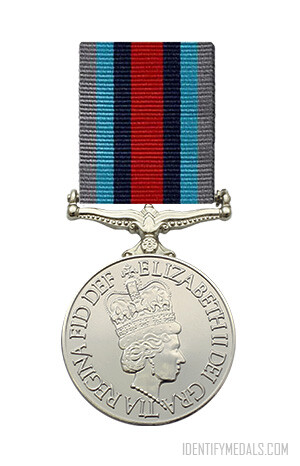
The obverse shows the crowned effigy of Queen Elizabeth II with the inscription ELIZABETH II DEI GRATIA REGINA FID. DEF. 

The reverse displays the Union Flag, surrounded by the inscription FOR OPERATIONAL SERVICE and the four major points of the compass with, between the points, four Coronets: Royal (top left), Naval (top right), Mural-Army (bottom left), and Astral-Royal Air Force (bottom right).

The ribbon is a broad central red stripe, flanked each side by a stripe of navy blue and one of light blue, to represent the three services, with an outer stripe of grey.

The General Service Medal Variants

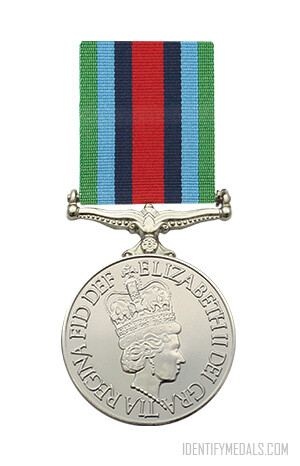
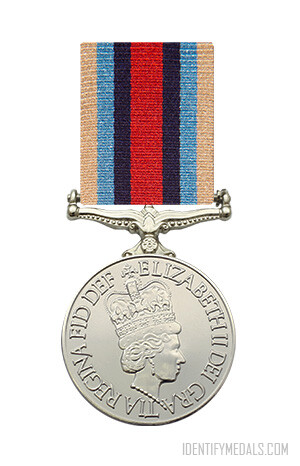
The OSM has been awarded for four separate campaigns, each with a distinctive ribbon. The other three are:

Buy an OSM Medal Online

Right Now on eBay 
Clicking a link to eBay may result in a referral commission being paid if a purchase is made.
Loading...

The Ebola Medal for Service in West Africa

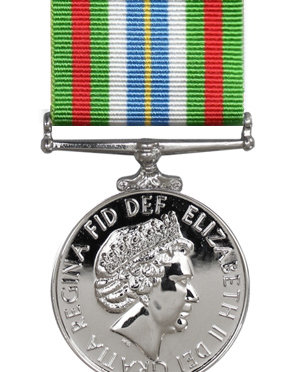
The Ebola Medal for Service in West Africa (also known simply as the Ebola Medal) is a service medal issued to the Armed Forces and to civilians, working either for Her Majesty’s Government or for non-governmental organisations, in support of the British Government’s response to the Ebola crisis in West Africa between March 2014 and March 2016.

The medal is the first medal awarded by the UK Government for a humanitarian crisis response.

The medal is awarded either for 21 days of continuous service within the operating area, or 30 days accumulated service on working visits of 48 hours or more to the operating area. The following groups are eligible for award:

  • Military personnel under the command of Commander, Joint Operations, and other members of UK Armed Forces providing direct support to HM Government’s response.
  • Any volunteer or employee directly deployed by the Department for International Development (DFID), UK-Med, Public Health England, the National Health Service or the Stabilisation Unit in support of HM Government’s response.
  • Any member of Her Majesty’s Civil Service.
  • Any UK national employed by an NGO funded by the DFID supporting HM Government’s response.
  • Any UK national responding to the Ebola crisis in support of HM Government’s response whose service can be verified.

The Ebola Medal for Service Design

The medal is circular, struck in nickel-silver and manufactured by Worcestershire Medal Service. It measures  36mm diameter and is suspended from a ribbon by way of a swivel straight bar.

The obverse was designed by Ian Rank-Broadley, has the legend “ELIZABETH II DEI GRATIA REGINA FID.DEF.” and the effigy of Elizabeth II wearing the Girls of Great Britain and Ireland tiara.

The reverse is designed by John Bergdahl, and features a flame on a background depicting the Ebola virus – above this are the words “For Service” and below “West Africa Ebola Epidemic”.

The name of the recipient (name and title if civilian; name, rank and serial number if military) is engraved on the rim of the medal.

The ribbon is a central yellow stripe, flanked by blue and white stripes, and symmetrical red stripes flanked by green stripes either side. These represent the colours from the national flags of the countries in West Africa affected by Ebola.

The Civilian Service Medal (Afghanistan)

The Civilian Service Medal (Afghanistan) is a medal awarded by the British government to civilians (and members of the UK Armed Forces in certain non-combat roles) to recognize service since 19 November 2001 in the transition to democracy in Afghanistan.

The medal can be awarded to:

  • Crown servants, whether recruited in the United Kingdom, Afghanistan or elsewhere;
  • who have served in the geographical territory of Afghanistan on or after 19 November 2001, for 30 days continuously, or 45 days aggregated;
  • No minimum qualifying period for those killed, captured, wounded or disabled during service;
  • The medal was not awarded to those eligible for the Operational Service Medal for Afghanistan.
  • Locally employed civilians were not eligible.

The Civilian Service Medal Design

The Civilian Service Medal (Afghanistan) is circular and measures 36.07 mm in diameter and 4 mm thick. It’s struck in cupro-nickel with a rhodium plating/coating.

On the obverse, the medal has the Ian Rank-Broadley effigy of Queen Elizabeth II with the wording ELIZABETH II DEI GRATIA REGINA FID DEF.

On the reverse, there’s an Afghanistan mountain scene with the word Afghanistan written in Latin and Arabic lettering. The recipient’s name is inscribed on the rim.

  • The medal has a plain, straight suspender. The 32 millimeter-wide ribbon is sand-colored with a broad green central stripe and narrow pale grey stripes towards each edge. The ribbon is the same as for the Iraq Reconstruction Service Medal but with grey, rather than blue thin stripes.

The Iraq Reconstruction Service Medal

Time Period: Post-WW2
Year of Institution: 26 June 2004
Country: Great Britain

The Iraq Reconstruction Service Medal is a British service medal awarded to civilian public servants, contractors and consultants, and to members of the Armed Forces working with British Government Departments, who were either appointed, deployed or employed by Her Majesty’s Government (HMG) to work in Iraq, and who had served at least 40 days. The medal is distributed by the Foreign and Commonwealth Office.

The Iraq Reconstruction Service Medal was not awarded for service that also qualified for the Iraq military (campaign) Medal, although both medals could be awarded for different periods and types of service.

There are no clasps for this medal.

The Iraq Reconstruction Service Medal Design

The medal is circular, made of plated cupro-nickel and produced by the Royal Mint. It measures 36 mm in diameter.

The obverse has the Ian Rank-Broadley effigy of Elizabeth II, with the legend “ELIZABETH II DEI GRATIA REGINA FID.DEF.”

On the reverse are cuneiform symbols which can be roughly translated as “land bringing forth life”, with the stylized depiction of two rivers, based on a relief carving from Mesopotamia in the British Museum. Below is the word “IRAQ”.

The recipient’s name is inscribed on rim of the medal. The ribbon is 32 mm wide and sand-colored with a broad green central stripe and narrow blue stripes towards each edge.

The Iraq Medal

The Iraq Medal is a campaign medal issued to members of the British Armed Forces and certain attached personnel who served between 20 January 2003 and 22 May 2011 on, or in support of, Operation Telic.

The Iraq Medal is a campaign medal issued to members of the British Armed Forces and certain attached personnel who served between 20 January 2003 and 22 May 2011 on, or in support of, Operation Telic – the designation for British operations during the 2003 Invasion of Iraq and its aftermath. It was authorized on 23 February 2004.

The medal was awarded to those meeting the qualifying period of service within the defined operational area. Eligibility was extensive, and included both Regular and Reserve members of the armed forces, foreign and Commonwealth exchange and attached forces, Ministry of Defence civilians, members of the Royal Fleet Auxiliary and embedded journalists.

The medal was awarded with the clasp “19 Mar to 28 Apr 2003″ to British service and attached personnel who:

  • served in Zone 1 (Iraq) between 19 March and 28 April 2003, and:
  • completed seven days continuous service; or
  • served as aircrew flying into Iraq and who completed two or more operational sorties.

A silver rosette denotes the clasp when worn on the ribbon bar.

The Iraq Medal Design

The Iraq Medal is made of cupro-nickel and measures 36 millimeters (1.4 in) in diameter.

The obverse shows the crowned effigy of Queen Elizabeth II facing right, with the inscription ELIZABETH II DEI GRATIA REGINA FID DEF. The reverse shows an image of a Lamassu (an ancient Assyrian statue) above the word IRAQ.

The ribbon measures 32 millimeter (1.25 in) wide and is sand color with three narrow central stripes of black, white, red representing the Iraqi flag.

Find This Medal

Right Now on eBay 
Clicking a link to eBay may result in a referral commission being paid if a purchase is made.
Loading...