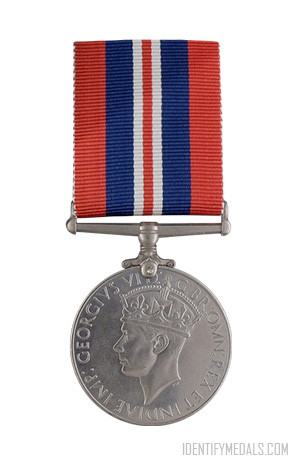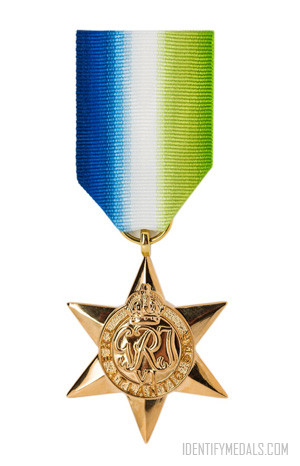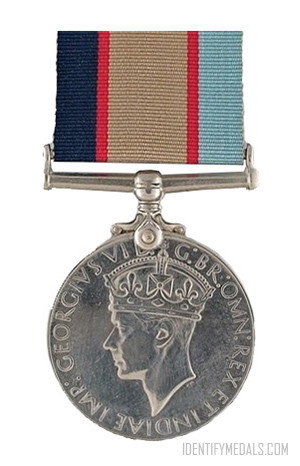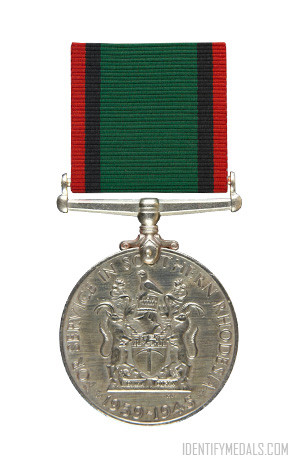
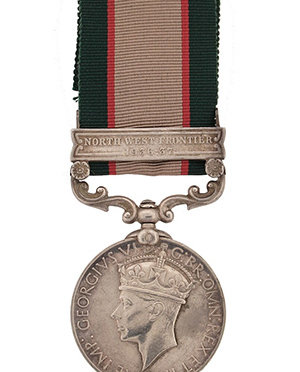
The India General Service Medal (1936)

The Indian General Service Medal is a British campaign medal issued to officers and men of the British and Indian armies.

The Indian General Service Medal (also known as 1936 IGSM) is a British campaign medal issued to officers and men of the British and Indian armies, and of the Royal Air Force approved on 3 August 1938.

The 1936 IGSM was awarded for minor military campaigns on the North-West Frontier of India between 1936 to 1939. Two campaigns / clasps were sanctioned, both relating to operations in Waziristan:

  • The North West Frontier 1936–37 Clasp
  • The North West Frontier 1937–39 Clasp

The Indian General Service Medal 1937-1939 clasp was only struck and distributed after the Second World War. Recipients of a Mention in Dispatches were entitled to wear an oak leaf emblem on the ribbon.

The Indian General Service Medal Design

The medal was struck at the Calcutta mint for Indian forces and London mint for British forces. The claw mount attaching the medal disc to the suspension is different in the two medals, the Calcutta Mint version has a plain curved style, and the London made medals are of a more elaborate raised scroll type.

The ribbon is 32mm, grey flanked by narrow red stripes, with broad green stripes at the edges.

Following the grant of Indian Independence in 1947 the medal became obsolete, although it could still to be worn in uniform by British, Indian and Pakistani servicemen.
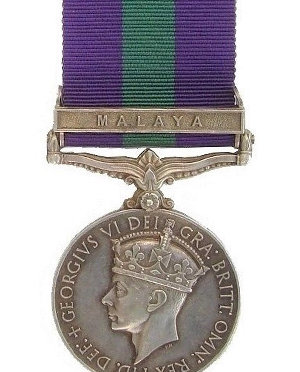
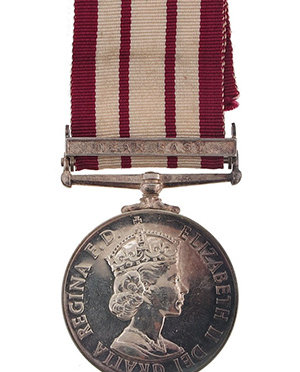
The General Service Medal (1918)

The General Service Medal recognizes service in minor Army and Royal Air Force operations for which no separate medal was possible.

The General Service Medal (also known as 1918 GSM) recognizes service in minor Army and Royal Air Force operations for which no separate medal was possible. Local forces such as police qualified for many of the clasps, as could units of the Indian Army prior to 1947.

The General Service Medal was equivalent to the 1915 Naval General Service Medal. Both these medals were replaced by the GSM in 1962.

The General Service Medal 1918 Design

The 1918 General Service Medal is a circular silver medal. The obverse bears the crowned effigy of the reigning monarch. The reverse shows a standing winged figure of Victory in a Corinthian helmet and carrying a trident, also bestowing a wreath on the emblems of the Army (the sword) and the RAF (the wings).

A bronze oak leaf emblem is worn on the ribbon of the medal to signify a mention in dispatches for a campaign for which the General Service Medal was awarded.

Eighteen clasps were approved for the 1918 General Service Medal. They consist of small metal bars into which the name of the relevant campaign or theatre of operations was molded. The clasps were: South Persia, Kurdistan, Iraq, NW Persia, Southern Desert Iraq, North Kurdistan, Palestine, S.E. Asia 1945–46, Bomb and Mine Clearance 1945–49 and 1949-56, Palestine 1945–48, Berlin Airlift, Malaya, Canal Zone, Cyprus, Near East, Arabian Peninsula and Bruinei.

The 1918 General Service Medal was never awarded without a clasp.

The Naval General Service Medal (1915)

The Naval General Service Medal is a British military medal instituted in 1915 to recognize service by the Royal Navy and Royal Marines.

The Naval General Service Medal (also known as 1915 NGSM) is a British military medal instituted in 1915 to recognize service by the Royal Navy and Royal Marines in minor campaigns that would not otherwise earn a specific campaign medal. The Army/Air Force equivalent was the General Service Medal (1918). Both these medals were replaced by the General Service Medal in 1962.

The Naval General Service Medal Design

The medal is made of silver and measures 36 millimeters (1.4 in) in diameter. The obverse bears the image of one of three successive Sovereigns, King George VKing George VI and Queen Elizabeth IIThe reverse shows a mounted figure of Britannia in a chariot pulled by two sea-horses, her left hand resting on a union shield.

The 32 millimeters (1.3 in) wide ribbon is crimson-colored with three white stripes. From 1920 a bronze oak leaf emblem was also worn on the ribbon of the medal to signify a mention in dispatches for a campaign for which the NGSM was awarded.

The 1915 NGSM was never awarded without a clasp. These are the seventeen clasps that were authorized: Persian Gulf 1909–1914, Iraq 1919–1920, N.W. Persia 1920, Palestine 1936–39, S.E. Asia 1945-46, Minesweeping 1945–51, Palestine 1945–48, Malaya, Yangtze 1949, Bomb and Mine Clearance 1945–46, Bomb and Mine Clearance 1945–53, B & M Clearance Mediterranean, Canal Zone, Cyprus, Near East, Arabian Peninsula and Brunei.

The Transport Medal

The Transport Medal was a campaign medal awarded by the Lord Commissioners of the Admiralty to masters and officers of merchant ships.

Time Period: Pre-WW1
Year of Institution: 8 November 1903
Country: Great Britain

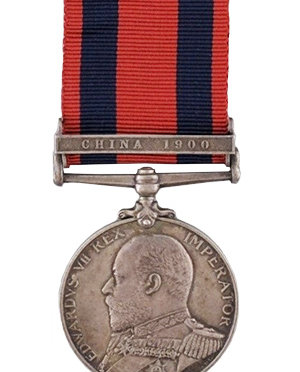
The Transport Medal was a British campaign medal awarded by the Lord Commissioners of the Admiralty to masters and officers of merchant ships employed by the Transport Service to move troops to either South Africa during the South African War or to China during the Boxer Rebellion.  The Transport Medal was created on 8 November 1903 and officers of hospital ships used in the campaigns also qualified.

It was intended that the medal would be awarded for future conflicts, but was not awarded again after the South Africa and China wars.

The Transport Medal Design

The obverse of the medal bears the head of King Edward VII in Royal Navy uniform, with the inscription EDWARDVS VII REX IMPERATOR. The reverse depicts HMS Ophir beneath a map of the world with, below, the words in Latin OB PATRIAM MILITIBUS PER MARE TRANSVECTIS ADJUTAM which translates as for services rendered in transporting troops by sea.

Two clasps were awarded: S.AFRICA 1899–1902 (for services related to the South African War) and CHINA 1900 (for services related to the Boxer Rebellion).

A total of 1,719 medals were awarded, 1,219 with the ‘S. Africa 1899-1902’ clasp, 322 with the ‘China 1900’ clasp and 178 with both clasps.

The Tibet Medal

The Tibet Medal is a British military medal awarded to members of the Tibet Mission and accompanying troops who served at or beyond Siliguri.

The Tibet Medal is a British military medal awarded to all members of the Tibet Mission and accompanying troops who served at or beyond Siliguri from 13 December 1903 to 23 September 1904 and authorized in February 1905.

Approximately 3,350 silver Tibet Medals were awarded, including about 600 to the first battalion the Royal Fusiliers and about 2,600 to members of the Indian Army, in addition to staff and support personnel. More than 2,500 bronze medals were awarded, mainly to those employed in transporting supplies, including to the Peshawar Camel Corps and locally recruited coolies.

The Tibet Medal Design

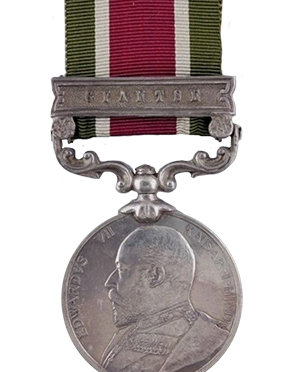
The obverse of the medal, designed by G. W. de Saulles, a British medallist that worked under Queen Victoria and Edward VII) shows the bust of Edward VII in Field Marshal’s uniform and the legend ‘EDWARDVS VII KAISAR-I-HIND’.
The reverse, designed by E. G. Gillick, a British sculptor, depicts the Potala (winter palace of the Dalai Lamas) in Lhasa on top of the red hill with the words ‘TIBET 1903-04’ below.

The medal was awarded in silver to combatant troops and in bronze to camp followers, with both eligible for the ‘Gyantse’ clasp. The clasp ‘GYANTSE’ was given to those present in operations between 3 May and 6 July 1904 in or near Gyantse Fortress. The suspender is of the swiveling ornate scroll type.

The India General Service Medal (1909)

The Indian General Service Medal is a British campaign medal issued to officers and men of the British and Indian armies and approved in 1909.

The Indian General Service Medal (also known as 1909 IGSM) is a British campaign medal issued to officers and men of the British and Indian armies and approved on 1 January 1909. From 1919 it was also awarded to officers and men of the Royal Air Force (the Waziristan 1925 clasp was awarded solely to the RAF).

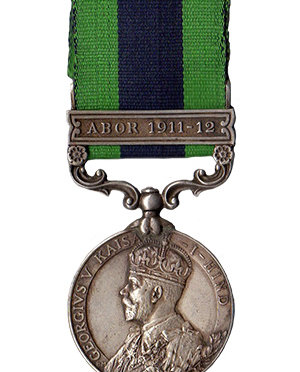
The 1909 Indian General Service Medal was awarded for various minor military campaigns in India from 1908 to 1935, and each campaign is represented by a clasp, of which 12 were sanctioned.

The Indian General Service Medal Design

The medal measures 36 millimeters (1.4 in) in diameter. For early campaigns it was awarded in silver to combatants and in bronze to native bearers and servants. From 1919 on. all awards were in silver.

There are three versions of the Indian General Service Medal obverse (King Edward VII 1908-10, King George V 1911-25 and King George V 1930-35). The reverse depicts Jamrud Fort at the Khyber Pass with the word ‘India’ below between a wreath of oak and olive branches.

The Medal with the Waziristan 1925 bar was awarded to only 46 officers and 214 men of the Royal Air Force. It is by far the rarest bar given with an India General Service Medal.

From 1920, those mentioned in dispatches in a campaign for which the medal was awarded could wear a bronze oakleaf on the medal ribbon.

The George Medal

The George Medal (or GM) is a decoration of the United Kingdom and Commonwealth instituted in 1940 by King George VI for gallantry.

The George Medal (or GM) is a decoration of the United Kingdom and Commonwealth instituted on 24 September 1940 by King George VI as an award for gallantry “not in the face of the enemy” where the services were not so outstanding as to merit the George Cross.

During the height of the Blitz in 1940, there was a strong desire to reward the many acts of civilian courage. The existing awards were not judged suitable to meet the new situation, so it was decided that the George Cross and the GM would be instituted to recognize both civilian gallantry in the face of enemy bombing and brave deeds more generally.

The King announced the new awards by saying:

In order that they should be worthily and promptly recognized, I have decided to create, at once, a new mark of honor for men and women in all walks of civilian life. I propose to give my name to this new distinction, which will consist of the George Cross, which will rank next to the Victoria Cross, and the George Medal for wider distribution.

The warrant for the GM, dated 24 January 1941, was published in The London Gazette on 31 January 1941. Although the original warrant did not explicitly permit it to be awarded posthumously, this was changed in December 1977 to allow posthumous awards.

Recipients are entitled to the post-nominal letters GM.

The George Medal Design

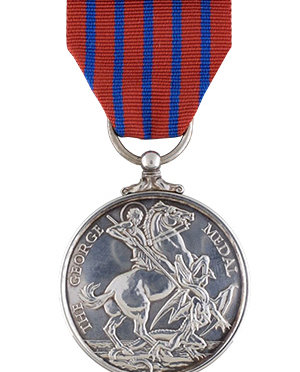
The medal is circular and struck in silver. It measures 36 mm (1.4 in) in diameter.

The obverse depicts the crowned effigy of the reigning monarch. To date, there have been four types:

  • George VI, 1940 to 1948. Inscribed GEORGIVS VI D: G: BR: OMN: REX ET INDIAE IMP.
  • George VI, 1948 to 1952. Inscribed GEORGIVS VI DEI: GRA: BRITT: OMN: REX FID: DEF:
  • Elizabeth II, 1952 to late 1950s. Inscribed ELIZABETH II D: G: BR: OMN: REGINA F.D.
  • Elizabeth II, late 1950s to date. Inscribed ELIZABETH II DEI GRATIA REGINA F.D.

The reverse shows Saint George on horseback slaying the dragon on the coast of England, with the legend THE GEORGE MEDAL around the top edge of the medal.

The ribbon is 31.7 mm (1.25 in) wide, crimson with five narrow blue stripes. The name of the recipient is engraved on the rim of the medal, although some Army awards have impressed naming.

Find This Medal

Right Now on eBay 
Clicking a link to eBay may result in a referral commission being paid if a purchase is made.
Loading...

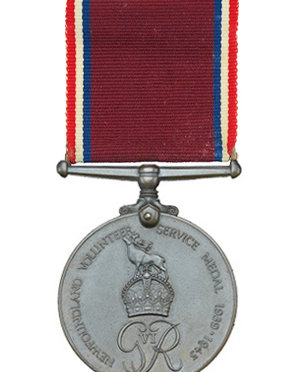
The Newfoundland Volunteer War Service Medal

The Newfoundland Volunteer War Service Medal is a British medal created to honor those from Newfoundland & Labrador.

The Newfoundland Volunteer War Service Medal is a British medal created to honor those from Newfoundland & Labrador who served in the British Forces outside of the province from September 3, 1939 through September 2, 1945.

The medal was specifically created to honor service with the British Imperial Forces, the Newfoundland Overseas Forestry Unit, the Merchant Navy and the Newfoundland Regiment, or any other unit or organization prescribed by the Lieutenant Governor in Council. It was issued to those who did not receive a volunteer war service medal from another country, and those who had volunteered and served in units contributed by the Dominion of Newfoundland to the allied war effort.

The Newfoundland Volunteer War Service Medal Design

The Newfoundland Volunteer War Service medal is circular, made of bronze and measures 36 millimeters (1.4 in) in diameter.

The obverse has the legend NEWFOUNDLAND VOLUNTEER SERVICE MEDAL 1939-45 around the edge and bears the Crown of King George VI surmounted by a Newfoundland stag caribou. The reverse bears a depictions of Britannia standing, with a spear in her right hand and the sun’s rays behind her. Two lions encircle each side with their heads towards the bottom. The medal is numbered to an applicant on the rim.

The New Zealand War Service Medal

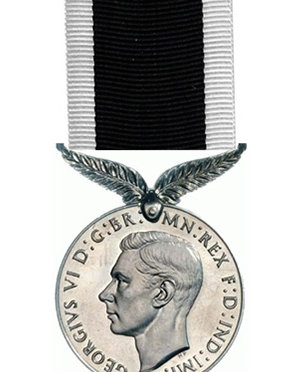
The New Zealand War Service Medal (NZWSM) was awarded to members of the New Zealand armed forces and Reserves during WW2.

The New Zealand War Service Medal (or NZWSM) was awarded to members of the New Zealand armed forces, the National Military Reserve and the Home Guard, as well as the New Zealand Merchant Navy and Naval Auxiliary Patrol Service.

The NZWSM was awarded for 28 days’ full-time aggregated service or six months’ part-time aggregated service between 3 September 1939 and 2 September 1945. Service brought to an end by death on duty, or due to wounds sustained on duty, or honorable discharge as a result of such wounds, automatically qualified for award of the medal.

The New Zealand War Service Medal Design

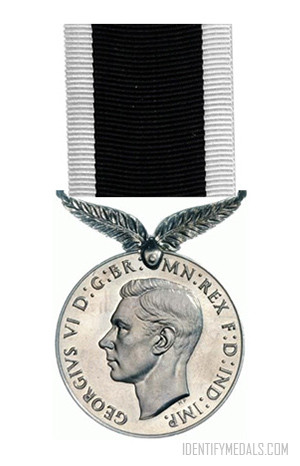
The obverse of the medal shows the uncrowned effigy of King George VI, facing left, with the legend “GEORGIVS VI D:G:BR:OMN:REX F:D:IND:IMP.”

The reverse (designed by the historian and typographer Dr John Beaglehole and the wood engraver E Mervyn Taylor) has the inscription “FOR SERVICE TO NEW ZEALAND 1939-1945” above a fern leaf. It was the first distinctively ‘New Zealand’ campaign medal, emphasized by the use of the fern leaf motif on the reverse and suspension, and the national colors of black and white in the ribbon.

Find This Campaign Medal

Right Now on eBay 
Clicking a link to eBay may result in a referral commission being paid if a purchase is made.
Loading...

More WW2 British Campaign Medals

During World War II (1939–1945) British campaign medals were awarded to members of the British Armed Forces and civilians for active service in specific military campaigns or operations. These included:

The War Medal 1939-1945 Obverse

The War Medal 1939-1945

The War Medal 1939–1945 is a British campaign medal instituted by the United Kingdom on 16 August 1945. The medal was awarded to subjects of the British Commonwealth who had served full-time.

Read More »
WW2 Medals and Awards: The Pacific Star

The Pacific Star

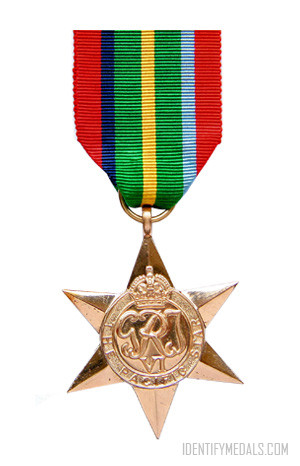
The Pacific Star is a British military campaign medal instituted by the United Kingdom in 1945 for those who served in the Pacific Campaign.

Read More »
WW2 Medals and Awards: The Africa Star

The Africa Star

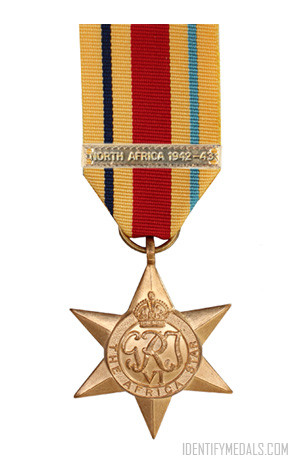
The Africa Star is a military campaign medal awarded to those who served in the Second World War specifically in North Africa. 

Read More »

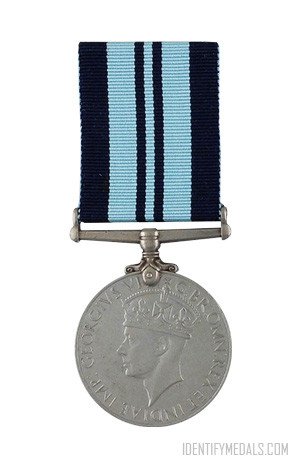
The India Service Medal

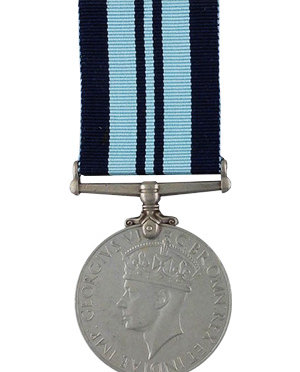
The India Service Medal – 1939-1945 is a Commonwealth campaign medal awarded to Indian Forces for three years service in India in WW2.

The India Service Medal – 1939-1945 is a Commonwealth campaign medal awarded to Indian Forces for three years non-operational service in India during the Second World War.

The India Service Medal was awarded to Forces including Reserve, State and Womens’ forces, for at least three years non-operational service in India between 3 September 1939 and 2 September 1945. It was issued in addition to, and worn immediately after, British campaign World War II medals (although those eligible for the Defence Medal could not receive the India Service Medal as well).

The India Service Medal - 1939-1945 Design

The India Service Medal is circular and made of cupro-nickel. It measures 36mm in diameter.

The obverse of the medal has the crowned effigy of King George VI facing left, with the legend “GEORGIVS VI D:G:BR:OMN:REX ET INDIAE IMP.” The reverse shows a relief map of India and the words “INDIA” above and “1939-45” below.

The medal was awarded unnamed.

Find This Campaign Medal

Right Now on eBay 
Clicking a link to eBay may result in a referral commission being paid if a purchase is made.
Loading...

More WW2 British Campaign Medals

During World War II (1939–1945) British campaign medals were awarded to members of the British Armed Forces and civilians for active service in specific military campaigns or operations. These included:

WW2 Medals and Awards: The Italy Star

The Italy Star

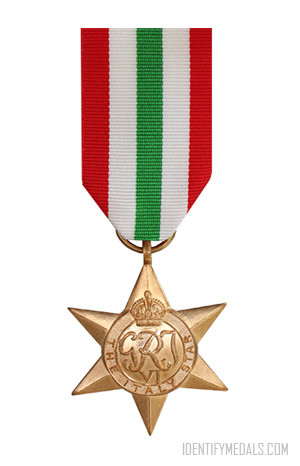
The Italy Star is a military campaign medal, instituted by the United Kingdom in May 1945 for service in the Italian Campaign 1943 to 1945.

Read More »
WW2 Medals and Awards: The Arctic Star

The Arctic Star

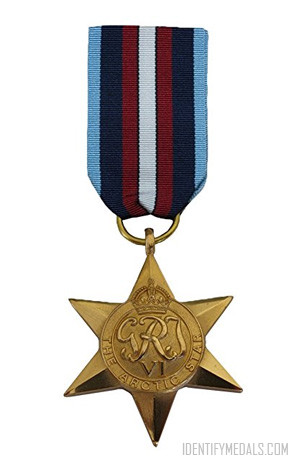
The Arctic Star is a military campaign medal which was instituted for service on the Arctic Convoys north of the Arctic Circle in WW2. 

Read More »