The Conspicuous Gallantry Cross and Medal

The Conspicuous Gallantry Cross (CGC) is a second level military decoration of the British Armed Forces created in 1993.

The Conspicuous Gallantry Cross (also known as CGC) is a second level military decoration of the British Armed Forces created in 1993 after a review of the British honors system as part of the drive to remove distinctions of rank in awards for bravery.

The CGC now serves as the second level award for gallantry for all ranks across the whole armed forces. The CGC may be awarded posthumously, “in recognition of an act or acts of conspicuous gallantry during active operations against the enemy“.

All ranks of the Royal Navy, Royal Marines, British Army, and Royal Air Force may be awarded the CGC in recognition of qualifying acts of gallantry. Recipients are entitled to the postnominal letters CGC

The Conspicuous Gallantry Cross and Medal Design

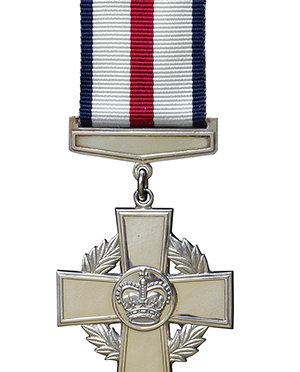
The medal is in the shape of a cross pattée and truck in silver. Arranged behind the cross, visible between the arms is a laurel wreath.

On the obverse, the circular medallion in the center depicts St. Edward’s crown. The reverse is plain which allows room for the engraving of the rank, name, and unit of its recipient.

The award date is also engraved on the reverse of the medal. The medal is suspended by a white ribbon with two narrow dark blue stripes at the edge and one center stripe in crimson.
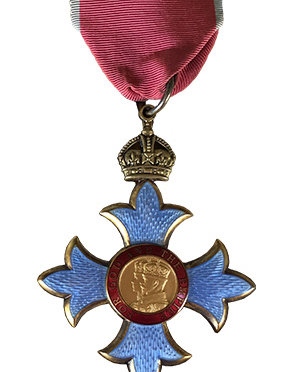

The Order of the British Empire

The Most Excellent Order of the British Empire is a British order of chivalry that rewards charitable works and public service.

The Most Excellent Order of the British Empire is a British order of chivalry that rewards work with charitable and welfare organizations, contributions to the arts and sciences and public service outside the Civil service.

The Most Excellent Order of the British Empire was established on 4 June 1917 by King George V, and comprises five classes across both civil and military divisions. The most senior two of them make the recipient either a knight (male) or Dame (female).

The five classes of appointment to the Order are, in descending order of precedence:

  1. Knight Grand Cross or Dame Grand Cross of the Most Excellent Order of the British Empire (GBE)
  2. Knight Commander or Dame Commander of the Most Excellent Order of the British Empire (KBE or DBE)
  3. Commander of the Most Excellent Order of the British Empire (CBE)
  4. Officer of the Most Excellent Order of the British Empire (OBE)
  5. Member of the Most Excellent Order of the British Empire (MBE)

The senior two ranks of Knight or Dame Grand Cross, and Knight or Dame Commander, entitle their members to use the title of Sir for men and Dame for women before their forename.

The Order of the British Empire Medal Design

Members of the Order wear elaborate vestments on important occasions, which vary by rank: The mantle was originally made of yellow satin lined with blue silk but is now rose pink satin lined with pearl-grey silk. It’s worn only by Knights and Dames Grand Cross. The collar is made of gold and consists of six medallions depicting the Royal Arms, alternating with six medallions depicting the Royal and Imperial Cypher of George V (GRI, which stands for “Georgius Rex Imperator“) and is also worn by only Knights and Dames Grand Cross.

The star is an eight-pointed silver star worn pinned to the left breast and bearing a crimson ring with the motto of the Order inscribed. Within the ring, before 1937 a figure of Britannia was originally shown. Since then, the effigies of George V and Mary of Teck are shown instead.

The badge was, until 1937, suspended on a purple ribbon with a red central stripe for the military division. After 1937 the ribbon became rose-pink with pearl-grey edges, with the addition of a pearl-grey central stripe for the military division. The badge is in the form of a cross patonce, the obverse of which bears the same field as the star; the reverse bears George V’s Royal and Imperial Cypher. Both are within a ring bearing the motto of the Order. The size of the badges varies according to rank.

Find This Medal

Right Now on eBay 
Clicking a link to eBay may result in a referral commission being paid if a purchase is made.
Loading...

The Order of Merit

The Order of Merit is an award established in 1902 that recognizes distinguished service in the armed forces, science, art, or culture.

The Order of Merit (or Ordre du Mérite in French) is an order of merit that recognizes distinguished service in the armed forces, science, art, literature, or for the promotion of culture.

The Order was established in 1902 by King Edward VII and is restricted to a maximum of 24 living recipients from the Commonwealth realms, plus a limited number of honorary members.

The first mention of a possible Order of Merit was made following the Battle of Trafalgar, in correspondence between First Lord of the Admiralty Lord Barham and William Pitt, though nothing else came of the idea. Queen Victoria, her courtiers, and politicians also considered it, as well as her husband Albert, Prince Consort.

Victoria’s son, King Edward VII, eventually founded the Order of Merit on 26 June 1902 as a means to acknowledge “exceptionally meritorious service in Our Navy and Our Army, or who may have rendered exceptionally meritorious service towards the advancement of Art, Literature and Science.

The Order of Merit’s precedence among other honors differs between countries. From its inception, the order has been open to women, Florence Nightingale being the first woman to receive the honor in 1907. Since 1991, it has been required that the insignia be returned upon the recipient’s death.

The Order of Merit Medal Design

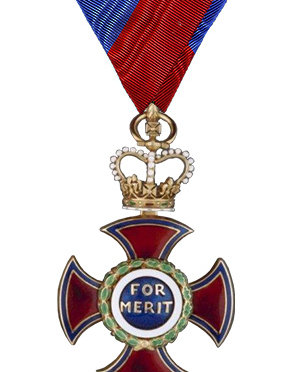
The Order of Merit badge consists of a golden crown suspended from a red enameled cross, which is centered by a disk of blue enamel surrounded by a laurel wreath and bearing in gold lettering the words FOR MERIT.

The insignia for the military grouping is distinguished by a pair of crossed swords behind the central disk. The ribbon is divided into two stripes of red and blue.

Men wear their badges on a neck ribbon, while women carry theirs on a ribbon bow pinned to the left shoulder, and aides-de-camp may wear the insignia on their aiguillettes.

The Order of the Bath Medal

The Most Honorable Order of the Bath is a British order of chivalry founded by King George I in 1725 and turned into a Military Order.

The Most Honorable Order of the Bath (also knows previously as “The Most Honorable Military Order of the Bath“) is a British order of chivalry founded by King George I on 18 May 1725 and erected into a regular Military Order.

The name Order of the Bath is derived from the ancient practice of ritual purification by bathing, symbolizing spiritual cleansing and renewal. In medieval times, knights were often ceremonially bathed before being dubbed into chivalric orders, signifying their commitment to noble ideals and virtues. The knights product of this ceremony were known as “Knights of the Bath“.

The Order was re-organized in 1815 in two divisions: Military and Civil. Members can belong to either the Civil or the Military Division. Before 1815, the order had only a single class (Knight Companion), but it no longer exists.

The Order of the Bath Classes

The Order of the Bath consists of three classes, each with its own distinctive medal. These three classes of the Order of the Bath recognize different levels of achievement and service to the British Crown. 

  • Knight Grand Cross (GCB): The highest class of the Order is awarded for the most exceptional acts of service and gallantry. Recipients of this honor are entitled to wear a star and a badge. 

  • Knight Commander (KCB): The second class is awarded for distinguished service and gallantry. Recipients of this honor are entitled to wear a star and a badge suspended from a crimson ribbon worn around the neck.

  • Companion (CB): The third and lowest class is awarded for meritorious service and gallantry. Recipients are entitled to wear a badge only.

A Brief History of the Order of the Bath

The origins of the Order can be traced back to the medieval period, with its establishment formally documented in the early 18th century. The modern incarnation of the Order of the Bath was founded by King George I of Great Britain in 1725. The king established the order as a means of recognizing and rewarding military and civil merit within his realm. 

During the Napoleonic Wars of the late 18th and early 19th centuries, the Order of the Bath experienced a period of revival and expansion. It became one of the most prestigious honors bestowed by the British Crown, awarded to military officers and civil servants for distinguished service, bravery, and leadership in times of conflict.

Over the centuries, the Order of the Bath has continued to evolve, adapting to changes in British society and the nature of warfare. It remains an important institution, honoring individuals who have made significant contributions to the nation, both in times of war and peace.

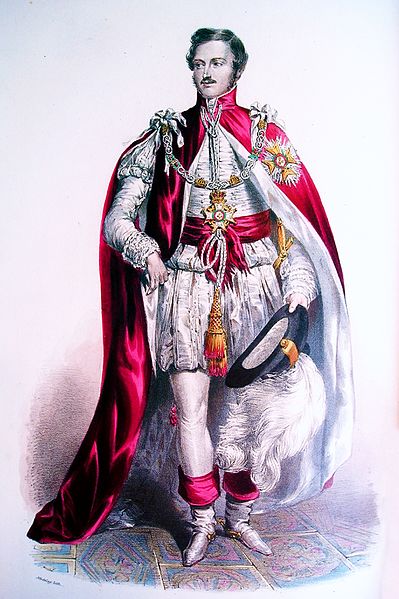
Prince Albert, the Prince Consort, Great Master 1843–1861.

The Most Honorable Order of the Bath Medal Design

Members of the Order wear elaborate costumes on important occasions (such as its quadrennial installation ceremonies and coronations), which vary by rank.

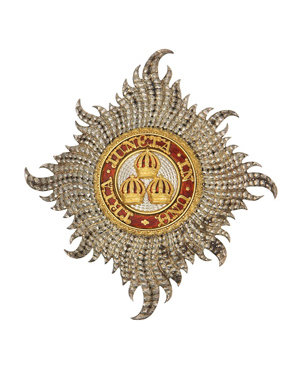
The star is a silver flaming star surmounted by a circular gold band enameled red bearing the motto around the top and laurel around the foot. It encloses three gold crowns enameled in red. The collar chain is made of gold and composed of nine crowns and eight devices (a rose, a thistle, and a shamrock), connected by gold, white-enameled knots. The collar badge is a skeletal gold badge with an oval collar and the inscription “TRIA JUNCTA IN UNO” (or “Three joined in one” in Latin) in white enameled letters. The inscription encloses a thistle, rose, and shamrock. The sash badge is similar to the collar one, but smaller and without white enamel. The ribbon is 38 millimeters and deep red.

The military badge is a gold Maltese Cross of eight points, enameled in white. Each point of the cross is decorated by a small gold ball, and each angle has a small figure of a lion. The center of the cross shows three crowns on the obverse side, and a rose, a thistle and a shamrock emanating from a scepter on the reverse. Both are surrounded by a red circular ring bearing the motto of the Order and flanked by two laurel branches, above a scroll bearing the words Ich Dien in gold letters.

The civil badge is a plain gold oval bearing three crowns on the obverse side, and a rose, a thistle, and a shamrock, emanating from a scepter on the reverse side; both emblems are surrounded by a ring bearing the motto of the Order.

The Waterloo Medal

The Waterloo Medal is a British military medal established in 1816-17 and struck for all those who participated in the Waterloo campaign.

The Waterloo Medal is a British military medal established in 1816-17 by the House of Commons. The military medal was to be struck for all those who participated in the Waterloo campaign.

On 23 April 1816, it was announced in the London Gazette that the Prince Regent had been graciously pleased to confer the Waterloo Medal upon every officer, non-commissioned officer and soldier of the British Army who took part in the battles of Ligny (16 June 1815), Quatre Bras (16 June 1815) and/or Waterloo (18 June 1815). This included also members of the King’s German Legion.

The measure was supported by the Duke of Wellington, who on 28 June 1815 wrote to the Duke of York: “…the expediency of giving to the non commissioned officers and soldiers engaged in the Battle of Waterloo a medal. I am convinced it would have the best effect in the army, and if the battle should settle our concerns, they will well deserve it.

On 17 September 1815, the Duke of Wellington wrote to the Secretary of State for War recommending “that we should all have the same medal, hung to the same ribbon as that now used with the [Army Gold] Medal.

The Waterloo Medal was finally issued in 1816–1817 and given to every soldier that had been present at one or more of the battles of Ligny, Quatre Bras and Waterloo. Each and every soldier was also credited with two years extra service and pay, and were to be known as “Waterloo Men“.

Different Waterloo Medals

The Waterloo medal was the first medal issued by the British Government to all soldiers present during an action, and it was also the first campaign medal awarded to the next-of-kin of men killed in action.

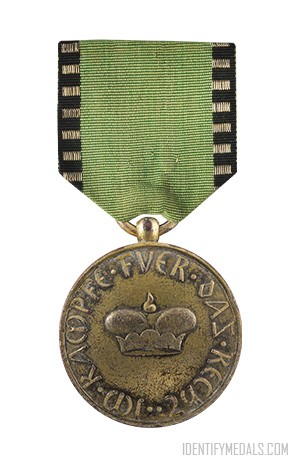
Seven nations of the Seventh Coalition struck medals for soldiers who took part in the campaign: 

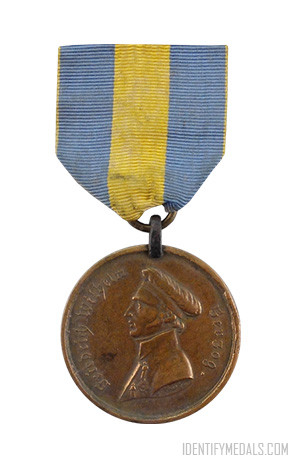
British Campaign Medals: The Brunswick Waterloo Medal

The Brunswick Waterloo Medal

The Brunswick Waterloo Medal was a campaign medal awarded to those who participated in the Battles of Quatre Bras and Waterloo.

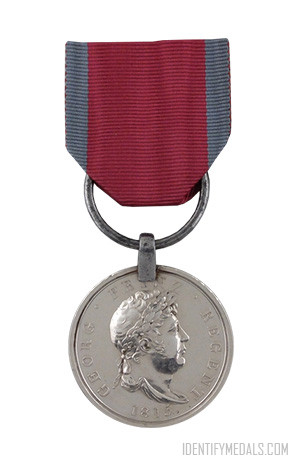
British Campaign Medals: The Hanoverian Waterloo Medal

The Hanoverian Waterloo Medal

The Hanoverian Waterloo Medal was issued to all members of the Hanoverian army who fought in the battles of Quatre Bras and Waterloo.

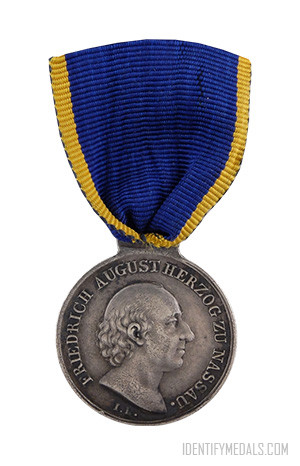
British Campaign Medals: The Nassau Medal for Waterloo

The Nassau Waterloo Medal

The Waterloo Medal is a campaign of the Duchy of Nassau established by Frederick Augustus, Duke of Nassau on 23 December 1815.

The Waterloo Medal Design

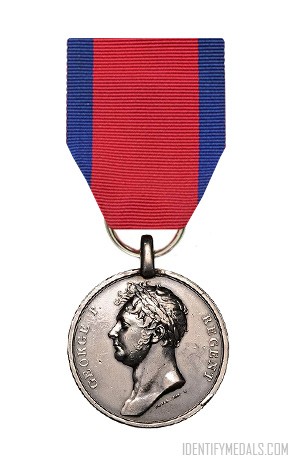
The Waterloo medal is made of silver and is 37 mm (1.5 in) in diameter. It was designed by Thomas Wyon, a recently appointed Chief Engraver to the Royal Mint. The medals were to be awarded originally in bronze, but it was decided at a late stage that they should be produced in fine silver.

The obverse of the Waterloo medal shows a left facing effigy of the Prince Regent with the inscription GEORGE P. REGENT. The reverse displays a figure of Victory seated on a plinth with the words WELLINGTON above, and WATERLOO and the date JUNE 18 1815 below.

The design of the Waterloo medal was modeled on an ancient Greek coin from Elis, that belongs today to the British Museum collection.

Find This Medal

Right Now on eBay 
Clicking a link to eBay may result in a referral commission being paid if a purchase is made.
Loading...

The Seringapatam Medal

The Seringapatam medal (Sri Ranga Pattana) is a British military medal commissioned by the East India Company in 1801 and given to soldiers.

The Seringapatam medal (or Sri Ranga Pattana) is a British military medal commissioned by the East India Company in 1801 and distributed to soldiers who had contributed to the British victory in the 1799 Battle of Seringapatam, fought against the armies of Tipu Sultan, who was the ruler of the Kingdom of Mysore

These medals were issued to all participants, but their materials were of various values; Those given to the highest-ranking commanders were made of gold, the ones given to intermediate ranks were silver, silver-gilt, or bronze, and those for lesser ranks were made of tin or pewter.

The Seringapatam Medal Design

The medal was designed by Conrad Heinrich Küchler, a German engraver who  worked as a designer of coinage and medals for the manufacturer and mint owner Matthew Boulton from 1793 until his death. Küchler was Boulton’s sole artist for designing and die-cutting, and produced the designs for various coins, medals and tokens, including the copper “cartwheel” pennies and twopences.

Many of the Seringapatam medals were manufactured at the Soho Mint in Birmingham, although a smaller version of the medal was manufactured in the Calcutta Mint.

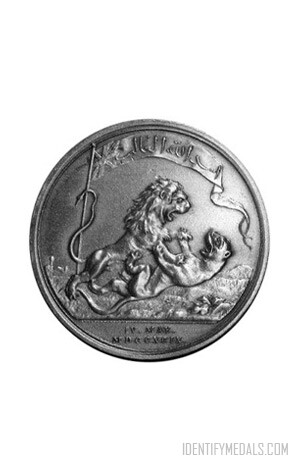
The reverse of the medal displays the storming of the fort, with the sun at its meridian. The obverse shows the British lion trampling Tipu’s emblem, the tiger, with the caption “Asad Allah al-Ghalib” (that means “Lion of God the Conqueror” in Arabic).

The Gulf Medal

The Gulf War Medal is a British campaign medal issued to officers and men of British forces who served in Kuwait and Saudi Arabia during Operation Granby.

The Gulf War Medal is a British campaign medal issued to officers and men of British forces who served in Kuwait and Saudi Arabia during Operation Granby (the Liberation of Kuwait) in 1990–91 and approved in 1992.

It was instituted to recognize and honor the service of British and Commonwealth military personnel who participated in the Gulf War (also known as Operation Desert Storm) and subsequent operations in the Persian Gulf region in the early 1990s.

The Gulf Medal was established in 1992 and was awarded for various periods of operational service in the Gulf region, depending on the specific campaign or operation. The medal comes in several variations, each with its own distinctive ribbon and clasp, denoting the specific period and theater of service.

In addition to the Gulf Medal, there is also a separate medal called the Iraq Medal, which was awarded for service in later operations in Iraq, particularly during the post-9/11 period.

The Gulf War Medal Clasps

Two clasps were authorized for those who served in Kuwait during the Iraqi invasion, and for those who took part in operations to liberate Kuwait:

  • 2 Aug 1990: Awarded to the members of the Kuwait Liaison Team who were in Kuwait on the said date, and who were taken hostage by the invading Iraqi Army.
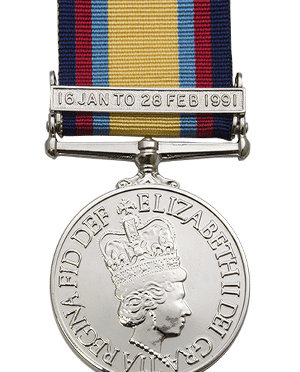
  • 16 Jan-28 Feb 1991: Awarded for seven days continuous service between these dates in the designated Theatre of Operations. This clasp signifies service during the actual war.

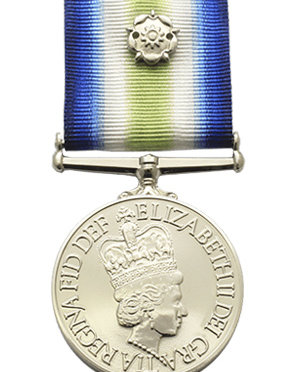
In undress uniform, a rosette is worn on the medal ribbon to denote the award of either clasp.

The Gulf War Medal Design

The Gulf Medal is made of cupro-nickel and measures 36 millimeters (1.4 in) in diameter.

The obverse shows the crowned effigy of Queen Elizabeth II facing right with the inscription ELIZABETH II DEI GRATIA REGINA FID. DEF. The reverse display an eagle in flight above an automatic rifle superimposed on an anchor, representing the three services, with THE GULF MEDAL above and 1990-91 below. The recipients details were impressed in capitals on the edge of the medal.

The Gulf War Medal ribbon measures 32 millimeters (1.3 in) wide, and shows a sand-colored broad central stripe flanked by narrow stripes of dark blue, red and light blue which represent the three services. A dark blue line appears on both outer edges.

Find This Medal

Right Now on eBay 
Clicking a link to eBay may result in a referral commission being paid if a purchase is made.
Loading...

The South Atlantic Medal

The South Atlantic Medal is a British campaign medal awarded to civilians and military personnel for service in the Falklands War of 1982.

The South Atlantic Medal is a British campaign medal awarded to British civilians as well as military personnel for service in the Falklands War of 1982. Over 33,000 medals have been awarded. The South Atlantic Medal Association was formed in 1997 for recipients of the South Atlantic Medal.

Initially, about 29,700 people were awarded the South Atlantic medal, including Prince Andrew. Civil servants serving in Accession Island, NAAFI staff, war artist Linda Kitson and journalists attached to the armed forces, including Michael Nicholson, have also received this medal.

Since 2014 an additional 3,626 South Atlantic medals have been awarded without rosette, in response to the extension of the qualifying period to 21 October 1982.

The South Atlantic Medal Design

The South Atlantic Medal is made of cupronickel, and measures 36 mm in diameter. It was struck by the Royal Mint and issued by the Army Medal Office, Droitwich. The design, attributed to HM the Queen, was based on the ribbon for the 1939-45 Atlantic Star.

The obverse shows a crowned effigy of The Queen facing right, with the inscription ELIZABETH II DEI GRATIA REGINA FID:DEF (“Elizabeth II, by the grace of God, Queen and Defender of the Faith”). The reverse displays the Falkland Islands’ coat of arms, bearing the words “DESIRE THE RIGHT” (an allusion to English explorer John Davis’ ship, “Desire”). The border is made up of a laurel wreath below and the words “SOUTH ATLANTIC MEDAL” above.

The initials and surname, rank or rating, service number and unit of the recipient are diamond engraved on the edge of the medal, but the Royal Navy officers (as was the tradition) don’t include the service number.

The 32 mm ribbon has a central stripe of “sea green” flanked on each side by stripes of white and “empire blue” symbolizing the Atlantic Ocean.

Find This Medal

Right Now on eBay 
Clicking a link to eBay may result in a referral commission being paid if a purchase is made.
Loading...

The General Service Medal (1962)

The General Service Medal 1962 (or 1962 GSM) is a campaign medal of the United Kingdom awarded for what were often arduous campaigns.

The General Service Medal 1962 (or 1962 GSM) is a campaign medal of the United Kingdom awarded for what were often arduous campaigns and well fought operations and introduced in 1962 to combine the General Service Medal (1918), which was awarded to the Army and RAF, and the Naval General Service Medal (1915). The 1962 General Service Medal was awarded until 2007.

The General Service Medal 1962 Design

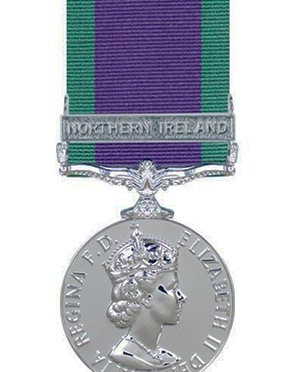
The 1962 GSM is a circular silver medal measuring 36 mm in diameter. The obverse bears the crowned effigy of Queen Elizabeth II with the inscription ELIZABETH II DEI GRATIA REGINA F.D. The reverse shows the words ‘FOR CAMPAIGN SERVICE‘ under a crown, all surrounded by a wreath of oak leaves. The name, rank, service number and regiment or corps of the awardee are annotated on the rim of the medal.

The ribbon is 32 mm wide, purple with two outer stripes of dark green. In different proportions, these are the same colours as the GSM 1918–62.

Those mentioned in despatches during a campaign qualifying for the 1962 GSM wear a bronze oak leaf on the medal ribbon.

Fourteen clasps were awarded, and the medal always had one of them. The maximum appears to have been six, which were worn in the order that the recipient qualified for them and not the date of the relevant Army Order. There was no minimum qualifying period for each clasp for those killed, wounded or disabled during operations.

The clasps were: Cyprus 1963-64, Borneo, Radfan, South Arabia, Malay Peninsula, South Vietnam, Northern Ireland, Dhofar, Lebanon, Gulf of Suez, Gulf, Kuwait, North Irak and Turkey and Air Operations Irak.

Find This Medal

Right Now on eBay 
Clicking a link to eBay may result in a referral commission being paid if a purchase is made.
Loading...

The Korea Medal

The Korea Medal (or Médaille de Corée in French), also known as the Queen’s Korea Medal, was a campaign medal created in 1951 to recognize troops from Australia, Canada, New Zealand, and the United Kingdom who had given 28 days service offshore during the Korean War, or at least one day’s service in an air sortie over Korea.

The Korean War was the first event in which United Nations (UN) armed forces took on a combat role in a multinational effort to stop the North Korean takeover of the Republic of Korea. It involved the participation of 20 UN member states, the Republic of Korea and Italy.

Except for Canada, the medal was identical in all countries where it was awarded, and holds a different place in each country’s order of precedence for honors.

The Korean War Medal Design

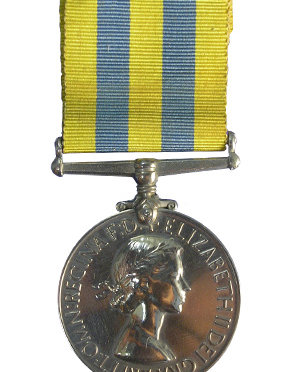
Designed by Edward Carter Preston, a Liverpool artist, sculptor and medallist, the Korea Medal measures 36 millimetres (1.4 in) and is a disc. All medals were made of cupro-nickel, except for the Canadian version that was made of silver.

On the Korean War medal obverse is an effigy of Queen Elizabeth II, surrounded by an inscription that symbolizes her roles as both fount of honour and Commander-in-Chief of her various forces. At the time of the medal’s creation, King George VI was monarch. However, he died on 6 February 1952 and so the image of his daughter was placed on the obverse of the medal, uncrowned.

There are three versions of the inscription surrounding the Queen’s head:

  • ELIZABETH II DEI GRA. BRITT. OMN. REGINA F.D. (Elizabeth II, by the Grace of God Queen of all the Britons, Defender of the Faith).
  • ELIZABETH II DEI GRATIA REGINA F.D. (Elizabeth II, by the Grace of God Queen, Defender of the Faith), later awards omitting BRITT. OMN..
  • ELIZABETH II DEI GRATIA REGINA CANADA (Elizabeth II, by the Grace of God Queen of Canada), awarded to Canadian participants.

On the reverse is a depiction of Hercules wrestling the Hydra—a symbolic representation of communism—with the word KOREA below.

The recipient’s name, rank and regimental number is impressed on the medal’s rim.