The Army of India Medal

The Army of India Medal is a British campaign medal issued to officers and men of the British Army and the Army of the East India Company.

The Army of India Medal (AIM) is a British campaign medal approved on 21 March 1851 and issued to officers and men of the British Army and the Army of the Honourable East India Company.

The Army of India Medal was as a retrospective award to survivors of various actions during the period 1803–1826, among them four wars: the Second Mahratta War (1803–04), the Gurkha War (1814–16), the Pindaree or Third Mahratta War (1817–18), and the First Burmese War (1824–26) with the siege of Bhurtpoor (1825–26).

Each action or battle was represented by a clasp on the ribbon. A total of twenty-one ribbons were sanctioned, and while the maximum awarded to one man was seven, most medals were awarded with a single clasp.

Because the medal was only awarded to survivors, there are substantially fewer medals compared with the number of men who served during this period. Forty-eight years had passed between the first battle commemorated and the date of issue. A total of 4,500 medals were awarded.

The Army of India Medal Design

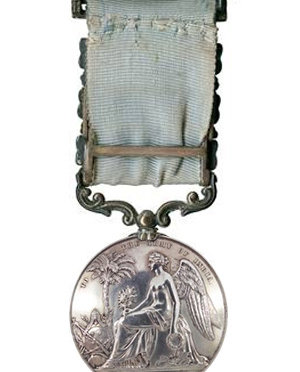
The Army of India medal is circular and made of silver. It measures 1.4 inches (36 mm) in diameter and was designed by William Wyon.

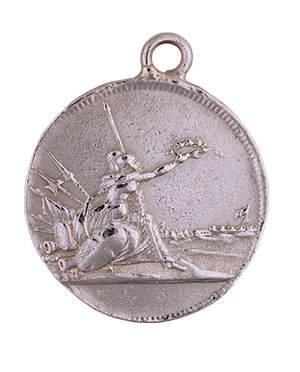
The obverse bears an effigy of a young Queen Victoria wearing a diadem. On either side of the effigy is the inscription VICTORIA and REGINA. The reverse bears and an allegorical representation of Victory holding a laurel branch in her right hand and a wreath in her left. In the foreground is a lotus flower, with a palm tree and trophy of arms in the background. Above is the inscription TO THE ARMY OF INDIA, below in the exergue 1799-1826.

The pale blue ribbon is 1.25 inches (32 mm) wide.
The Ghuznee Medal

The Ghuznee Medal is a campaign medal awarded to troops for participation in the storming of the fortress of Ghuznee in Afghanistan.

The Ghuznee Medal is a British campaign medal struck in 1839 and awarded to troops of the British and Indian Armies for participation in the storming of the fortress of Ghuznee in Afghanistan, from 21 to 23 July 1839 (known as the Battle of Ghazni that took place during the First Anglo-Afghan War).

The Ghuznee Medal was the second medal awarded to all ranks of the British Army for a specific campaign (the first one was the Waterloo Medal).

The medal was struck on the orders of Shuja Shah Durrani, the Shah of Afghanistan, to show his appreciation to the British forces who had helped him restore his throne by storming the fortress. Because the Shah died before the medals could be distributed, it was then bestowed by the Governor-General of India in the name of the Government of India.

The Ghuznee Medal Design

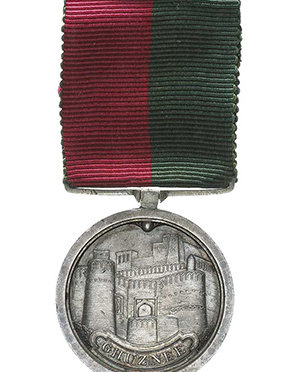
The Ghuznee Medal is made of silver and is based on a design by John Luard, a British army officer and artist. It was struck at the Calcutta Mint. It measures  37 millimeters (1.5 in) in diameter.

The obverse shows the fortress of Ghuznee with the word ‘GHUZNEE’ below. The reverse depicts a mural crown surrounded by a laurel wreath and the date ’23d JULY 1839’.

The suspender is straight with a ring passing through a smaller loop soldered to the top of the medal. The ribbon has two equal stripes of crimson and dark green. Originally the ribbon was to have been half green and half yellow.
The medal was issued unnamed.

Two separate dies exist for this medal with one having a wider border around the edge than the other. The second also has a narrower and taller fortress.

The Burma Medal (1826)

The Burma Medal was granted to native officers and men who participated in the campaign for the subjugation of Burma.

In 1824 raiding by Burmese troops of King Bagyidaw of Ava (in what is now modern-day Myanmar) into the border states of Sylhat and Cachar (today India) caused their independent rulers to appeal for help from the British in India. This led to a reprisal expedition with the aim of taking Rangoon.

The campaign lasted through two years of extremely difficult fighting, until in 1826 King Bagyidaw agreed a treaty with the British. He was to abdicate in 1837.

This medal was awarded by the British East India Company to the Indian troops involved in what was called the “war in Ava”.

The Burma Medal is a very seldom seen award from the reign of George IV.

The Burma Medal Design

The Burma Medal was the first of the H.E.I.C. campaign medals in what was to become a standard 1.5 inch (38mm) diameter. The silver issue of the medal was awarded to Indian troops from Bengal and Madras in 1832; officers received a gold version.

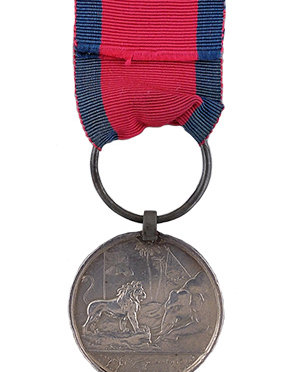
The obverse shows the elephant of Ava at right bowing before the British lion at left, who stands before a Union Jack flagstaff. The reverse is an army approaching a coastal city, with boats at sea to the left beyond a tall palm.

The medal was fitted with a large steel clip and ring for suspension (just like the Waterloo Medal). British troops in this campaign were belatedly awarded the “AVA” clasp to the Army of India Medal.

The Capture of Ceylon Medal

The Capture of Ceylon Medal was instituted on 15 May 1807 by an Order in Council at Fort William, India and awarded to part of the forces under the command of the East India Company that participated in the British Invasion of Dutch Ceylon.

The Invasion of Ceylon was part of the French Revolutionary Wars, over the 21 July 1795 – 16 February 1796 period. Two medals were cast in gold for officers (some believe natives), with 120-121 being cast in silver for members (Gun Lascars) of the Bengal Artillery.

The Capture of Ceylon Medal Design

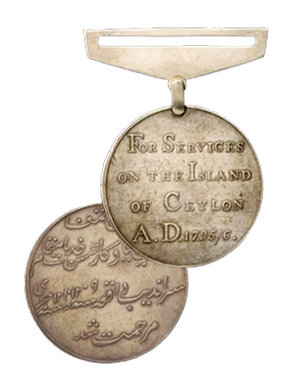
The Capture of Ceylon measures 1.9 inches (48 mm) in diameter, and is struck in gold or silver.

The obverse face displays an English inscription For Services on the Island of Ceylon A.D. 1795/6. The reverse face shows a Persian inscription: “This medal was given by way of acknowledgment of services in Ceylon in the year of the Hegira 1209-1210.

The medal was intended to be worn round the neck with a yellow cord.

The Army Gold Medal (Peninsular Gold Medal)

The Army Gold Medal (also known as the Peninsular Gold Medal with an accompanying Gold Cross) is a British campaign medal awarded in recognition of field and general officers’ successful commands in campaigns, mainly the Peninsular War.

The Army Gold Medal was established in 1810 to reward service at Napoleonic War battles since 1808. It was awarded only to majors and above and in two sizes, with the larger going to senior officers. The award could be awarded posthumously and sent to the officer’s family.

The Army Gold Medal was not a general medal because it was issued only to officers whose status was no less than that of battalion commander or equivalent.

The Army Gold Medal Design

The medal came in three styles: Large, small and gold.

The Large Gold Medal was designed by Thomas Wyon and was restricted to general officers. It measures 2.12 inches (54 mm) in diameter, and is mounted in a gold frame, glazed on both sides. The obverse shows Britannia with shield, seated and facing left and holding a laurel wreath in her right hand and a palm branch in her left. Behind her, the head of a lion can be seen. The reverse displays a laurel wreath surround, with the name of the battle engraved in the center, although that for Barrosa was die struck.

The Small Gold Medal was awarded to officers between the rank of major and colonel. It measures 1.3 inches (33 mm) in diameter, it’s mounted in a gold frame and glazed, and of the same design as the Large Medal.

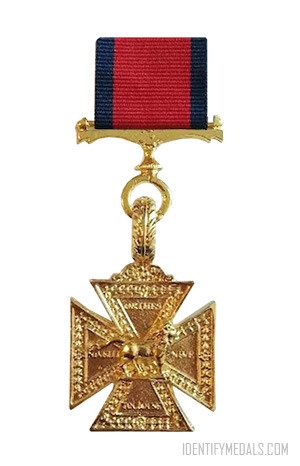
The Gold (or Peninsular) Cross was awarded to those who earned four or more gold medals, which it replaced. Worn around the neck, it is an ornamental cross pattée 1.5 inches (38 mm) across, with a proud lion at its center and the four qualifying actions embossed on its arms. The obverse and reverse are the same. Any further actions were marked with a clasp.

The Medal for Egypt 1801

The Medal of Egypt 1801 (also known as the 1801 East India Company’s Egypt Medal) was issued by the Honourable East India Company to British and Indian troops from India who formed a Division under Major General Baird.

In July 1802 the EIC authorized a medal for service in Egypt, although it wasn’t issued until 1811. The medal was produced by the Calcutta Mint, and warded in gold (126 of them have been awarded) and silver (some 2200 medals were given).

The Medal of Egypt 1801 was not given to British troops.

The Medal of Egypt 1801 Design

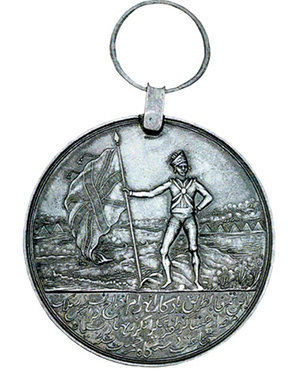
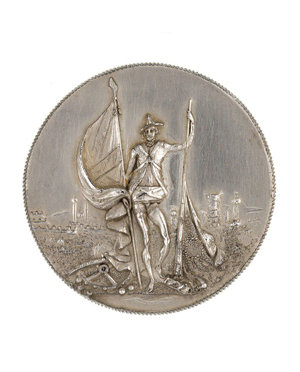
The medal is struck in gold or silver. The obverse illustrates a standing sepoy, holding a large ensign, an attack upon a fortified position in the distance, inscribed below in Persian “This medal has been presented in commemoration of the defeat of the French armies in the Kingdom of Egypt by the great bravery and ability of the victorious army in England“.

The reverse is a starboard quarter view of a full rigged ship under sail approaching land, four pyramids and an obelisk in the distance at the right, Roman numeral dated “MDCCCI” (1801) below.

The silver medal measures 51.7 mm.

The Mysore Medal

Time Period: Pre-WW1
Year of Institution: ~ 1790
Country: Great Britain

The Honourable East India Company Medal for Mysore 1790-1792 was awarded to Havildars, Naiks, Tindals, Sepoys and Lascars, to Indian troop of the Honourable East India Company and to all those who served under Cornwallis, Abercromby and Medows in the defeat of Tippoo Sahib in the Third Mysore War of 1790 to 1792.

Tippoo Sahib, the Maharajah of Mysore in south India, attacked in 1790 the British allied state of Travancore, causing the British to retaliate. The south Mysore region of Coimbatore was reduced, whilst General Abercromby captured the west coast province of Malabar. But Tippoo in turn invaded the British held Carnatic region.

One year later, the Governor General Lord Cornwallis took the field and launched a major offensive into the heart of Mysore. They managed to capture the town and fortress of Bangalore in the face of heavy opposition in March 1791.

Cornwallis then continued with the stronghold of Seringapatam but had to withdraw until 1791, when he captured a series of strongly held fortresses between Bangalore and Seringapatam, capturing the town on 6th to 7th February. As a result Tippoo Sahib came to terms, signing a treaty, 19th March, in which a substantial tract of land was ceded to the British and her Mahratta allies and a war indemnity paid.

The Mysore Medal Design

The Mysore medal is a small medal. It was produced in two sizes: 43mm in diameter for gold and silver, and 38mm for small silver. The big medal was given to Indian officers, and the smallest to other ranks.

It measures 38 mm in diameter and it’s struck in silver.

The suspension is fitted with cord.

The Deccan Medal

The Deccan Medal is a silver medal issued by the East India Company to Indian officers and men for service in Gujerat during the First Maratha War (1778-1782) and for service in the Carnatic during the 2nd Mysore War (1780-1784).

The First Anglo-Maratha War was the first of three Anglo-Maratha wars fought between the British East India Company and Maratha Empire in India. The war began with the Treaty of Surat and ended with the Treaty of Salbai. British troops under the command of Colonel Keating, left Surat on March 15 1775 for Pune. They were totally defeated on May 18, 1775 with some 96 people killed. 

The Supreme Council of Bengal condemned the Treaty of Surat, sending Colonel Upton to Pune to annul it and make a new treaty with the regency. An agreement between Upton and the ministers of Pune called Treaty of Purandar was signed on March 1, 1776.

The Deccan Medal is the earliest Anglo-Indian medal issued alike to all ranks and is considered the first ‘general issue’ war medal.

The Deccan Medal Design

Minted in Calcutta, the Deccan medal was round and struck in gold, silver and small silver. The medal was awarded in two sizes: 40.5mm for gold and silver, and 32mm for small silver. The larger medals were given to Indian officers only.

The medal was worn round the neck suspended from a yellow cord.

The Indian Order of Merit

The Indian Order of Merit (IOM) is a military and civilian decoration of British India established in 1837on 1 May 1837.

Time Period: Pre-WW1
Year of Institution: 1 May 1837
Country: Great Britain

The Indian Order of Merit (also known as IOM) is a military and civilian decoration of British India established in 1837 by General Order of the Governor-General of India, No. 94 of 1 May 1837.

Following the Partition of India in 1947 it was decided to discontinue the award, and a separate Indian honours system was developed in 1954 to act retrospectively.

For a long period of time the IOM was the highest decoration that a native member of the British Indian Army could receive and initially it had three divisions. This was changed in 1911 when Indian servicemen became eligible for the Victoria Cross.

A civilian division of the IOM also existed between 1902 and 1939, however, it was only conferred very rarely. The name of the medal was changed in 1902 to avoid confusion with a British Order of the same name.

The Indian Order of Merit Medal Design

The medal was originally introduced with three classes: First, second and third classes.

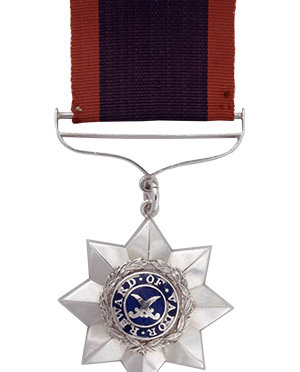
The Third Class is an eight pointed dull silver star with blue circle surrounded by silver laurels. In the middle, with crossed swords and the words, the words Awarded for Valour were written (this was changed to Awarded for Gallantry in 1944.)

The Second Class is an eight pointed shiny silver star with blue circle, surrounded by gold laurels in the middle, with crossed swords and the words Awarded for Valour, this was changed to Awarded for Gallantry in 1944.

The First Class is an eight pointed gold star with blue circle, surrounded by gold laurels in the middle, with crossed swords and the words Awarded for Valour, this was changed to Awarded for Gallantry in 1944.

The ribbon is dark blue and flanked by two red stripes of about a sixth of the width.

The Royal Red Cross

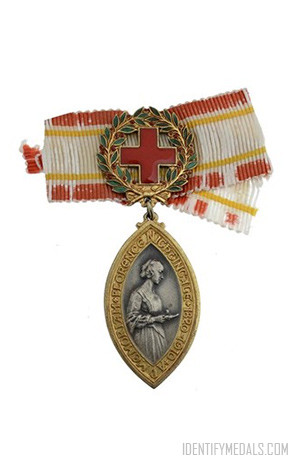
The Royal Red Cross is a military decoration established by Queen Victoria and awarded for exceptional services in military nursing.

The Royal Red Cross is a military decoration awarded in the United Kingdom and Commonwealth for exceptional services in military nursing. It was established on 27 April 1883 by Queen Victoria.

The Royal Red Cross has a single class of Member and it was first awarded to the founder of modern nursing, Florence Nightingale. A second and lower class, Associate, was added during World War I in 1917.

The award is awarded to a fully trained nurse of an officially recognized nursing service, military or civilian, who has shown exceptional devotion and competence in the performance of nursing duties, over a continuous and long period, or who has performed an exceptional act of bravery and devotion at her or his post of duty.

The decoration was conferred exclusively to women until 1976.  Recipients of the Royal Red Cross are entitled to use the post-nominal letters “RRC” or “ARRC” for Members and Associates respectively.

The Royal Red Cross Medal Design

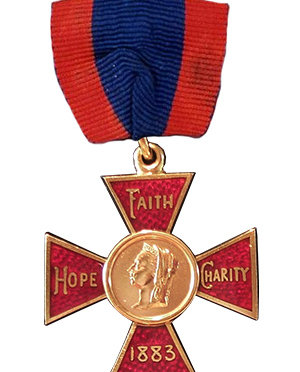
The badge for RRC is shaped like a golden cross. It measures 1.375 inches (or 3.49 cm) wide.

The obverse is enameled red, with a circular medallion (now bearing an effigy of the reigning monarch) at its centre. The words “Faith“, “Hope” and “Charity” are inscribed on the upper limbs of the cross, and the year “1883” in the lower limb.

The reverse is plain except a circular medallion bearing the Royal Cypher of the reigning monarch.

The ribbon for both grades is dark blue with crimson edge stripes. To recognise further exceptional devotion and competency in the performance of nursing duties or exceptional act of bravery and devotion at her or his post of duty, a bar may be awarded to a recipient of the RRC. The bar is linked to the cross and is made of red enamel. A rosette is worn on the ribbon in undress to denote a bar to the RRC.

Find Red Cross Medals Online

More Red Cross Medals