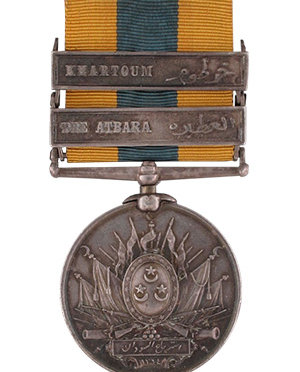
The Khedive’s Sudan Medal 1896-1908

The Khedive’s Sudan Medal is a campaign medal established 12 February 1897 by Khedive Abbas Hilmi Pasha and awarded to Egyptian and British forces for service during the reconquest of Sudan and the final part of the Mahdist War.

The medal was initially created to commemorate the reconquest of the Dongola province in 1896, but subsequently authorized for later campaigns and actions until 1908. 

All those who received the Khedive’s Sudan Medal for service on the Nile during 1896-98 also received the Queen’s Sudan Medal.

The medal was awarded with fifteen different clasps, although it’s seldom seen with more than two:

  • Firket (7 June 1896)
  • Hafir (19-26 September 1896)
  • Abu Hamed (7 July 1897)
  • Sudan 1897
  • The Atbara (8 April 1898)
  • Khartoum (2 September 1898) (For the Battle of Omdurman)
  • Gedaref (7 September to 26 December 1898)
  • Gedid (22 November 1899)
  • Sudan 1899
  • Bahar-ed-Ghazal 1900-02
  • Jerok (January to March 1902
  • Nyam-Nyam (January to May 1905)
  • Talodi (2-15 June 1905)
  • Katfia (April 1908)
  • Nyima (1-21 November 1908)

The Khedive’s Sudan Medal 1896-1908 Design

The medal is circular and measures 39 millimeters in diameter. It was awarded in silver to soldiers of the Egyptian and British armies, and in bronze to a small number of non-combatants, mainly grooms from the Indian Army and officers’ servants.

The obverse of the medal shows the Arabic cipher of the Khedive, and the Hijri year 1314. The reverse features an oval shield superimposed over a trophy of flags and arms.

The ribbon is 38 mm wide, yellow with a broad center stripe of blue, representing the Nile flowing through the desert.

The medal hangs from a straight bar suspension. For British troops, the recipient’s name and details were engraved on the medal’s edge.
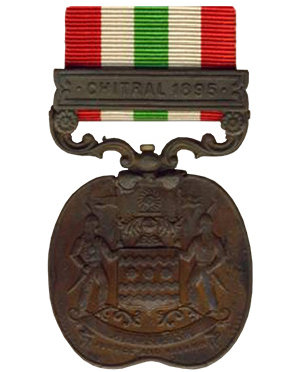
The Jummoo and Kashmir Medal

The Jummoo and Kashmir Medal is a British campaign medal established in 1895 and awarded by the Maharajah of Jummoo (Jammu) and Kashmir to the Indian troops who participated in the defense of Chitral, a dependency of Kashmir, during the siege of 4 March to 20 April by Chitralis and Afghans led by Umra Khan and Sher Afzur.

The medal always comes with the clasp and has the name of the maker (GURNEY LONDON) on the reverse. The medal in silver was presumably awarded to officers and the medal in bronze to other ranks.

The Jummoo and Kashmir Medal Design

The medal has a unique kidney shape and measures 35 millimeters high and 38 millimeters wide.

The obverse shows the arms of Jummoo (Jammu) and Kashmir. The reverse bears a view of Chitral fort with troops in the foreground.

The ribbon is white with red stripes at the edges and a central green stripe. 

The India Medal

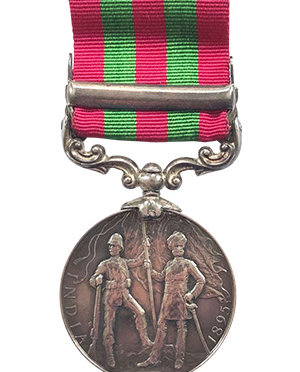
The India Medal was approved in 1896 and issued as an award to officers and men of the British and Indian armies.

The India Medal is a campaign medal approved in 1896 for issue to officers and men of the British and Indian armies. This medal replaced the India General Service Medal (1854).

The India Medal was awarded for various minor military campaigns in India, chiefly for service on the North-West Frontier from 1895 to 1902.

Each campaign was represented by a clasp on the ribbon of the medals. Seven were sanctioned:

  • Defense of Chitral 1895 (3 March – 13 April 1895)
  • Relief of Chitral 1895 (7 March – 15 August 1895)
  • Punjab Frontier 1897-98 (10 June 1897 – 6 April 1898)
  • Malakand 1897 (26 July – 2 August 1897)
  • Samana 1897 2 (August – 2 October 1897)
  • Tirah 1897-98 (2 October 1897 – 6 April 1898)
  • Waziristan 1901-02 (23 November 1901 – 10 March 1902)

The India Medal Design

The medal is circular, struck in silver for soldiers of the British and Indian armies, and in bronze to native bearers and servants. It measures 36 millimeters (1.4 in) in diameter.

The obverse bears the profile of Queen Victoria or, for those awarded the medal with the Waziristan 1901–02 clasp, King Edward VII, both with a suitable inscription. The reverse portrays a British and an Indian soldier together carrying a standard with the inscription “India 1895“, and the Edward VII version omits the date. The reverse was designed by G. W. de Saulles.

The ribbon measures 1.25 inches (32 mm) wide and has five equal stripes of red, green, red, green, red.

The name and details of the recipient were engraved on the edge of the medal, normally in running script.

The Hong Kong Plague Medal

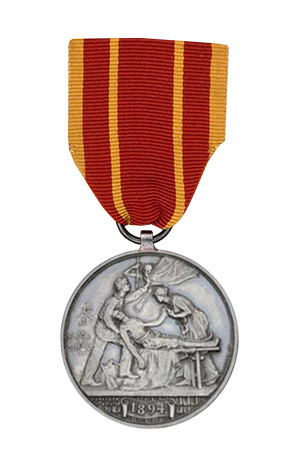
The Hong Kong Plague Medal was established in 1894 and awarded by the colonial authorities in Hong Kong to nurses, civil servants, police, British Army and Royal Navy personnel who rendered assistance when the crown colony was stricken by a severe epidemic of bubonic plague in 1894.

Even though stringent measures were taken, bubonic plague swept through Hong Kong from May to September 1894, claiming 2,500 lives. To deal with such a deadly epidemic, the Sanitary Board passed bye-laws on 11 May 1894 that permitted house-to-house searches to discover and isolate as soon as possible persons suffering from plague and to clean the houses in which plague was present. Initially, the work was carried out by the local European police inspectors and sergeants accompanied by Chinese constables and detectives, but as the epidemic spread like wildfire, the work soon exceeded the capacity of the local police.

About 400 medals were issued in silver and awarded to 300 men of the King’s Shropshire Light Infantry, 50 petty officers and ratings of the Royal Navy and NCOs and other ranks of the Royal Engineers, as well as about the same number of police and junior officials. Exactly 45 medals were struck in gold for award to officers, nursing sisters and senior officials.

The medal was not authorized for wear on uniform by the British troops.

The Hong Kong Plague Medal Design

The medal is circular, struck in silver or gold and measures 36 millimeters (1.4 in) in diameter.

The obverse shows a Chinese man lying on a bed being tended to by a female nurse while a man holds off the winged figure of Death. The figure of Death is aiming his spear at a plague-stricken Chinese man laid on a table. The woman, symbolizing Charity, has her right hand on the patient’s heart and her left hand holding a bottle of medicine. On the left the words ‘Hong Kong‘ are inscribed in Chinese characters, while a scroll shows the date 1894.

The reverse bears two inscriptions: ‘For services rendered during the plague of 1894‘ and ‘Presented by the Hong Kong Community‘.

The ribbon is red with yellow edges and two thin yellow stripes down the center. The naming is in impressed capitals giving the recipients rank, name, and regiment.

Notes

This page was updated on 21 March 2023. The medal showed an image that belonged to Liverpool Medals but didn’t show the correct attribution. 

The Central Africa Medal

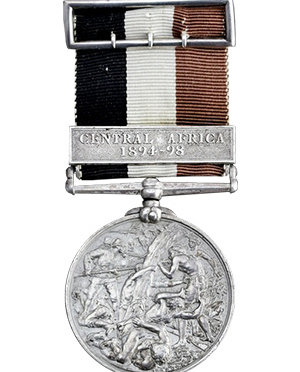
The Central Africa Medal is a campaign medal awarded for service in Eastern and Central Africa and 1894-1898 in British Central Africa.

The Central Africa Medal is a British campaign medal awarded for service 1891-1894 in Eastern and Central Africa, and 1894-1898 in British Central Africa.

Award of the medal was approved by Queen Victoria in Army Order No. 66, 1 April 1895. The initial decoration was for various military expeditions from July 1891 to June 1894, but was subsequently extended to the Unyoro Expedition in 1895 and later authorized for service in British Central Africa 1895-1898.

Most medals were awarded to members of the Indian Army and British-led local forces for suppressing slave-trading or to punish raids on neighboring tribes.

No British Army units were present, although some British officers and non commissioned officers seconded to local units received the medal, as did a small number of Royal Navy personnel.

The Central Africa Medal Design

The medal is circular, measures 36 millimeters (1.4 in) in diameter and was struck in silver to combatants and in bronze to native porters and authorized servants. The medal uses the same design as the Ashantee Medal and the East and West Africa Medal, although with a different ribbon.

The obverse shows the left-facing effigy of Queen Victoria wearing a diadem with a veil behind. On either side is the inscription VICTORIA on the left and REGINA on the right. The designer for the obverse was Leonard Charles WyonThe reverse shows a scene, inspired by the Ashanti War, of British soldiers fighting the Ashanti in the jungle. It was designed by Sir Edward John Poynter.

The ribbon measures 31.7 millimeters (1.25 in) wide, and has three equal stripes of black, white and pale brown, also described as copper or terra cotta. It was worn with the black to the left when facing the wearer and the colors symbolize the troops who took part – African, European, and Indian.

The recipient’s name and unit were usually engraved or impressed on the rim of the medal, although some were issued unnamed.

The Hunza Nagar Badge

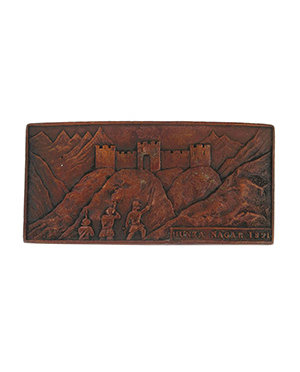
The Hunza Nagar Badge was manufactured by Gurney of London in 1891 and awarded by the Maharajah of Jammu and Kashmir to his troops who served in the operation against the border states of Hunza and Nagar. This war is known in Pakistan as the “Anglo-Brusho War”.

The British gained control of Nagar during a battle at Nilt Nagar (Jangir-e-Laye) in 1891. The fort at Nilt was stormed, and after a fortnight’s delay, the cliffs beyond it were also carried by assault. Hunza and Nagar were occupied, the chief of Nagar was reinstated on making his submission, and the half-brother of the raja of Hunza was installed as chief in the place of his brother.

Awarded in a single class, it was originally worn as a brooch at the neck, and later, it was decided that it could be worn as a medal and some of the badges had the fittings altered in order to accommodate the ribbon. Approximately 1,515 of the badges were issued.

Recipients of the Hunza Nagar badge also qualified for the Indian general service medal with clasp for Hunza 1891.

The Hunza Nagar Badge Design

The medal is a rectangular plaque struck in bronze and measures 46 by 27 millimeters in diameter.

The obverse shows an officer and two sepoys storming the fort in the hills at Nilt, with mountains in the background and the inscription “HUNZA NAGAR 1891” below and to the right.

The reverse is plain except for the maker mark “GURNEY & SON, LONDON, WOODSTOCK STREET” or just “WOODSTOCK STREET”.

The suspension in through two loops on the reverse. The ribbon is 46mm by 32mm large and has a broad red diagonal bar and white center stripe and green upper left and lower right corners.

The British South Africa Company’s Medal

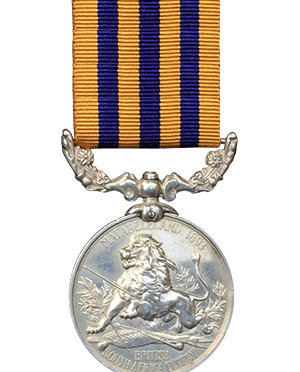
The British South Africa Company Medal was sanctioned by Queen Victoria to troops who had been engaged in the First Matabele War.

The British South Africa Company Medal is a British campaign medal established in 1896 and sanctioned by Queen Victoria and the British South Africa Company to troops who had been engaged in the First Matabele War. The majority of awards were to colonial and locally-raised troops, rather than members of the regular British Army.

In 1897, the award was extended to those engaged in the two campaigns of the Second Matabele War, namely Rhodesia (1896) and Mashonaland (1897). The three medals are the same except for the name of the campaign for which the medal was issued, inscribed on the reverse.

In 1927, the government of Southern Rhodesia re-issued the medal and instituted a new clasp, to commemorate the Pioneer Column that operated within Mashonaland in 1890. Those previously awarded the medal were required to exchange it for the new version.

The four clasps issued were:

  1. Matabeleland 1893
  2. Rhodesia 1896
  3. Mashonaland 1897
  4. Mashonaland 1890

The British South Africa Company’s Medal Design

The medal is circular, struck in silver and measures 36 millimeters (1.4 in) in diameter. It was manufactured by Heaton and Company of Birmingham.

The obverse shows a left-facing effigy of Queen Victoria wearing a diadem and veil. Around the edge is inscribed “Victoria Regina”.

The reverse was designed by Richard Caton Woodville Jr and depicts a charging lion, wounded in the chest with an assegai. In the foreground are native weapons and a shield, in the background is a mimosa bush, and below the scene the inscription: “BRITISH SOUTH AFRICA COMPANY”. The recipient’s first eligible campaign is inscribed at the top on all versions of the medal except the 1927 issue.

The ribbon measures 35 millimeters (1.4 in) wide and is watered silk in golden yellow with three dark blue stripes.

The swiveling suspension bar is decorated with shamrocks, thistles and roses. The medals were named to the recipient using a number of different engraved and impressed styles, depending on when the medal was issued.

The Imperial British East Africa Company’s Medal

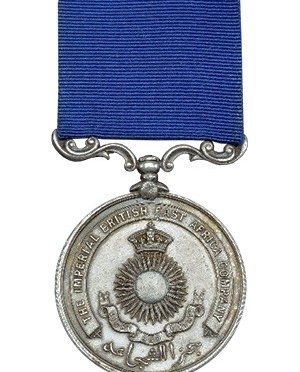
The Imperial British East Africa Company Medal was established in 1890 and is the rarest of the medals awarded by the chartered companies. It was initially intended solely as a gallantry award, but after the BEA Company was wound up in 1895 further issues were authorised for service in Witu (1890) and the Ugandan civil war (1890-91).

The Imperial British East Africa Company (or IBEAC) was a commercial association founded to develop African trade in the areas controlled by the British Empire. The company was incorporated in London on 18 April 1888, and granted a royal charter by Queen Victoria on 6 September 1888. The IBEAC oversaw an area of about 246,800 square miles (639,000 km2) along the eastern coast of Africa. It granted immunity of prosecution to British subjects whilst allowing them the right to raise taxes, impose custom duties, administer justice, make treaties and otherwise act as the government of the area.

The following campaigns were in the company’s jurisdiction:

  • The campaign against the sultan of Witu (1890),
  • Uganda Religious War 1891-92.

There are only 29 confirmed medals and post 1895 authorizations.

The Imperial British East Africa Company’s Medal Design

The medal is circular, struck in silver and measures 40mm in diameter.

The obverse shows the company’s arms of a crowned sun and a scroll underneath with the inscribed motto “LIGHT AND LIBERTY“. The Arabic inscription beneath that translates as ‘The Reward of Bravery‘. Around the outer edge, the name of the company is inscribed: “THE IMPERIAL BRITISH EAST AFRICA COMPANY“.

The reverse is plain, except for a lotus flower wreath.

The ribbon is plain dark blue and the suspension is a plain ring suspender (above) or a swiveling scroll suspender (below).

The North West Canada Medal

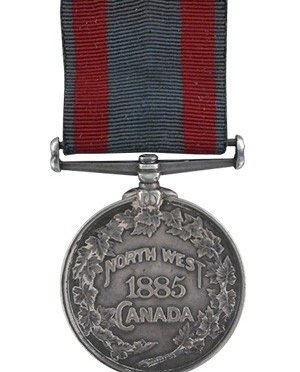
The Northwest Canada Medal is a British campaign medal established by the Canadian Government in September 1885 and issued to the soldiers, volunteers, and North-West Mounted Police (NWMP) personnel who participated in putting down the North-West Rebellion in 1885 and who served west of Port Arthur, Ontario.

The medal was created after consultation between the Governor-General of Canada and the British Secretary of State for the Colonies. Recipients included a number of volunteers, including the crew of the steamer “Northcote” for service at the Battle of Batoche, and members of the Prince Albert Volunteers for service at the Battle of Duck Lake.

Although no British Army units took part, seventeen British Army officers were attached to Canadian units. All those who received the medal, except for members of the NWMP, also received a grant of 320 acres of land, or scrip of $80 in lieu. During the 1930s, surviving NWMP recipients were each granted $300.

The clasp SASKATCHEWAN was awarded to those present at any of the three main encounters during the rebellion. Approximately 1,760 medals were awarded with this clasp. A number of veterans of the Battle of Batoche added an unofficial “BATOCHE” clasp to their medal.

Medals were issued unnamed, although many recipients had their name and unit engraved on the rim.

The North West Canada Medal Design

The medal is circular, struck in silver and measures 36 millimetres (1.4 in) in diameter. The obverse was designed by L. C. Wyon and the reverse by Thomas Brock.

The obverse shows an effigy of Queen Victoria, facing left and wearing a diadem and veil. Around the edge is the inscription VICTORIA REGINA ET IMPERATRIX. The reverse bears the inscription NORTH WEST 1885 CANADA in three lines surrounded by a wreath of maple leaves.

The medal is suspended from a ribbon in slate grey 32 millimetres (1.3 in) wide, with crimson 6 millimetres (0.24 in) stripes, 3 millimetres (0.12 in) from each edge.

The General Gordon’s Star for the Siege of Khartoum

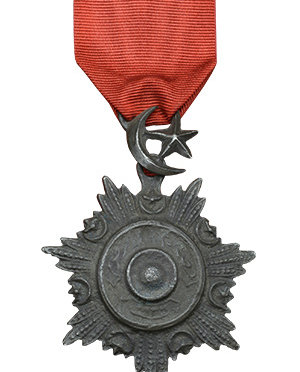
The General Gordon’s Star for the Siege of Khartoum is a British campaign medal established in 1884 and created by Charles Gordon to boost the morale of the garrison at Khartoum.

Several serious defeats of Egyptian forces in 1884 led to a concerted British campaign in defence of Egyptian claims, but control could not be recovered. The British withdrew their forces to Egypt and to Khartoum, where General Gordon defended the city whilst awaiting a relief column that, beset by Mahdist attacks, arrived too late. Gordon had the star cast locally in a sand mould, using his own breast star of the Turkish Order of Mejidieh as the model.

When a recipient had to purchase their medal, the proceedings went to a fund to feed the poor. Payne reported a story which suggests that owners of these stars became particular targets of the Mahdi’s vengeance.

The General Gordon’s Star for the Siege of Khartoum Design

The medal is a seven-pointed silver or pewter star measuring 80 mm high and 54 mm wide, with three concentric circles and seven groups of rays. On each ray are superimposed seven crescents and stars.

The obverse depicts a central boss in a circle with three Arabic enclosed inscriptions and chevrons between them. The reverse is plain.

The medal is suspended by a ring from a Crescent and Star ornament. The ribbon is deep blue or red.