The Nassau Waterloo Medal

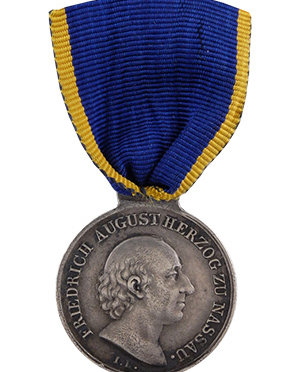
The Waterloo Medal is a campaign of the Duchy of Nassau established by Frederick Augustus, Duke of Nassau on 23 December 1815.

The Waterloo Medal is a campaign of the Duchy of Nassau established by Frederick Augustus, Duke of Nassau on 23 December 1815.

The Duchy of Nassau was an independent state between 1806 and 1866 and was located in what is now the German states of Rhineland-Palatinate and Hesse. Its ruling dynasty, now extinct, was the House of Nassau. On 17 July 1806, the remaining counties of Nassau-Usingen and Nassau-Weilburg joined the Confederation of the Rhine.

For the Waterloo Campaign the Duke brought a force of 7,400 into the field, many of whom were seasoned veterans from the French armies of the Peninsular War.

The Nassau Waterloo Medal Design

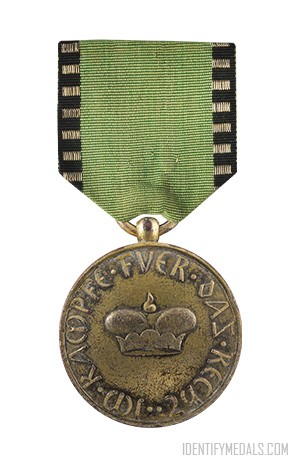
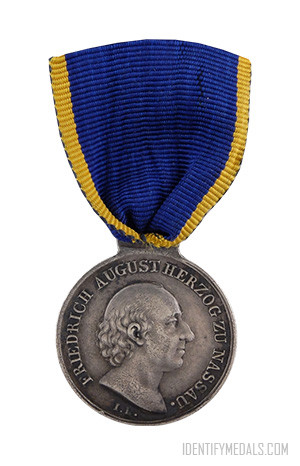
The medal is struck in silver and measures 28 mm in diameter.

The obverse shows Duke Friedrich of Nassau, and the reverse bears the winged figure of Victory crowning a soldier with laurels. The exergue has inscribed the date of the action. 

The ribbon is dark blue edged in yellow.

The Different Waterloo Medals

The Waterloo medal was issued by the British Government to all soldiers present during action. Seven nations of the Seventh Coalition struck differently designed medals for soldiers who took part in the campaign. These are:

The Waterloo Medal - British Medals Pre-WW1

The Waterloo Medal

The Waterloo Medal is a British military medal established in 1816-17 and struck for all those who participated in the Waterloo campaign.

British Campaign Medals: The Brunswick Waterloo Medal

The Brunswick Waterloo Medal

The Brunswick Waterloo Medal was a campaign medal awarded to those who participated in the Battles of Quatre Bras and Waterloo.

British Campaign Medals: The Hanoverian Waterloo Medal

The Hanoverian Waterloo Medal

The Hanoverian Waterloo Medal was issued to all members of the Hanoverian army who fought in the battles of Quatre Bras and Waterloo.

Where to Find Waterloo Medals

Right Now on eBay 
Clicking a link to eBay may result in a referral commission being paid if a purchase is made.
Loading...

The Hanoverian Waterloo Medal

The Hanoverian Waterloo Medal was issued to all members of the Hanoverian army who fought in the battles of Quatre Bras and Waterloo.

The Hanoverian Waterloo Medal was a British Campaign issued to all members of the Hanoverian army who fought in the battles of Quatre Bras and Waterloo 16–18 June 1815.

The Hanoverian troops, excluding those of the King’s German Legion, present on the 16, 17 and 18 June at Battle of Quatre Bras and Waterloo, under the command of General Charles Alten, amounted to almost 16,900 men, equivalent to 18% of Wellington‘s Allied Army.

This medal was founded by George, the Prince Regent in December 1817, and was awarded to every soldier who was present in the Hanoverian army at the Battle of Waterloo.

The medal remained the property of the soldier, and if he left the military service, he was still allowed to wear it. It could not, however, under any circumstances, be transferred from one soldier to another (after the death of the first recipient, it was ordered that it should remain in his family as an heirloom).

The Hanoverian Waterloo Medal Design

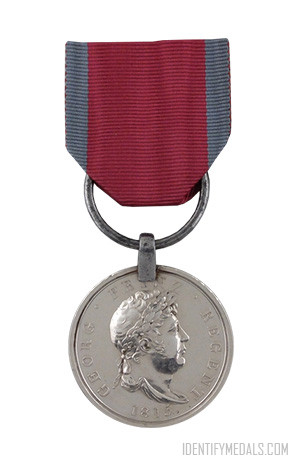
The medal is struck in silver and measures 35 mm in diameter.

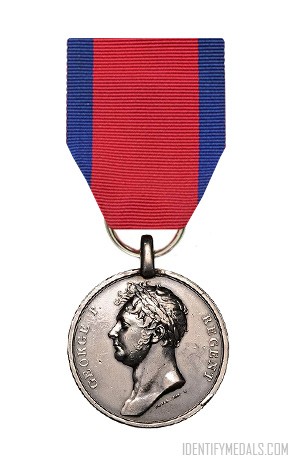
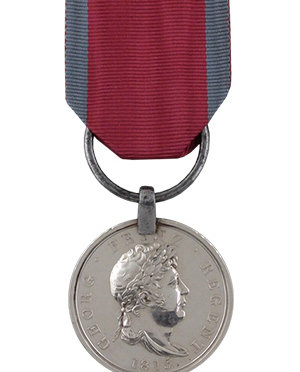
The obverse shows a profile and laureate head of the Prince Regent to the right, with the legend “GEORG. PRINZ. REGENT, 1815” around it. The reverse bears two branches of laurel and a breastplate, with two spears and two colors crossed on either side. Underneath is the date “WATERLOO JUN. XVIII.” and, above, in Roman letters, “HANNOVER SCHER TAPFERKEIT“. Round the rim is inscribed the soldier’s name, regiment, etc.

The ribbon is maroon edged with light blue.

The Different Waterloo Medals

The Waterloo medal was issued by the British Government to all soldiers present during action. Seven nations of the Seventh Coalition struck differently designed medals for soldiers who took part in the campaign. These are:

The Waterloo Medal - British Medals Pre-WW1

The Waterloo Medal

The Waterloo Medal is a British military medal established in 1816-17 and struck for all those who participated in the Waterloo campaign.

British Campaign Medals: The Brunswick Waterloo Medal

The Brunswick Waterloo Medal

The Brunswick Waterloo Medal was a campaign medal awarded to those who participated in the Battles of Quatre Bras and Waterloo.

British Campaign Medals: The Nassau Medal for Waterloo

The Nassau Waterloo Medal

The Waterloo Medal is a campaign of the Duchy of Nassau established by Frederick Augustus, Duke of Nassau on 23 December 1815.

Where to Find Waterloo Medals

Right Now on eBay 
Clicking a link to eBay may result in a referral commission being paid if a purchase is made.
Loading...

The Brunswick Waterloo Medal

The Brunswick Waterloo Medal was a campaign medal awarded to those who participated in the Battles of Quatre Bras and Waterloo.

The Brunswick Waterloo Medal was a campaign medal of the Duchy of Brunswick, a historical German state established by the Congress of Vienna in 1815. The medal was awarded to troops and officers from Brunswick who participated in the Battles of Quatre Bras and Waterloo.

The Brunswick Waterloo Medal was authorized by the Prince Regent.

The Brunswick Waterloo Medal Design

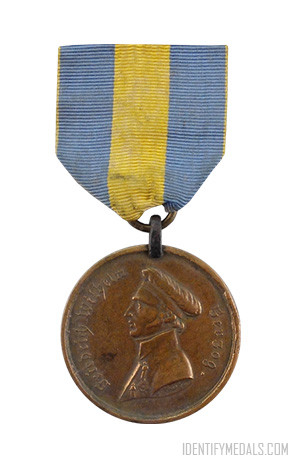
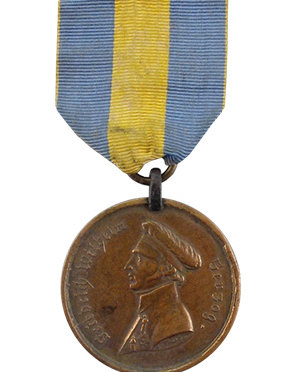
The medal is struck in bronze from captured French cannons and measures 35 mm in diameter.

The obverse shows, in a left-facing profile, the fallen Duke of Brunswick, Frederick William. Around the edge is the inscription, in German Script, “FRIEDRICH WILHELM HERZOG”. The reverse bears the date 1815 in the center, surrounded by a wreath of oak and laurels. Around the outside of the wreath is the inscription, “Braunschweig Seinen Kriegern” (or “Brunswick to her Warriors”) and “Quatrebras und Waterloo” below.

The ribbon measures 1 12 inches (38 mm) wide, and is yellow with blue edge stripes 38 inch (9.5 mm) wide. The medal is suspended from a steel clip and ring.

The Different Waterloo Medals

The Waterloo medal was issued by the British Government to all soldiers present during action. Seven nations of the Seventh Coalition struck differently designed medals for soldiers who took part in the campaign. These are:

The Waterloo Medal - British Medals Pre-WW1

The Waterloo Medal

The Waterloo Medal is a British military medal established in 1816-17 and struck for all those who participated in the Waterloo campaign.

British Campaign Medals: The Hanoverian Waterloo Medal

The Hanoverian Waterloo Medal

The Hanoverian Waterloo Medal was issued to all members of the Hanoverian army who fought in the battles of Quatre Bras and Waterloo.

British Campaign Medals: The Nassau Medal for Waterloo

The Nassau Waterloo Medal

The Waterloo Medal is a campaign of the Duchy of Nassau established by Frederick Augustus, Duke of Nassau on 23 December 1815.

Where to Find Waterloo Medals

Right Now on eBay 
Clicking a link to eBay may result in a referral commission being paid if a purchase is made.
Loading...

The Army Gold Medal

The Army Gold Medal is a British campaign medal awarded to field and general officers in recognition of successful commands in campaigns.

The Army Gold Medal, also known as the Peninsular Gold Medal, was a British campaign medal awarded to field and general officers in recognition of successful commands in campaigns, predominantly the Peninsular War (1807–1814). The medal was issued only to officers whose status was no less than that of battalion commander or equivalent.

The Peninsular War was a military conflict fought by Bourbon Spain and Portugal, assisted by Great Britain, against the invading and occupying forces of the First French Empire for control of the Iberian Peninsula during the Napoleonic Wars. The war on the peninsula lasted until the Sixth Coalition defeated Napoleon in 1814, and is regarded as one of the first wars of national liberation, significant for the emergence of large-scale guerrilla warfare.

Naval Gold Medals had been awarded since 1794 to captains and admirals who had served in specified successful naval actions. The Army Gold Medal was established in 1810 to reward service at Napoleonic War battles since 1808. Like the Maida Gold Medal, it was awarded only to majors and above and, like the Naval Gold Medal, it was awarded in two sizes, with the larger to senior officers. In October 1813, to prevent a proliferation of awards to one recipient, an order was created instructing that only one medal be worn.

The award could be awarded posthumously, and sent to the officer’s family.

The Army Gold Medal Design

The medal is struck in gold and measures 54 mm and 33 mm in diameter.

Large Gold Medal

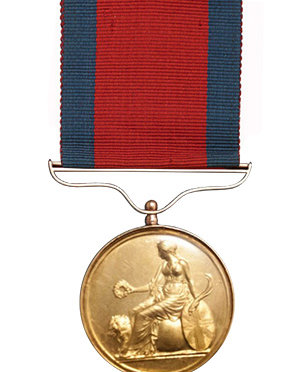
The Large Gold Medal, restricted to general officers, was designed by Thomas Wyon. It was mounted in a gold frame, and glazed on both sides. The obverse shows Britannia with a shield, seated and facing left and holding a laurel wreath in her right hand and a palm branch in her left. Behind her is the head of a lion. The reverse shows a laurel wreath, with the name of the battle engraved in the center, although that for Barrosa was die struck. The large medal was worn around the neck.

Small Gold Medal

The Small Gold Medal, awarded to officers between the rank of major and colonel. was mounted in a gold frame and glazed, and had the same design as the large medal. It was worn on the left chest, often from a buttonhole, with the ribbon attached via a wide curved suspender.

Gold (or Peninsular) Cross

The Gold (or Peninsular) Cross, awarded to those who earned four or more gold medals. It is an ornamental cross pattée with a proud lion at its center and the four qualifying actions embossed on its arms. The obverse and reverse are the same. The medal was worn around the neck with the ribbon attached via an ornate loop.

The ribbon for all the awards was broad crimson with blue borders and measured 1.75 inches (44 mm) wide.

The Maida Gold Medal

The Battle of Maida Medal was established in 1806 and awarded to the thirteen senior officers involved in the battle of Maida. Only an unknown number of gold and silver specimens are known to exist.

The Battle of Maida was fought on 4 July 1806 was a battle between the British expeditionary force under General Sir John Stuart and a much larger French force outside the town of Maida in Calabria, Italy during the Napoleonic Wars. Sir John Stuart’s forces numbered about 4,500, while Marshal Reynier’s force consisted of more than 6,000. French casualties were heavy, estimated to be in excess of 2,000, while those of the British were limited to less than 400.

The Battle of Maida was the British Army’s first victory since the beginning of the French Revolution on mainland Europe. It shattered Napoleon’s aura of invincibility, created by his outstanding victories such as Marengo and Austerlitz. It also proved to the Duke of Wellington, who received a report on the battle, that British lines could beat French columns.

The Maida Gold Medal Design

The medal is struck in gold and measures 39 mm in diameter.

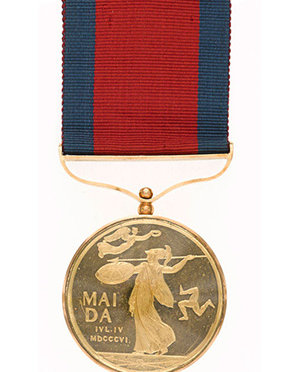
The obverse shows the laureated profile of George III. The reverse bears the winged figure of Victory hovering with a laurel wreath over the head of Britannia. Britannia has her shield upraised and is in the act of throwing a spear. The name and date of the battle appear on her left, with the trinacria or three-legged emblem on the right.

The ribbon measures 38mm wide and is crimson edged with navy blue.

The Naval Gold Medal

The Naval Gold Medal is a British Campaign medal awarded between 1793 and 1815 to senior officers of the Royal Navy for specified actions.

Twenty-two large medals were awarded to flag officers (admirals), commodores and captains of the fleet, while 117 smaller medals were awarded to captains. Because a separate medal was awarded for each action, it was possible for a recipient to receive and wear more than one.

Awards of the gold medal were discontinued after 1815, as would-be recipients became eligible for the Order of the Bath.

The Naval Gold Medal Design

The medal was struck in gold and measured 51 mm (large) and 38 mm (small) in diameter.

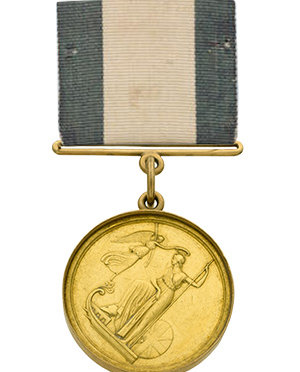
The obverse shows the winged figure of Victory bestowing a laurel wreath on the head of Britannia, standing in the prow of a galley with a Union Jack shield behind her. Her right foot is on a helmet, and her left hand holds a spear.

The reverse bears the engraved rank and name of the recipient, and the event and date for which the medal was awarded. The large medal has a surround of a wreath of oak and laurel.

The ribbon measures 44mm wide for the large medal and 38 mm for the small, and is white with dark blue edges.

The Coorg Medal

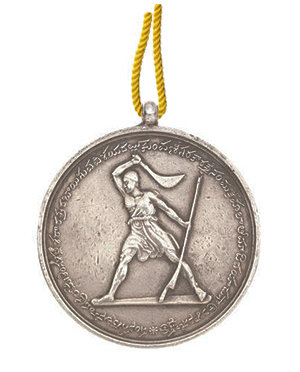
The Coorg Medal was authorized in August 1837 and awarded by the Honourable East India Company (HEIC) to local forces who helped suppress the rebellion of 1837.

Coorg was annexed into the Madras Presidency of the British HEIC after the Coorg War of 1834. In April 1837 a rebellion broke out, but soon ended when many chiefs and local troops gave their support to the British.

The medal was not awarded to all participants, but only to the most senior among the loyal Coorgs and those that had distinguished themselves. DewansSubedars, and other chiefs received the medal in gold (a total of 44 awarded), with fourteen of the most distinguished receiving it suspended from a gold chain. Lesser leaders and peasant class combatants received the medal in silver (300 awarded).

Europeans and members of the armies of the Honourable East India Company from outside Coorg were not eligible for this medal.

The Coorg Medal Design

The medal was struck at the Calcutta Mint in gold or silver and measured 50 mm in diameter.

The obverse shows the figure of a Coorg warrior raising a knife in his right hand ready to strike, while his left-hand holds a musket. Around the perimeter is an inscription in Canarese script reading: “A mark of favor given for loyalty to the Company’s Government in suppressing rebellion in the months of April and May 1837.”

The reverse bears crossed knives and other Coorg ornaments within a wreath, surrounded by the English language inscription: “For distinguished conduct and loyalty to the British Government. Coorg April 1837.”

The medal was awarded without a ribbon, but with a chain (for the gold medals) or yellow cord (for the rest).

The Nepal Medal

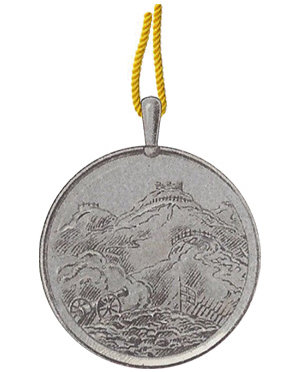
The Nepal Medal was authorised on 20 March 1816 and awarded by the Honourable East India Company (HEIC) to native Indian officers, and Indian soldiers for particularly distinguished conduct during the Anglo-Nepalese War of 1814–16.

The award was created by the Marquess of Hastings, Governor-General of India, for award to all native Indian officers, and to selected native soldiers for distinguished zeal and courage during the War. The War was fought between the British HEIC and the Kingdom of Nepal as a result of border disputes between the two countries, and ended in 1816 with the Treaty of Sugauli.

A total of 300 medals were awarded. Members of the British Army were not eligible for the medal, but were entitled to the Army of India Medal with clasp Nepaul.

The Nepal Medal Design

The medal was struck at the Calcutta Mint in gold or silver and measured 51 mm in diameter.

The obverse shows a fortified mountain-top with, in the foreground, a cannon and troops marching with a flag and fitted bayonets behind a hill.

The reverse bears the Persian inscription: “This medal was conferred by the Nawab Governor-General Baghatur, in testimony of the energy, good service, skill and intrepidity which was displayed during the campaigns in the hills, in the Hijri years 1229 and 1230.”

The medal was awarded without a ribbon, but with a yellow cord.

The Java Medal

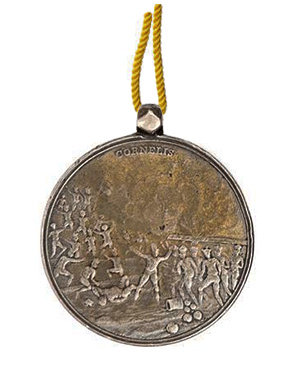
The Java Medal is a campaign medal authorized in February 1812  and awarded by the Governor-General of India to soldiers of the armies of the Honourable East India Company (HEIC) who participated in the Invasion of Java in August and September 1811, during the Napoleonic Wars.

The medal was awarded to more senior officers in gold (133 awarded) and other ranks in silver (6,519 awarded). Recipients of the silver medal included both native Indian (5,761 recipients) and European (about 750 recipients) soldiers in HEIC service.

Members of the British Army and Royal Navy present did not receive the medal, but were instead eligible for the Military General Service Medal with Java Clasp.

The Java Medal Design

The medal was struck at the Calcutta Mint in gold or silver and measured 49 mm in diameter.

The obverse shows the storming of Fort Cornelis, which British and HEIC troops captured on 26 August 1811, with the word CORNELIS above.

The reverse bears the Persian inscription “This medal was conferred in commemoration of the bravery and courage exhibited by the Sepoys of the English Company in the capture of the Kingdom of Java, in the Hijri year 1228″ with the inscription around the edge reading “JAVA CONQUERED XXVI AUGUST MDCCCXI”.

The medal was awarded without a ribbon, but with a yellow cord.

The Bagur and Palamos Medal

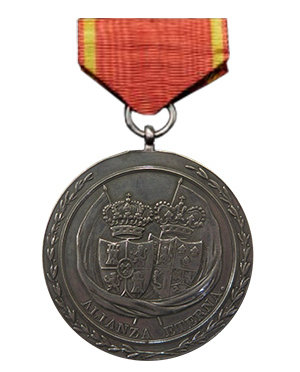
The Bagur and Palamos Medal was awarded by the Spanish Government to the Officers, seamen, and marines of H.M. Ships Kent, Ajax and Cambrian as a reward for the assistance they rendered the Spaniards in their attempt to expel the French from Catalonia in September 1810.

At Bagur, the Spaniards with the help of the British Marines, defeated a French detachment and destroyed a battery, and in the attack on Palamos, by the co-operation of the ships, the French were again defeated and the place taken.

The medal was awarded in gold and silver, with as few as 8 gold medals being awarded.

The Bagur and Palamos Medal Design

The medal was struck in gold or silver and measured 45 mm in diameter.

The obverse bears the crowned shields of Spain and Great Britain placed side by side, surrounded by their respective flags. An inscription below reads ‘ALIANZA ETERNA.’, surrounded by a laurel wreath.

The reverse shows the inscription, ‘BAGÚR 10 de Setiembre 1810‘ ‘PALAMÓS 14 de Setiembre 1810‘ and, enclosed by a circle, ‘GRATITUD DE ESPAÑA A LA INTREPIDEZ BRITANICA.’

The ribbon is red with yellow edges.