The Medal for Capture of Rodriguez, Isle of Bourbon and Isle of France

The Medal for the capture of Rodriguez, Isle of Bourbon and Isle of France is a campaign medal awarded by the Governor-General of India to native Indian soldiers of the East India Company (EIC), the Bengal and Bombay Armies who took part in the capture of three French islands on the Indian Ocean.

These actions included the Island of Rodriguez in July 1809; the Isle of Bourbon (now Réunion) in July 1810; and the Isle de France (now Mauritius) in November 1810. Only 200 EIC troops were present in Rodrigues, the smallest, while the Isle de France involved 10,000 British and Indian forces.

The medal was authorized in September 1811 by Lord Minto, the Governor-General of India, and the medals were completed and distributed in 1813. A total of 2,201 medals were issued, with native Indian officers awarded the medal in gold (45 awarded) and other ranks receiving silver medals (2,156 awarded).

The Medal for Capture of Rodriguez, Isle of Bourbon and Isle of France Design

The medal was struck at the Calcutta Mint in gold or silver and measures 49 mm in diameter.

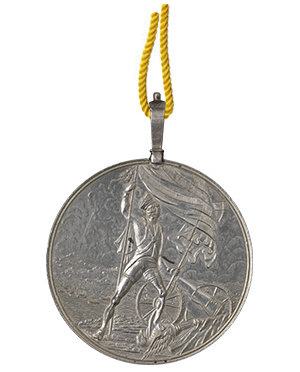
The obverse depicts a sepoy standing in front of a field gun, holding a Union Jack in his right hand and a musket with a fixed bayonet in his left. His foot tramples the French colors and Imperial Eagle, while the British fleet is at anchor is in the background.

The reverse bears an inscription in Persian, within a wreath, that translates as: “This medal was conferred in commemoration of the bravery and accustomed fidelity exhibited by the Sepoys of the English Company in the capture of the Mauritius Islands in the Hijri year 1226″. Around the edge and outside the wreath, is the English inscription: “RODRIGUES VI JULY MDCCCIX. BOURBON VIII JULY & ISLE OF FRANCE III DEC. MDCCCX”.

The medal was issued unnamed with a flattened loop for suspension, through which passed a yellow cord allowed the medal to be worn around the neck.
The Davison’s Trafalgar Medal

Time Period: Pre-WW1
Year of Institution: 1805
Country: Great Britain

The Davison’s Trafalgar Medal was awarded to survivors of the action by Alexander Davison, Nelson’s prize agent. It was given to the ratings of HMS Victory who took part in the battle.

This medal is said to have been given as a gift of Mr. A. Davison.

The Davison’s Trafalgar Medal Design

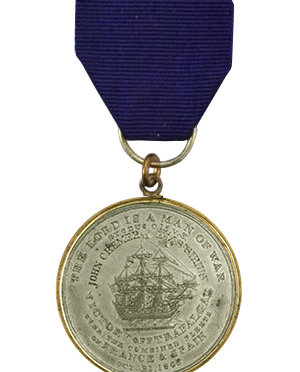
The medal is struck in pewter with a copper ring and measures 52 mm in diameter.

The obverse bears an oval shield with Nelson’s arms and ribbon below inscribed with his motto ‘PALMAM QUI MERUIT FERAT‘, surmounted by a bust of the admiral within laurel and palm branches. Around the shield is inscribed the motto ‘TRIA . JUNCTA . IN . UNO.’ and ‘ADMIRAL LORD NELSON D. OF BRONTE‘. The inner line reads ‘ENGLAND EXPECTS EVERY MAN WILL DO HIS DUTY‘ and bellow ‘NATUS SEP. 29. 1758.’ ‘HOSTE DEVICTO REQUIEVIT’, ‘OCT. 21 1805‘. The maker’s initials are ‘H.F.’

The reverse shows a starboard broadside view of a ship of the line at anchor and the legend: ‘THE LORD IS A MAN OF WAR’, ‘EXODUS C.15. V.3.’, ‘JOHN CREMER HMS SIRIUS‘ and below ‘VICTORY OFF TRAFALGAR OVER THE COMBINED FLEETS OF FRANCE & SPAIN’, ‘OCT. 21.1805‘.

The medal was given without a ribbon but used unofficially a 32 mm navy blue one.

The Boulton’s Trafalgar Medal

The Boulton’s Trafalgar Medal was struck by Matthew Boulton of the Soho Mint, Birmingham, on his own initiative, to be presented to survivors of the battle of Trafalgar. Boulton was “publicly saddened” that King George III had not produced an award for the brave Royal Navy seamen who fought & won the Battle of Trafalgar on 21st October 1805.

It’s said that when the crews found out that the medal wasn’t made of silver (they were small, flat, two-piece metal shells) and couldn’t be pawned for 5 shillings, the vast majority were duly thrown overboard into the harbor.

The medal was re-stuck on at least two occasions. There’s a medal in the exhibition at the Nelson, Navy, Nation Gallery in the National Maritime Museum, Greenwich, London.

The Boulton’s Trafalgar Medal Design

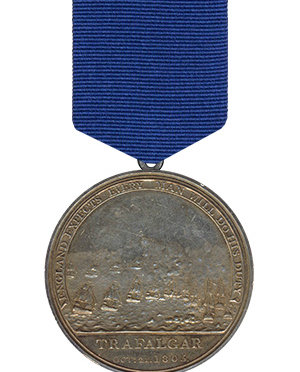
The medal is struck in gold, silver, white metal, gilt-bronze or bronze and measured 48 mm in diameter.

The obverse shows the bust of Vice-Admiral Viscount Nelson with pigtail, in uniform and with ribbon and star of the Bath. An inscription reads: ‘HORATIO VISCOUNT NELSON K.B. DUKE OF BRONTE &‘.

The reverse shows a general view of the battle and the legend: ‘ENGLAND EXPECTS THAT EVERY MAN WILL DO HIS DUTY‘. On the exergue is inscribed: ‘TRAFALGAR. OCTR. 21. 1805‘.

The medal was initially awarded without a ribbon or suspension but unofficially used a 32mm navy blue one.

The Highland Society’s Medal for Egypt 1801

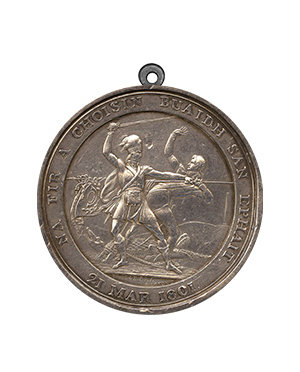
The Highland Society’s Medal for Egypt 1801 was awarded by the Highland Society of London to all ranks of The Black Watch, or 42nd Regiment, for their conduct at the Battle of Alexandria on 21 March 1801, against the French.

General Abercromby commanded the British expedition to Egypt (landing at Aboukir Bay on 2 March 1801) in the face of strenuous French opposition in what is considered one of the most brilliant exploits of all times. Abercromby died after a surprise attack on 21 March and died aboard the flagship seven days later.

Medals in gold were presented to the Prince Regent and Abercromby’s sons, while later silver and bronze variations were awarded to senior officers of the expedition and soldiers who had distinguished themselves in the campaign.

The Highland and Agricultural Society (now Royal) was founded in 1784 to promote the development of agriculture in Scotland (and in particular in the Highlands).

The Highland Society’s Medal for Egypt 1801 Design

The medal is struck in gold or silver, and measures 49 mm in diameter. It was designed by Pidgeon.

The obverse bears the right-facing bust of General Sir Ralph Abercromby and a Latin inscription alluding to his death in Egypt. The reverse shows  a Gaelic inscription: “NA FIR A CHOISIN BUAIDHSAN EPHAIT“, or ‘These are the heroes who won Victory in Egypt‘ and the date 21 MAR 1801. On the edge is the inscription “On choumun Chaeleach D’on Fhreiceadan Dubh Na XLII RT” (or “From the London Highland Society to the Black Watch or 42nd Regt.)

The emblem of the sphinx was awarded as a battle honor to regiments that had distinguished themselves in the Egyptian Campaign of 1801.

The medals were originally awarded without a ribbon.

The Sultan’s Medal for Egypt

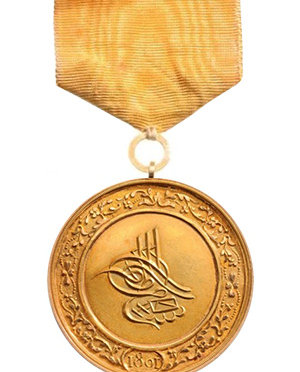
The Sultan’s Medal for Egypt was awarded by Sultan Selim III of Turkey to British Officers and NCOs for their participation in the Turkish campaign against the French in Egypt in 1801.

This medal was produced in five gold versions for award to different ranks of commissioned officers, and one silver version for award to sergeants and corporals.

Fewer than 100 First Class medals were ever awarded.

The Sultan’s Medal for Egypt Design

The medal is struck in gold or silver, and varies in size.

The obverse shows, within a ribboned arabesque floral wreath as a border, the Sultan’s toughra or monogram. The reverse bears, within a similar border, the crescent of the moon and an eight-pointed star.

The medals were originally suspended by a gold hook and chain, while the silver medals were hung from a sand-colored ribbon.

The Earl St Vincent’s Medal

The Earl St Vincent’s Medal was instituted in 1800 and presented in silver and bronze to officers and sailors who had followed Admiral Sir John Jervis from his flagship Victory to the Ville de Paris (and remained loyal to him during the mutiny at the Nore, which involved over 10% of the seamen in the Royal Navy).

When the British fleet under Admiral Sir John Jervis defeated a much larger Spanish fleet under Admiral Don José de Córdoba y Ramos near Cape St. Vincent, Portugal in February 1797, Jervis was made Baron Jervis of Meaford and Earl St Vincent and was granted a pension for life of £3,000 per year.

A specimen in gold was presented to George III and is now in the British Museum and there is also another gold example in the National Maritime Museum.

The Earl St Vincent’s Medal Design

The medal is struck in gold or silver, and measures 48 mm wide. It was designed by Lady Spencer (as recorded in correspondence to her from Jervis in June 1801).

It’s not known how many gold specimens were made, but it can only have been a couple or so.

The obverse bears the bust of the Admiral with his hair long and tied with a ribbon. The uniformed bust of Adml. Jervis l. is surrounded by the inscription “EARL ST VINCENT’S TESTIMONY OF APPROBATION 1800“.

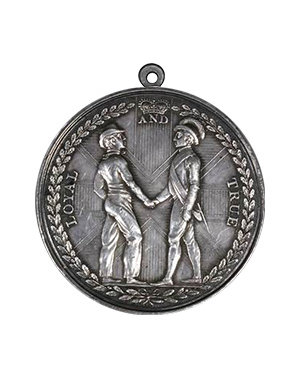
The reverse shows a Rev. Naval Officer and enlisted sailor shaking hands, with a backdrop of the Union flag, all within an oaken wreath.

The medal was awarded without a ribbon.

The Davison’s Nile Medal

The Davison’s Nile Medal was instituted in 1798 by Alexander Davison, who was appointed by Nelson for the captured ships after the battle of the Nile on 1 August 1798.

Davison had this medal struck and presented to all who took part in the action. It was awarded in gold to Nelson and his captains, in silver to Lieutenants and Warrant Officers, in gilt metal to Petty Officers, and in copper to seamen and marines.

Admiral Nelson’s medal was stolen in 1900 and it’s believed to have been melted down.

The Davison’s Nile Medal Design

The medal is struck in gold, silver, gilt-bronze or bronze and measures 47 mm wide.

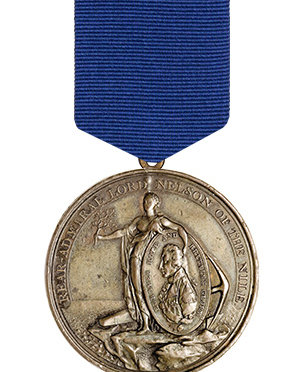
The obverse shows, on a rock near the sea, Peace standing and holding in her right an olive branch. She supports with her left hand a medallion of Nelson, an anchor behind her. An inscription reads ‘REAR-ADMIRAL LORD NELSON OF THE NILE‘, ‘EUROPE’S HOPE AND BRITAIN’S GLORY‘, and below: ‘C.H.K‘. (C.H. Küchler).

The reverse bears a view of Aboukir Bay (the Aboukir promontory on the eastern rather than the western side of the bay), the English Fleet going into action and the French at anchor. A legend reads ‘ALMIGHTY GOD HAS BLESSED HIS MAJESTY’S ARMS‘. In the exergue is the inscription ‘VICTORY OF THE NILE AUGUST 1 1798‘, ‘M . B . SOHO‘ and ‘C . H . KUCHLER . FEC.’ The edge reads: ‘FROM ALEXR DAVISON, ESQR. ST. JAMES’ SQUARE A TRIBUTE OF REGARD.’

The award was given without a ribbon, but was used with an unofficial 32mm wide deep navy blue one and fitted with a ring.

The St Vincent’s Black Corps Medal

The St Vincent’s Black Corps Medal was instituted in 1795 and awarded to NCOs and men of the St. Vincent’s Black Rangers for service against rebellious Caribs and French forces in 1795.

The first Capture of Saint Vincent took place between 16 and 18 June 1779 during the American Revolutionary War. A French force commander named Charles-Marie de Trolong du Rumain landed on the island of Saint Vincent in the West Indies and quickly took over much of the British-controlled part of the island, assisted by local Black Caribs who held the northern part of the island. The area remained under Carib control until the Second Carib War of 1795, a conflict that pitted large numbers of British military forces against a coalition of Black Carib, runaway slaves, and French forces for control of the island.

British efforts to penetrate and control the interior and windward areas of the island were repeatedly frustrated by disease, incompetence and effective Carib defenses until a major military expedition by General Ralph Abercromby was eventually successful in crushing the Carib opposition in 1797.

The Corps of Natives were raised by Major Seton from among the island’s slaves for service against the rebellious forces.

The St Vincent’s Black Corps Medal Design

The medal is struck in bronze and measures 48.5 mm wide.

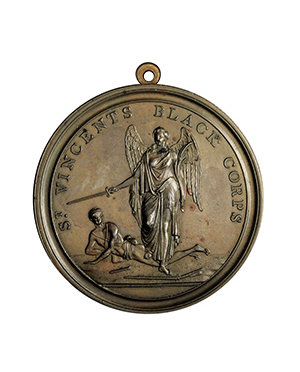
The obverse shows the winged figure of Victory brandishing a sword over a fallen foe who has abandoned his musket. The reverse bears a native holding a musket and a bayonet and has the inscription “BOLD ROYAL OBEDIENT” around and “H.G.FEC.” in the exergue.

The award was given without a ribbon.

The Defence of Gibraltar Medal

The Defence of Gibraltar Medal was instituted on 13 September 1782 by military commanders General Eliott and Sir John Picton, and awarded to British and Hanoverian troops present during the Franco-Spanish siege of 1779-1783.

Several private medals were struck to commemorate the Defence of Gibraltar during thesiege. The most commonly encountered are the ones struck in silver, which were provided by George Augustus Eliott and Sir Thomas Picton themselves.

The Defence of Gibraltar Medal Design

The medal is struck in silver and measures 49 mm wide (Eliott) and 59 mm wide (Picton).

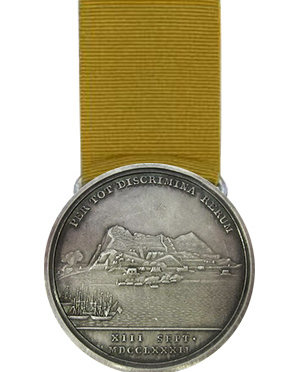
The obverse for Eliott’s medal was designed by Lewis Pingo and shows a view of the Rock and the naval attacks of 13 September 1782, the climax of the siege. The reverse shows an inscription reading BRUDERSHAFT (“Brotherhood” in German), above a wreath containing the names of the three Hanoverian commanders and General Eliott.

The obverse of Picton’s medal shows a map of the Rock. The reverse shows a 22-line text (the most verbose British medal) above a recumbent lion crutching a shield bearing the castle and key emblem of Gibraltar.

The award was given without a ribbon or suspension, although some later examples show a yellow one.

The Carib War Medal

The Carib War Medal was instituted by the Legislative Assembly of St Vincent in the West Indies and awarded to British and West Indian forces (members of the militia and volunteers) who took part in fighting attempts by white settlers to seize Carib-owned land in 1772-1773, which led to a negotiated peace.

The Caribs were descended from the original Carib population of the eastern Caribbean who had intermarried with runaway African slaves. After the allocation of St Vincent to Britain in the Peace of Paris in 1763, the white planters who settled there attempted to seize Carib lands, but the latter fought a successful campaign of resistance and forced the British to sign a treaty recognizing their rights.

The Carib War Medal Design

The medal is struck in  silver and measures 52 mm wide.

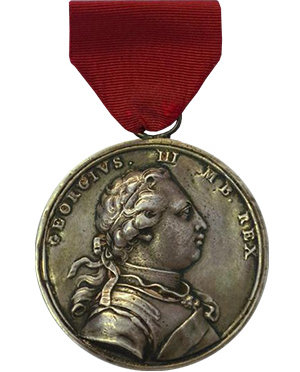
The obverse shows a bust of George III in armor. The reverse bears Britannia offering an olive branch to a defeated Carib, and the date MDCCLXXIII in the exergue.

The award was given without a ribbon or suspension, although some later examples show a red one.