The Louisburg Medal

The Louisburg Medal was only given to certain recipients for acts of bravery or distinguished service in the capture of Louisburg in Canada in July 1758, during the Seven Years War. The land forces were commanded by James Wolfe and Jeffrey Amherst, while the fleet was commanded by Edward Boscawen.

The medal could be awarded to British Army and Navy.

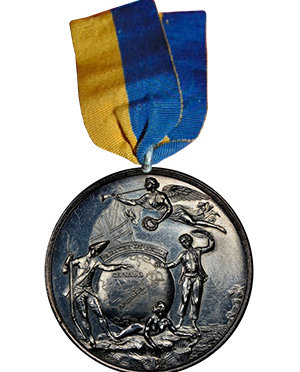
The detail of a rare gold Louisburg medal can be seen on this page courtesy of the National Maritime Museum, Greenwich, London (not on display).

The Louisburg Medal Design

The medal is struck in gold, silver or bronze and measures 42 mm wide.

The obverse shows a globe surrounded by allegorical figures of victory and flanked by servicemen. A Grenadier on the left is turning towards a woman crushed below the globe, who points to approaching boats, while a sailor on the right waves his hat. The inscription on the globe reads “CANADA“, “AMERICA“. The reverse bears burning ships in the harbor, with batteries in the foreground firing at two French vessels, one in flames (The Prudent) and one being towed away (The Bienfaisant). The legend reads “LOVISBOVRG . TAKEN . MDCCLVIII“.

The ribbon measures 32 mm wide and is half yellow and half blue, although the medal was not initially intended for wear and has no suspension.
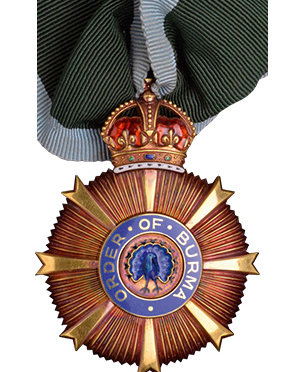
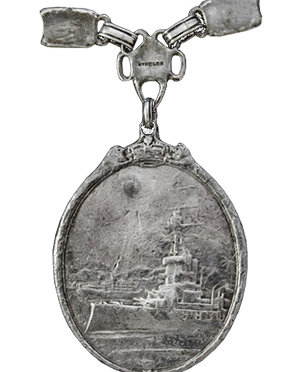
The Order of Burma

The Order of Burma was awarded by the Governor for long, faithful and honorable service by Commissioned Officers in the Burma Forces.

The Order of Burma was instituted by King George VI three years after Burma became independent of British India. It was awarded by the Governor of British Burma for long, faithful and honorable service by Governor’s Commissioned Officers (for example native Burmese) in the Burma Army, the Burma Frontier Force, and the Burma Military Police.

The award was founded by Royal Warrant on 10 May 1940, and conferred in a single class. It September 1945 the royal warrant was amended to permit awards of the order for gallantry.

Only 24 awards were made.

The Order of Burma Design

The Order was struck in gold and is a rayed circle measuring 52 mm high and 39 mm (1.5 in) in diameter.

The obverse has a central roundel showing a peacock displaying his tail, surrounded by the words ‘ORDER OF BURMA’ and surmounted by an Imperial crown.

The ribbon measures 38 mm and is dark green with light blue edges.

The King’s Medal for Native Chiefs

The King’s Medal for Native Chiefs was instituted in 1920 and awarded exceptionally in silver-gilt and usually in silver.

The King’s Medal for Native Chiefs was instituted in 1920 and awarded exceptionally in silver-gilt (First Class) and usually in silver (Second Class).

Various large silver medals were struck for award to native chiefs in various parts of the world, from the eighteenth century onwards. This oval medal was worn around the neck from a silver collar. More modern issues, however, are smaller and intended for wear with a ribbon from the breast.

The medal is normally returned on the death of the recipient.

The King’s Medal for Native Chiefs Design

The medal is struck in silver or silver-gilt and measures 40mm by 34 mm (the original oval with collar) or 36mm by 32mm (the later circular version). 

The obverse bears the crowned effigy of the monarch. The reverse shows a warship, symbolic of imperial power. The medals of Elizabeth II come in two versions: On is larger in size and has a collar, the other is smaller (1955) and fitted with a plain ring for suspension.

The ribbon is yellow watered silk, with two white central stripes (silver-gilt_ or a single white stripe (silver).

The Sea Gallantry Medal

The Sea Gallantry Medal (or SGM, officially ‘The Board of Trade Medal for Saving Life at Sea‘), is an award for civil gallantry at sea in Great Britain and the Commonwealth issued through the Merchant Shipping Act 1854 and first struck in 1855. This medal is exceptional in that it was authorized not by Royal Warrant but by Parliamentary legislation.

The 1856 Act made provision for monetary rewards for life-saving at sea, but in 1855 this was transmuted into medals in gold, silver or bronze. These medals were first warded either for ‘humanity‘, where there was little risk to the life of the recipient or for gallantry, where there was a significant risk to the recipient. The gold medal, if it was ever awarded, must have been of the greatest rarity.

Recipients were entitled to the post-nominal “SGM” until 29 November 2019.

There have only been two awards of the Sea Gallantry Medal (Bronze) since 1974: one in 1981 and the other in 1989. The medal was appeared to have fallen into disuse, although the award (as of 2020) has not been canceled.

The Sea Gallantry Medal Design

The medals were struck in silver or bronze (maybe in gold) and measured initially 58mm. These were not intended for wearing. In 1903 Edward VII ordered that the medal be reduced to 33mm wide and fitted with a suspension bar and ribbon for wearing. Both medals were issued with a minimum of the recipient’s name and date of rescue around the rim, and were sculpted by Bernard Wyon.

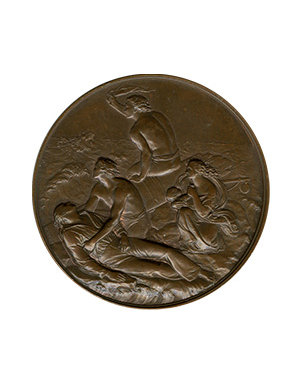
The obverse shows the profile of the reigning monarch. The reverse bears the image of a family on a storm-tossed shore reviving a drowning sailor.

The ribbon is bright red with narrow white stripes towards the edges.

The King’s Medal for Service in the Cause of Freedom

The King’s Medal for Service in the Cause of Freedom was awarded to foreign civilian nationals who had given meritorious service to the Allied cause.

The King’s Medal for Service in the Cause of Freedom is a British medal instituted on 23 August 1945 by King George VI and awarded to foreign civilian nationals, mainly of allied countries, who had given meritorious service to further the interests of the British Commonwealth or the Allied cause during World War II.

Among those activities recognized by the decoration are fundraising for British war relief, scientific research that aided the war effort, and organizing ambulance services. Those who helped British military personnel to escape the enemy, return from occupied areas or for other dangerous work for the British or Allied cause during the war were eligible for the King’s Medal for Courage in the Cause of Freedom.

The medal was awarded 2,539 times.

The King’s Medal for Service in the Cause of Freedom Design

The medal is struck in silver and measures 36 millimeters (1.4 in) in diameter.

The obverse shows the left facing crowned effigy of King George VI with the inscription ‘GEORGIVS VI D:G:BR:OMN:REX ET INDIAE IMP‘.

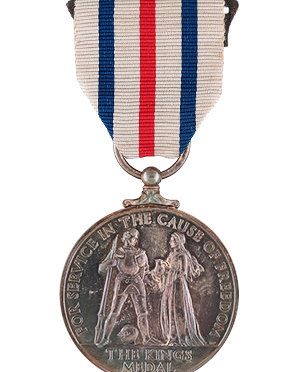
The reverse bears a medieval warrior in armor carrying a broken lance, being offered sustenance by a woman. The upper circumference is inscribed ‘FOR SERVICE IN THE CAUSE OF FREEDOM‘, with ‘THE KINGS MEDAL‘ below.

The ribbon measures 32 millimeters (1.3 in) wide and is white with a central red stripe, flanked by blue stripes. The medal has a ring suspension and was awarded unnamed.

The Allied Subjects’ Medal

The Allied Subjects’ Medal is a decoration awarded to citizens of allied countries who gave assistance to British and Commonwealth soldiers.

The Allied Subjects’ Medal is a British decoration instituted in 1920 and distributed by the Foreign Office to citizens of allied and neutral countries who gave assistance to British and Commonwealth soldiers – especially escaped prisoners of war, behind enemy lines between 1914–1918. Most medals were awarded to Belgian and French citizens, although Danish, Dutch and other nationals also received it.

Because of delays caused by discussions within Government on the precise form and design of the award meant that it was only manufactured and distributed in 1922.

In France and Belgium, it was generally referred to as Médaille de la Reconnaissance britannique or Médaille de la Reconnaissance anglaise, after the Médaille de la Reconnaissance française.

In total, 134 silver and 574 in bronze medals were awarded, nearly half to women. In addition, 28 further foreign nationals who had rendered notable assistance received honorary appointments to the Order of the British Empire, while about one thousand others received letters of thanks for their services.

The Allied Subjects’ Medal Design

The medal was struck in silver and bronze, and measures 36 millimeters (1.4 in) in diameter. Both medals have the same design.

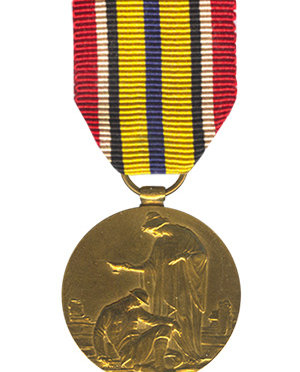
The obverse shows the left facing bareheaded effigy of King George V with the inscription “GEORGIVS V BRITT: OMN: REX ET IND: IMP:“. The reverse bears a female allegory of Humanity offering a cup to a British soldier resting on the ground, with ruined buildings in the background.

The ribbon is 25 millimeters (1.0 in) wide, and incorporates the French and Belgian national colors: It’s red with a light blue center, flanked by stripes of yellow black and white.

The medal was awarded unnamed.

The medal has a ring suspension.

The Distinguished Conduct Medal

The Distinguished Conduct Medal, or DCM, was established in 1854 and is the oldest British award for gallantry in the field by other ranks.

The Distinguished Conduct Medal, or DCM, was established in 1854, during the Crimean War, by Queen Victoria. It’s the oldest British award for gallantry in the field by other ranks (personnel who are not commissioned officers) of the British Army. The medal was also awarded to personnel of other Commonwealth Dominions and Colonies.

The Distinguished Conduct Medal ranked below the Victoria Cross, until its discontinuation in 1993 when it was replaced by the Conspicuous Gallantry Cross. Prior to its institution, there had been no official medal awarded by the British Crown in recognition of individual acts of gallantry in the Army. The Distinguished Conduct Medal was awarded with a gratuity, that varied in amount depending on rank, and given on the recipient’s discharge from the Army.

In May 1894, Queen Victoria authorized Colonial governments to adopt various military medals for awards to their local military forces. The Colony of Natal and the Cape Colony introduced this system in 1894, and the Transvaal Colony followed in 1902, while Australia, Canada and New Zealand also adopted the medal. However, only the Natal and Canada versions were finally awarded.

All awards of the Distinguished Conduct Medal were notified in the London Gazette and, during the First World War, citations were generally also included.

A bar was introduced in 1881 to be awarded in recognition of each subsequent act of distinguished conduct for which the medal would have been awarded.

The Distinguished Conduct Medal Design

The medal is struck in silver and is a disk measuring 36 millimeters (1.4 inches) in diameter and 3 millimeters (0.12 inches) thick.

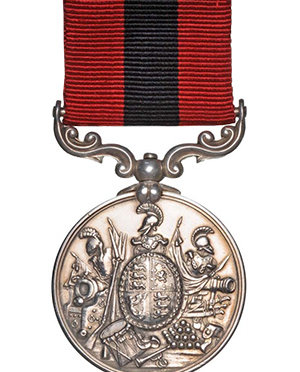
The original obverse shows a Trophy of Arms, designed by Benedetto Pistrucci, which incorporates a central shield bearing the Royal Coat of Arms without any inscription. From 1902, after the accession of King Edward VII, the effigy of the reigning monarch replaced the trophy of arms, with the respective titles of the monarch inscribed around the perimeter. There were eight variants of the obverse:

  • King Edward VII – “EDWARDVS VII REX IMPERATOR”.
  • King George V, bareheaded – “GEORGIVS V BRITT: OMN: REX ET IND: IMP:”.
  • King George V, crowned – “GEORGIVS•V•D•G•BRITT•OMN•REX•ET•INDIÆ•IMP•”.
  • King George VI – Two versions: “GEORGIVS VI D:G:BR OMN REX ET INDIAE IMP:” and “GEORGIVS VI DEI GRA: BRITT: OMN: REX FID: DEF:”.
  • Queen Elizabeth II – Two versions,: “ELIZABETH II D:G:BR:OMN: REGINA F:D:” and “ELIZABETH II DEI GRATIA REGINA F.D”.

The reverse is smooth, with a raised rim and the inscription “FOR DISTINGUISHED CONDUCT IN THE FIELD” in four lines, underlined by a laurel wreath between two spear blades.

The suspender is an ornamented scroll. The ribbon is 32 millimeters wide and dark crimson, with a 10 millimeters wide navy blue band in the center. All medals awarded bear the recipient’s number, rank, name and unit on the rim.

The Albert Medal for Lifesaving

The Albert Medal for Lifesaving is a British medal established by a Royal Warrant on 7th March 1866 and awarded to recognize the saving of life. It has since been replaced by the George Cross.

The medal was named in memory of Prince Albert and originally was awarded to recognize saving life at sea. It was discontinued in 1971 with the last two awards promulgated in the London Gazette of 31 March 1970. The first recipient was Samuel Popplestone, a tenant farmer who on 23 March 1866 helped to rescue four men after the cargo ship Spirit of the Ocean lost its battle with force eleven gales and was torn apart as it was swept onto the notorious Start Point rocks in Devon.

A Royal Warrant in 1867 created two classes of Albert Medal. The titles of the medals changed in 1917, the gold “Albert Medal, first-class” becoming the “Albert Medal in gold” and the bronze “Albert Medal, second class” being known as just the “Albert Medal”.

The decoration was discontinued in 1971 and all living recipients were invited to exchange the award for the George Cross. From the total of 64 eligible to exchange, 49 took up the option.

The Albert Medal for Lifesaving Design

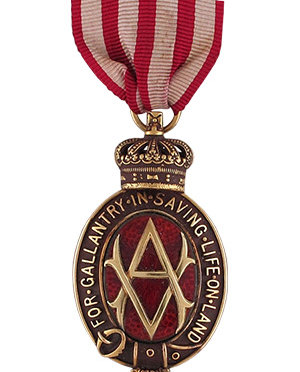
The medal was made of gold (although early examples are gold and bronze), and consists of an oval enclosing the entwined initials V and A. The sea medals have, in addition, an anchor. The oval is enclosed by a bronze garter with the words FOR GALLANTRY IN SAVING LIFE, with AT SEA or AT LAND as appropriate, and is enameled in red or crimson respectively. The medal is surmounted by a crown pierced by a ring for suspension.

The original medal had a blue ribbon 58” (16 mm) wide with two white stripes. A further Royal Warrant in 1867 created two classes of Albert Medal, and the ribbon of the first-class changed to 1 ​38” (35 mm) wide with four white stripes.

The Kaisar-I-Hind Medal

The Kaisar-i-Hind Medal for Public Service was awarded by the Emperor or Empress of India from 1900 to 1947 for significant contributions.

The Kaisar-i-Hind Medal (or Kaisar-i-Hind Medal for Public Service in India, قیصرِ ہند‎ qaisar-e-hind in Urdu, कैसर-इ-हिन्द in Hindi) was established in May 1900 (instituted by Queen Victoria on 10 April 1900) and awarded by the Emperor/Empress of India between 1900 and 1947 to “any person without distinction of race, occupation, position, or sex who shall have distinguished himself (or herself) by important and useful service in the advancement of the public interest in India.

The word kaisar, meaning “emperor” is a derivative of the Roman imperial title Caesar. The title Kaisar-i-Hind was coined in 1876 by the orientalist G.W. Leitner in a deliberate attempt to dissociate British imperial rule from that of preceding dynasties.

The last ruler to bear it was George VI. While never officially rescinded, the Kaisar-i-Hind ceased to be awarded following the passage of the Indian Independence Act 1947.

The Kaisar-I-Hind Medal Grades or Classes

The medal had three grades:

  • Gold
  • Silver
  • Bronze

The Gold Medal for Public Service in India was awarded directly by the monarch on the recommendation of the Secretary of State for India. Silver and Bronze medals were awarded by the Viceroy.

The Kaisar-I-Hind Medal Design

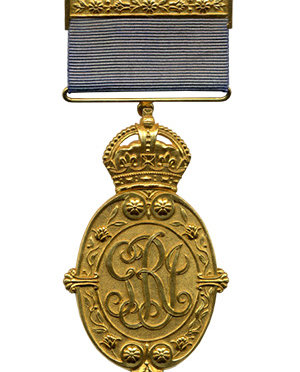
The medal measures 61 mm high and 34 mm wide. It consists of an oval-shaped badge or decoration in gold, silver or bronze with the Royal Cipher and Monarchy on the obverse, and the words “Kaisar-i-Hind for Public Service in India” on a scroll across the center against a floral background on the reverse. The badge is surmounted by the imperial crown.

The decoration was to be worn suspended from the left breast by a dark blue ribbon. The medal has no post-nominal initials.

The Order of British India

The Order of British India is an order of merit established in 1837 by the East India Company and incorporated into the British Honors System in 1859. It’s awarded for “long, faithful and honorable service“.

The Order was awarded by the Viceroy of India to selected serving officers of between 20 and 30 years of service. It was initially intended as a means of providing recognition for serving Indian officers in the East India Company’s military forces, as the so-called “Native Officers” faced slow promotion under a system that was based on advancement through seniority.

The 1st Class of the Order, limited to a further 100 people, conferred the title of sirdar bahadoor (heroic leader) and an increase in salary of two rupees a day. Appointments to the 2nd Class, entitled the recipient to the title of bahadoor (hero) and a more modest wage increase. Holders of both classes could use the post-nominal letters OBI.

In September 1939 eligibility was extended to include native officers serving in the Indian States Forces, Frontier Corps and Military Police, and further extended in January 1944 to include native officers and Indian Warrant Officers in the Royal Indian Navy and the Hong Kong and Singapore Royal Artillery, as well as foreign officers.

The order became obsolete in 1947, after the partition of British India into the Dominion of India and the Dominion of Pakistan.

The Order of British India Design

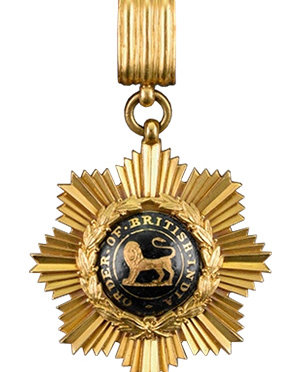
The badge for the First Class consisted of a gold star 1.7 inches (43 mm) in diameter composed of rays of gold. In its center are the words ORDER OF BRITISH INDIA encircling a lion on a background of light blue enamel, surrounded by a laurel wreath and surmounted by a Crown. The enamel behind the wording was dark blue until 1939, when it was changed to the same light blue as appears behind the lion.

The badge for the Second class comprised a slightly smaller gold star 1.5 inches (38 mm) in diameter of similar design to the first class, but without the crown and with the center enamel in dark blue enamel. 

The ribbon was originally sky-blue but changed to dark red in 1838 after it was found that the hair oil favored by Indian soldiers stained the ribbon. From September 1939 the first class ribbon had two thin light blue strips added towards the center of the dark red ribbon, while the second class had one light blue stripe added to the center of the ribbon.