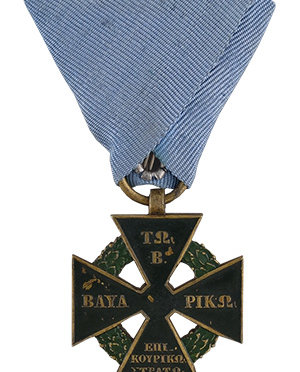
The Cross for the Bavarian Auxiliary Corps

The Cross of the Bavarian Auxiliary Corps medal was created on November 22, 1833 and awarded to 3582 members of the Bavarian Auxiliary Corps who escorted King Otho I (the young Prince Otho of Bavaria) from his native Bavaria to Greece in that same year.

The Royal Bavarian Auxiliary Corps (or Β. Βαυαρικό Επικουρικό Σώμα in GreekKgl. Bayerisches Hilfskorps in German) was a Bavarian Army expeditionary force established in 1832 to accompany Prince Otto as the first king of independent Greece in 1833, to serve as a military force and enforce order until a native military could be established. It replaced the forces maintained there by the Great Powers—chiefly the French troops of the Morea Expedition—as well as the remnants of the Greek forces organized during the Greek War of Independence.

Most of the Bavarians left by 1837, but many remained behind, dominating the Greek army and the administration. This “Bavarocracy” (Βαυαροκρατία) provoked great resentment from the Greeks, and was one of the chief causes of the 3 September 1843 Revolution. Many Bavarians remained behind in Greece and became Greek citizens.

The Cross for the Bavarian Auxiliary Corps Design

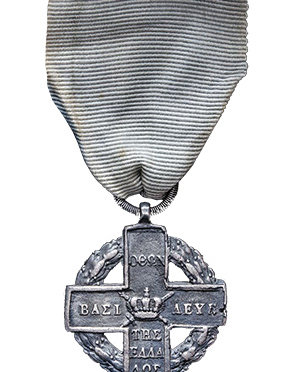
The bronze and lacquer Cross features an obverse inscription that translates to “Othon King of the Hellenes,” and a reverse inscription that translates to “To the Royal Bavarian Auxiliary Corps.”

It measures 32.7mm x 37.5mm.

The Cross for the War of Independence 1821-1829

  • Time Period: Pre-WW1
  • Year of Institution: 3 September 1843
  • Country: Greece

The Cross for the War of Independence 1821-1829 medal is was created in 1834 to be awarded to all those who took part in the Struggle for the Independence of Greece, or the Greek War of Independence.

Its final form and way of conferring were confirmed by the National Assembly of the 3rd of September 1843.

The Greek War of Independence, also known as the Greek Revolution (or Ελληνική ΕπανάστασηElliniki Epanastasi in Greek), was a successful war of independence waged by Greek revolutionaries against the Ottoman Empire between 1821 and 1830. The Greeks were later assisted by the Russian Empire, Great Britain, and the Kingdom of France, while the Ottomans were aided by their North African vassals, the eyalets of Egypt, Algeria, and Tripolitania, and the Beylik of Tunis.

The Cross for the War of Independence 1821-1829 Design

The medal is struck in bronze or silver and weights 11,1 grams. It measures 31 mm.

The Order of Beneficence (Greece)

The Order of Beneficence (or Τάγμα της Ευποιΐας in Greek), is an order of Greece established in 1948 as a moral reward for women especially, Greek and foreign, for the good services they have rendered to the Fatherland in the field of charity as well as for their performance in the arts and letters.

The medal is conferred by the Greek government and has five classes:

  • Grand Cross – wears the badge on a sash from the right shoulder, plus the star on the left chest;
  • Grand Commander – wears the badge on a bow, plus the star on the left chest;
  • Commander – wears the badge on a bow;
  • Gold Cross – wears the badge on a ribbon on the left chest;
  • Silver Cross – wears the badge on a ribbon on the left chest.

The Order of Beneficence Design

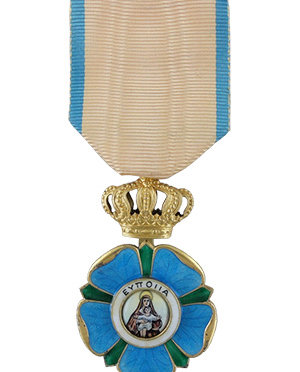
The badge of the Order is a five tipped blue-enameled flower, in silver for the Silver Cross class, in gold for the higher classes.

The overall design is clearly derived from the then-recently abolished British Order of the Indian Empire. The obverse central disc bears a portrait of the Holy Virgin with the Divine Child in Her arms with the legend “ΕΥΠΟΙΙΑ” («Beneficence») on a white enamel ring. The reverse side bears the emblem of the Hellenic Republic.

The star of the Order is a silver eight-pointed star with straight rays, with the same central disc as the obverse of the badge, while the reverse side also bears the emblem of the Hellenic Republic. The ribbon of the Order is orange with blue edges.

The Order of Honor (Greece)

The Order of Honor (or Τάγμα της Τιμής in Greek) is an order of Greece, second in rank to the Order of the Redeemer, and was established in 1975 to replace the abolished Royal Order of George I.

The medal is conferred by the Greek government upon “Greek citizens who are distinguished in struggles for the Fatherland, to senior executives of the public administration, to eminent personalities of the arts and letters as well as to distinguished scientists or individuals who excelled in the field of trade, shipping and industry. It is also conferred upon foreigners who, due to their distinguished position and through their personal worth, have contributed to the promotion of Greece“.

As all Greek orders, the Order of Honor has five classes:

  • Grand Cross (Μεγαλόσταυρος)
  • Grand Commander (Ανώτερος Ταξιάρχης)
  • Commander (Ταξιάρχης)
  • Gold Cross (Χρυσός Σταυρός)
  • Silver Cross (Αργυρός Σταυρός)

The Order of Honor Design

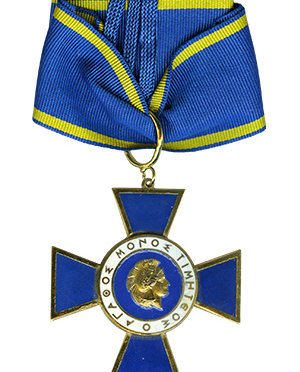
The badge of the order is a blue-enamelled cross, in silver for the Silver Cross class, in gold for the higher classes. The Silver and Gold Crosses have a diameter of 37 mm, while the senior grades have a diameter of 57 mm. A competition followed for the design of the new decoration, won by Konstantinos Kontopanos. His design was finalised in the Presidential Decree 849 of 11 November 1975.

The obverse central disc bears a portrait of the goddess Athena and the legend Ο ΑΓΑΘΟΣ ΜΟΝΟΣ ΤΙΜΗΤΕΟΣ (“Only the righteous should be honoured”) on a white enamel band. The reverse bears a simplified national emblem of Greece in the form of a white Greek cross on blue, and on a circular band the legend ΕΛΛΗΝΙΚΗ ΔΗΜΟΚΡΑΤΙΑ (“Hellenic Republic”) and the year of the order’s founding (1975).

The star of the order is a silver eight-pointed star with straight rays, with the entire badge in the centre. The reverse bears the Greek national emblem in white enamel and the legend ΕΛΛΗΝΙΚΗ ΔΗΜΟΚΡΑΤΙΑ 1975 in gold letters. The ribbon of the Order is blue with orange edges. The first four grades have a ribbon of 35 mm, with 3 mm-wide edges, while the shash of the Grand Cross is 100 mm wide, with edges 8 mm wide.

The Medal of Military Merit (Greece)

The Medal of Military Merit (Μετάλλιο Στρατιωτικής Αξίας) is a military decoration of Greece created in 1916 for wartime meritorious service.

  • Time Period: WW1
  • Year of Institution: 28 February 1917
  • Country: Greece

The Medal of Military Merit (or Μετάλλιο Στρατιωτικής Αξίας in Greek) is a military decoration of Greece, originally created in 1916 for wartime meritorious service. After World War II the medal became a peace-time medal reserved for officers. After the abolition of the Greek monarchy in 1974, its design was slightly altered.

The medal was created as the Military Medal (Στρατιωτικόν Μετάλλιον) by the National Defence Government on 28 October 1916, during the National Schism, and was adopted as the Medal of Military Merit nationwide by Royal Decree on 30 June 1917.

The Medal of Military Merit Design

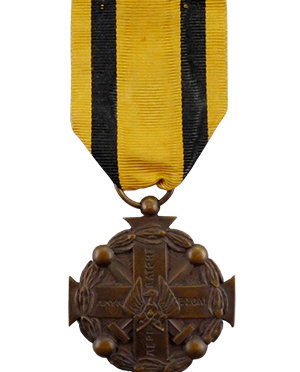
The medal was designed by the French sculptor André Rivaud (who also designed the 1916 War Cross) and is similar to its current version, a copper cross pattée concave with the arms filled, enclosed in a laurel wreath and with two crossed short swords superimposed.

The cross’s arms bear the legend ΑΜΥΝΕΣΘΑΙ ΠΕΡΙ ΠΑΤΡΗΣ (“Defending the fatherland”, a quote of Hector from the Iliad). The 1916 version had a phoenix rising from its ashes in the center, while the post-1974 version substitutes the national emblem of Greece. The 1916 version bore the legend ΕΛΛΑΣ 1916–1917 (“Greece 1916–1917”) on the reverse (although some medals omit the date or the inscription altogether), while the current version bears the legend ΓΙΑ ΣΤΡΑΤΙΩΤΙΚΗ ΑΞΙΑ (“For Military Merit”).

The 1916 version was suspended by a yellow ribbon with two black stripes, while the current version’s ribbon has three equal blue-white-blue stripes, edged with yellow. When worn as a ribbon bar, the circular wreaths were substituted by branches.

Originally the medal had four classes, with the third, second and first classes distinguished respectively by a bronze, silver and gilded laurel wreath on the ribbon, while the fourth class was plain.

The War Cross (Greece)

The War Cross (or Πολεμικός Σταυρός) is a military decoration of Greece, awarded for heroism in wartime to both Greeks and foreign allies.

  • Time Period: WW1
  • Year of Institution: 28 February 1917
  • Country: Greece

The War Cross (or Πολεμικός Σταυρός in Greek) is a military decoration of Greece, awarded for heroism in wartime to both Greeks and foreign allies.

There have been three versions of the cross, the 1917 version covering World War I (established by the Venizelist “National Defence” Government on 28 February 1917, and confirmed by Royal Decree on 31 October), the 1940 version covering the Second World War and the Greek Civil War, and the 1974 version covering peacekeeping missions in the subsequent years.

Its creation was inspired by the French Croix de guerre, and it was awarded to military personnel of all branches for acts of valor in the Macedonian Front (1916–1918), the Allied Expedition to the Ukraine (1919) and the Greco-Turkish War of 1919–1922 (rarely after 1920 due to its Venizelist connotations). In addition, from 1919, the first class could be awarded to the war flags of distinguished regiments.

When Greece found itself at war again in October 1940 after the Italian invasion, the staunchly royalist dictatorial government chose an entirely different design instead of simply re-establishing the old version. The new medal was instituted by Royal Decree on 11 November 1940 and continued to be awarded throughout the Second World War. It was re-authorised on 19 April 1947 for the Greek Civil War (1946–1949) and extended until 1953, covering the Greek participation in the Korean War.

In 1974, during the last months of the Greek military junta and following the abolition of the monarchy in June 1973, the junta issued Law 376/74 on military medals, which revised the until then current regulations. It specified that the War Cross would have three classes, with the 1st class was reserved for senior officers and war flags, the 2nd class for mid-level officers and the 3rd class for junior and warrant officers, NCOs and privates.

The War Cross Design

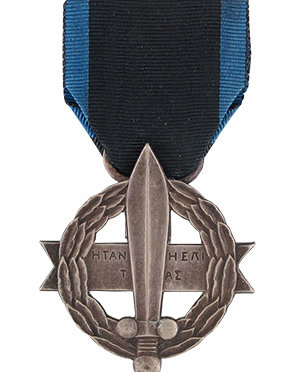
The War Cross medal was designed by the French sculptor André Rivaud and struck in silver.

1917 Version

The obverse features a vertical sword on a circular wreath, with a horizontal plaque, bearing the ancient Spartan motto “Η ΤΑΝ Η ΕΠΙ ΤΑΣ” (“[return home] either with your shield, or upon it”) underneath. The reverse bears the inscription “ΕΛΛΑΣ” (“Greece”) and underneath the dates “1916–1917”.

The ribbon was black, edged with blue, and 35–37 mm wide. The cross was awarded in three classes, distinguished by the devices born on the ribbon: the 3rd class being plain, the 2nd class bearing a bronze five-pointed star, and the 1st class a bronze palm leaf. Subsequent awards were designated by the addition of silver five-pointed stars on the ribbon.

1940 Version

The medal’s design is also a modification of the French Croix de guerre, featuring in the obverse a bronze cross pattée with the royal monogram (two crossed gammas and a crown) of King George II, atop two crossed swords, and topped by a royal crown. The reverse bears the date “1940”.

The ribbon features three equal alternating bands of red, blue and red. The cross was awarded in three classes, distinguished by the colour of the crown: bronze for the 3rd class, silver for the 2nd, and gold for the 1st class. Several variations exist because many manufacturers were used, some in Greece and others in the United Kingdom, with minor variations in the style of the crown and the cross, as well as design of the obverse side (in some versions, the date lies within a circle).

1974 Version

The medal was not officially redesigned at the time. In 1985, a provisional version was cut. It retained the same basic design as the 1940 version, but without the royal cypher, which was replaced by an oak wreath, and the crowns, which were replaced by bronze, silver and gold versions of the national emblem of Greece for the 3rd, 2nd and 1st classes respectively. The reverse bore the legend “ΕΛΛΗΝΙΚΗ ΔΗΜΟΚΡΑΤΙΑ” (“Hellenic Republic”). Four medals of the 1st class were issued to war flags of units participating in UN peacekeeping missions.

The design was finalized in Presidential Decree 159 of 17 March 2003. It retains the basic design of the 1940 and 1985 crosses, but the national emblem has been moved to the center of the cross, in bronze, silver and gold versions for the 3rd, 2nd and 1st classes respectively.

The Order of Saints Olga and Sophia

  • Time Period: Pre-WW1
  • Year of Institution: January 1936
  • Country: Greece

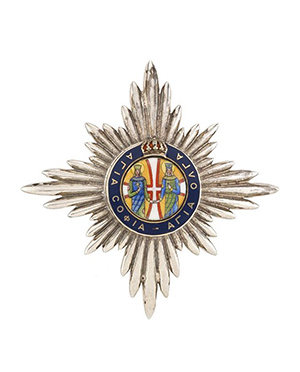
The Royal Family Order of Saints Olga and Sophia (or Βασιλικόν Οἰκογενειακόν Τάγμα Ἁγίων Ὂλγας καὶ ΣοφίαςVasilikon Oikogeneiakon Tagma Agion Olgas kai Sofias) was an order of the Greek royal family reserved for women.

It was the third highest hohor of the modern Greek state and the Crown after the Order of the Redeemer and the male-only Order of Saints George and Constantine. It was instituted in January 1936 by King George II in the memory of his grandmother (Queen Olga) and his mother (Queen Sophia).

The order was abolished in 1973 by the Greek state and today is awarded only by the head of the former Greek royal family, at the monarch’s pleasure for personal services of women to the Crown.

The Order of Saints Olga and Sophia Design

The Order is awarded on the following Grades:

  • Dame 1st Class or Grand Cross
  • Dame 2nd Class
  • Dame 3rd Class
  • Dame 4th Class
  • Grand Cross (‘Μεγαλόσταυρος’) – wears the badge of the Order on a collar or on a sash on the right shoulder, and the star of the Order on the left chest;
  • Grand Commander (‘Ανώτερος Ταξιάρχης’) – wears the badge and the star of the Order on the left chest;
  • Commander (‘Ταξιάρχης’) – wears the badge of the Order on a necklet;
  • Gold Cross (‘Χρυσούς Σταυρός’) – wears the badge on a ribbon on the left chest;
  • Silver Cross (‘Αργυρούς Σταυρός’) – wears the badge on a ribbon on the left chest.

The Order of Saints George and Constantine

The Royal Family Order of Saints George and Constantine is an order of the Greek royal family established in January 1936 by King George II.

  • Time Period: Pre-WW1
  • Year of Institution: January 1936
  • Country: Greece

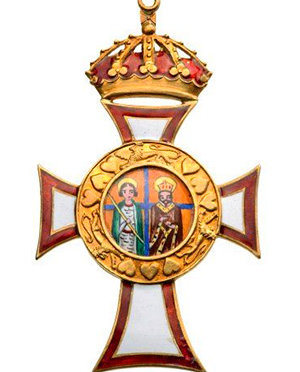
The Royal Family Order of Saints George and Constantine (or Βασιλικόν Οἰκογενειακόν Τάγμα Ἁγίων Γεωργίου καὶ ΚωνσταντίνουVasilikon Oikogeneiakon Tagma Agion Georgiou kai Konstantinou) is an order of the Greek royal family.

or the duration of its existence, it has been the second highest decoration awarded by the modern Greek state and the Greek crown, after the Order of the Redeemer. It was instituted in January 1936 by King George II in the memory of his grandfather (King George I) and his father (King Constantine I).

The order is awarded only to men, while the corresponding Order of Saints Olga and Sophia is reserved for women.

The Order of Saints George and Constantine Design

The order’s design was influenced by the royal family’s Danish origin, evoking the appearance of the Order of the Dannebrog. The order is not awarded since 1975 by the Greek state after the abolition of monarchy and today is awarded only by the Greek Royal Family.

The Order has five classes:

  • Grand Cross (‘Μεγαλόσταυρος’) – wears the badge of the Order on a collar or on a sash on the right shoulder, and the star of the Order on the left chest;
  • Grand Commander (‘Ανώτερος Ταξιάρχης’) – wears the badge and the star of the Order on the left chest;
  • Commander (‘Ταξιάρχης’) – wears the badge of the Order on a necklet;
  • Gold Cross (‘Χρυσούς Σταυρός’) – wears the badge on a ribbon on the left chest;
  • Silver Cross (‘Αργυρούς Σταυρός’) – wears the badge on a ribbon on the left chest.

The Order of the Phoenix

  • Time Period: Pre-WW1
  • Year of Institution: 13 May 1926
  • Country: Greece

The Order of the Phoenix (or Τάγμα του Φοίνικος) is an order of Greece established on May 13, 1926, by the republican government of the Second Hellenic Republic to replace the defunct Royal Order of George I.

The honor is bestowed by the Greek government to Greek citizens who have excelled in the arts and literature, science, public administration, shipping, commerce, and industry. It is also awarded to foreigners who have helped raise Greece’s international prestige.

The order was retained after the restoration of the monarchy in 1935 and continues to be awarded by the current Third Republic.

The Order has five classes:

  • GRE Order of the Phoenix - Grand Cross BAR.png Grand Cross (‘Μεγαλόσταυρος’) – wears the badge of the Order on a sash on the right shoulder, and the star of the Order on the left chest;
  • GRE Order of the Phoenix - Grand Commander BAR.png Grand Commander (‘Ανώτερος Ταξιάρχης’) – wears the badge of the Order on a necklet, and the star of the Order on the left chest;
  • GRE Order of the Phoenix - Commander BAR.png Commander (‘Ταξιάρχης’) – wears the badge of the Order on a necklet;
  • GRE Order of the Phoenix - Gold Cross BAR.png Officer or Gold Cross (‘Χρυσούς Σταυρός’) – wears the badge on a ribbon on the left chest;
  • GRE Order of the Phoenix - Silver Cross BAR.png Member or Silver Cross (‘Αργυρούς Σταυρός’) – wears the badge on a ribbon on the left chest.

The Order of the Phoenix Design

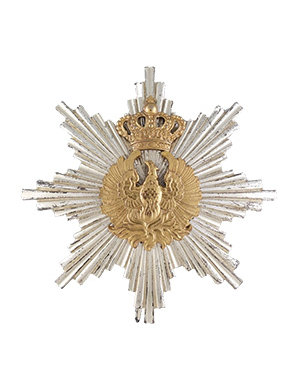
The badge of the Order is a white-enameled cross, in silver for the Silver Cross class, in gold for the higher classes, with the Phoenix (symbolizing the rebirth of the Hellenic nation) at the center. A five-pointed star is at the upper arm of the cross.

The first version of the Order (1926–1935) featured the letters “E-T-T-A” in Byzantine uncial on each arm of the cross, the initials of the motto Εκ της τέφρας μου αναγεννώμαι (“From my ashes I am reborn”). During the Monarchy (1935–1974) the letters were removed and the badge was topped by a crown, while the badge’s reverse side featured the monogram of the reigning monarch. The current version (since 1975) omits the crown, while the reverse features the Greek National Emblem with the words ΕΛΛΗΝΙΚΗ ΔΗΜΟΚΡΑΤΙΑ (“Hellenic Republic”).

The star of the Order is a silver eight-pointed star with straight rays, with the phoenix at the centre; during the Monarchy it was topped by a crown. The ribbon of the Order is orange with black edges. Crossed swords on the insignia indicate that the award was given in the military division of the Order.

The Royal Order of George I

  • Time Period: Pre-WW1
  • Year of Institution: 16 January 1915
  • Country: Greece

The Royal Order of George I (or Βασιλικόν Τάγμα Γεωργίου Α’) is a Greek order instituted by King Constantine I in 1915 in honor of his father, George I. Since the monarchy’s abolition in 1973, it is considered a dynastic order of the former Greek royal family.

The Order was only the second Greek order to be created after the Order of the Redeemer in 1833 and remained the second senior award of the Greek state for the duration of its existence. The order was closely associated with the Greek monarchy and was hence abolished with the establishment of the Second Hellenic Republic in 1924. The order was restored along with the monarchy in 1935, and continued to be awarded until the final abolition of the monarchy in 1973.

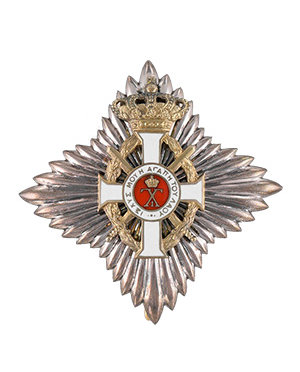
The Order of George I Design

The badge of the Order is a white-enameled Latin cross pattée, in silver for the Silver Cross class, in gold for the higher classes, with a wreath of laurels between the arms of the cross.

The obverse central disc was in red enamel, bearing the royal cypher of George I, two crossed gammas with a crown above and a “I” below, surrounded by a white enamel ring bearing the royal motto ΙΣΧΥΣ ΜΟΥ Η ΑΓΑΠΗ ΤΟΥ ΛΑΟΥ (“The Love of My People is My Strength”). The reverse central disc bears the years of George I’s reign, 1863-1913. The badge is topped by a crown; the military division also had crossed swords behind the badge. The Commemorative Medal’s badge is identical in design, except that the cross is not enameled.

The star of the order is a silver star with straight rays, with eight points for Grand Cross and four points for Grand Commander, and with the obverse of the badge superimposed upon it.

The ribbon of the Order is plain crimson red.