
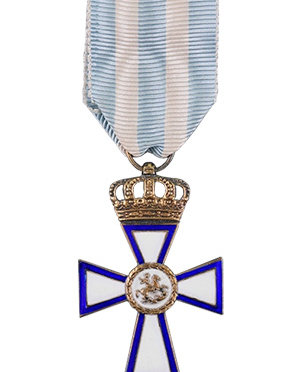
The Cross of Valor (Greece)

The Cross of Valour is the second highest military decoration of the Greek state, awarded for acts of bravery or distinguished leadership.

  • Time Period: Pre-WW1
  • Year of Institution: 13 May 1913
  • Country: Greece

The Cross of Valor (or Αριστείον ΑνδρείαςAristeion Andreias, “Gallantry/Bravery Award“) is the second highest military decoration of the Greek state, awarded for acts of bravery or distinguished leadership on the field of battle.

It has been instituted three times, first on 13 May 1913 during the Balkan Wars but not issued until 1921 during the Greco-Turkish War of 1919–1922, then on 11 November 1940 shortly after the outbreak of the Greco-Italian War and finally in 1974.

The award was liberally distributed during the campaigns of 1921–1922: from the first awards in July 1921 to the end of the war in August 1922. The Cross of Valor continued to be awarded for actions during the Greek Civil War and for the Greek participation in the Korean War, as well as for a few cases from World War II, from 1947 to 1955.

The Royal Decree of 31 March 1921 instituted the Cross of Valor in three grades: Commander’s Cross (Σταυρός Ταξιάρχη), worn as a badge on a necklet, and the Gold Cross (Χρυσούς Σταυρός) and Silver Cross (Αργυρός Σταυρός), worn as badges on chest ribbons. No limit was set on the number of awards in each grade.

The Cross of Valor Design

The design of the badge was specified as a “crowned cross, bearing in the middle of the obverse side, in a circle of narrow laurel leaves, the image of St. Demetrios, while on the middle of the reverse side in a similar circle it bears the words ΑΞΙᾼ (“for valor” in Greek)”.

The Silver Cross was to be made entirely of silver, while the Gold and Commander’s crosses were enameled in white with blue edges. The ribbon consists of five pale blue and white stripes. For each repeat award, a silver 4-millimeter star was added to the ribbon.

For World War II awards, a bar with “1940” was placed on the ribbon to distinguish it from the earlier 1913 version.
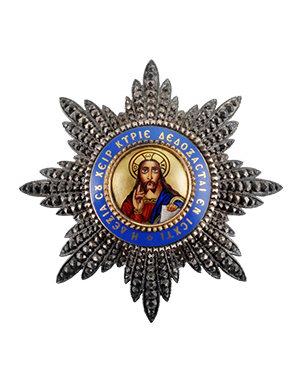
The Order of the Redeemer

The Order of the Redeemer is an order of merit of Greece and the oldest and highest decoration awarded by the modern Greek state.

  • Time Period: Pre-WW1
  • Year of Institution: 1829
  • Country: Greece

The Order of the Redeemer (or Τάγμα του Σωτήρος, Tágma tou Sotíros), also known as the Order of the Saviour, is an order of merit of Greece and the oldest and highest decoration awarded by the modern Greek state.

According to the original decree, the Order was to be awarded to those Greek citizens who partook in the War of Independence, or “who should distinguish themselves henceforth in any branch of public service, in the army and navy, in the diplomatic and judicial corps, in public administration, in the arts, science, agriculture and industry, commerce, or should distinguish themselves in any other social field through outstanding civic virtue, and through illustrious services to the Throne, for the Glory of the Hellenic name and for the welfare of the fatherland”, while foreigners were admitted either for past services to Greece, or due to their ability “to bring honour to the Order, through their outstanding personal virtues and excellence“.

The Order was established by the Fourth National Assembly at Argos in 1829, during the final year of the Greek War of Independence. The decision was not immediately implemented, however, and the relevant decree was signed on May 20, 1833. According to the decree of the establishment, the name of the Order “shall recall the, by divine assistance miraculously and fortuitously accomplished, the salvation of Greece“.

The Order of the Redeemer has five classes:

  • GRE Order Redeemer 1Class.png Grand Cross (‘Μεγαλόσταυρος’) – wears the badge of the Order on a sash on the right shoulder, and the star of the Order on the left chest;
  • GRE Order Redeemer 2Class.png Grand Commander (‘Ανώτερος Ταξιάρχης’) – wears the badge of the Order on a necklet, and the star of the Order on the left chest;
  • GRE Order Redeemer 3Class.png Commander (‘Ταξιάρχης’) – wears the badge of the Order on a necklet;
  • GRE Order Redeemer 4Class.png Gold Cross (‘Χρυσούς Σταυρός’) – wears the badge on a ribbon on the left chest;
  • GRE Order Redeemer 5Class.png Silver Cross (‘Αργυρούς Σταυρός’) – wears the badge on a ribbon on the left chest.

The Order of the Redeemer Medal Design

The form of the various insignias has been altered a number of times since the establishment of the order, the most obvious change being the removal of the crown during the periods of Republican rule.

The original decree of 1833 described the badge of the Order as consisting of a white enamelled Maltese cross (silver for the Silver Cross, gold for the higher grades), surmounted by a crown, set on a green enamelled wreath, one half of which is an oak branch and the other half a laurel branch.

The obverse featured a white cross on a blue background (the coat of arms of Greece) with Otto’s Bavarian arms in an inescutcheon in the centre, surrounded by this inscription on an outer ring: Η ΔΕΞΙΑ ΣΟΥ ΧΕΙΡ, ΚΥΡΙΕ, ΔΕΔΟΞΑΣΤΑΙ ΕΝ ΙΣΧΥΙ (“Thy right hand, O Lord, is become glorious in power”, Exodus, 15:6). The reverse featured a portrait of Otto with the circular inscription: ΟΘΩΝ, ΒΑΣΙΛΕΥΣ ΤΗΣ ΕΛΛΑΔΟΣ (“Otto, King of Greece”).

After Otto’s deposition in 1863, his portrait was removed and substituted by an icon of Jesus, the Redeemer of Orthodox Christian soteriology.