The Sainya Seva Medal

The Sainya Seva Medal is awarded by the Indian Armed Forces to recognize non-operational service performed under challenging conditions.

  • Time Period: Post-WW2
  • Institution: 26 January 1950
  • Country: India

The Sainya Seva Medal is an honor awarded by the Indian Armed Forces to recognize non-operational service performed under challenging conditions in harsh climates and designated areas.

Established on 26 January 1960, the medal was introduced by the Government of India with the President’s approval. It was instituted alongside other notable awards, including the Vishisht Seva Medal series (Class I, II, III), the Videsh Seva Medal, the Sena Medal, the Nao Sena Medal, and the Vayu Sena Medal.

The Sainya Seva Medal highlights the dedication of individuals serving in demanding environments, emphasizing their commitment and resilience in the face of hardship.

The Sainya Seva Medal Criteria

The medal is conferred for completing at least one year of non-operational service in specified geographic areas identified as having extreme conditions or severe climates. 

The medal is awarded to a broad range of personnel, including:

  • Commissioned Officers, Junior Commissioned Officers, and other ranks of the regular Army.
  • Non-Combatants (Enrolled) serving in the Armed Forces.
  • Members of auxiliary and reserve forces.
  • Nursing Officers and other personnel in nursing services.
  • Lawfully constituted armed forces, including police and central armed police forces.

Medal Clasps

  • Jammu and Kashmir: Awarded for one year of service since 27 Oct 1947; Air Force: 10 sorties/40 hours flying; inscribed जम्मू कश्मीर with a chinar leaf.
  • NEFA: One year of service in NEFA (1947–1958); Air Force: 10 sorties/40 hours flying; inscribed ने फ़ा on bamboo stalk.
  • Himalaya: One year of service in northern Himalayas; Air Force: 10 sorties/40 hours flying; inscribed हिमालय with a pine tree. Discontinued since 1986.
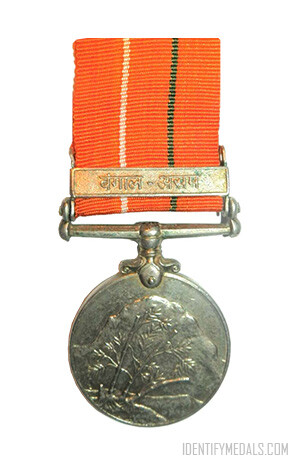
  • Bengal-Assam: One year of service in West Bengal/Assam (after 26 Oct 1962); Air Force: 10 sorties/40 hours flying; inscribed बंगाल-असम.
  • Andaman and Nicobar: One year of service in the islands (post-20 May 1966); Air Force: 50 hours flying; inscribed अण्डमान और निकोबार with lotus designs.
  • Marusthal: One year of service in Gujarat/Rajasthan deserts; Air Force: 10 sorties/40 hours flying; inscribed मरुस्थल.
  • 6YR Sea Service: Awarded since 2017 for six cumulative years of naval service in anti-piracy, coastal patrols, and seaward defense.

The Sainya Seva Medal Design

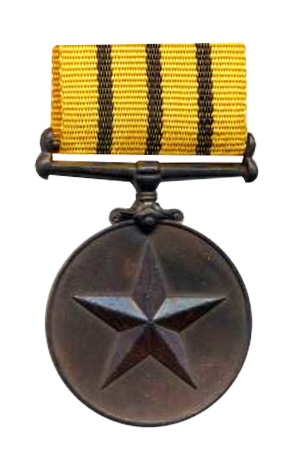
The Sainya Seva Medal is a circular medal made of cupro-nickel, measuring 35 mm (1.4 inches) in diameter. It is suspended from a straight bar, which holds the clasps.

  • Obverse: Features an image of Nanda Devi with bamboo in the foreground, symbolizing nature and resilience.
  • Reverse: Displays a gate of the Purana Qila (Old Fort) with the inscription “Sainya Seva Medal” in Hindi above it.

The ribbon, measuring 32 mm (1.3 inches), is saffron with a white vertical stripe and a dark green vertical stripe dividing it into three equal sections, representing balance and harmony.

The award is always accompanied by a clasp engraved with the name of the location where the service was rendered. For subsequent qualifications, only an additional clasp indicating a new service area is issued.
The Vishisht Seva Medal

  • Time Period: Post-WW2
  • Institution: 26 January 1960
  • Country: India

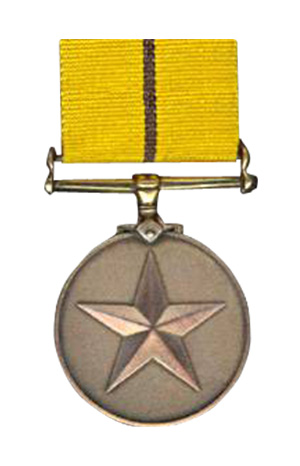
The Vishisht Seva Medal is a decoration of the Indian armed forces awarded for “distinguished service of a high order” to all ranks of the Indian Armed forces. The award carries with it the right to use “VSM” as post-nominal letters.

The medal was originally established as the “Vishisht Seva Medal, Class III” on 26 January 1960. It may be granted posthumously.

The Vishisht Seva Design

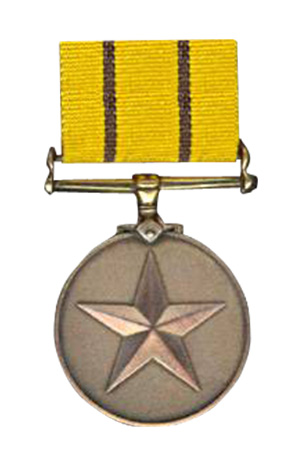
The medal is circular, truck in silver, and measures 35 mm in diameter. It’s fitted to a plain horizontal bar with standard fittings.

The obverse bears the State Emblem. On its reverse, it has a five pointed star.

The ribbon is golden color with three blue vertical stripes in the center.

The Ati Vishisht Seva Medal

  • Time Period: Post-WW2
  • Institution: 26 January 1960
  • Country: India

The Ati Vishisht Seva Medal is a military award of India for distinguished service of an exceptional order to all ranks of the armed forces. It was established in 1960 and is a peacetime equivalent of Uttam Yuddh Seva Medal.

The Ati Vishisht Seva Medal was originally instituted as the “Vishisht Seva Medal, Class II” on 26 January 1960.

The Ati Vishisht Seva Design

The medal is struck in silver gilt, circular and measures 35 mm in diameter. 

The obverse bears the Lion Capital. On its reverse, it has a five pointed star.

The ribbon is golden color with two blue vertical stripes.

The Param Vishisht Seva Medal

  • Time Period: Post-WW2
  • Institution: 26 January 1960
  • Country: India

The Param Vishisht Seva Medal is a military award of India constituted in 1960 and awarded in recognition to exceptional peace-time service of the most exceptional order. The medal was originally instituted as the “Vishisht Seva Medal, Class I” on 26 January 1960. 

 All ranks of the Indian Armed Forces including Territorial Army, Auxiliary and Reserve Forces, Nursing officers and other members of the Nursing services and other lawfully constituted Armed Forces are eligible for the award. The medal may be awarded posthumously.

The Param Vishisht Seva Design

The medal is struck in gold gilt, round, and measures 35 mm in diameter. It’s fitted to a plain horizontal bar with standard fittings.

The obverse bears the State Emblem. On its reverse, it has a five pointed star.

The ribbon is golden color with one blue vertical stripe in the center, which divides it into two equal parts. If a recipient of the medal is subsequently awarded the medal again, every such further award shall be recognized by a bar to be attached to the riband by which the medal is suspended. 

The Yudh Seva Medal

  • Time Period: Post-WW2
  • Institution: 26 June 1980
  • Country: India

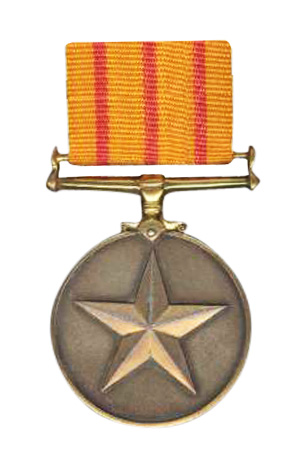
The Yudh Seva Medal is one of India’s military decorations for distinguished service during wartime. It is awarded for a high degree of distinguished service in an operational context, such as times of war, conflict, or hostilities.

The medal may be awarded posthumously.

The Yudh Seva Design

The medal is circular and measures 35 mm in diameter. It’s fitted to a plain horizontal bar with standard fittings.

The obverse bears the State Emblem and the inscription “YUDH SEVA MEDAL“. On its reverse, it has a five pointed star.

The ribbon is golden color with three red vertical stripes in the center.

The Uttam Yudh Seva Medal

  • Time Period: Post-WW2
  • Institution: 26 June 1980
  • Country: India

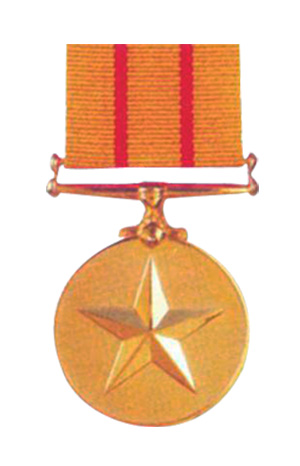
The Uttam Yudh Seva Medal is one of India’s military decorations for Wartime Distinguished Service in an operational context (times of war, conflict, or hostilities).

The Uttam Yudh Seva Design

The medal is struck in gold gilt, circular and measures 35 mm in diameter. It’s fitted to a plain horizontal bar with standard fittings.

The obverse bears the State Emblem and the inscription “UTTAM YUDH SEVA MEDAL“. On its reverse, it has a five pointed star.

The ribbon is golden color with two red vertical stripes.

The Sarvottam Yudh Seva Medal

  • Time Period: Post-WW2
  • Institution: 26 June 1980
  • Country: India

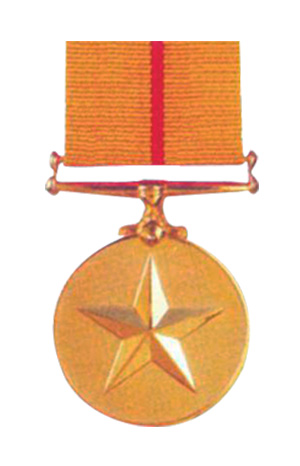
The Sarvottam Yudh Seva Medal is India’s highest wartime distinguished service decoration. It is awarded in an operational context such as during times of war, conflict, or hostilities. It is the military equivalent of the Param Vishisht Seva Medal.

The Sarvottam Yudh Seva Medal may be awarded to all ranks of the Army, the Navy and the Air Force including those of Territorial Army Units, Auxiliary and Reserve Forces and other lawfully constituted Armed Forces. The medal can be awarded posthumously.

The Sarvottam Yudh Seva Medal has only been awarded three times in history: To Lieutenant General A.S. Kalkat, the overall commander of the Indian Peacekeeping Force (IPKF) in Sri Lanka. To Air Marshal Vinod Patney was the Western Air Commander and to Lieutenant General H.M. Khanna was the Northern Army Commander during the Kargil War.

The Sarvottam Yudh Seva Design

The medal is struck in gold gilt, circular and measures 35 mm in diameter. It’s fitted to a plain horizontal bar with standard fittings.

The obverse bears the State Emblem and the inscription “SARVOTTAM YUDH SEVA MEDAL“. On its reverse, it has a five pointed star.

The ribbon is golden color with one red vertical stripe in the center, which divides it into two equal parts. If a recipient of the medal is subsequently awarded the medal again, every such further award shall be recognized by a bar to be attached to the riband by which the medal is suspended. 

The Vayu Sena Medal

The Vayu Sena Medal is a gallantry award for servicemen in the Indian Air Force. It was instituted in 1960 and usually awarded in peacetime.

  • Time Period: Post-WW2
  • Institution: 17 June 1960
  • Country: India

The Vayu Sena Medal is a gallantry award for servicemen in the Indian Air Force. It was instituted on 17 June 1960 by the President of India and is usually awarded in peacetime. However, it has been granted during times of conflict for acts of gallantry in the face of enemy (although not as many times as the Vir Chakra Decoration).

It is possible to receive the Vayu Sena Medal posthumously. 

The Vayu Sena Medal Design

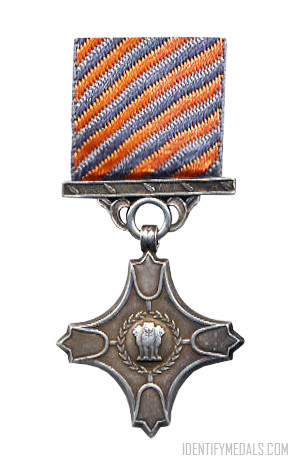
The medal is a four-armed silver star with the ends shaped like lotus flower blooms. 

The obverse bears the national emblem of India. The reverse shows a Himalayan Eagle with wings spread, and the legend, above and below, in Hindi “Vayu Sena Medal” or “Air Force Medal“. 

The ribbon measure 30 mm wide and alternates 2mm diagonal stripes in grey and orange-saffron. 

The Nau Sena Medal

  • Time Period: Post-WW2
  • Institution: 17 June 1960
  • Country: India

The Nau Sena Medal is a gallantry award for servicemen in the Indian Navy instituted on 17 June 1960 for individual acts of exceptional devotion to duty or courage as have special significance for the Navy.

The Nao Sena Medal was instituted by the Government of India, with the approval of the President of India.

The Nau Sena Medal Design

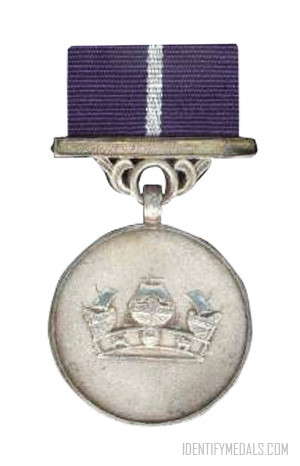
The medal is pentangular in shape, struck in silver and has curved sides. 

The obverse bears an embossed Naval Crest. The reverse shows a trident within a circle and rope. There’s also an inscription reading “Nau Sena Medal” in Hindi embossed along the upper rim.

The ribbon is navy blue with a single central white line and measures 32 mms wide. 

The Sena Medal

  • Time Period: Post-WW2
  • Institution: 17 June 1960
  • Country: India

The Sena Medal is a decoration from India awarded to members of the Indian army for acts of exceptional devotion to duty or courage. It was established on 17 June 1960 by the Government of India, with the approval of the President of India, and may be made posthumously.

The Sena Medal can be awarded for gallantry or for distinguished service carried out by any soldier not in the face of the enemy – so it serves as a sort of general commendation medal for the Indian Army too.

From 1 February 1999, the central government set a monthly stipend of Rs. 250 (later revised, currently around Rs. 2000) for recipients of the award when given for bravery. 

The Sena Medal Design

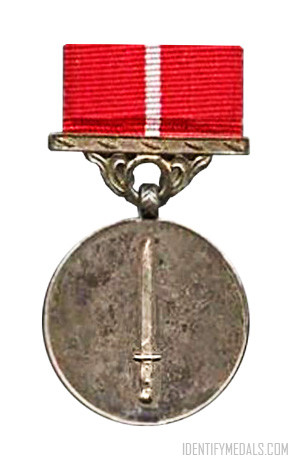
The medal is circular in shape. The obverse bears a bayonet pointing upwards. The reverse shows a standing soldier with the legend in Hindi “Sena Medal” above.

The ribbon is red with a single central white line, measuring 32 mms long.