The Medal for Mothers and Widows of the Fallen

Time Period: The Great War, Second World War

Institution: 24 May 1919
Country: Italy

The Medal for Mothers and Widows of the Fallen (or Medaglia di Madri e Vedove Dei Caduti in Italian) is an Italian medal instituted on 24 May 1919 (with Royal decree no. 800 of 1919) as a token of national gratitude to Italian mothers who had lost one or more children during the First World War.

Both legitimate and natural mothers who had recognized the fallen son were entitled to the badge, but only if it was indubitable that the soldier had fallen in combat or as a result of injuries sustained in combat. It was granted by the Ministry of War or the Navy, depending on whether the fallen soldier was part of the land or sea army.

The medal was established by the Kingdom of Italy and reconfirmed by the Italian Republic for the Second World War. A similar recognition was established in 1887 for the mothers of the fallen of the Battle of Dogali. The recognition was also extended to the African Campaign, the Spanish Campaign, thje Expedition to Albania, The 1940/43 War, and WW2.

The Medal for Mothers and Widows of the Fallen Design

The medal is circular and could be cast in bronze of the guns taken from the enemy. It was designed by G. Prini and measures 32 mm in diameter.

The obverse shows an allegorical design of a woman offering a laurel wreath to a dying soldier while another woman stands in the background. The reverse is bears the inscription “IL FIGLI / CHE TI NACQVE / DAL DOLORE / TI RINASCE “O BEATA” / NELLA GLORIA / E IL VIVO EROE / “PIENA DI GRAZIA ” / E TECO” (“The son which was born out of you in pain, is reborn to you, o blessed one, full of glory and he lives as a hero. With gratitude“).

There are several variants produced by private industries. Some of these show, under the left arm of the fallen, the name of the model maker “G. PRINI – MOD.” and the name of the manufacturer: Sacchini, S. Johnson or Lorioli and Castelli.

The ribbon is dark grey, with thin green, white, and red stripes in the center and measures 37 mm wide. A ministerial circular dated March 23, 1921 established that each fallen child was represented by an equivalent number of bronze crowns on the ribbon.

The Medal for the War Volunteer 1915-1918

The Medal for the War Volunteer 1915-1918 is an Italian medal instituted in 1924 and awarded to Italian armed volunteers of the Great War.

The Medal for the War Volunteer 1915-1918 (or Medaglia di Volontario di Guerra 1915-1918 in Italian) is an Italian medal instituted on 24 May 1924 and awarded to those who entered the Italian armed volunteer forces during WW1. It was established with Royal Decree n. 1163 by the Italian government.

The medal was awarded to those who had participated in the war operations in a way worthy of commendation and who gave proof of belonging to one of the following categories:

  1. Former reformers who spontaneously enlisted as officers, non-commissioned officers or troop soldiers or of the CRE at least one month before the date of the decree that would have called them for a review visit;
  2. Soldiers who, declared unsuitable for war service due to injuries sustained in the war or due to infirmities, spontaneously returned to be part of the operating army or navy;
  3. Second and third category military personnel who had spontaneously taken up military service as officers, non-commissioned officers or militaries of the troop or the CRE at least four months before the date of the decree calling their class or category and actually were incorporated into the operating army or navy before the said recall;
  4. Spontaneously enrolled at least four months before being called to visit before the conscript councils and actually left to be incorporated into the army or navy operating before the date on which they would normally have passed the visit;
  5. Exempted by law from military service who, at least five months before November 4, 1918, spontaneously renounced the dispensation to be incorporated into the operating army or navy;

The fallen, the wounded in combat and those decorated with the military Order of Savoy or the value for war actions carried out during the voluntary service, were entitled to the medal even if the service itself had started within a time limit lower than those indicated above. With art. 4 of the Royal Decree n. 1529 of 1925 merit was also granted to maritime members who had sailed on merchant steamers without having military service obligations and who had obtained the War Merit Cross or were in the conditions to obtain it. With RD n. 2127 of 1925, the eligibility criteria were regulated in a more detailed manner and the exclusion from the granting of those who, despite possessing the qualifications, were deemed, in the opinion of the competent issuing authorities, unworthy to boast of them for having in the meantime he received criminal convictions or for serious moral reasons.

The same medal was later issued for the Second World War and for a number of colonial wars. It was abolished in 2010.

The Medal for the War Volunteer 1915-1918 Design

The medal is circular. The obverse depicts the crowned head of “Italia” and the inscription “PER L’ITALIA” (or “For Italy“). The reverse bears a naked warrior bearing a shield and a veiled woman behind him. Around the rim of the medal is the inscription “VOLONTARIO DI GVERRA MCMXV-MCMXVIII” (“War volunteer” and the dates of the war).

The WW2 version of the medal has the dates 1936-1939 in Roman figures in the obverse, and the letters A.O.I (Africa Orientale Italiana, Italian East Africa) on the reverse. Many medals had no dates inscribed on them.

The ribbon is plain red.

The 1915-1918 War Medal

The War Medal 1915-1918 is an Italian medal instituted in 1920 and awarded for participation in WW1. It replaced a previous ribbon bar.

The War Medal 1915-1918 (or Commemorative Medal for the Italo-Austrian War 1915–1918) is an Italian medal instituted on 29 July 1920 and awarded for participation in WW1 – or service during and immediately after World War I in the national territory of Italy, in the Dodecanese, in Albania, Syria, and Palestine.

The medal replaced a previous ribbon bar that had been introduced on 21 May 1916 and was awarded for one year of service in a war zone. When the medal replaced the ribbon bar, a number of new bars were attached to the ribbon according to the recipient’s service. The bars were covered in laurel leaves and could be:

  • 1915
  • 1916
  • 1917
  • 1918
  • Albania 1919
  • Albania 1920

Approximately 1,800,000 War Medal 1915-1918 medals were awarded.

The War Medal 1915-1918 Design

The medal is circular and struck in bronze.

The obverse shows the helmeted head of King Victor Emanuel II. Around the rim is the inscription “GVERRA PER L’VNITA D’ITALIA 1915 1918” (“War for the Unity of Italy“). The reverse bears the figure of an upright Victory standing on shields born by two soldiers. Around the rim is the inscription “CONIATA ‘NEL BRONZO NEMICO” (“Made from enemy bronze“).

The ribbon has alternating thin stripes of green, white, and red.

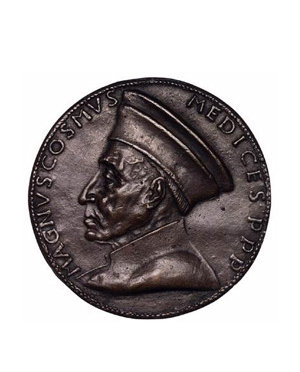
The Portrait Medal of Cosimo de’ Medici

The Portrait Medal of Cosimo de’ Medici celebrates Cosimo I de’Medici and is the earliest example of item created by the Florentine school.

The Portrait Medal of Cosimo de’ Medici celebrates Cosimo I de’Medici (1389-1464) and is the earliest example of a product created by the Florentine school.

Cosimo I was the head of the de’Medici family, a family of bankers who were the de facto rulers of Florence during most of the Italian Renaissance. He was granted the title Pater Patriae by the Florentine Signoria after his death on 1 August 1464.

The idea of a ʽportraitʼ on coins, as well as the title pater patriae, was inspired by the rediscovery of Roman coins in the Renaissance (medieval coinage did not have portraits). Ancient coins were the subject of interest and intense study among scholars from the early fifteenth century onwards, and admired by humanists for their large size, their high relief, and the use of bronze.

The Portrait Medal of Cosimo de' Medici Design

The medal was not produced after 1469, and the effigy on the obverse was copied from the manuscript by Francesco del Chierico (Florence, Biblioteca Medicea Laurenziana, Ms Plut. 84, I, c. 3), and on behalf of Piero di Lorenzo de’Medici. Although many different artists have been proposed for the medal’s creator, for example Niccolò di Forzore Spinelli, Donatello, Michelozzo, Cristoforo di Geremia, and Bertoldo di Giovanni, the question concerning the author’s identity remains a mystery.

The obverse of the medal bears the bust of Cosimo I in profile, facing left. He’s wearing a flat beret (proper for persons of high rank) and a buttoned cloak. A circular legend in Roman capitals reads: “MAGNVS COSMVS MEDICES P(RIMVS) P(ATER) P(ATRIAE).”

The reverse shows a female figure allegoric of Florence (inspired by Graeco-Roman coins depicting Concordia), seated on a throne. The exergue reads “FLORENTIA“. She’s wearing a peplos and is veiled, likely as a sign of mourning for Cosimo. She holds an olive branch in her left hand, and her right is stretching forward and grasping a globe – which might recall the Medici family emblem. The circular legend of the reverse reads “PAX LIBERTASQVE PVBLICA“.

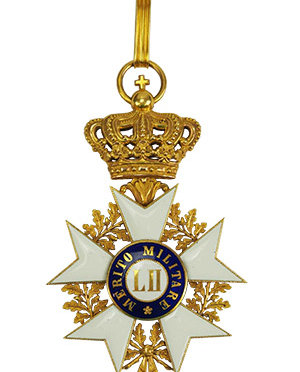
The Order for Civil and Military Merit (Tuscany)

The Order for Civil and Military Merit is a military order of the Grand Duchy of Tuscany. The medal is struck in gold.

The Order for Civil and Military Merit is a military order of the Grand Duchy of Tuscany. 

The Grand Duchy of Tuscany was a central Italian monarchy that existed from 1569 to 1859, succeeding the Duchy of Florence. In the 19th century, it had a population of about 1,815,000 inhabitants.

The order was established to recognize significant contributions in both civil and military fields, reflecting the Grand Duchy’s rich history and commitment to honoring exemplary service and achievements within its territories.

The Long Service Decoration Design

The medal is struck in gold and reads “MERITO MILITARE” (“Military Merit“). The initials in the obverse are those of Leopoldo II. The reverse is plain.

The Order of Saint Stephen (Tuscany)

The Order of Saint Stephen is a Roman Catholic Tuscan dynastic military order created by Cosimo I de’ Medici and approved by Pope Pius IV.

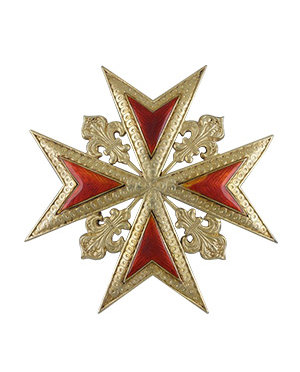
The Order of Saint Stephen (or “Sacro Militare Ordine di Santo Stefano Papa e Martire”, “Holy Military Order of St. Stephen Pope and Martyr“) is a Roman Catholic Tuscan dynastic military order founded in 1561. The order is dedicated to the martyred Pope Stephen I, whose feast day is 2 August – the date that coincides with Cosimo’s victories at the Battle of Montemurlo and the Battle of Marciano (Scannagallo).

The order was created by Cosimo I de’ Medici, the first Grand Duke of Tuscany with the approbation of Pope Pius IV on 1 October 1561. The order was permanently abolished in 1859 by the annexation of Tuscany to the Kingdom of Sardinia, with the last member of the Medici dynasty to be a leader being Gian Gastone de Medici in 1737. 

The objective of the order was to fight the Ottoman Turks and the pirates that sailed the Mediterranean Sea in the 16th century. Cosimo needed a symbolic fight to unite the nobility of the different cities that conformed his new grand duchy, as well as to demonstrate his support of the Roman Catholic Church. It was present at the siege of Malta (1565), the Battle of Lepanto (1571) and the capture in 1607 of Annaba in Algeria.

Initially, the Order was financed by the Grand Duke. Later and thanks to prudent purchases of agricultural estates, it increased its heritage by becoming one of the major wheat producers and merchants of Tuscany. Before being enrolled in the Order, three years of novitiate had to be followed, during which notions of geometry, cosmography, arithmetic, drawing, cartography, history and practice of firearms were taught and tested.

Today, Archduke Sigismund, Grand Duke of Tuscany awards an Order of Saint Stephen which he claims to be a continuation of the order founded by Grand Duke Cosimo I. Some 80 individuals are currently associated with this order.

The Order of Saint Stephen Design

The badge of the order is shaped like a star, struck in silver with a thin sheet of gold (not gold plated), and decorated with red enamels. It’s surmounted by a golden crown.

The Second Class Star (pictured above) measures 63mm by 64mm.

The ribbon is red.

The Order of Saint Joseph (Tuscany)

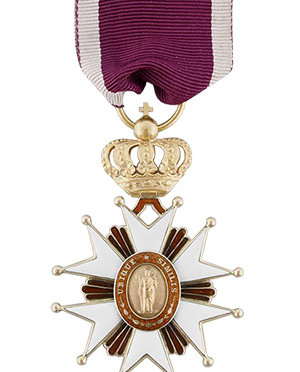
The Order of Saint Joseph was instituted in 1807 by Ferdinand III, Grand Duke of Tuscany and awarded for services towards culture.

The Order of Saint Joseph was instituted in 1807 by Ferdinand III, Grand Duke of Tuscany (during his reign as Grand Duke of Würzburg), and transformed in 1817 into a Tuscan Roman Catholic Dynastic Order. It is awarded for services towards Tuscan culture and civilization and to the Grand Ducal House as a whole.

The order was originally divided into civil and military categories, although these are now defunct. It is now divided into three levels:

  • Knights Grand Cross (30 members),
  • Commander (60 members), and
  • Knights (150 members).

Sovereigns, Heads of State, and Princes of the Grand Ducal House and other Royal Houses, Cardinals of the Holy Roman Church and Tuscan Metropolitan Archbishops were excluded form the count. All members had to be Catholics and the number of women could not exceed fifty (excluding Princesses of the Grand Ducal and other Royal Houses, wives of Heads of State and Dames of the Order of Saint Stephen).

The Order of Saint Joseph Design

The medal is struck in gold with white enamels. It measures 38.02 mm (w) x 57.01 mm (h – inclusive of ring suspension) and weighs 14.7 g. The shape of the medal is a six-armed cross with ball finials and exhibits three delicate red-enameled gold rays between in each quadrant. The cross is surmounted by a classic royal crown in gold.

The obverse depicts, in gold, a figure of St. Joseph surrounded by the Latin inscription “Ubique Similitus” (or “Everywhere the Same”) with a red-enameled border. The reverse, also in gold, bears the inscription “S J F 1807”(the date of institution).

The ribbon is red with white edges.

The Italian Independence Medal

The Italian Independence Medal was instituted in 1865 to reward the participants of the wars against Austria and the Sicilies.

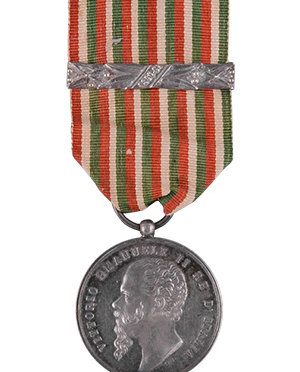
The Italian Independence Medal (or Medaglia per le guerre di Indipendenza e l’Unita d’italia) was instituted on March 4, 1865 by Royal Decree No. 2174 of King Vittorio Emmanuele II to reward the participants of the wars against Austria and the Kingdom of the 2 Sicilies.

This medal replaced all other previously granted awards, except the Crimea, St. Helena, Napoleonic campaigns of 1859 and the Expedition of Thousands medals.

The Italian Independence Medal Design

The medal is struck in silver and measures 32 millimeters in diameter.

The ribbon has green, red and white stripes.

The Italian African Campaign Medal

The Italian African Campaign Medal was awarded for campaigns and battles to colonize part of North Africa in the late 19th century.

The Italian African Campaign Medal for the 1895-96 Campaign is an Italian Pre-WW1 medal awarded for the various Italian campaigns and battles to colonize part of North Africa in the late nineteenth century.

The medal was established on 3 November 1894.

The Italian African Campaign Medal Design

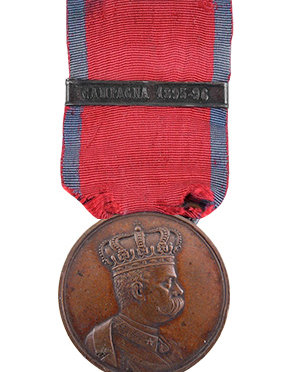
The medal is struck in bronze and has a diameter of 32 millimeters. It was awarded with a silver clasp reading the name of the corresponding campaign (for example, “Campagna 1895-96“).

The obverse bears the crowned bust of Umberto I facing right, crowned, and in military uniform. The reverse bears the inscription ‘CAMPAGNE D’AFRICA‘ within a laurel wreath.

The ribbon is 39 millimeters wide and red, with 6 mm blue edges. The medal is fitted with a fixed bar loop suspender and the two rectangular campaign bars slide over the ribbon.

The Italian Red Cross Medal of Merit

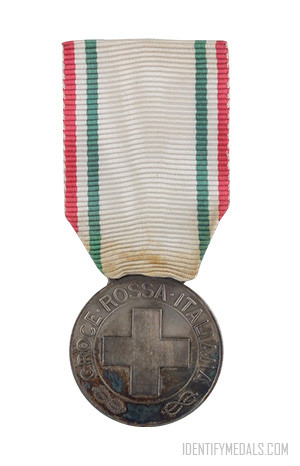
The Italian Red Cross Medal of Merit (Al merito della Croce Rossa) is an Italian award established in 1913 and awarded in three grades.

The Italian Red Cross Medal of Merit (or Medaglia al merito della Croce Rossa Italiana) is an Italian award established in 1913.

The medal was awarded in both peacetime and wartime. In peacetime, for particular merits or personal actions and for social commitment and organizational capacity. In wartime for those who have particularly distinguished themselves or worked for the Association in peace and humanitarian support operations in support of populations affected by armed conflict.

The medal was awarded in the following grades:

  • Gold Medal of Merit, awarded for services rendered in wartime in the area of ​​operations,
  • Silver Medal of Merit, awarded for services rendered in times of war in the area of ​​operations, and
  • Bronze medal of merit, awarded for services rendered in wartime in the area of ​​operations.
  • Diploma of Merit, awarded for services rendered in times of war in the area of ​​operations.

The Italian Red Cross Medal of Merit Design

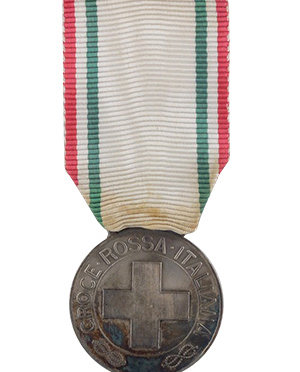
The medal has a diameter of 34 millimeters and weighs about 16,67 grams. It was issued with a red case, with red fitted leatherette exterior.

The ribbon is white with narrow red, white, and green edges.

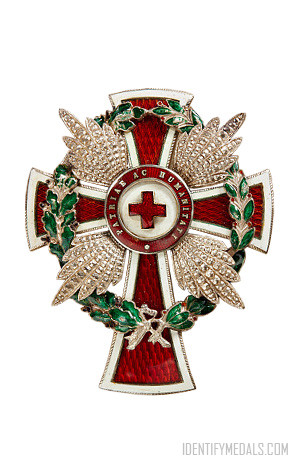
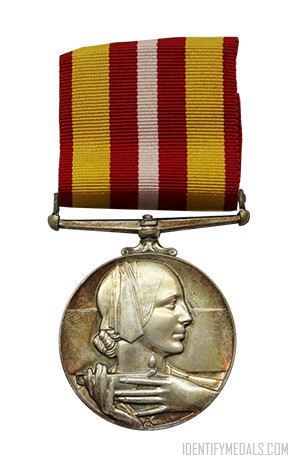
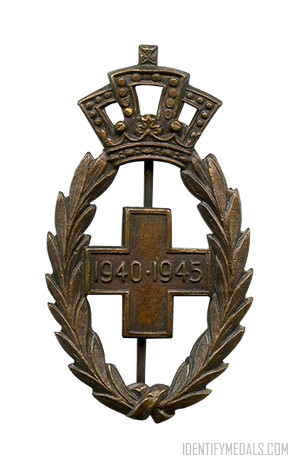
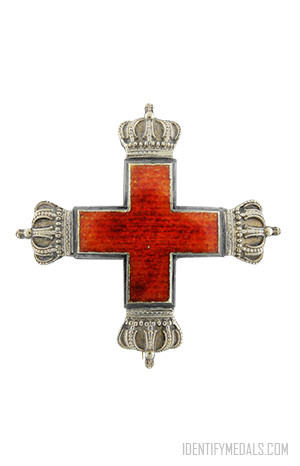
Find Red Cross Medals Online

More Red Cross Medals