The Commemorative Cross for the Operations in the Persian Gulf

The Commemorative Cross for the Operations in the Persian Gulf is an Italian award for participation in Operazione Locusta.

The Commemorative Cross for the Operations in the Persian Gulf is an Italian award created to commemorate Italy’s participation in the Gulf War (1990-1991). Italy has been a part, in accordance to its long history of peacekeeping activities, of numerous UN missions and sub-regional peacekeeping efforts in Somalia, the Balkans, Afghanistan and Iraq. Some of these missions were accompanied by a series of crosses and distinct ribbon combinations.

The code name given to the contribution of the Italian Air Force in the Gulf War was Operazione Locusta. Following the invasion and annexation of Kuwait by Iraq (September 25, 1990) the Italian Government sent eight multi-role fighter bombers Tornado IDS to the Persian gulf. The bombers belonged to the 6º, 36º and 50º Stormo, which were deployed at the Al Dhafra Air Base, in United Arab Emirates. The deployment of Italian aircraft was part of the international security system implemented by UN Security Council Resolution 678.

The use of Italian aircraft as part of the Desert Storm operation represented the first operational employment in combat missions of Italian Air Force aircraft after the end of World War II. The RF104-G returned to Italy on March 11, 1991.

The Cross for the Operations in the Persian Gulf Design

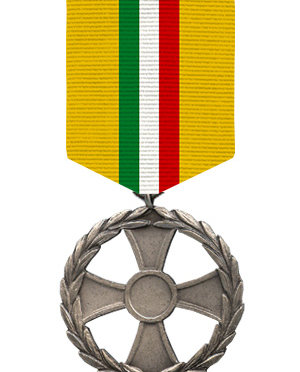
The medal is a silver cross. The ribbon is yellow with a central green, white and red stripe.

In some cases the mission medals were issued with bronze (silver in the case of Afghanistan) bars to denote the specific mission. For earlier missions, the planchet was engraved with the name of the mission.

Find This Medal

Right Now on eBay 
Clicking a link to eBay may result in a referral commission being paid if a purchase is made.
Loading...

The Civil Order of Savoy

The Civil Order of Savoy was founded as an order of knighthood in 1831 by the King of Sardinia, Charles Albert, Duke of Savoy. 

The Civil Order of Savoy was founded as an order of knighthood in 1831 by the King of Sardinia, Charles Albert, Duke of Savoy.

The intention was to reward those virtues not belonging to the existing Military Order of Savoy, founded by Vittorio Emanuele I in 1815. The order has one degree, that of Knight (Cavalieri dell’Ordine civile di Savoia), and is limited to 70 members. Admission is in the personal gift of the head of the House of Savoy.

The civil order was continued on the unification of Italy in 1861, but has been suppressed by law since the foundation of the Republic in 1946. Umberto II did not abdicate his position as fons honorum however, and the now dynastic order remains under the Grand Mastership of the head of the former Royal house. While the continued use of those decorations awarded prior to 1951 is permitted in Italy, they no longer confer any right of precedence in official ceremonies. The military order on the other hand, was revived as the Military Order of Italy and remains a national order today

The Civil Order of Savoy Design

The insignia bears the inscription Al Merito Civile—1831; the letters C.A. on the reverse substituted for V.E. after the death of Charles Albert in 1849.

The Order of the Crown of Italy

The Order of the Crown of Italy was a national order founded in 1868 to commemorate the unification of Italy in 1861.

The Order of the Crown of Italy (or Ordine della Corona d’Italia) was founded as a national order in 1868 by King Vittorio Emanuele II, to commemorate the unification of Italy in 1861. It was awarded in five degrees for civilian and military merit.

Compared with the older Order of Saints Maurice and Lazarus (1572), the Order of the Crown of Italy was awarded more liberally and could be conferred on non-Catholics as well; eventually, it became a requirement for a person to have already received the Order of the Crown of Italy in at least the same degree before receiving the Order of Saints Maurice and Lazarus.

The order has been suppressed by law since the foundation of the Republic in 1946. However, Umberto II did not abdicate his position as fons honorum and it remained under his Grand Mastership as a dynastic order. While the continued use of those decorations conferred prior to 1951 is permitted in Italy, the crowns on the ribbons issued before 1946 must be substituted for as many five pointed stars on military uniforms.

The following grades exist:

  • Cavaliere di Gran Croce OCI Kingdom BAR.svg   Knight Grand Cross (Cavaliere di Gran Croce decorati del Grande Cordone)
  • Grande ufficiale OCI Kingdom BAR.svg   Grand Officer (Grande Ufficiale dell’Ordine della Corona d’Italia)
  • Commendatore OCI Kingdom BAR.svg   Commander (Commendatore dell’Ordine della Corona d’Italia)
  • Ufficiale OCI Kingdom BAR.svg   Officer (Ufficiale dell’Ordine della Corona d’Italia)
  • Cavaliere OCI BAR.svg   Knight (Cavaliere dell’Ordine della Corona d’Italia)
The Order of the Crown of Italy Design

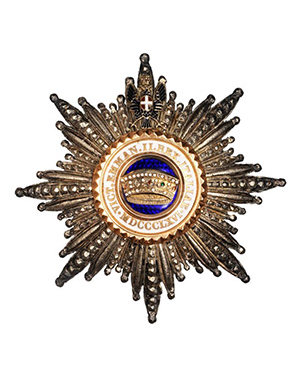
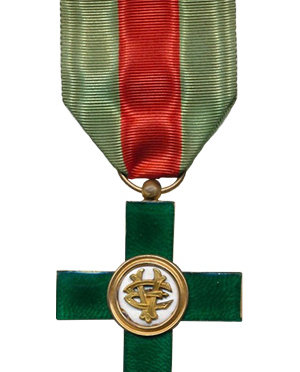
The badge of the order was a gilt cross with curved edges, enameled in white, with the so-called Savoy knots between the arms of the cross.

The obverse central disc featured the Iron Crown of Lombardy (as appeared on the Austrian Order of the Iron Crown) on a blue enamel background. The reverse central disc had a black-enameled eagle bearing the Savoy cross on a golden background.

The star of the Grand Cross was an eight-pointed faceted silver star; the central disc featured the Iron Crown on a blue enameled background, surrounded by a white enamel ring bearing the inscription VICT. EMMAN. II REX ITALIAE MDCCCLXVI (Victor Emmanuel II, King of Italy, 1866). There was a black-enameled eagle bearing the Savoy cross above the star.

The star of the Grand Officer was an eight-pointed faceted silver star with ball tips at each point and with the obverse of the badge superimposed upon it.

The ribbon of the order was red-white-red.

The Order of Merit for Labor

The Order of Merit for Labor is a national order of chivalry for meritorious agriculture, industry and commerce acts.

The Order of Merit for Labour (or Ordine al Merito del Lavoro) was founded as a national order of chivalry in 1923 by King Vittorio Emanuele III of Italy and is awarded to those “who have been singularly meritorious” in agriculture, industry and commerce, crafts, lending and insurance.

It is a continuation of the earlier Ordine al Merito Agrario, Industriale e Commerciale founded in 1901. Members of the order may use the title Cavaliere del lavoro.

The origins of the order lie with King Umberto I who, in 1898, instituted “a decoration for agricultural and industrial merit and a medal of honour.” The first was the exclusive prerogative of large landowners and industrialists, the latter for their employees. This was replaced by the Chivalrous or Knightly Order of Agricultural, Industrial and Commercial Merit in 1901, which was intended by Vittorio Emanuele III to give greater dignity to the earlier award.

Awarded in the single degree of Knight, the order is open to all Italians, living at home and overseas. Every year, on 1 June, 25 new Knights of Labour are invested from a shortlist of 40 candidates. The related Star of Merit for Labour, established in 1923, confers the title of Maestro del Lavoro.

The order is bestowed by decree of the President of the Italian Republic, its head since 1952, on the recommendation of the Minister of Economic Development (successor to the Minister of Industry, Commerce and Craftsmanship). The badge bears the inscription Al merito del lavoro—1901; the V.E. monogram formerly at the centre of the Greek cross, now substituted for the national coat of arms.

The Order of Merit of the Italian Republic

The Order of Merit of the Italian Republic (Ordine al merito della Repubblica Italiana) was founded by the second President in 1951.

The Order of Merit of the Italian Republic (or Ordine al merito della Repubblica Italiana) was founded as the senior order of knighthood by the second President of the Italian Republic, Luigi Einaudi in 1951.

The highest ranking honor of the Republic, it is awarded for “merit acquired by the nation” in the fields of literature, the arts, economy, public service, and social, philanthropic and humanitarian activities and for long and conspicuous service in civilian and military careers. The post-nominal letters for the order are OMRI.

Investiture takes place biannually on 2 June, the anniversary of the foundation of the Republic and on 27 December, the anniversary of the promulgation of the Italian Constitution. However, those awards on Presidential motu proprio, related to termination of service or granted to foreigners may be made at any time.

The order is bestowed by decree of the President of the Italian Republic, as head of the orders of knighthood, on the recommendation of the President of the Council of Ministers. Except in exceptional circumstances, no one can be awarded for the first time a rank higher than Knight. The minimum age requirement is normally 35.

The Order of Merit o the Italian Republic Design

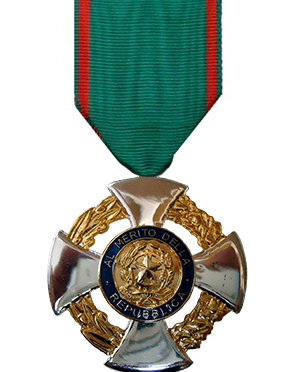
The badge, modified in 2001, bears the inscription Al Merito della Repubblica encircling the national coat of arms on the obverse and the Latin Patriæ Unitati (the union of the country) and Civium Libertati (the liberty of the people) encircling the head of Italia Turrita on the reverse.

The five degrees with corresponding ribbons are as follows (with numbers to June 2013):

  • Knight Grand Cross with Colla
  • 1st Class / Knight Grand Cross
  • 2nd Class / Grand Officer
  • 3rd Class / Commander
  • 4th Class / Officer
  • 5th Class / Knight

The Commemorative Cross of the 11th Army

The Commemorative Cross of the 11th Army is an Italian medal recognized on 15 April 1943 and awarded to members of the 11th Army.

The Commemorative Cross of the 11th Army (or Croce Commemorativa dell’11a Armata in Italian) is an Italian medal recognized on 15 April 1943, and awarded during 1942 to members of the 11th Army who served in the campaign against Greece in 1940-1941.

It honored the efforts and contributions of those who participated in the military operations, reflecting their dedication and bravery in the conflict. The cross serves as a symbol of recognition for the sacrifices and achievements of the 11th Army in this challenging campaign.

The 11th Army

The 11th Army was a unit of the Royal Italian Army during World War II. It played a significant role in the Greco-Italian War, part of the larger Balkan Campaign.

The 11th Army was involved in the initial invasion of Greece in October 1940, which aimed to expand Italian influence in the Balkans. Despite initial setbacks and difficult terrain, the 11th Army’s efforts were part of Italy’s broader strategy in the region. The Commemorative Cross of the 11th Army was later awarded to recognize the service of its members during this campaign.

The Commemorative Cross of the 11th Army Design

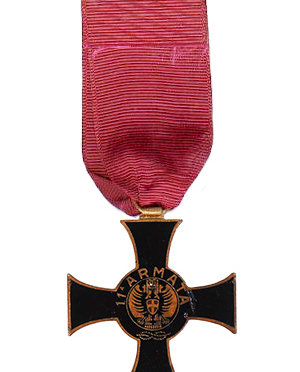
The Commemorative Cross of the 11th Army medal is made of gilt-edged black enamel cross pattée with laterally-pierced cylinder suspension.

The obverse shows with a circular central medallion with the arms of Savoy of a white cross on a red shield imposed on the two-headed Albanian eagle, inscribed 11a ARMATA above and with a knot below. The reverse gilt with the black circular inscription ‘VEEMENZA E TENACIA’ (Vehemence and Tenacity) and dated ‘16 NOVEMBRE 1940 XIX’; on replaced correct ribbon.

The Commemorative Medal for the Victory Over Greece

The Commemorative Medal for the Victory Over Greece was an Italian medal from the World War II period awarded after repelling their attack.

The Commemorative Medal for the Victory Over Greece is an Italian medal from the WW2 period.

Italy invaded Greece on 28 October 1940 from the Italian-occupied Albania. By April 1941, the Hellenic Army had repelled the attack and had pushed the Italians deep inside the Albanian territory. Trying to prevent the imminent Italian defeat, Germany attacked Greece and Yugoslavia, from/with Bulgaria, on 6 Apr. 1941 and forced the continental Greek Forces to capitulate 3 weeks later.

The Commemorative Medal for the Victory Over Greece Design

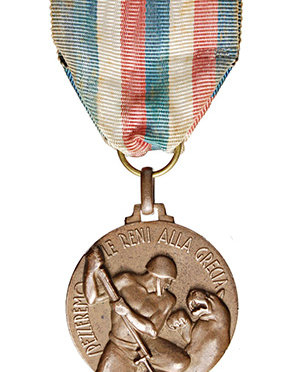
The medal shows on the obverse a dramatic scene of Italian soldier driving bayonette into a lioness. The medal measures 32.5mm in diameter. On the obverse there is the famous phrase of Mussolini “Spezzeremo le reni alla Grecia” (we will split the kidneys of Greece) during his speech on the radio on Nov. 19 1940.

The Commemorative Cross for the Expeditionary Corps in Russia

The Commemorative Cross for the Expeditionary Corps in Russia is an Italian medal given to the Italian Expeditionary Corps in Russia.

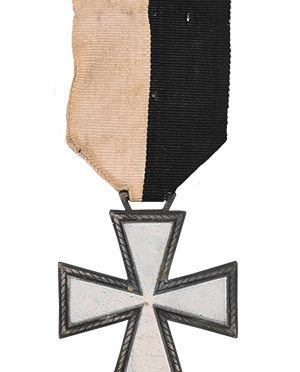
The Commemorative Cross for the Expeditionary Corps in Russia (also known as “Ice Cross”) is an Italian medal given to the Italian Expeditionary Corps in Russia – “C.S.I.R.” (Corpo di Spedizione Italiano in Russia).

During World War II, the Italian Expeditionary Corps in Russia was a corps-sized expeditionary unit of the Regio Esercito (Italian Army) that fought on the Eastern Front. In July 1942, the three divisions of the CSIR all became part of the Italian XXXV Army Corps.

The Commemorative Cross for the Expeditionary Corps in Russia Design

The Commemorative Cross for the Expeditionary Corps in Russia medal is made of zinc alloy and white enamels.

The medal measures 41.3 mm.

The Medal for the Fascist Campaign 1919-1922

The Fascist Campaign Medal was an Italian award distributed to all who participated in the Fascist Campaign of 1919-1922.

The Fascist Campaign Medal (also Medal for the Fascist Campaign 1919-1922, or “Medaglia per le campagne fasciste 1919-1922″ in Italian) is an Italian award distributed to all who participated in the Fascist Campaign of 1919-1922.

This period marks the rise of Fascism in Italy, culminating in the March on Rome, which brought Benito Mussolini and his Fascist Party to power. The medal honors those who supported the movement during its early, tumultuous years, recognizing their contributions to the establishment of the Fascist regime. The design typically features Fascist symbols and inscriptions commemorating the campaign and its significance in Italian history.

The Fascist Campaign Medal Design

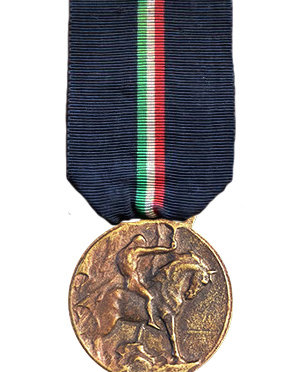
The dimensions of the Medal for the Fascist Campaign 1919-1922 are 3,5 x 14 cm. The medal shows a dramatic equestrian scene on the obverse, and joined hands and inscription “Per L’Italia, Ora e Sempre” (For Italy, Now and Always) on its reverse.

The Commemorative Medal Marcia su Roma

The Commemorative Medal Marcia su Roma was designed by sculptor Eugenio Baroni and produced by FM Lorioli & Castelli-Milano.

The Commemorative Medal Marcia su Roma (or Medaglia commemorativa della Marcia su Roma in Italian) was designed by sculptor Eugenio Baroni and produced by FM Lorioli & Castelli-Milano.

The medal was awarded in gold to Benito Mussolini, to the quadrumviris and to the administrative secretary of the PNF Giovanni Marinelli; in silver to the 19 commanders of the columns of the teams organized to converge on Rome; and in bronze to all members of the National Fascist Party that had participated in the march between 27 October and 1 November 1922.

Through Royal Decree No. 273 of January 31, 1926, it was also authorized for members of the Volunteer Militia for National Security. A second provision, given on 1 November 1928, granted its use to those soldiers who on 28 October 1922 did not provide effective service in the Armed Forces of the State.

The full right to use the banner of all members of the FF.AA., was granted by Royal Decree No. 1179 of July 15, 1938.

The Commemorative Medal Marcia su Roma Design

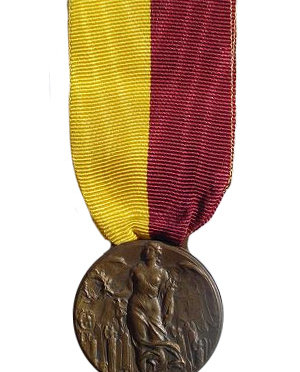
The ribbon colors of the Commemorative Medal Marcia su Roma are those of the city of Rome. It was coined made by Mussolini on the occasion of first Anniversary and distributed to all participants in this event that brought fascism to power in november 1, 1922.

The medal consists of a disk with a total diameter of 34 mm. and cambretta attachment. The obverse of the Commemorative Medal Marcia su Roma medal shows a winged victory holding a crown of oak with his right hand and holding a lictorian beam with his left hand. Behind the figure there are legionary signs, fasces and Roman daggers.

The reverse of the medal shows in the center an empty quadrangular space where the recipient could have his name engraved. At the base of the square space is the abbreviation FM Lorioli & Castelli Milano et EB Mod. Rip. Ris (incense). The square space is delimited by four lictor beams. Circularly the edge is bordered by a double circle in which the legends Marcia Su Roma are engraved on the top, and 27 October-1 November 1922 , at the bottom. Among the legends there are two small stars.