The Army Officer Pilot Badge

[vc_row][vc_column width=”1/4″][vc_single_image image=”5593″ img_size=”full”][/vc_column][vc_column width=”3/4″][vc_column_text]

The Army Officer Pilot Badge

[/vc_column_text][vc_column_text]

Time Period: Interwar Period
Institution: 1923
Country: Medals from Japan Japan

[/vc_column_text][vc_separator css=”.vc_custom_1526473075957{padding-top: 16px !important;padding-bottom: 16px !important;}”][vc_column_text]The Army Officer Pilot Badge is a Japanese badge established in 1923 and in two classes: silver for officers and
bronze for NCOs.

As an incentive to lure infantry, artillery, cavalry, and engineer officers into aviation to become pilots, the Japanese Army instituted its pilot’s badge in time for the graduation of the first pilots.

The award was abolished in 1940, but the NCO class badge was still awarded up until the end of WW2.

The Army Officer Pilot Badge Design

The badge measures 37.5 mm by 51.6 mm and is made of multiple pieces in silver and bronze with a gilt star in the center, illustrating wings on either side framing a series of rays emanating from behind the star, and a two-bladed propeller at the base of the wings. It has a vertical pinback.[/vc_column_text][vc_raw_html css=”.vc_custom_1589024511233{padding-top: 24px !important;padding-bottom: 24px !important;}”]JTNDaW5zJTIwY2xhc3MlM0QlMjJlcG4tcGxhY2VtZW50JTIyJTIwZGF0YS1jb25maWctaWQlM0QlMjI1ZWI2OTU4ZmM2NWQ2MDczY2I1YTg1MGElMjIlM0UlM0MlMkZpbnMlM0U=[/vc_raw_html][/vc_column][/vc_row][vc_row][vc_column][vc_column_text css=”.vc_custom_1555950715853{padding-bottom: 24px !important;}”]

Explore More Japanese Medals

[/vc_column_text][vc_basic_grid post_type=”post” max_items=”18″ style=”pagination” items_per_page=”6″ element_width=”2″ gap=”20″ arrows_design=”vc_arrow-icon-arrow_06_left” arrows_position=”outside” paging_design=”none” item=”masonryGrid_Default” grid_id=”vc_gid:1589024428851-9b2cc382-a678-3″ taxonomies=”85″ el_class=”relatedMedals”][/vc_column][/vc_row][vc_row][vc_column][vc_column_text css=”.vc_custom_1555951766219{padding-bottom: 24px !important;}”]

Explore More Medals from Pre-WW1

[/vc_column_text][vc_basic_grid post_type=”post” max_items=”18″ style=”pagination” items_per_page=”6″ element_width=”2″ gap=”20″ orderby=”rand” arrows_design=”vc_arrow-icon-arrow_06_left” arrows_position=”outside” paging_design=”none” item=”masonryGrid_Default” grid_id=”vc_gid:1589024428853-be68fe47-0021-6″ taxonomies=”8″ el_class=”relatedMedals”][/vc_column][/vc_row]
The 1900 Boxer War Medal (Japan)

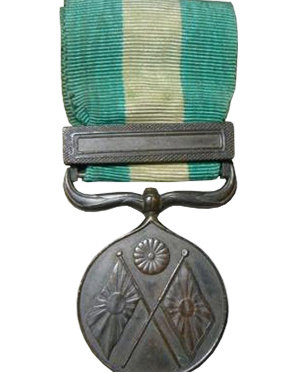
The 1900 Boxer War Medal was a Japanese medal created by Imperial Edict in 1901 to commemorate those that fought during the Boxer Rebellion.

The 1900 Boxer War Medal was a Japanese medal created by Imperial Edict No. 142 and issued on April 21, 1901. It’s a commemorative medal for those who had participated in the relief of the Beijing legations during the Boxer Rebellion.

The Military Medal of Honor (or 従軍記章 jugun kisho in Japanese) was a military decoration for meritorious service to the Empire of Japan, formerly awarded to all military personnel who participated in battles in a war and effectively abolished during the Allied Occupation of Japan in the post-war years (1945–1951).

The plausible re-institution of a modern equivalent was made unlikely by the adoption of Japan’s post-war Constitution which disavows the right of the state to engage in aggressive war.

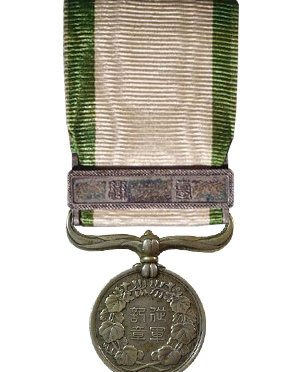
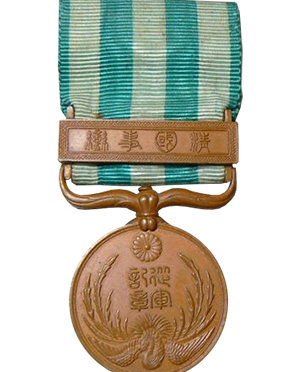
The 1894-95 Sino-Japanese War Medal

The 1894-95 Sino-Japanese War Medal was awarded in commemoration of the First Sino–Japanese War, which lasted from 1894 to 1895.

The 1894-95 Sino-Japanese War Medal was awarded in commemoration of the First Sino–Japanese War, which lasted from 1 August 1894 to 17 April 1895.

The war was fought between Qing Dynasty China and Meiji Japan, primarily over control of Korea. After more than six months of continuous successes by the Japanese army and naval forces, as well as the loss of the Chinese port of Weihai, the Qing leadership sued for peace in February 1895.

The Military Medal of Honor (or 従軍記章 jugun kisho in Japanese) was a military decoration for meritorious service to the Empire of Japan, formerly awarded to all military personnel who participated in battles in a war and effectively abolished during the Allied Occupation of Japan in the post-war years (1945–1951).

The plausible re-institution of a modern equivalent was made unlikely by the adoption of Japan’s post-war Constitution which disavows the right of the state to engage in aggressive war.

The 1874 Formosa Expedition War Medal

The 1874 Formosa Expedition War Medal was established in 1875 to commemorate the 3000 Japanese warriors who went to Formosa.

The 1874 Formosa Expedition War Medal was established by Daijou-kan Law #54 on April 10, Meiji 8 [1875]. Revised (Law #141) on November 15, 1876.

The Japanese expedition of 1874 to Taiwan Province, also referred to as the Taiwan Expedition of 1874, was in response to the Mudan Incident of 1871. Fifty-four shipwrecked Ryukyuan sailors were killed by Paiwan aborigines in December 1871 in southern Taiwan. In seeking restitution from Qing China, Japan reached an impasse when the Chinese claimed that they were not responsible for the actions of the aborigines in territory that was nominally under Chinese sovereignty.

The Japanese government sent an expedition of 3,600 soldiers led by Saigō Tsugumichi in May 1874. The Japanese won a decisive victory at the Battle of Stone Gate on 22 May 1874. Thirty aborigines were either killed or mortally wounded in the battle, and a great number wounded. Japanese casualties were six killed and thirty wounded.

In November 1874 the Japanese forces withdrew from Taiwan after the Qing government agreed to an indemnity of 500,000 Kuping taels.

The Military Medal of Honor (or 従軍記章 jugun kisho in Japanese) was a military decoration for meritorious service to the Empire of Japan, formerly awarded to all military personnel who participated in battles in a war and effectively abolished during the Allied Occupation of Japan in the post-war years (1945–1951).

The plausible re-institution of a modern equivalent was made unlikely by the adoption of Japan’s post-war Constitution which disavows the right of the state to engage in aggressive war.

The 1874 Formosa Expedition War Medal Design

The obverse of the medal bears branches of Imperial Paulonia Leaves. Inscribed ‘War Medal.’ The reverse is inscribed ‘Meiji 7 [1874] Year of the Dog.’ The latter refers to the Chinese Sexagenary Cycle.

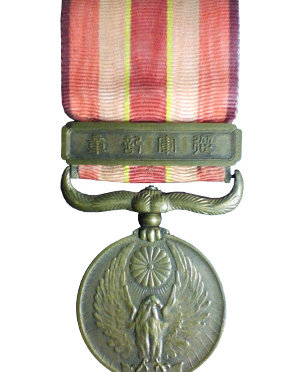
The 1931-34 China Incident War Medal

The China Incident Medal (Sina jihen jugun kisho) medal was created in 1939 and awarded for service in China during the Shōwa period.

The China Incident Medal (Sina jihen jugun kisho) medal was created by Imperial Edit No. 496 on July 27, 1939 and awarded for service in China at any time from the 12th through the 20th years of the Shōwa period — Shōwa 12-20 (1937–1945). The decoration was abolished in 1946 by government ordinance No. 177.

Although the Japanese government still uses “China Incident” in formal documents, media in Japan often paraphrase it with other expressions like Japan-China Incident (日華事変 Nikka jihen) or (日支事変 Nisshi jihen). The word Shina is now construed by China as a derogatory term.

The Military Medal of Honor (or 従軍記章 jugun kisho in Japanese) was a military decoration for meritorious service to the Empire of Japan, formerly awarded to all military personnel who participated in battles in a war and effectively abolished during the Allied Occupation of Japan in the post-war years (1945–1951).

The plausible re-institution of a modern equivalent was made unlikely by the adoption of Japan’s post-war Constitution which disavows the right of the state to engage in aggressive war.

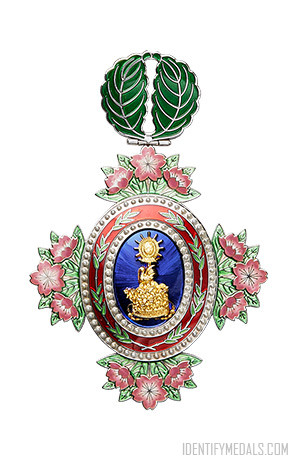
The Order of the Precious Crown

The Order of the Precious Crown (Hōkan-shō) is an Order from Japan established in 1888 by Emperor Meiji and usually reserved for females.

  • Time Period: Pre-WW1
  • Institution: 4 January 1888
  • Country: Medals from Japan Japan

The Order of the Precious Crown (or 宝冠章 Hōkan-shō in Japanese) was established on January 4, 1888, by Emperor Meiji. It’s the lowest ranking of the Japanese orders currently awarded and conventionally reserved for female recipients (such as female members of the royal family).

Until 2003, the Order of the Precious Crown ranked below the Order of the Rising Sun but above the Order of the Sacred Treasure, and was bestowed as a female-only version of the Order of the Rising Sun. The Order of the Precious Crown is now only bestowed upon female members of the Imperial Family and foreign ladies of distinction.

Originally the order had five classes, but on April 13, 1896, the sixth, seventh, and eighth classes were added. Unlike many European counterparts can be awarded posthumously. 

The Order of the Precious Crown is given by the Emperor of Japan at the monarch’s pleasure and, since 2003, no longer uses numbers to represent rank.

The Classes of the Order of the Precious Crown

The Order of the Precious Crown had eight classes (today, it has six. The 7th and 8th classes were abolished in 2003). The First Class is usually awarded to female royalty or, occasionally, to the royal family in foreign countries. This typically happens when necessary for diplomatic ceremonies. 

These are the ribbon bars of the order:

  • JPN Hokan-sho 1Class BAR.svg Grand Cordon, Paulownia 
  • JPN Hokan-sho 2Class BAR.svg Second Class, Peony
  • JPN Hokan-sho 3Class BAR.svg Third Class, Butterfly
  • JPN Hokan-sho 4Class BAR.svg Fourth Class, Wisteria
  • JPN Hokan-sho 5Class BAR.svg Fifth Class, Apricot
  • JPN Hokan-sho 6Class BAR.svg Sixth Class, Ripples
  • JPN Hokan-sho 7Class BAR.svg Seventh Class, Medal
  • JPN Hokan-sho 8Class BAR.svg Eighth Class, Medal 

The Order of the Precious Crown Badge Design

The badge of the order is a gold oval medallion with floral designs at its four ends. Aat the centre is an ancient Japanese crown on a blue background, surrounded by a red ring. It is suspended from a smaller badge, its design varies according to class. 

The ribbon of the Order of the Precious Crown is yellow with red stripes near the borders. For the 1st class, a sash is worn on the right shoulder (all other classes use a bow on the left shoulder).

The star of the order is worn only by the first class and has five rays studded with pearls, with floral designs between the rays. The central disc features a Ho-o or phoenix on a blue background, surrounded by a red ring emblazoned with a laurel wreath.

The medal for the 6th and 7th classes is golden bronze. The face presents the crossed flags of Japan and the Emperor, both surmounted by the Rising Sun. The obverse presents a conventional monumental shaft flanked by a branch of laurel and a palm branch.

The Order of Culture (Japan)

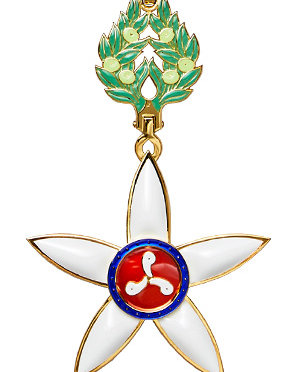
The Order of Culture (Bunka-kunshō) is an order of Japan established in 1937 and conferred by the Emperor of Japan in person.

The Order of Culture (or 文化勲章 Bunka-kunshō in Japanese) is an order of Japan established on February 11, 1937 and conferred by the Emperor of Japan in person on Culture Day (November 3) each year.

Candidates for the Order of Culture are selected from the Persons of Cultural Merit by the Minister of Education, Culture, Sports, Science, and Technology, upon hearing the views of all the members of the selection committee for the Persons of Cultural Merit. The Minister then recommends the candidates to the Prime Minister so that they can be decided by the Cabinet.

The order only has one class and may be awarded to men and women of any country for contributions to Japan’s art, literature, science, technology, or anything related to culture in general. Those that receive the order are also entitled to an annuity for life.

The Order of Culture Design

The badge of the Order of Culture is made in gold with white enamel. It has the form of a Tachibana orange blossom, with the central disc bearing three crescent-shaped jades (magatama).

The badge is suspended on a gold and enamel wreath of mandarin orange leaves and fruit, which is in turn suspended on a purple ribbon worn around the neck.

The Order of the Sacred Treasure

The Order of the Sacred Treasure (or 瑞宝章 Zuihō-shō) is the most widely conferred Japanese order. It was established in 1888 by Emperor Meiji.

The Order of the Sacred Treasure (or 瑞宝章 Zuihō-shō in Japanese) is the most widely conferred Japanese order and it was established on 4 January 1888 by Emperor Meiji and originally called the Order of Meiji. It is awarded for both civil and military merit, though of a lesser degree than that required for the conferment of the Order of the Rising Sun.

It was initially awarded in eight classes, but since 2003 this has been changed to six classes (the lowest two medals were abolished that year). The Order is awarded to those who have made distinguished achievements in research fields, business industries, healthcare, social work, state/local government fields or the improvement of life for handicapped/impaired persons.

Although the order was originally only given to males, it’s been made available to women since 1919. Conventionally, a diploma is prepared to accompany the insignia of the order. In some rare instances, the personal signature of the emperor will have been added.

The Order of the Secret Treasure Design

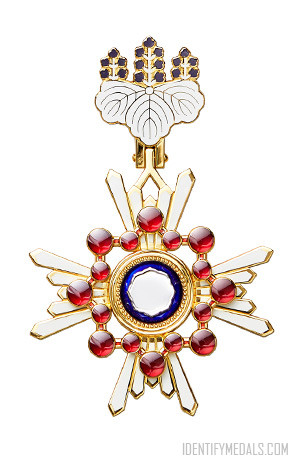
The insignia of the order incorporates symbols for the three imperial treasures: the Yata Mirror, so sacred that not even the Emperor is allowed to look at it; the Yasakani Jewel, which is made of the finest jade; and the Emperor’s personal sword.

The star for the Grand Cordon and Second Class has two sets of Maltese crosses, one in gilt and one placed diagonally in silver.

The badge for the first through sixth classes is a Maltese cross, in gilt (1st–4th classes), gilt and silver (5th class) and silver (6th class), with white enameled rays (representing the sword). The central disc is blue, bearing an eight-pointed silver star (representing the mirror), surrounded by a wreath with red-enameled dots (representing the jewel).

Until 2003, when it was abolished, the badge of the seventh and eighth classes was an eight-pointed silver medal, partially gilded for the 7th class.

The Order of the Rising Sun

The Order of the Rising Sun (Kyokujitsu-shō) was the first national decoration awarded by the Japanese government, established in 1875.

The Order of the Rising Sun (旭日章 Kyokujitsu-shō) is a Japanese order established on 10 April 1875 by decree of the Council of State. The Order was the first national decoration awarded by the Japanese government.

The order is conferred upon those who have made distinguished achievements in international relations, promotion of Japanese culture, advancements in their field, development in welfare, or preservation of the environment. Prior to the end of World War II, it was also awarded for exemplary military service. 

While it is the third highest order bestowed by the Japanese government, it is however generally the highest ordinarily conferred order. The highest Japanese order, the Order of the Chrysanthemum, is reserved for heads of state or royalty, while the second highest order, the Order of the Paulownia Flowers, is mostly reserved for politicians.

The awarding of the Order is administered by the Decoration Bureau of the Cabinet Office headed by the Japanese Prime Minister. It is awarded in the name of the Emperor and can be awarded posthumously.

The Order of the Rising Sun Medal Classes

The Order was awarded in nine classes until 2003 and from then on in six classes.

  • ribbon bar 1st Class: Grand Cordon
  • ribbon bar 2nd Class: Gold and Silver Star (Rays, Principal Grade)
  • ribbon bar 3rd Class: Gold Rays with Neck Ribbon (Cordon, Middle Grade)
  • ribbon bar 4th Class: Gold Rays with Rosette (Cordon, Junior Grade)
  • ribbon bar 5th Class: Gold and Silver Rays (Double Rays)
  • ribbon bar 6th Class: Silver Rays (Single Ray)
  • ribbon bar 7th Class: Green Paulownia Leaves
  • ribbon bar 8th Class: White Paulownia Leaves

The Order of the Rising Sun Medal Design

The badge features rays of sunlight from the rising sun. The design symbolizes energy as powerful as the rising sun in parallel with the “rising sun” concept of Japan (“Land of the Rising Sun“).

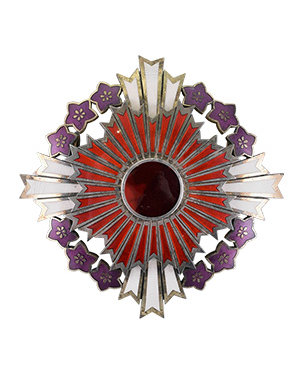
The star for the Grand Cordon and Second Class is a silver star of eight points, each point having three alternating silver rays; the central emblem is identical to the badge. It is worn on the left chest for the Grand Cordon, on the right chest for the 2nd Class.

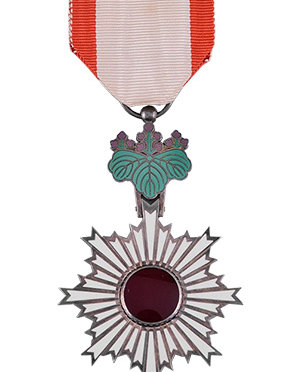
The badge for the Grand Cordon to Sixth Classes is an eight-pointed badge bearing a central red enameled sun disc, with gilt points (1st–4th Classes), with four gilt and four silver points (5th Class), or with silver points (6th Class); each point comprises three white enameled rays. It is suspended from three enameled paulownia leaves on a ribbon in white with red border stripes, worn as a sash from the right shoulder for the Grand Cordon, as a necklet for the 2nd and 3rd Classes and on the left chest for the 4th to 6th Classes (with a rosette for the 4th Class).

The badge for the Seventh and Eighth Classes consisted of a silver medal in the shape of three paulownia leaves, enameled for the 7th Class and plain for the 8th Class. Both were suspended on a ribbon, again in white with red border stripes, and worn on the left chest. Both classes were abolished in 2003 and replaced by the Order of the Paulownia Flowers, a single-class order that now ranks above the Order of the Rising Sun.

The ribbon of the Order references the colors of the Japanese flag (a red disc on a white background) but are represented in stripes (a central large white stripe and smaller red ones on the edges).

Where to Find an Order of the Rising Sun Medal

Right Now on eBay 
Clicking a link to eBay may result in a referral commission being paid if a purchase is made.
Loading...

The Order of the Paulownia Flowers

The Order of the Paulownia Flowers is an order presented by the Japanese government and established in 1888 during the Meiji Restoration.

The Order of the Paulownia Flowers (桐花章 Tōka shō) is an order presented by the Japanese government and established in 1888 during the Meiji Restoration as the highest award in the Order of the Rising Sun.

The only grade of the order is Grand Cordon of the Order of the Paulownia Flowers (旭日桐花大綬章 Kyokujitsu tōka daijushō), which ranks higher than the Order of the Rising Sun but lower than the Order of the Chrysanthemum.

Traditionally, the order has been conferred upon eminent statesmen, former prime ministers and senior cabinet ministers, diplomats and judges. It may be conferred posthumously, and is the highest regularly conferred honor in the Japanese honors system.

The Order of the Paulownia Flowers Medal Design

The badge for the Order is a gilt cross with white enameled rays, bearing a central emblem of a red enameled sun disc surrounded by red rays, and with three paulownia blossoms between each arm of the cross. It is suspended from three enameled paulownia leaves on a sash in red with white border stripes, and is worn on the right shoulder.

The star for the Order is the same as the badge, but without the paulownia leaves suspension. It is worn on the left chest.