
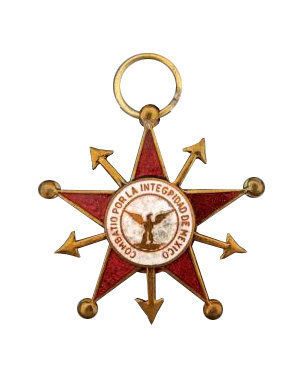
The Star for Bejar and El Salado (1842)

This set of medals were issued during the period 1835-1841 of armed conflict between settlers and the Mexican army that began in late 1835.

As the number of American settlers in the Mexican state of Texas kept growing, the Mexican government made the decision in 1830 to close the border to all immigration, imposing as well numerous restrictions like the abolition of slavery.

The Mexican government believed the United States had instigated the Texas insurrection (October 2, 1835 – April 21, 1836) with the goal of annexation. The Mexican Congress passed the Tornel Decree, declaring that any foreigners fighting against Mexican troops “will be deemed pirates and dealt with as such, being citizens of no nation presently at war with the Republic and fighting under no recognized flag.”

The revolution began in October 1835, after a decade of political and cultural clashes between the Mexican government and the increasingly large population of American settlers in Texas. Colonists and Tejanos disagreed on whether the ultimate goal was independence or a return to the Mexican Constitution of 1824. In March 1836, a second political convention declared independence and appointed leadership for the new Republic of Texas.

Determined to avenge Mexico’s honor, Santa Anna vowed to personally retake Texas. His Army of Operations entered Texas in mid-February 1836 and found the Texians completely unprepared. Mexican General José de Urrea led a contingent of troops on the Goliad Campaign up the Texas coast, defeating all Texian troops in his path and executing most of those who surrendered. Santa Anna led a larger force to San Antonio de Béxar (or Béxar), where his troops defeated the Texian garrison in the Battle of the Alamo, killing almost all of the defenders.

After the Texans’ defeat in April 1836 of General Santa Anna, Mexico made no further attempt to reconquer the territory, although it refused to recognize its independence. The annexation of Texas as the 28th state of the United States, in 1845, led directly to the Mexican–American War. By the terms of the Treaty of Guadalupe Hildago, signed in 1848, Mexico ceded almost half its national territory to the United States.
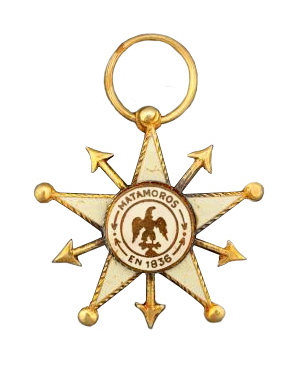
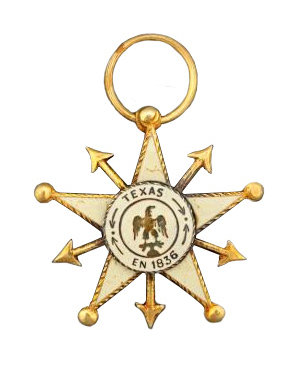
The Star for the Defense of Matamoros (1836)

This set of medals were issued during the period 1835-1841 of armed conflict between settlers and the Mexican army that began in late 1835.

As the number of American settlers in the Mexican state of Texas kept growing, the Mexican government made the decision in 1830 to close the border to all immigration, imposing as well numerous restrictions like the abolition of slavery.

The Mexican government believed the United States had instigated the Texas insurrection (October 2, 1835 – April 21, 1836) with the goal of annexation. The Mexican Congress passed the Tornel Decree, declaring that any foreigners fighting against Mexican troops “will be deemed pirates and dealt with as such, being citizens of no nation presently at war with the Republic and fighting under no recognized flag.”

The revolution began in October 1835, after a decade of political and cultural clashes between the Mexican government and the increasingly large population of American settlers in Texas. Colonists and Tejanos disagreed on whether the ultimate goal was independence or a return to the Mexican Constitution of 1824. In March 1836, a second political convention declared independence and appointed leadership for the new Republic of Texas.

Determined to avenge Mexico’s honor, Santa Anna vowed to personally retake Texas. His Army of Operations entered Texas in mid-February 1836 and found the Texians completely unprepared. Mexican General José de Urrea led a contingent of troops on the Goliad Campaign up the Texas coast, defeating all Texian troops in his path and executing most of those who surrendered. Santa Anna led a larger force to San Antonio de Béxar (or Béxar), where his troops defeated the Texian garrison in the Battle of the Alamo, killing almost all of the defenders.

After the Texans’ defeat in April 1836 of General Santa Anna, Mexico made no further attempt to reconquer the territory, although it refused to recognize its independence. The annexation of Texas as the 28th state of the United States, in 1845, led directly to the Mexican–American War. By the terms of the Treaty of Guadalupe Hildago, signed in 1848, Mexico ceded almost half its national territory to the United States.
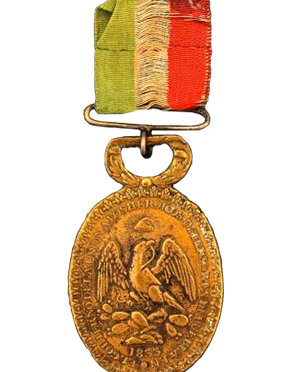
The Star for the Defense of Texas (1836)

This set of medals were issued during the period 1835-1841 of armed conflict between settlers and the Mexican army that began in late 1835.

As the number of American settlers in the Mexican state of Texas kept growing, the Mexican government made the decision in 1830 to close the border to all immigration, imposing as well numerous restrictions like the abolition of slavery.

The Mexican government believed the United States had instigated the Texas insurrection (October 2, 1835 – April 21, 1836) with the goal of annexation. The Mexican Congress passed the Tornel Decree, declaring that any foreigners fighting against Mexican troops “will be deemed pirates and dealt with as such, being citizens of no nation presently at war with the Republic and fighting under no recognized flag.”

The revolution began in October 1835, after a decade of political and cultural clashes between the Mexican government and the increasingly large population of American settlers in Texas. Colonists and Tejanos disagreed on whether the ultimate goal was independence or a return to the Mexican Constitution of 1824. In March 1836, a second political convention declared independence and appointed leadership for the new Republic of Texas.

Determined to avenge Mexico’s honor, Santa Anna vowed to personally retake Texas. His Army of Operations entered Texas in mid-February 1836 and found the Texians completely unprepared. Mexican General José de Urrea led a contingent of troops on the Goliad Campaign up the Texas coast, defeating all Texian troops in his path and executing most of those who surrendered. Santa Anna led a larger force to San Antonio de Béxar (or Béxar), where his troops defeated the Texian garrison in the Battle of the Alamo, killing almost all of the defenders.

After the Texans’ defeat in April 1836 of General Santa Anna, Mexico made no further attempt to reconquer the territory, although it refused to recognize its independence. The annexation of Texas as the 28th state of the United States, in 1845, led directly to the Mexican–American War. By the terms of the Treaty of Guadalupe Hildago, signed in 1848, Mexico ceded almost half its national territory to the United States.

The Defense of Puebla Medal (1833)

The Defense of Puebla was a government authorized medal for the militia defenders at Puebla during the Revolt of the Polkos in Mexico in 1833.

The Defense of Puebla was a government authorized medal for the militia defenders at Puebla during the Revolt of the Polkos in Mexico in 1833.

Valentín Gómez Farías (14 February 1781 – 5 July 1858) was the President of Mexico for five short periods between the 1830s and 1840s. During his term in 1833 and in the absence of President Antonio López de Santa Anna (1794–1876), he enacted significant liberal reforms that were aimed at undermining the power of the Roman Catholic Church and the army in Mexico – for example, he advised Catholic clerics to limit their sermons to religious concerns and stop intervening in politics.

Some of Gómez Farías’ legislation restricted the Catholic Church’s power and eliminated some military privileges. The Conservatives, the Church, and the Army quickly responded in the form of the Revolt of the Polkos, calling for the removal of the Liberal government. During it, five Mexican National Guard regiments rose up in rebellion against the Mexican government, in protest over legislation that permitted the government to requisition money and property from the Catholic Church.

After the revolt was put down, the government authorized a medal for the militia defenders at Puebla: The Defense of Puebla medal.