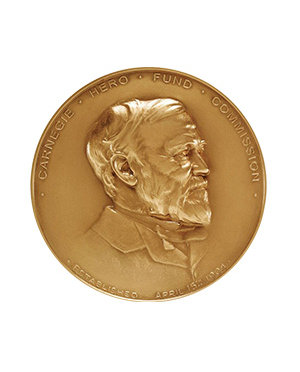
The Carnegie Hero Fund Medal

The Carnegie Hero Fund Commission was established to recognize persons who perform extraordinary acts of heroism in civilian life.

The Carnegie Hero Fund Commission (or Medaille van het Carnegie Heldenfonds in Dutch), also known as Carnegie Hero Fund, was established to recognize persons who perform extraordinary acts of heroism in civilian life in the United States and Canada, and to provide financial assistance for those disabled and the dependents of those killed saving or attempting to save others.

Those chosen for recognition receive the Carnegie Medal and become eligible for scholarship aid and other benefits. A private operating foundation, the Hero Fund was established in Pittsburgh, Pennsylvania, in 1904 with a trust fund of $5 million by Andrew Carnegie, a Scottish-American industrialist and philanthropist.

The fund was inspired by Selwyn M. Taylor and Daniel A. Lyle, who gave their lives in rescue attempts following the Harwick Mine disaster in Harwick, Pennsylvania, just outside Pittsburgh, on January 25, 1904. The disaster claimed 181, including Taylor and Lyle, who were killed during rescue attempts. Greatly touched by Taylor’s and Lyle’s sacrifice, Carnegie had medals privately minted for their families, and within two months he wrote the Hero Fund’s governing “Deed of Trust”, which was adopted by the newly created commission on April 15, 1904.

Administered by a 21-member board still based in Pittsburgh, the Hero Fund has awarded 9,893 medals as of September, 2016, and has given $38.5 million in one-time grants, scholarship aid, death benefits, and continuing assistance.

The Carnegie Hero Fund Medal Design

The three inch (7.13 cm) in diameter bronze medals which are given to awardees, are struck by Simons Brothers Co. of Philadelphia and consist of 90% copper and 10% zinc.

A verse from the New Testament of the Bible encircles the outer edge: “Greater love hath no man than this, that a man lay down his life for his friends” (John 15:13).

The first medals issued by the trust were in bronze, silver and gold. The trust soon stopped issuing gold medals. The last silver medal was issued in 1981.

The Resistance Memorial Cross

The Resistance Memorial Cross or Commemorative Cross is a medal awarded to members of the Dutch resistance during the Second World War.

The Resistance Memorial Cross or Resistance Commemorative Cross (or Verzetsherdenkingskruis in Dutch) is a medal awarded in the Netherlands to members of the Dutch resistance during the Second World War.

The medal was instituted by Royal Decree (No. 104) on 29 December 1980, after the 35th anniversary of the liberation of the Netherlands. The cross is only awarded at the request of a person eligible to receive it. Approximately 15,000 have been awarded, recorded in the Gedenkenboek verzetsherdenkingskruis.

The Resistance Memorial Cross may be awarded to:

  • Members of resistance groups recognized in the Royal Decree dated 5 September 1944 or to any resistance group known to the Council on Extraordinary Pensions or the 1940-1945 Foundation.
  • Anyone recognized by the Council on Extraordinary Pension as a participant in the resistance, regardless of whether they were awarded a pension.
  • Individuals defined by the Law on the Improvement of the Legal Status of Resistance Fighters (law of 1/20/76, Stb. 19) adjudged as having spent time in service to the resistance.
  • Soldiers of the Dutch Internal Armed Forces in occupied territory.
  • Those who participated in actions during World War II in Japanese or Japanese-occupied territory, which after the war, were designated as resistance of the enemy by the committee.
  • Anyone who does not meet any preceding provisions, may still be considered a participant in the resistance in the judgement of the committee.

The Resistance Memorial Cross Design

The medal comprises a silver cross hung from a striped ribbon. The obverse of the cross bears a vertical flaming sword, surmounted by the Dutch royal crown. Below the sword are the dates 1940 above 1945. The horizontal arms of the cross are inscribed with the words DE TYRANNY VERDRYVEN (“to destroy tyranny”), a line in the Dutch national anthem.

The reverse bears a Dutch lion, and the date of institution, 1980. The cross is suspended by a ring from a ribbon colored with asymmetric stripes: the left half is red-white-blue (for the Dutch flag) and the right half orange (the national color of the Netherlands) with a black border on each edge.

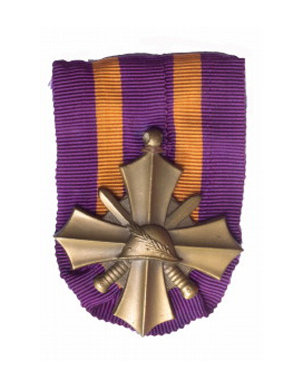
The Mobilisation War Cross

The Mobilization War Cross (or Mobilisatie-Oorlogskruis in Dutch) is a Dutch medal awarded for service during World War II.

The Mobilisation War Cross (or Mobilisatie-Oorlogskruis in Dutch) is a Dutch medal awarded for service during World War II.

The Mobilisation War Cross was established on 11 August 1948 by royal decree of Queen Wilhelmina. Those eligible for the award include military personnel who served for at least six months between 6 April 1939 – 20 May 1940. However, the Cross can also be awarded to non-military personnel or people who did not serve a full six months, as long as the subject performed military tasks for the Kingdom of the Netherlands.

On 1 December 1992, the original royal decree was rescinded and replaced.

The Mobilisation War Cross Design

The decoration is a cross in bronze over a ribbon of colors purple and orange. The obverse shows a helmet and set of swords.

The Medal of Recognition 1940-1945

The Medal of Recognition 1940–1945 is a medal of the Kingdom of the Netherlands that was established by Royal Decree on 9 February 1946.

The Medal of Recognition 1940–1945 (or Erkentelijkheidsmedaille 1940–1945 in Dutch) is a medal of the Kingdom of the Netherlands that was established by Royal Decree on 9 February 1946.

The decoration was of two classes, silver and bronze, and was awarded to those who aided the Dutch during the period of World War II, or afterwards helped relieve those who had suffered from the German occupation.

The Medal of Recognition 1940-1945 Design

The decoration was designed as a circular medal 29 millimeters in diameter and exists in two classes, silver and bronze.

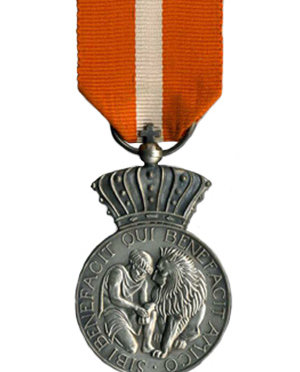
On the front Androcles is portrayed taking the thorn from the lion’s paw. The choice of motif was guided by the fact that the lion is the royal emblem of the Netherlands and the story was once commonly cited as an example of enduring gratitude. The inscription round the front edge reads SIBI BENEFACIT QUI BENEFACIT AMICO (‘He benefits himself who benefits a friend’). On the reverse of the medal the inscription reads POPULUS BATAVUS GRATO ANIMO (‘With the gratitude of the Dutch people’).

The medal’s ribbon is orange with a broad white stripe down the middle, on which there is a small silver or bronze crown according to class.

The Flood Disaster Medal

The Flood disaster Medal (Watersnoodmedaille) was created by royal decree on 27 March 1855 by King William III of the Netherlands.

The Decoration for acknowledgment of excellent deeds performed during a flood disaster (or Onderscheidingsteken ter erkenning van uitstekende daden bij watersnood verricht in Dutch), usually called Flood disaster Medal (Watersnoodmedaille), was created by royal decree on 27 March 1855 by King William III of the Netherlands.

The medal is intended for those civilians who have shown zeal, courage, leadership, and self-sacrifice during the event of a flood disaster

The Flood Disaster Medal Design

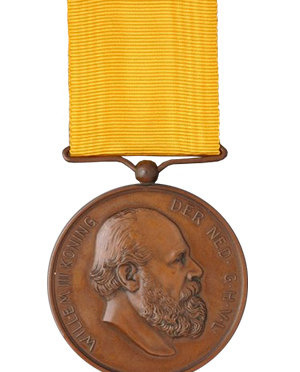
The Flood Disaster medal is round, made of bronze and features the profile of King William III of the Netherlands. The ribbon is yellow.

The Museum Medal

The Honorary Medal for Merits toward Museum Collections (or Museum Medal) is one of the oldest civil decorations of the Netherlands.

The Honorary Medal for Merits toward Museum Collections (or Erepenning voor Verdiensten jegens Openbare Verzamelingen in Dutch), also known as the Museum Medal, is one of the oldest civil decorations of the Netherlands.

It was created by royal decree on 26 June 1817 by King William I of the Netherlands. The decree describes the following: “An honorary medal for appearance of interest in the state collection by donation shown“. The medal is awarded in gold, silver or bronze as a token of appreciation to those who “donate to the Dutch monarch any works of art, that were collected with much effort.

By royal decree, on 5 May 1877, eligibility for this award was extended by King William III of the Netherlands, with the description “to those who donated important works of art to the state museums or who showed praiseworthy acts regarding the different scientific collections or art collection of the state museums“.

Due to this description, the medal obtained its current official name. However, since the end of the 19th century, this decoration is primarily known as the “Museum Medal”.

Eligibility for this award was once again extending, by Queen Wilhelmina, on 28 October 1919 with the description “merit towards community (public) collections“. What was initially a medal for generous donors became now an official royal award for merit.

The Museum Medal Design

Up until 1897, the honorary medal was only a standing decoration, when Queen Wilhelmina of the Netherlands declared that the medal could be worn suspended from a ribbon. Queen Juliana of the Netherlands decided by royal decree on 26 July 1952 that the shape of the medal and ribbon should be changed.

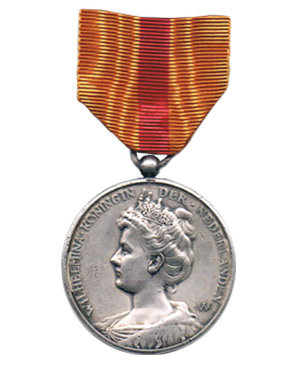
The current ribbon is orange with two red lines descending down the middle. A ribbon bar is also given with the award, with a palm branch device in either gold or silver for recipients of the gold or silver versions of the medal, respectively. Queen Beatrix of the Netherlands later changed the composition of the medallion, and is now depicted on the obverse of the medal.

The De Ruyter Medal

The De Ruyter Medal was created by royal decree to be awarded to those members of the Dutch Merchant fleet who distinguish themselves.

The De Ruyter Medal (or De Ruyter-medaille in Dutch) was created by royal decree no. 1 on 23 March 1907 by Queen Wilhelmina of the Netherlands, to be awarded to those members of the Dutch Merchant fleet who distinguish themselves by praiseworthy acts of duty for the Dutch Ship transport.

With the De Ruyter Medal the Kingdom of the Netherlands honors since 1907 the three-hundredth birthday of Michiel de Ruyter, one of the most famous admirals in Dutch history. The medal can be awarded in gold, silver or bronze. Awarding is on basis of nomination of the Netherlands government and by royal decree.

The Ruyter Medal Design

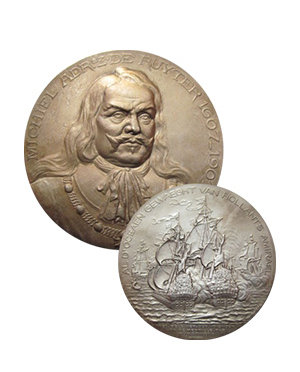
The Ruyter medal is a round medal with, on the front side, a picture of Michiel de Ruyter. The medal is worn with a dark orange ribbon.

The Airman’s Cross

The Airman’s Cross (Vliegerkruis) is an important military decoration of the Kingdom of the Netherlands created in 1941 for Dutch military.

The Airman’s Cross (or Vliegerkruis in Dutch) is an important military decoration of the Kingdom of the Netherlands created in 1941. The cross is meant for that Dutch military, who displayed during one of more flights in an aircraft, initiative, courage and perseverance against the enemy or during hostile actions. The cross is also awarded to allied pilots, whose actions or performances in the air were of high importance for the Netherlands.

Till 2007 in total of 735 Airman’s Crosses are awarded, most recently to a F-16 pilot, Air Force Major M. Duivesteijn. This because of his “exceptional courage and perseverance” at a flight above former Yugoslavia within the framework of NATO Operation Allied Force in 1999. Well-known recipients are also Erik Hazelhoff Roelfzema, the “Soldier of Orange“, and Prince Bernhard of the Netherlands.

The Airman’s Cross is the fifth highest military decoration still being awarded for bravery and has precedence after the Cross of Merit.

The Cross of Merit Design

The Airman’s Cross resembles the Dutch Bronze Cross but is worn on a diagonally-striped orange and white ribbon inspired by those of the British Distinguished Flying Cross and Air Force Cross.

The cross is silver with four arms. There is a crowned central medallion bearing an albatross in flight with “INITIATIEF MOED VOLHARDING” (INITIATIVE COURAGE PERSEVERANCE) around the edge of the medallion. The date 1941 appears above the body of the albatross. The reverse is plain.

The Cross of Merit (Netherlands)

The Cross of Merit is an award for working in the interest of the Netherlands with distinguishing valor while faced with enemy action.

The Cross of Merit (“Kruis van Verdienste”) is an award for “working in the interest of the Netherlands while faced with enemy actions and distinguishing oneself through valor and resolute behavior“. One did not have to be on the front line to win this award.

On 20 February 1941, the Dutch government in exile in London instituted several new awards for bravery. The new way that wars were fought, with civilian resistance and the merchant navy in great peril, made this necessary. Amongst the new decorations was the “Cross of Merit” (“Kruis van Verdienste”).

The cross has often been awarded to those who managed to flee to England and to the armed resistance. It was rarely awarded after the Korean War, but since the fighting of the Netherlands army in Afghanistan, Uruzgan, this World War II decoration has been awarded again on a regular basis with the latest on 7 October 2009 to eleven Dutch soldiers.

During the second world war in the Far East this cross was awarded to several people employed by the Koninklijke Paketvaart-Maatschappij (K.P.M.) as some of their merchant navy ships had been commissioned by the Dutch Navy during the Battle of the Java Sea.

The Bronze Cross Design

The medal is a bronze cross with a blue and yellow ribbon. There are several issues and types of this decoration.

In case of repeated awards a large “2” or “3” is pinned to the ribbon.

The Bronze Cross (Netherlands)

The Bronze Cross of the Kingdom of the Netherlands was instituted by Queen Wilhelmina during the German occupation of the Netherlands.

The Bronze Cross of the Kingdom of the Netherlands (or “Het Bronzen Kruis” in Dutch) was instituted on 11 June 1940 by Queen Wilhelmina of the Netherlands while she was residing in London during the German occupation of the Netherlands.

The Bronze Cross has precedence after the Resistance Star East Asia, but is the third-highest military decoration still being awarded for bravery.

Several British, American, Canadian and Polish soldiers are among the 3,501 recipients of the Bronze Cross that is awarded by Royal Decree.

The Bronze Cross Design

The medal is a bronze cross pattée. A wreath consisting of tendrils of oak and laurel leaves is tied around the royal cipher.

The orange ribbon has a Nassau blue stripe in the center. Orange is the color of the Queen, the head of the House of Orange, and blue is the heraldic color of the ancestral house of Nassau.

The Cross has no clasps. If it is awarded again a large Arabic golden figure “2” or “3” is attached to the ribbon.