The Victoria Cross for New Zealand

The Victoria Cross for New Zealand is a military decoration awarded members of the New Zealand Armed Forces for valor or gallantry.

The Victoria Cross for New Zealand (VC) is a prestigious military decoration presented for acts of valor or gallantry in the presence of the enemy, recognizing the courage of individuals within the New Zealand Armed Forces. This commendation is not bound by rank, encompassing all services and even civilians under military command.

Established in 1999, the Victoria Cross for New Zealand is part of New Zealand’s updated honors system, replacing several British awards with homegrown distinctions.

It draws its inspiration from the original British Victoria Cross, initially introduced by Queen Victoria in 1856 to acknowledge acts of valor during the Crimean War. Notably, the Victoria Cross for New Zealand has been awarded just once, on July 2, 2007, recognizing Lance Corporal Willie Apiata for his actions in 2004. The medal itself is crafted from gunmetal sourced from cannons seized by the British during 19th-century campaigns, possibly in Russia or China. Australia and Canada similarly feature their own versions of the Victoria Cross, serving as the highest accolades for gallantry within their respective military personnel.

The Victoria Cross for New Zealand Design

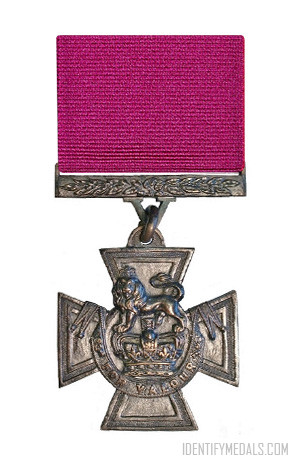
The Victoria Cross for New Zealand faithfully adheres to the original design of the Victoria Cross. This distinguished decoration takes the form of a cross pattée with straight edges, measuring approximately 36 millimetres (1.4 inches) in both width and height. At its center, the cross bears a crown, atop which rests a majestic lion, accompanied by the inscription “For Valour.”

The cross gracefully hangs from a ring, connected to a seriffed “V”-shaped bar adorned with laurel leaves, through which the crimson ribbon is threaded. On the reverse side of the suspension bar, one finds an engraved record of the recipient’s name, rank, number, and unit. The reverse of the medal features a circular panel at its center, displaying the date of the act for which it was bestowed.

The ribbon is crimson, measuring 38 millimetres (1.5 inches) in width.

Find This Medal

Right Now on eBay 
Clicking a link to eBay may result in a referral commission being paid if a purchase is made.
Loading...

The George Cross (Great Britain)

The George Cross is the second highest award of the UK honors system and it’s awarded for acts of the greatest heroism or courage.

The George Cross (also known as GC) is the second highest award of the United Kingdom honors system and it’s awarded “for acts of the greatest heroism or for most conspicuous courage in circumstance of extreme danger“, not in the presence of the enemy, to members of the British armed forces and to British civilians.

The medal may be awarded to a person of any military rank in any service and to civilians including police, emergency services and merchant seamen. Many of the awards have been personally presented by the British monarch to both recipients and in the case of posthumous awards to next of kin. These investitures are usually held at Buckingham Palace.

The George Cross was instituted on 24 September 1940 by King George VI. At this time, during the height of the Blitz, there was a strong desire to reward the many acts of civilian courage. The existing awards open to civilians were not judged suitable to meet the new situation, therefore it was decided that the George Cross and the George Medal would be instituted to recognize both civilian gallantry in the face of enemy action and brave deeds more generally.

Posthumous awards have been allowed since it was instituted.

The George Cross Criteria

The George Cross is awarded for acts of the greatest heroism or the most conspicuous courage in circumstances of extreme danger. It is intended to recognize acts that exemplify selfless bravery

It can be awarded to both military personnel and civilians and is the highest gallantry award for civilians, as well as for military personnel in situations where military honors would not typically be granted. The GC may also be awarded posthumously.

The cross has been awarded to several foreigners for their acts of exceptional bravery. Examples include:

  1. Malta: Awarded to the entire island of Malta in 1942 for the collective bravery of its citizens during sustained aerial bombardment in World War II.
  2. Rustum Sohrabji Ghandhi: An Indian naval officer awarded in 1952 for his gallantry during a rescue operation.
  3. Michael Pratt: An Australian police officer awarded in 1978 for his actions during a bank robbery.

The George Cross Design

The medal was designed by Percy Metcalfe. The Warrant for the GC (along with that of the George Medal), dated 24 September 1940, was published in The London Gazette on 31 January 1941.

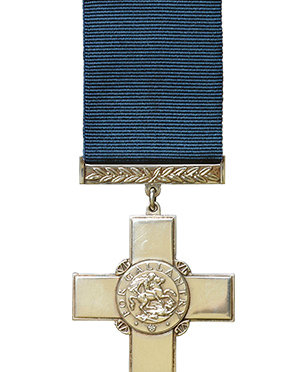
It measures 48 mm in height, with a maximum width of 45 mm. The obverse is a plain silver cross with circular medallion in the center depicting the effigy of St. George and the Dragon, surrounded by the words “FOR GALLANTRY“. In the angle of each limb is the Royal Cypher GVI.

The reverse is plain, with a center engraved with the name of recipient and date of award. The cross is attached by ring to bar ornamented with laurel leaves, through which the ribbon passes.

Find a George Cross

Right Now on eBay 
Clicking a link to eBay may result in a referral commission being paid if a purchase is made.
Loading...