The Volunteer Cross for War 1918-1921

Time Period: Interwar Period, WW1

Year of Institution: 15 June 1939
Country: Poland

The Volunteer Cross for War and the Volunteer Medal for War (or Krzyż i Medal Ochotniczy za Wojnę in Polish) were military decorations from Poland introduced just before the start of World War II and later awarded by the Polish government in exile.

The Volunteer Cross for the War could be awarded to volunteers serving in the years 1918-1921, if they met one of the following criteria:

  • Fallen or wounded on the battlefield,
  • Decorated with the Virtuti Militari Cross or the Cross of Valor,
  • They actively served 3 months, including at least 2 months in units fighting at the front or 6 months as instructors in military schools of weapons and school camps.

The Cross and the Volunteer Medal for War were introduced by an act of the Sejm on 15 June 1939. It was to be awarded to people who volunteered for duty in the years 1918 to 1921 and helped to strengthen the independence of the Polish Republic, covering mainly the Polish-Ukrainian War and Polish-Soviet war.

Because of the German invasion of Poland in 1939 and the outbreak of World War II no decorations were awarded at the time. It was only after 1945 that the Polish government in exile was able to award the decorations. The communist authorities of the People’s Republic of Poland refused to recognize the decoration. After the fall of communism, a very similar decoration, Krzyż za udział w Wojnie 1918-1921, was introduced.

The Volunteer Cross for War 1918-1921 Design

The medal has the form of a straight isosceles cross made of steel and measures 42 by 42 mm. It consists of four equal arms, extended at the ends, with a flattened octagonal cross-section and tied in the centre by a cube.

On the cross arms of the Cross, in the obverse, there is a horizontal inscription: “OCHOTNIKOWI WOJENNEMU”, and on the vertical arms the dates: 1918 and 1921. In the middle of the crossing of the arms there is an image of a white enamel eagle.

The cross and medal were to be worn on a 37 mm wide ribbon in red with two narrow white vertical stripes.
The Commemorative Medal For the War 1918-1921

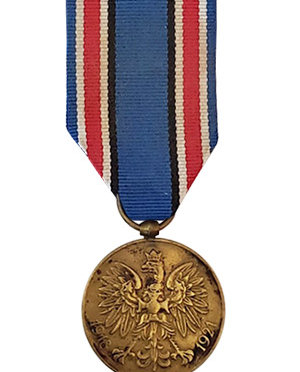
The Commemorative Medal For the War 1918-1921 medal was awarded to military who served against Soviet Russian forces.

The Commemorative Medal For the War 1918-1921 medal was instituted on 21 September 1928 and awarded to military who served for a minimum of 3 months with a unit actively engaged against Soviet Russian forces during the war of 1918 to 1921.

For volunteers, the qualifying period was two months and for auxiliary units 5 months. There was no qualifying minimum period of service for those wounded in the conflict.

The Polish-Soviet war of 1918 to 1921 arose from the chaos at the end of World War I and the Russian Revolution of 1917, with Poland seeking to reinforce its independence after centuries of occupation and division and expand its frontiers eastward and Soviet forces attempting to take control of former Imperial Russian territories. The Treaty of Riga that ended the war in 1921 effectively divided the disputed area between the two combatants.

The Commemorative Medal For the War 1918-1921 Design

The medal is circular and struck in bronze. It has a laterally pierced cylinder suspension.

The obverse features a Polish eagle, the Order of Virtuti Militari imposed on its chest, and the inscription ‘1918 1921’. The reverse is inscribed ‘POLSKA SWEMV OBROŃCY’ (“Poland for her Defenders”) within an oak leaf border.

The central stripe of the ribbon is blue flanked by thinner stripes of black, white, purple, white and blue.

The Virtus et Fraternitas Medal

The Virtus et Fraternitas Medal was established on 9 November 2017 and awarded to those who provided aid and assistance to Polish citizens.

The Virtus et Fraternitas Medal (or Medal Virtus et Fraternitas) was established on 9 November 2017 awarded to those who provided aid and assistance to Polish citizens. It is also bestowed to honor individuals who voluntarily keep alive the memory of those who did not survive the war or the forced deportations, and found their graves abroad.

The medal is awarded by the President of Poland on recommendation of the director of the Pilecki Institute as a token of commemoration and gratitude. The medal was awarded for the first time on 19 June 2019.

The Virtus et Fraternitas Medal Design

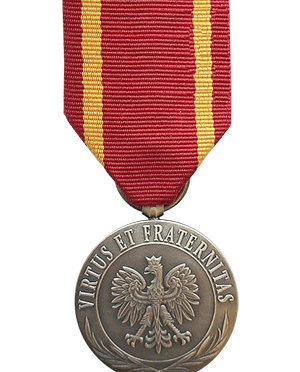
The medal is round and struck in silver, and measures 36 mm in diameter.

On the obverse is inscribed “VIRTUS ET FRATERNITATIS” (“Virtue and Brotherhood”). In the center of the medal carved stylized image of the White Eagle. 

The Virtus et Fraternitas Medal is suspended from a purple ribbon, 36 mm wide. Symmetrically arranged along the edges of the ribbon are gold stripes each 4 mm wide, both 4 mm from the edge.

The Cross of Freedom and Solidarity

The Cross of Freedom and Solidarity was established in 2010 to honor killed, wounded or imprisoned members of the democratic opposition.

The Cross of Freedom and Solidarity (or Krzyż Wolności i Solidarności in Polish) was established on 5 August 2010, to honor members of the democratic opposition in Poland who between the years 1956 and 1989 were killed, seriously wounded or injured, arrested, imprisoned or interned for at least 30 days, who lost jobs or were expelled from school or university for at least 6 months as a result of their activities for the benefit of a free and democratic Poland.

Individuals who are found having collaborated with the communist regime may not be awarded.

The Cross of Freedom and Solidarity Design

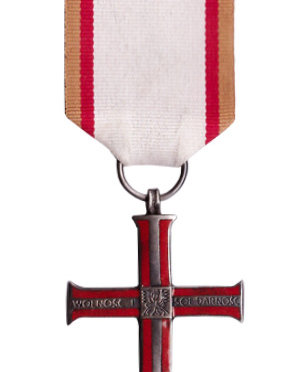
The cross is a red enameled Greek cross struck in silver, similar to that of the Order of the Cross of Independence and the Cross of Independence of 1930. The cross is 42 mm in diameter.

On the obverse, the inscription “WOLNOŚĆ I SOLIDARNOŚĆ” (“Freedom and Solidarity”) is written across the horizontal arms. In the center of the cross carved stylized image of the White Eagle. The reverse side of the cross is smooth.

The Cross of Freedom and Solidarity is suspended from a white ribbon, 38 mm wide. Symmetrically arranged along the edges of the ribbon are gold and crimson stripes each 3 mm wide.

The Medal for Long Marital Life

The Medal for The Medal for Long Marital Life was established in 1960 and awarded to couples who have been married for at least 50 years.

The Medal for Long Marital Life (or Medal Za Długoletnie Pożycie Małżeńskie in Polish) is a medal from Poland established on February 17, 1960 and awarded to couples who have been married for at least 50 years.

The medal is still awarded in cities across the country but ‘PRL’ has become ‘PR’ on the reverse. . In addition to having a 50-year-long marriage, couples should also have at least one child, either their own or adopted, to qualify for the medal.

The Medal for Long Marital Life Design

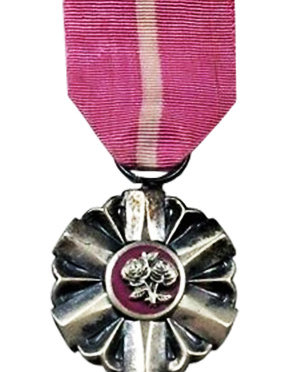
The medal is round, struck in silver, and has six rays. It measures 35mm in diameter.

The obverse has a pink enameled center with two roses with intertwined stems superimposed. The reverse has the letters PRL in the center. Surrounding this are the words: “ZA DLUGOLETNIE POZYCIE MALZENSKIE” in a circle.

The ribbon is 37mm wide with a 4mm wide white stripe in the centre of the ribbon.

The Medal for Long Service

The Medal for Long Service is a decoration from Poland awarded in three classes to members of the Armed Forces and other uniformed services.

The Medal for Long Service (or Medal za Długoletnią Służbę in Polish) is a decoration established on January 8, 1938 and awarded in three classes (gold, silver, and bronze) to members of the Polish Armed Forces and other uniformed services, and to civil servants who have honorably completed 30, 20 or 10 years of service to the State.

After the outbreak of the Second World War the conferment was suspended, and after that, the medal was eventually discontinued. In 1951, it was replaced by the Medal of the Armed Forces in the Service of the Fatherland for members of the armed forces. The Medal for Long Service was revived by the Law of 14 June 2007, which amended the Act of 16 October 1992, concerning medals and decorations.

The original medal was awarded by the appointed minister to any member of the armed forces or other uniformed services, or to civilian employees of the government or local government following 30 (gold medal), 20 (silver medal), or 10 years (bronze medal) of continuous or cumulative service. The recipients of the medal were required to make a monetary payment for it.

Since 2007 the medal has been conferred by the President of Poland. Unlike its pre-World War II counterpart, the conferment is not automatic but is decided on an individual basis.

The Medal for Long Service Design

The medal is circular, measures 35 mm in diameter, and is made from gilded, silver-plated or bronze-patined metal.

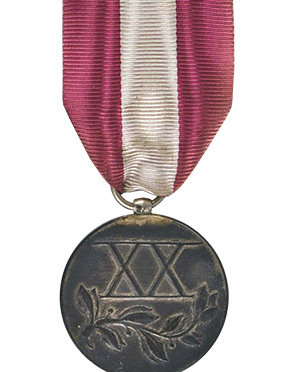
The obverse depicts a Polish crowned eagle surrounded by rye ears and circumscribed “ZA DŁUGOLETNIĄ SŁUŻBĘ” (“FOR LONG SERVICE“). On the reverse are the Roman numerals “XXX” (30), “XX” (20) or “X” (10), with a laurel spray below.

The same numeral in gold, silver or bronze is attached to the ribbon bar. The ribbon has three stripes in red, white, and red.

The Medal for Sacrifice and Courage

The Medal for Sacrifice and Courage was established in 1960 and is awarded to those who, with disregard for their own life, help others.

The Medal for Sacrifice and Courage (or Medal za Ofiarność i Odwagę in Polish) is a medal from Poland established on February 17, 1960. It is awarded to those who, with disregard for their own life, save people from drowning, aid the victims of natural disasters, fires, explosions, or other unfortunate circumstances, or protect the property of others during such events.

The Medal for Sacrifice and Courage Design

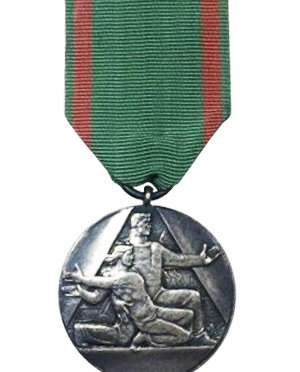
The medal is round and was designed in 1960 by Józef Gosławski. The obverse features an image of a man and woman framed by a triangular background.

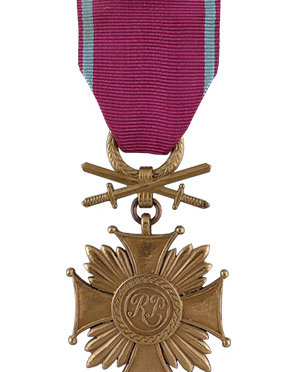
The Cross of Merit with Swords (Poland)

The Cross of Merit with Swords is a military award of Poland established October 19, 1942, by the Polish Government in Exile.

The Cross of Merit with Swords (or Krzyż Zasługi z Mieczami in Polish) is a military award of Poland established October 19, 1942, by the Polish Government in Exile.

The Cross of Merit with Swords is awarded for deeds of bravery and valor during time of war not connected with direct combat, and for merit demonstrated in perilous circumstances.

The Order has three grades:

1. Gold Cross of Merit with Swords
2. Silver Cross of Merit with Swords
3. Bronze Cross of Merit with Swords

The cross may be awarded twice in each grade to the same person.

The Cross of Merit with Swords Design

The medal is struck in silver or bronze (the first class with red and white enamels), measures 40.5 mm (w) x 40.5 mm (h) ad weighs approximately 24 grams. The shape is a cross with sunlight rays between the arms.

In the center medallion, in the obverse, are the initials RP (“Rzeczpospolita Polska” or Republic of Poland). The ribbon is red with white edges. The suspension has crossed sowrds.

The medal was awarded with a molded box and a certificate.

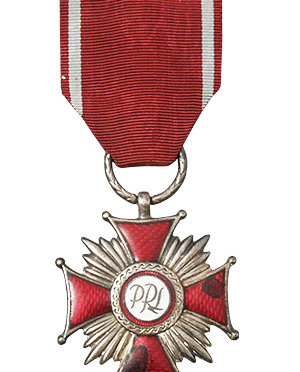
The Cross of Merit (Poland)

The Cross of Merit is a civil state decoration of Poland established on June 23, 1923, to recognize services to the state.

The Cross of Merit (or Krzyż Zasługi in Polish) is a civil state decoration of Poland established on June 23, 1923, to recognize services to the state.

At the time of its establishment in 1923, the Cross of Merit was the highest civilian award in Poland. It was given to citizens who went beyond the call of duty in their work for the country and society as a whole.

The Order has three grades:

1. Gold Cross of Merit (Złoty Krzyż Zasługi)
2. Silver Cross of Merit (Srebrny Krzyż Zasługi)
3. Bronze Cross of Merit (Brązowy Krzyż Zasługi)

The Cross of Merit may be awarded twice in each grade to the same person.

The Cross of Merit Design

The medal is struck in silver or bronze (the first class with red and white enamels), measures 40.5 mm (w) x 40.5 mm (h) ad weighs approximately 24 grams. The shape is a cross with sunlight rays between the arms.

In the center medallion, in the obverse, are the initials RP (“Rzeczpospolita Polska” or Republic of Poland). The ribbon is red with white edges.

The medal was awarded with a molded box and a certificate.

The Cross of Merit for Bravery (Poland)

The Cross of Merit for Bravery is awarded for selfless bravery in the defense of the law, national borders, and life and property.

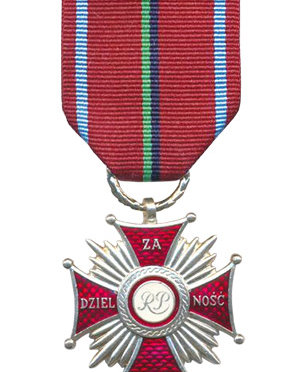
The Cross of Merit for Bravery (or Krzyż Zasługi za Dzielność in Polish) is a medal of Poland awarded for selfless bravery in the defense of the law, national borders, and the life and property of citizens in especially difficult circumstances.

The medal was established on March 7, 1928 as a military-grade of the Cross of Merit. The medal was awarded until World War II and was not recognized by the post-war government. On October 16, 1992 the medal was reintroduced and is currently awarded to police officers, firefighters, and several military and civilian agencies involved in intelligence or security.

The Cross of Merit for Bravery Design

The obverse bears the words “Za Dzielność” (“For Bravery” in Polish) and the letters RP for the Republic of Poland.