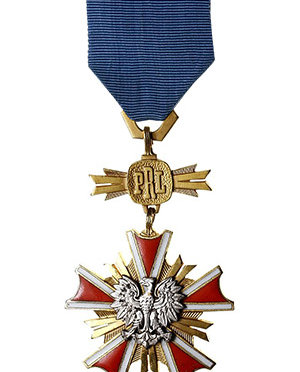
The Order of Merit of the Republic of Poland

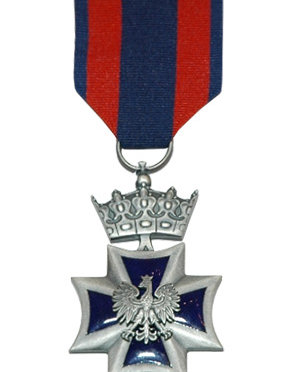
The Order of Merit of the Republic of Poland was created in 1974 and is awarded to persons who have rendered great service to the country.

  • Time Period: Post-WW2
  • Year of Institution: 10 April 1974
  • Country: Poland

The Order of Merit of the Republic of Poland (or Order Zasługi Rzeczypospolitej Polskiej in Polish) is an order of merit of Poland created in 1974, awarded to persons who have rendered great service to the country. It is granted to foreigners or Poles resident abroad. As such it is sometimes referred to as a traditional “diplomatic order“.

The order was established by an act of 10 April 1974, as the Order of Merit of the Polish People’s Republic. It was awarded in five classes: Grand Cordon of the Order, Commandery with Star, Commandery, Gold Badge of the Order, and Silver Badge of the Order. It was awarded by the Polish Council of State.

Under the 1992 act, the order is awarded to foreigners or Poles resident abroad for distinguished contributions to international cooperation or cooperation between Poland and other countries. It is awarded by the President of Poland.

From 1974 to 1991 the Order was awarded in the following classes:

  •  st class – Grand Cordon of the Order of Merit of the People’s Republic of Poland
  • 2nd class – Commandery with Star of the Order of Merit of the People’s Republic of Poland
  • 3rd class – Commandery of the Order of Merit of the People’s Republic of Poland
  • 4th class – Gold Badge of the Order of Merit of the People’s Republic of Poland
  • 5th class – Silver Badge of the Order of Merit of the People’s Republic of Poland

Since 1992 the Order is awarded in the following classes:

  • 1st class – Grand Cross of the Order of Merit of the Republic of Poland
  • 2nd class – Commander’s Cross with Star of the Order of Merit of the Republic of Poland
  • 3rd class – Commander’s Cross of the Order of Merit of the Republic of Poland
  • 4th class – Officer’s Cross of the Order of Merit of the Republic of Poland
  • 5th class – Knight’s Cross of the Order of Merit of the Republic of Poland

The Order of Merit of the Republic of Poland Design

After the fall of communism in Poland in 1989, it was decided to retain the order, with necessary changes. The insignia was changed to the present ones by a presidential decree of 16 April 1991. The abbreviation “PRL” was changed to “RP,” the Eagle was given a crown in accordance with Poland’s new coat of arms, the date “1974” was removed from the reverse, and the color of the ribbon was changed from light cobalt blue to dark cobalt.
The Cross of Valor (Poland)

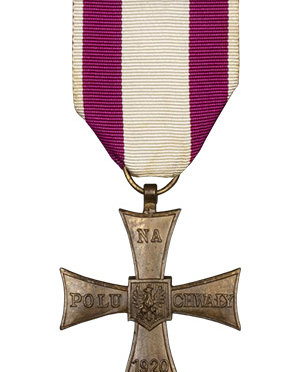
The Cross of Valor is a military decoration from Poland first introduced in 1920 for deeds of valour and courage on the field of battle.

The Cross of Valour (or Krzyż Walecznych in Polish) is a military decoration from Poland. It was first introduced by the Council of National Defense on 11 August 1920 and it is awarded to an individual who “has demonstrated deeds of valour and courage on the field of battle.” It may be awarded to the same person up to four times.

The medal was introduced in 1920 at the height of the Polish-Soviet War, shortly before the Battle of Warsaw. Through 29 May 1923, when the last medal for the Polish-Soviet War was awarded, the Cross of Valour had been granted to some 60,000 soldiers.

Apart from individuals who had participated in the Polish-Soviet War, the medal had also been awarded retroactively to some soldiers of the Polish Legions, of World War I military units, of the Silesian Uprisings, of the Great Poland Uprising, and to members of the Polish Military Organization. It had been awarded, as well, to veterans of the January 1863 Uprising and to the city of Płock. On 20 September 1940, the President of Poland agreed to award the medal to eligible individuals who had already been awarded it four times during the Polish-Soviet War. In 1943, after the Battle of Lenino, General Zygmunt Berling awarded the Cross of Valour to several soldiers.

The medal itself was approved as a military decoration by order of the Home National Council on 22 December 1944. Until 1947, some 40,000 of the medals had been awarded to Polish soldiers fighting alongside the Red Army.

The medal is given only in wartime or shortly after.[/vc_column_text][vc_column_text css=”.vc_custom_1611843202750{padding-top: 24px !important;}”]

The Cross of Valour Design

The award has the shape of a bronze cross.

On the obverse, in the center is a Polish crowned eagle with spread wings within a central shield. On the arms an inscription “Na Polu Chwały 1920” meaning “On the fields of Glory 1920”. The reverse bears an upright sword piercing a laurel wreath leaf crown with the inscription “Walecznym” meaning, “Valourious“.#

The cross is suspended from a purple and white ribbon.

The Order of the Cross of Independence

The Order of the Cross of Independence was established in 2010 to honor those who had served voluntarily between the years of 1939 and 1956.

  • Time Period: Post-WW2
  • Year of Institution: 5 August 2010
  • Country: Poland

The Order of the Cross of Independence (or Order Krzyża Niepodległości in Polish) was established on 5 August 2010, to honor those who between the years of 1939-1956 voluntarily served with merit in defending the independence of the Polish State. It is fifth in the order of precedence of Polish awards and decorations.

At its establishment, it was declared to be a continuation of the Cross of Independence which was instituted on 29 October 1930.

The Order is divided into two classes:

  • The Order of the Cross of Independence First Class. Awarded to those who guided the struggle or fought with arms for independence and sovereignty of the motherland with an extraordinary sacrifice.
  • The Order of the Cross of Independence Second Class. Awarded to those who for a significant period of time or in circumstances of extreme danger defended the independence and sovereignty of the homeland, fighting for her recovery, or maintaining the functioning of institutions and traditions of the Polish Republic.

The Order of the Cross of Independence Design

First class

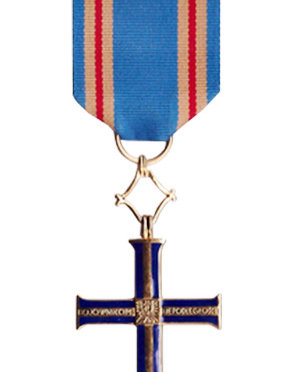
The first class cross of the Order of Independence is suspended by swords attached to a ribbon with a width of 45mm which is worn around the neck. The ribbon is blue with stripes of gold and red at the edges. The ribbon bar of the first class is denoted by a rosette at the center.

Second Class

The second class cross of the Order of the Cross of Independence is worn on the left breast suspended from a ribbon with a width of 40 mm, with colors identical to that of the first class. The ribbon bar of the second class is unadorned by any clasp or attachment.

The Order of the Military Cross (Poland)

The Order of the Military Cross (or Order Krzyża Wojskowego) is a Polish order established in 2006 and awarded for distinguished service.

  • Time Period: Post-WW2
  • Year of Institution: 18 October 2006
  • Country: Poland

The Order of the Military Cross (or Order Krzyża Wojskowego in Polish) is a Polish order established on 18 October 2006 and awarded for “distinguished service, sacrifice, and courage in actions against terrorism in the country or during foreign deployments of the Armed Forces of the Republic of Poland in times of peace.”

The Military Cross was established by the Law of 14 June 2007, which amended the Act of 16 October 1992, concerning medals and decorations. This law saw the creation of the Military Cross along with the Military Cross of Merit, Navy Cross of Merit, Air Force Cross of Merit and the Medal for Long Service. The change was implemented on 9 October 2007.

According to the previously mentioned law, “The Military Cross has the distinction of being the reward for acts of bravery and courage made during operations against acts of terrorism in the country, or during the use of the Polish Armed Forces outside the country in time of peace.” In the order of precedence of Polish medals, it ranks behind the Cross of Valor and the Cross of Merit for Bravery.

The Order has three classes:

  1. Grand Cross (Krzyż Wielki)
  2. Commander’s Cross (Krzyż Komandorski)
  3. Knight’s Cross (Krzyż Kawalerski)

The Order of Polonia Restituta

The Order of Polonia Restituta is a Polish state order conferred on military, civilians, or foreigners for outstanding achievements.

The Order of Polonia Restituta (or Order Odrodzenia Polski in Polish, Order of the Rebirth of Poland in English) is a Polish state order established in 1921 and conferred on both military and civilians as well as on foreigners for outstanding achievements in the fields of education, science, sport, culture, art, economics, national defense, social work, civil service, or for furthering good relations between countries.

The Order of Polonia Restituta was established on 4 February 1921 with Marshal Józef Piłsudski as first Grand Master. The Marshal awarded the first recipients on 13 July 1921. 

After World War II both the Polish government-in-exile and the Communist People’s Republic of Poland, aligned with the Warsaw Pact, awarded the order, though the versions differed slightly. The order was saved from abuse as it was simply passed over in favor of more traditional communist awards. During this time, the Order of Merit of Poland became the favored award for foreigners.

On 22 December 1990 the Polish government-in-exile returned the rights to its version of the order to the new Polish state. Invalid awards have been revoked and today the remaining communist versions of the order hold the same status as any other issues.

The Order of Polonia Restituta has five classes, categorized according to the Constitution of Poland, Article 138, as follows:

  • Grand Cross. Order of Polonia Restituta First Class, Krzyż Wielki, the Grand Cross, referred to as the Grand Cordon.
  • Commander’s Cross with Star. Order of Polonia Restituta Second Class, Krzyż Komandorski z Gwiazdą, the Commander’s Cross with Star. 
  • Commander’s Cross. Order of Polonia Restituta Third Class, Krzyż Komandorski, the Commander’s Cross.
  • Officer’s Cross. Order of Polonia Restituta Fourth Class, Krzyż Oficerski, the Officer’s Cross. 
  • Knight’s Cross. Order of Polonia Restituta Fifth Class, Krzyż Kawalerski, the Knight’s Cross.

The Order of Polonia Restituta Design

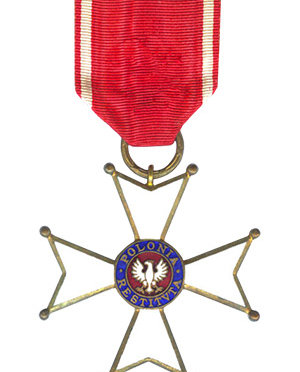
The badge of the Order of Polonia Restituta is a gold Maltese cross enameled in white.

The obverse central disc bears a white eagle on a red background, the Coat of Arms of Poland, surrounded by a blue ring bearing the words “Polonia Restituta“. The reverse central disc bears the year 1918 (for the People’s Republic of Poland version: 1944).

The badge is worn on a ribbon, red with a white stripe near the edges, as a sash on the right shoulder for Grand Cross, around the neck for Commander with Star and Commander, on the left chest with a rosette for Officer, and on the left chest without rosette for Knight.

The star of the order is an eight-pointed silver star with straight rays. The central disc is in white enamel, bearing the monogram “RP” (Republic of Poland) (for the People’s Republic of Poland, “PRL”) and surrounded by a blue ring bearing the Latin words “Polonia Restituta“.

The War Order of Virtuti Militari

The War Order of Virtuti Militari was created in 1792 by Stanisław II August and is Poland’s highest military decoration for heroism.

  • Time Period: Pre-WW1
  • Year of Institution: 22 June 1792
  • Country: Poland

The War Order of Virtuti Militari (meaning “For Military Virtue” in Latin;  Order Wojenny Virtuti Militari in Polish) was created in 1792 by Polish King Stanisław II August to commemorate the victorious Battle of Zieleńce and is Poland’s highest military decoration for heroism and courage in the face of the enemy at war. It’s the oldest military decoration in the world still in use.

The War Order of Virtuti Militari is awarded in five classes either for personal heroism or, to commanders, for leadership. Some of the heroic actions recognized by an award of the Virtuti Militari are equivalent to those meriting the British Victoria Cross, the German Iron Cross, and the American Medal of Honor.

Since the destruction of the Polish–Lithuanian Commonwealth in 1795, the award has been reintroduced, renamed, and banned several times. Throughout the decoration’s existence, thousands of soldiers and officers, Polish and foreign, several cities (and one ship) have been awarded the Virtuti Militari for valor or outstanding leadership in war.

Poland regained its independence in 1918 as the Second Republic of Poland and the Polish Sejm reintroduced the Virtuti Militari on 1 August the following year under a new official name, the “Military Award Virtuti Militari” (Order Wojskowy Virtuti Militari). The class system as introduced under the Duchy of Warsaw was:

  • Grand Cross with Star, Class I: “for a commander who has achieved victory in a battle of strategic importance, resulting in total defeat of the enemy, or a successful defense that has decided the fate of a campaign.”
  • Commander’s Cross, Class II: “for a commander who has achieved a notable tactical victory or a valorous and successful defense of a difficult position.”
  • Knight’s Cross – Class III: for officers, NCOs, and ordinary soldiers, previously awarded the Golden Cross, for acts of outstanding bravery, risk of life, or outstanding command over his troops.
  • Golden Cross – Class IV: for officers who commanded their troops with outstanding bravery and valor, and for NCOs and ordinary soldiers, previously awarded the Silver Cross, for acts of outstanding bravery and risk of life on the field of battle.
  • Silver Cross – Class V: for officers, NCOs, and ordinary soldiers, for acts of outstanding bravery and risk of life on the field of battle.

There have been no new awards since 1989.

The War Order of Virtuti Militari Design

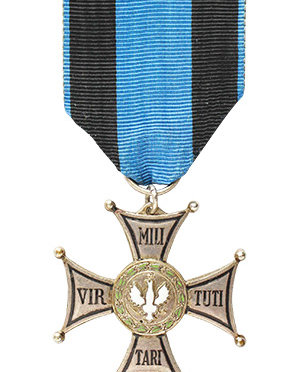
The medal is struck in silver gilt and decorated with enamels. It measures 30.75 by 40.30 mm. The obverse features a white eagle (Orzeł Biały), the national coat of arms of Poland. The reverse has the name of the order inscribed and the year of establishment.

The ribbon has a thin blue outer strip, thicker black ones, and a central blue stripe.

The Order of the White Eagle (Poland)

The Order of the White Eagle (or Order Orła Białego in Polish) is Poland’s highest order, awarded to both civilians and military for merit.

  • Time Period: Pre-WW1
  • Year of Institution: 1 November 1705
  • Country: Poland

The Order of the White Eagle (or Order Orła Białego in Polish) is Poland’s highest order and it’s awarded to both civilians and the military for their merits. The order was officially instituted on 1 November 1705 by Augustus II the Strong and bestowed on eight of his closest diplomatic and political supporters. It is awarded to the most distinguished Poles and the highest-ranking representatives of foreign countries.

Although Augustus the Strong limited the number of knights to seventy-two, he only conferred the Order forty times before his death in 1733 (his son, Augustus, awarded the Order more than three hundred times). The king may have been inspired to found the Order by the example of Peter the Great’s recent founding of the Russian Order of Saint Andrew and by the example of the prestigious French Order of the Holy Spirit.

Initially the creation of the Order was strongly opposed by many of the Polish nobility since membership in the Order conferred a distinction that violated the traditional equality of all Polish nobles. Since the Order had no patron saint, Augustus II made 2 August the feast of the Order. His son, Augustus III, however, changed the Order’s feast day to 3 August.

After the third partitioning of Poland, in 1795, the Order was abolished. It was renewed by 1807 and became the highest award of the Duchy of Warsaw, and after 1815 of the Kingdom of Poland. It was also popular among the Russian tsars, who also conferred the Order upon themselves. The Order of the White Eagle officially became Poland’s highest decoration by an act of Parliament of 4 February 1921. Following the collapse of communism, the Order was once again reinstated on 26 October 1992.

The Order of the White Eagle is one of the oldest orders in the world still in use.

The Order of the White Eagle Design

The badge Order of the White Eagle was originally a red enamel oval gold medal with an image of the Polish white eagle on its front side and bearing Augustus II’s royal cypher over crossed swords on its reverse side worn on a light blue ribbon. This was replaced by a Maltese cross in 1709.

The 1713 Insignia

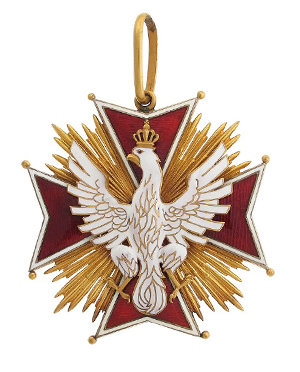
The 1713 badge was a Maltese cross enameled red with white borders with diamonds set in each of the balls at the eight points of the cross and with diamond set rays appearing between each of the points of the cross. In the center of the cross was a white enameled eagle in high relief with spread wings and facing left and with a diamond-set royal crown on its head. At the top of the cross between the two top points was a diamond-studded semi-circular link through which passed a diamond-studded ring through which, in turn, passed the light-blue ribbon from which it was worn. The reverse side was enameled white with red borders and had at its center an oval gold medallion with the founder’s crowned royal cypher above two crossed swords taken from his arms as the Arch-Marshall of the Holy Roman Empire.

The star of the order consisted of an eight-pointed gold star with straight rays which bore a red-bordered white enameled cross pattée with golden rays between the arms and with a golden rosette at its center. The arms of this cross pattée bore the motto “Pro Fide, Lege et Rege” (For Faith, Law and the King) in golden letters. The King of Poland could also wear the cross from a collar of 24 alternating links of white enameled eagles, crowned and holding scepters and orbs, and dark blue enameled ovals surrounded by gold rays.