The Medal for Valiant Labor in the Great Patriotic War 1941–1945

The Medal for Valiant Labor in the Great Patriotic War 1941–194 was awarded to Soviet industrial workers for long labor during the war.

The Medal for Valiant Labor in the Great Patriotic War 1941–1945 (or Медаль «За доблестный труд в Великой Отечественной войне 1941—1945 гг.», Medal «Za doblestnyj trud v Velikoj Otechestvennoj vojne 1941-1945 gg.» in Russian) was established on 6 June 1945 by decree of the Presidium of the Supreme Soviet of the USSR and awarded to all Soviet industrial workers for a term of one year or longer of labor during The Great Patriotic War (6 months for disabled military veterans/professional school graduates/the retired who returned to work to aid.)

The medal was awarded for wartime labor of one year or six months in the case of disabled veterans, to:

  • workers, technical personnel and employees of industry and transport;
  • farmers and agricultural specialists;
  • workers in science, technology, the arts, and literature;
  • employees of the Soviet, party, trade union, and other civic organizations.

Presentation of the award of the Medal “For Valiant Labor in the Great Patriotic War of 1941–1945” was made by the executive committees of city and district Soviets on the basis of documents issued by the heads of enterprises, institutions, party, government, trade unions, and other civic organizations.

Its statute was later amended by decree of the Presidium of the Supreme Soviet of the USSR on July 18, 1980.

The Medal for Valiant Labor in the Great Patriotic War 1941–1945 Design

The medal was 32mm in diameter, circular, and made of copper, with a raised rim on both sides. It was worn on the left side of the chest.

On the obverse, the left profile bust of Joseph Stalin wearing the uniform of a Marshal of the Soviet Union, along the upper circumference of the medal, the relief inscription “НАШЕ ДЕЛО ПРАВОЕ” (“OUR CAUSE IS JUST”), along the lower circumference of the medal, the relief inscription “МЫ ПОБЕДИЛИ” (“WE HAVE WON”).

On the reverse along the upper circumference of the medal, the relief inscription «ЗА ДОБЛЕСТНЫЙ ТРУД» (“FOR VALIANT LABOUR”), in the center, under a relief hammer and sickle, the inscription on four lines «В ВЕЛИКОЙ ОТЕЧЕСТВЕННОЙ ВОЙНЕ 1941–1945 ГГ.» (“THE GREAT PATRIOTIC WAR 1941–1945”), at the bottom, a small relief five-pointed star.

The Medal “For Valiant Labour in the Great Patriotic War 1941–1945” was secured by a ring through the medal suspension loop to a standard Soviet pentagonal mount covered by a 24mm wide red silk moiré ribbon with 2mm wide yellow edge stripes and a 7mm wide green central stripe.
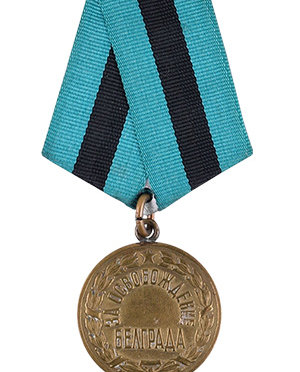
The Medal for the Liberation of Belgrade

The Medal for the Liberation of Belgrade was awarded to Soviet service personnel who took part in the liberation of Belgrade in 1944.

The Medal for the Liberation of Belgrade (or Медаль «За освобождение Белграда», Medal «Za osvobozhdenie Belgrada» in Russian) was established on 9 June 1945 by decree of the Presidium of the Supreme Soviet of the USSR and awarded to Soviet service personnel who took part in the liberation of Belgrade between 29 September and 22 October 1944.

The medal was awarded to soldiers of the Red Army, Navy, and troops of the NKVD, direct participants of the heroic assault and liberation of the city of Belgrade as well as to the organizers and leaders of combat operations in the capture of this city. Serving military personnel received the medal from their unit commander, retirees from military service received the medal from a regional, municipal, or district military commissioner in the recipient’s community.

The Medal for the Liberation of Belgrade Design

The medal was 32mm in diameter, circular, and made of brass, with a raised rim on the obverse. It was worn on the left side of the chest.

On its obverse along the entire medal circumference, a laurel wreath split only at the top by a small five-pointed star, within the wreath, along its upper inner circumference, the relief inscription ЗА ОСВОБОЖДЕНИЕ» (“FOR THE LIBERATION”), at lower center just above the wreath, the horizontal relief inscription «БЕЛГРАДА» (“OF BELGRADE”). On the reverse at the top, a relief plain five-pointed star over the relief date in three rows «20 ОКТЯБРЯ 1944» (“20 OCTOBER 1944”).

The Medal “For the Liberation of Belgrade” was secured by a ring through the medal suspension loop to a standard Soviet pentagonal mount covered by a 24mm wide green silk moiré ribbon with 8mm wide black central stripe.

The Medal for the Liberation of Warsaw

The Medal for the Liberation of Warsaw was awarded to Soviet service personnel who took part in the liberation of Warsaw between in 1945.

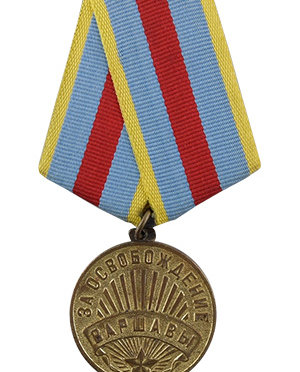
The Medal for the Liberation of Warsaw (or Медаль «За освобождение Варшавы», Medal «Za osvobozhdenie Warshavy» in Russian) was established on 9 June 1945 by decree of the Presidium of the Supreme Soviet of the USSR and awarded to Soviet service personnel who took part in the liberation of Warsaw between the 14 and 17 January 1945.

The medal was awarded to soldiers of the Red Army, Navy, and troops of the NKVD, direct participants of the heroic assault and liberation of the city of Warsaw as well as to the organizers and leaders of combat operations in the capture of this city. Serving military personnel received the medal from their unit commander, retirees from military service received the medal from a regional, municipal, or district military commissioner in the recipient’s community.

The Medal for the Liberation of Warsaw Design

The medal was 32mm in diameter, circular, and made of brass, with a raised rim on the obverse. It was worn on the left side of the chest.

On its obverse along the upper half of the medal’s circumference, the relief inscription «ЗА ОСВОБОЖДЕНИЕ» (“FOR THE LIBERATION OF”), at the bottom, a relief five-pointed star radiating divergent rays upwards, superimposed over the rays, a ribbon bearing the relief inscription «ВАРШАВЫ» (“WARSAW”). On the reverse at the top, a relief plain five-pointed star over the relief date in three rows «17 ЯНВАРЯ 1945» (“17 JANUARY 1945”).

The Medal “For the Liberation of Warsaw” was secured by a ring through the medal suspension loop to a standard Soviet pentagonal mount covered by a 24mm wide blue silk moiré ribbon with 2mm yellow edge stripes and a 6mm wide central red stripe.

The Medal for the Liberation of Prague

The Medal for the Liberation of Prague was awarded to Soviet service personnel who took part in the liberation of Prague in 1945.

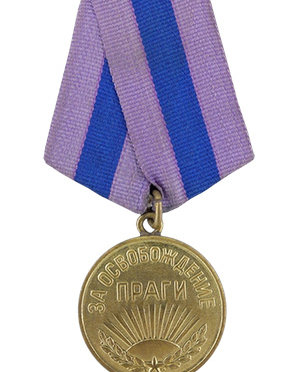
The Medal for the Liberation of Prague (or Медаль «За освобождение Праги», Medal «Za osvobozhdenie Pragi» in Russian) was established on 9 June 1945 by decree of the Presidium of the Supreme Soviet of the USSR and awarded to Soviet service personnel who took part in the liberation of Prague from the armed forces of Nazi Germany between the 3 and 9 May 1945.

The medal was awarded to soldiers of the Red Army, Navy, and troops of the NKVD, direct participants of the heroic assault and liberation of the city of Prague as well as to the organizers and leaders of combat operations in the capture of this city. Serving military personnel received the medal from their unit commander, retirees from military service received the medal from a regional, municipal, or district military commissioner in the recipient’s community.

The Medal for the Liberation of Prague Design

The medal was 32mm in diameter, circular, and made of brass, with a raised rim on the obverse. It was worn on the left side of the chest.

On its obverse along the upper half of the medal’s circumference, the relief inscription «ЗА ОСВОБОЖДЕНИЕ» (“FOR THE LIBERATION OF”), beneath the inscription, in prominent letters, the relief inscription «ПРАГИ» (“PRAGUE”). At the bottom, a small relief five-pointed star over a laurel wreath, over the wreath, a rising sun casting divergent rays upwards. On the reverse the relief date in three rows «9 МАЯ 1945» (“9 MAY 1945”) over a relief plain five-pointed star.

The Medal “For the Liberation of Prague” was secured by a ring through the medal suspension loop to a standard Soviet pentagonal mount covered by a 24mm wide purple silk moiré ribbon with an 8mm wide blue central stripe.

The Medal for the Capture of Vienna

The Medal for the Capture of Vienna was awarded to Soviet service personnel who took part in the capture of Vienna in 1945.

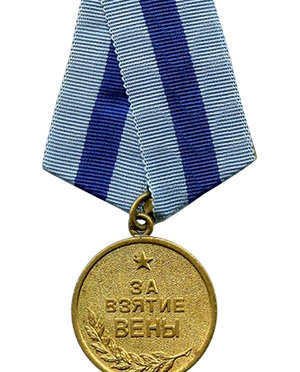
The Medal for the Capture of Vienna (or Медаль «За взятие Вены», Medal «Za vzjatie Veny» in Russian) was established on 9 June 1945 by decree of the Presidium of the Supreme Soviet of the USSR and awarded to Soviet service personnel who took part in the capture of Vienna from the armed forces of Nazi Germany between 16 March and 13 April 1945.

The medal was awarded to soldiers of the Red Army, Navy, and troops of the NKVD, direct participants of the heroic assault and capture of Vienna as well as to the organizers and leaders of combat operations in the capture of this city. Serving military personnel received the medal from their unit commander, retirees from military service received the medal from a regional, municipal, or district military commissioner in the recipient’s community.

The medal’s statute was amended on July 18, 1980, by decree of the Presidium of the Supreme Soviet of the USSR № 2523-X.

The Medal for the Capture of Vienna Design

The medal was 32mm in diameter, circular, and made of brass, with a raised rim on the obverse. It was worn on the left side of the chest.

On its pebbled obverse at the top, a relief five-pointed star. Below the star, the relief inscription in bold letters on three rows «ЗА ВЗЯТИЕ ВЕНЫ» (“FOR THE CAPTURE OF VIENNA”). At the bottom, the relief image of a laurel branch going up the left circumference of the medal up to the second row of the inscription. On the reverse at the top, a relief plain five-pointed star, below the star, the relief date in three rows «13 АПРЕЛЯ 1945» (“13 APRIL 1945”).

The medal was secured by a ring through the medal suspension loop to a standard Soviet pentagonal mount covered by a 24mm wide silk moiré light blue ribbon with an 8mm wide central dark blue stripe.

The Medal for the Capture of Königsberg

The Medal for the Capture of Königsberg was awarded to Soviet service personnel who took part in the capture of Königsberg in 1945.

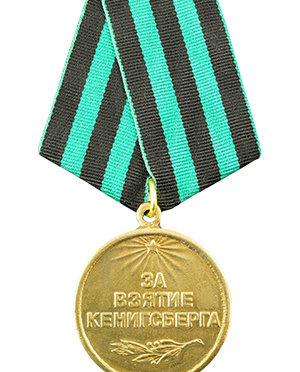
The Medal for the Capture of Königsberg (or Медаль «За взятие Кенигсберга», Medal «Za vzjatie Kenigsberga» in Russian) was established on 9 June 1945 by decree of the Presidium of the Supreme Soviet of the USSR and awarded to Soviet service personnel who took part in the capture of Königsberg from the armed forces of Nazi Germany between 23 January and 10 April 1945.

The medal was awarded to soldiers of the Red Army, Navy, and troops of the NKVD, direct participants of the assault and capture of Königsberg as well as to the organizers and leaders of combat operations in the capture of this city. Serving military personnel received the medal from their unit commander, retirees from military service received the medal from a regional, municipal, or district military commissioner in the recipient’s community.

The medal’s statute was amended on July 18, 1980 by decree of the Presidium of the Supreme Soviet of the USSR № 2523-X.

The Medal for the Capture of Königsberg Design

The medal was 32mm in diameter, circular, and made of brass, with a raised rim on the obverse. It was worn on the left side of the chest.

The obverse has a raised rim and shows a small relief five-pointed star with divergent rays at the top. Below this is a relief inscription in bold letters on three rows «ЗА ВЗЯТИЕ КЕНИГСБЕРГА» (“FOR THE CAPTURE OF KÖNIGSBERG”), with a relief image of a horizontal laurel branch below. The reverse bears the relief date in three rows «10 АПРЕЛЯ 1945» (“10 APRIL 1945”) below a relief plain five pointed star.

The medal is secured by a ring through the medal suspension loop to a standard Soviet pentagonal mount covered by a 24mm wide silk moiré ribbon with 2 mm green edge stripes and five 4 mm wide alternating stripes, three black and two green.

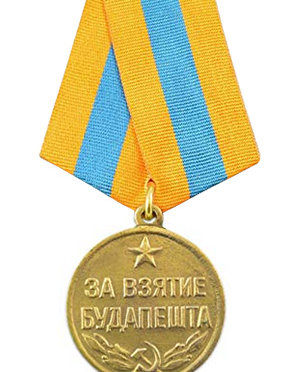
The Medal for the Capture of Budapest

The Medal for the Capture of Budapest was awarded to Soviet service personnel who took part in the capture of Budapest between 1944 and 1945.

The Medal for the Capture of Budapest (or Медаль «За взятие Будапешта», Medal «Za vzjatie Budapeshta» in Russian) was established on 9 June 1945 and awarded to Soviet service personnel who took part in the capture of Budapest from the armed forces of Nazi Germany between 20 December 1944 and 15 February 1945.

The medal was awarded to soldiers of the Red Army, Navy, and troops of the NKVD, direct participants of the heroic assault and capture of Budapest as well as to the organizers and leaders of combat operations in the capture of this city. Serving military personnel received the medal from their unit commander, retirees from military service received the medal from a regional, municipal, or district military commissioner in the recipient’s community.

The medal’s statute was amended on 18 July 1980 by decree of the Presidium of the Supreme Soviet of the USSR № 2523-X.

The Medal for the Capture of Budapest Design

The medal was 32mm in diameter, circular, and made of brass, with a raised rim on the obverse. It was worn on the left side of the chest.

On its obverse at the top, a relief five-pointed star, its top point touching the medal upper rim. Below the star, the relief inscription in bold letters on two rows «ЗА ВЗЯТИЕ БУДАПЕШТА» (“FOR THE CAPTURE OF BUDAPEST”). At the bottom, the relief image of a wreath of oak branches going up the left and right circumference of the medal up to the lower row of the inscription, in the center of the wreath, the relief image of the hammer and sickle. On the reverse at the top, a relief plain five-pointed star, below the star, the relief date in three rows «13 ФЕВРАЛЯ 1945» (“13 FEBRUARY 1945”).

The medal as secured by a ring through the medal suspension loop to a standard Soviet pentagonal mount covered by a 24mm wide silk moiré orange ribbon with an 8mm wide central blue stripe.

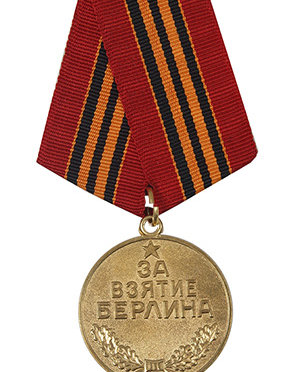
The Medal for the Capture of Berlin

The Medal for the Capture of Berlin was awarded to Soviet service personnel who took part in the capture of Berlin in 1945.

The Medal for the Capture of Berlin (or Медаль «За взятие Берлина», Medal «Za vzjatie Berlina» in Russian) was established on 9 June 1945 by decree of the Presidium of the Supreme Soviet of the USSR and awarded to Soviet service personnel who took part in the capture of Berlin from 22 April and 2 May 1945.

The medal was awarded to soldiers of the Red Army, Navy, and troops of the NKVD, direct participants of the assault and capture of Berlin as well as to the organizers and leaders of combat operations in the capture of this city. Serving military personnel received the medal from their unit commander, retirees from military service received the medal from a regional, municipal, or district military commissioner in the recipient’s community.

The medal’s statute was amended on July 18, 1980, by decree of the Presidium of the Supreme Soviet of the USSR № 2523-X.

The Medal for the Capture of Berlin Design

The medal was 32mm in diameter, circular, and made of brass, with a raised rim on the obverse. It was worn on the left side of the chest.

On its pebbled obverse at the top, a plain five-pointed star, its top point touching the medal upper rim. Below the star, the relief inscription in bold letters on three rows «ЗА ВЗЯТИЕ БЕРЛИНА» (“FOR THE CAPTURE OF BERLIN”) ending halfway down the medal. At the bottom, the relief image of a wreath of oak branches going up the left and right circumference of the medal up to the lower row of the inscription. On the reverse near the top, the relief date on three rows over a relief plain five-pointed star «2 МАЯ 1945» (“2 MAY 1945”).

The medal was secured by a ring through the medal suspension loop to a standard Soviet pentagonal mount covered by a 24mm wide red silk moiré ribbon with a 12mm wide Ribbon of St. George in the center.

The Medal for the Tapping of the Subsoil and Expansion of the Petrochemical Complex of Western Siberia

The Medal for the Tapping of the Subsoil and Expansion of the Petrochemical Complex was awarded for 3 years outstanding service.

The Medal for the Tapping of the Subsoil and Expansion of the Petrochemical Complex of Western Siberia (or Медаль «За освоение недр и развитие нефтегазового комплекса Западной Сибири», Medal «Za osvoenie nedr i razvitie neftegazovogo kompleksa Zapadnoj Sibiri» in Russian) was established on 28 July 1978 and awarded for 3 years outstanding service in the Petrochemical Complex Of Western Siberia.

The medal was awarded to active members in the underground exploration and development of the oil and gas complex of Western Siberia for selfless labor in the identification, exploration, and development of the mining and industrial processing of oil and gas, for work in construction, in manufacturing, in housing and other civilian facilities, in building highways, in electricity, transport or other services to the oil and gas industries, as well as to employees of scientific, research or design organizations, of institutions and organizations, of the service sector, Party, Soviet, trade union or Komsomol organs of the oil and gas industry, who produced conscientious work and contributed to the development of the petrochemical complex of Western Siberia over a period of at least three years.

Recommendations for the award were made by the administrative heads of enterprises, institutions, organizations, parties, trade unions or Komsomol organizations or labor collectives, and the executive committees of the District or City Council of People’s Deputies.

The Medal for the Tapping of the Subsoil and Expansion of the Petrochemical Complex of Western Siberia Design

The medal is circular, struck in brass, and measures 32 millimeters in diameter.

On its obverse, in the right half, the relief image of a sickle over a vertical hammer, in the background, the relief images of two oil rigs at the center, two gas tanks at left, a tractor and piping at lower center, at the bottom a small relief five-pointed star, along the medal circumference, the relief inscription «За освоение недр и развитие нефтегазового комплекса Западной Сибири» (“For the tapping of the subsoil and expansion of the petrochemical complex of Western Siberia”).

On the reverse, in the central upper half, a relief five-pointed star emitting rays from between its arms forming an inversed pentagon, superimposed over the star, the relief inscription «СССР» (“USSR”), at the bottom, crossed laurel and oak branches.

The medal was secured to a standard Soviet pentagonal mount by a ring through the medal suspension loop. The mount was covered by a 24 mm wide overlapping green silk moiré ribbon with a 6 mm wide central blue stripe bordered on both sides by 2 mm black stripes themselves bordered on the outside by 1 mm wide white stripes.

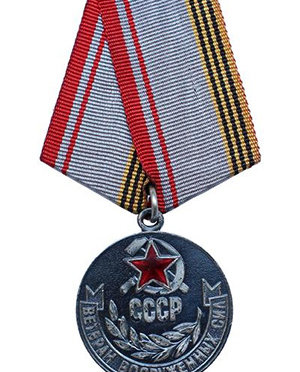
The Veteran of the Armed Forces of the USSR Medal

The Veteran of the Armed Forces of the USSR Medal was awarded for 25 years of impeccable military service.

The Veteran of the Armed Forces of the USSR Medal (or Медаль «Ветеран Вооружённых Сил СССР», Medal «Veteran Vooruzhennyh Sil SSSR» in Russian) was established on 20 May 1976 and awarded on behalf of the Presidium of the Supreme Soviet of the USSR for 25 years of impeccable military service to troops of the army, navy, of internal forces and of border troops. 

The medal was awarded to soldiers of the Soviet Army, of the Soviet Navy, of Border Troops, and of Internal Troops, who impeccably served in the Armed Forces of the USSR for 25 years or more. The medal could also be awarded to persons already retired from the service prior to the issuance of the Decree establishing it, who impeccably served in the Armed Forces of the USSR for 25 years or more.

The medal’s statute was twice amended by further decrees of the Presidium of the Supreme Soviet of the USSR, first on July 18, 1980 and lastly on January 10, 1984.

The Veteran of the Armed Forces of the USSR Medal Design

The medal is circular and struck in silver-plated tombac, measuring 32 millimeters in diameter and with a raised rim.

The obverse was oxidized and bore at its upper section a ruby-red enameled five-pointed star superimposed on the relief image of the hammer and sickle, just below in the center, the relief inscription «СССР» (“USSR”) over a curled laurel branch; at the bottom along the medal circumference, a relief scroll with the inscription in prominent letters «ВЕТЕРАН ВООРУЖЕННЫХ СИЛ» (“VETERAN OF THE ARMED FORCES”). The reverse was plain with a matte finish.

The medal was secured to a standard Soviet pentagonal mount by a ring through the medal suspension loop. The mount was covered by a 24mm wide grey silk moiré ribbon with four orange and three black stripes alternating along its right edge and two red stripes along its left edge. The width of the orange and black stripes was 1mm except for the outermost orange stripe which was 2mm, the red stripes were respectively 3mm and 1mm with a spacing of 2mm.