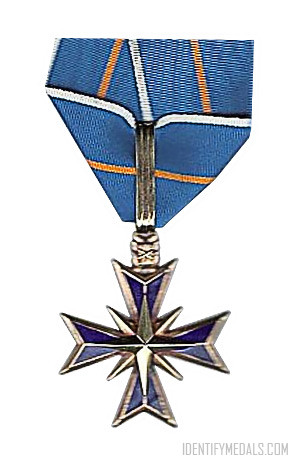
The Order of the Star of South Africa

The Order of the Star of South Africa is a South African National Order instituted by the Republic of South Africa and discontinued in 2002.

The Order of the Star of South Africa, a South African National Order, featured seven distinct decorations across both military and non-military categories. Established on July 1, 1975, by the Republic of South Africa, these decorations were awarded by the State President and, beginning in 1994, the President of South Africa. They were bestowed upon general and flag officers of the South African Defence Force in recognition of their outstanding contributions to national defense and security. This order replaced the 1952 Star of South Africa decoration and later included a civilian division in 1978.

The order drew its name from the Star of South Africa, the first significant diamond discovered in South Africa in 1869, along the banks of the Orange River. This discovery ignited the New Rush and led to the establishment of Kimberley.

Initially, the order exclusively recognized military merit, with two distinct classes:

  • The Star of South Africa, Gold (post-nominal letters SSA): Awarded for meritorious military service that enhanced the efficiency and readiness of the South African Defence Force, contributing significantly to national security.
  • The Star of South Africa, Silver (post-nominal letters SSAS): Recognizing exceptionally meritorious service of major military importance.

However, the order was discontinued on December 2, 2002, concluding its legacy of honoring those who played crucial roles in South Africa’s defense and security.

The Order of the Star of South Africa Design

The order’s obverse side features a gold or silver Maltese cross adorned with blue enamel. Two four-pointed stars are layered atop one another and upon the cross, with a central diamond. The pre-1994 South African Coat of Arms is depicted on the reverse side. In the SSA and SSAS classes of both divisions, protea flowers are positioned between the cross’s arms.

Each class possesses its distinct ribbon, with the first three classes worn around the neck and the others on the chest. Within the military division, the SSA ribbon is a plain dark blue, while the SSAS ribbon combines dark blue with a white central band. Until 1988, the Star of South Africa, Gold also featured a gold neck chain for ceremonial events.

In the non-military division, the ribbons exhibit dark blue with various combinations of orange and white bands:

  • Orange edges for the SSA.
  • White edges for the SSAS.
  • White edges and an orange center band for the CSSA.
  • White edges and an orange center band flanked by two white bands for the OSSA.
  • White edges with three white center bands for the MSSA.

Recipients of the SSA and SSAS classes also wear eight-pointed breast stars, showcasing the decoration’s obverse.

Find This Medal Online

Right Now on eBay 
Clicking a link to eBay may result in a referral commission being paid if a purchase is made.
Loading...

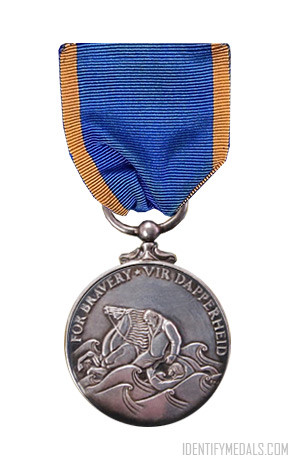
The Woltemade Decoration for Bravery

The Woltemade Decoration for Bravery is a South African civil decoration for acts of bravery and was discontinued in 1961.

The Woltemade Decoration for Bravery is a South African civil decoration awarded for acts of bravery. It replaced the King’s Medal for Bravery, Silver and Queen’s Medal for Bravery. The award of which was discontinued in South Africa in 1961.

The Silver Woltemade Decoration for Bravery was established by the Republic of South Africa in 1970 through a Warrant dated May 20, 1970, as published in Government Gazette no. 2718 on May 29, 1970. Subsequently, the Warrant was modified twice, on November 11, 1971, and May 30, 1973, to broaden the criteria for eligibility for this decoration.

The decoration pays tribute to the heroic act of Wolraad Woltemade, an elderly employee of the Dutch East India Company. On June 1, 1773, he sacrificed his life to save shipwrecked sailors in Table Bay. During a powerful Northwestern gale, the ship De Jonge Thomas lost its anchor and was pushed ashore at the Salt River Mouth. Woltemade courageously rode his horse into the turbulent sea seven times, rescuing surviving sailors with each trip. Tragically, during his eighth rescue attempt, Woltemade and his exhausted horse were overwhelmed by panicked sailors and succumbed to the sea.

The Woltemade Decoration for Bravery Design

The decoration is crafted from silver, measuring 38 millimeters in diameter, featuring a raised rim and a sizable ring suspender.

On the obverse side, it showcases Wolraad Woltemade on his horse amidst the waves, with the words “FOR BRAVERY • VIR DAPPERHEID” encircling the upper perimeter. This design mirrors the one used on the earlier King’s and Queen’s Medals for Bravery, Silver.

The reverse side displays the South African Coat of Arms’ crest, where a lion holds four staves, symbolizing the four provinces of the Republic of South Africa. Surrounding the crest is a wreath of proteas, encircled by the inscriptions “REPUBLIEK VAN SUID-AFRIKA” above and “REPUBLIC OF SOUTH AFRICA” below.

The ribbon, 44 millimeters wide, is predominantly blue with 4 millimeters wide light orange edges. 

Find This Medal Online

Right Now on eBay 
Clicking a link to eBay may result in a referral commission being paid if a purchase is made.
Loading...

The Union of South Africa Commemoration Medal

The The Union of South Africa Commemoration Medal is a military and civil medal that commemorates the opening of the first Union Parliament.

The Union of South Africa Commemoration Medal, both a military and civilian commemorative decoration, was bestowed in honor of the inauguration of the inaugural Union Parliament in 1910 by the Duke of Connaught and Strathearn. It can be regarded as one of the initial independence medals introduced across the Commonwealth during the 20th century.

The medal was conferred upon individuals from the military, naval forces, and select civilian leaders who played significant roles in the events. This recognition was based on the recommendation of the Principal Secretary of State for the Colonies. A roster was maintained, and it was to be finalized six months following the warrant’s issuance. After this period, any further awards could only be granted with Royal Approval and under highly exceptional circumstances.

The Union of South Africa Commemoration Medal Design

The medal was struck in silver and measures 36 millimetres in diameter. It also has a raised rim.

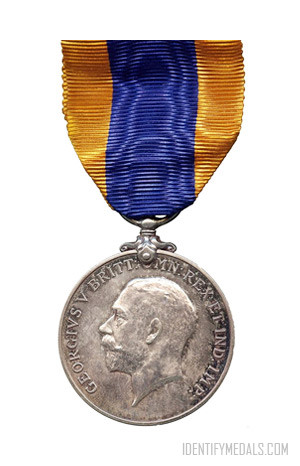
The obverse of the medal features a left-facing portrait of King George V, encircled by the inscription: “GEORGIVS V BRITT:OMN:REX ET IND:IMP:”. The medal is connected to a swiveling claw suspension, secured to the medal using a pin through its upper edge. The suspension includes a sizable ring.

On the reverse side, you can observe the representation of Mercury, symbolizing commerce and prosperity, crafting links of a chain on an anvil. Four of these links are inscribed with the names of the Union of South Africa’s provinces: “CAPE OF GOOD HOPE,” “NATAL,” “TRANSVAAL,” and “ORANGE RIVER.” Beneath this depiction, the year “1910” is intertwined with an olive branch. Surrounding the entire image is the inscription “TO COMMEMORATE THE UNION OF SOUTH AFRICA.”

The ribbon measures 38 millimeters in width and consists of two orange bands, each 10 millimeters wide, separated by a central dark blue band that is 18 millimeters wide.

Find This Medal Online

Right Now on eBay 
Clicking a link to eBay may result in a referral commission being paid if a purchase is made.
Loading...

More Union of South Africa Medals

The Union of South Africa King’s Medal for Bravery

The Union of South Africa King’s Medal for Bravery was the country’s highest civilian decoration between 1910 and 1961.

The Union of South Africa King’s Medal for Bravery 1910 was a military decoration awarded for acts of bravery and valor within the Union of South Africa, which was established in 1910 when the various British colonies and territories in South Africa united to form a single self-governing dominion within the British Commonwealth.

The medal was awarded during the reign of King George V

The King’s Medal for Bravery 1910 was awarded for acts of bravery and heroism performed within the boundaries of the Union of South Africa. It was primarily intended to recognize acts of courage and selflessness by civilians, police officers, and members of the military.

The King’s Medal for Bravery 1910 is no longer awarded, but it is a part of South Africa’s historical honors system and represents acts of bravery and heroism during the early years of the Union of South Africa

The Union of South Africa King’s Medal for Bravery Design

The medal is crafted in silver-gilt and takes the form of a 38-millimeter diameter disk with a raised edge and a prominent ring suspender.

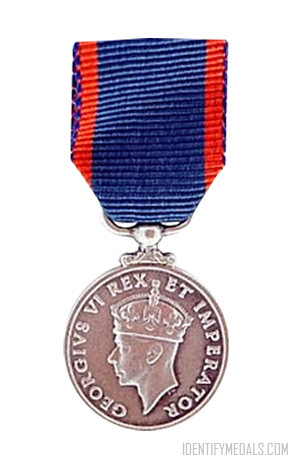
On the obverse, it features the crowned likeness of King George VI, facing left, encircled by the inscription “GEORGIVS VI REX ET IMPERATOR” along the upper edge. 

The reverse was selected through public competition. The victorious entry was designed by Miss Renee Joubert and portrays the 18th-century Cape hero Wolraad Woltemade mounted on his horse, saving shipwreck survivors from a turbulent sea. Consequently, the medal came to be widely known as the “Woltemade Medal.

The ribbon is 44 millimeters wide and dark blue with 4½ millimeters wide orange edges.

Find This Medal Online

Right Now on eBay 
Clicking a link to eBay may result in a referral commission being paid if a purchase is made.
Loading...

More Union of South Africa Medals

The South African Medal for War Services

The South African Medal for War Services is a service medal for voluntary unpaid service in support of the war effort during WW2.

The South African Medal for War Services is a South African service medal for voluntary unpaid service in support of the war effort during the Second World War (between 6 September 1939 and 15 February 1946). The South African Medal for War Services was instituted by a Royal Warrant dated 29 December 1945, countersigned and sealed at Cape Town on 6 February 1946.

Altogether 17,500 medals were awarded to people of both sexes, irrespective of whether or not they were British subjects. The requirement was a minimum of two years service, of which at least one year was continuous, rendered voluntarily and without pay within or outside the borders of the Union of South Africa, in one or more of the officially recognized voluntary non-military organizations, such as the Red Cross and the Governor-General’s War Fund, with the proviso that five or more hours were worked every week.

The South African Medal for War Services Design

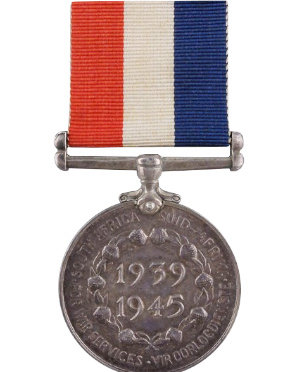
The medal is circular, struck in silver and measures 36 millimeters in diameter and 3 millimeters thick at the raised rim.

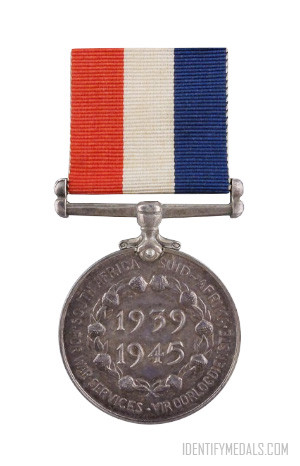
The obverse shows the years “1939” over “1945”, encircled by a wreath of protea flowers, all of which are surrounded by the name of the medal in English and Afrikaans, “SOUTH AFRICA” and “SUID-AFRIKA” above and “FOR WAR SERVICES • VIR OORLOGDIENSTE” below. The reverse bears the Coat of Arms of the Union of South Africa, with the medal number impressed at the bottom on the rim.

The ribbon has three equal stripes of red, white and blue (the national South African colors). The medal is affixed to the suspender by means of claws and a pin through the upper edge of the medal.

More Union of South Africa Medals

The Inter Allied Victory Medal (South Africa)

The South African Victory Medal was awarded to all those South Africans who were awarded the 1914–15 Star or the British War Medal.

The Allied Victory Medal was recommended by an inter-allied committee in March 1919. Fourteen victorious countries finally awarded the medal after World War I, and each allied nation would design a ‘Victory Medal’ for award to their own nationals. Certain features were to be shared: a winged figure of Victory on the obverse and the same ribbon.

The South-African Victory medal was awarded to all those South Africans who were awarded the 1914–15 Star or the British War Medal. The Union of South Africa awarded its own version of the Victory Medal, identical to the British version on the obverse, but with the inscription on the reverse in English and Dutch, the two official languages of South Africa at the time. Recipients had to have entered a theatre of the war between 5 August 1914.

The South Africa Inter Allied Victory Medal Design

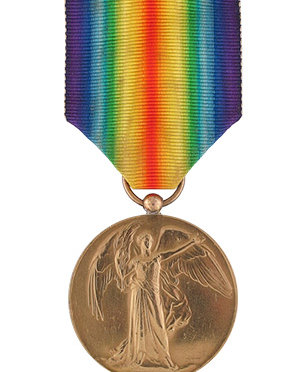
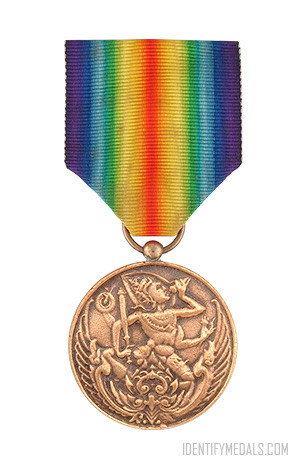
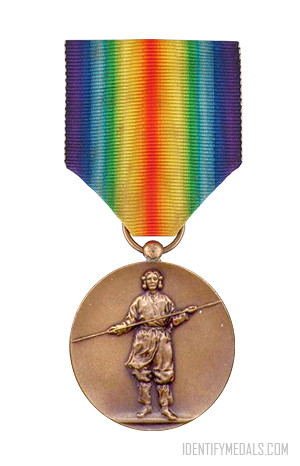
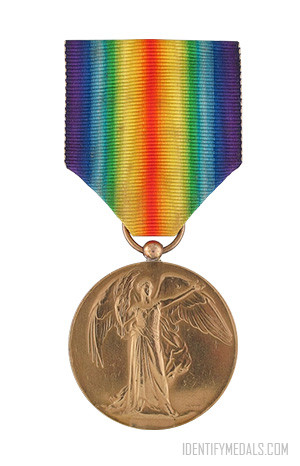
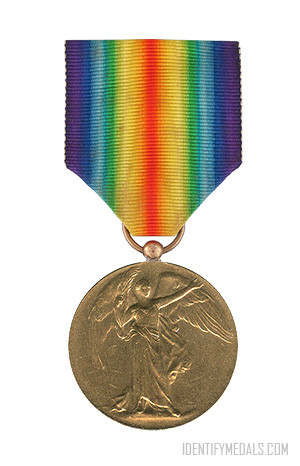
The Victory Medal measures 36 millimetres (1.4 in) in diameter and was designed by William McMillan. The design and ribbon was also adopted by Belgium, Brazil, Cuba, Czechoslovakia, France, Greece, Italy, Japan, Portugal, Romania, Siam, Union of South Africa and the USA. Each allied nation would design a ‘Victory Medal’ for award to their own nationals, all issues having certain common features, including a winged figure of victory on the obverse and the same ribbon.

The obverse of the medal bears the winged, full-length and full-front figure of Victoria, with her left arm extended and holding a palm branch in her right hand. The reverse reads “THE GREAT WAR FOR CIVILISATION” in three lines above and “DE GROTE OORLOG VOOR DE BESCHAVING” in three lines below, with the two inscriptions separated by “•••••” and with the years “1914-1919”, all surrounded by a laurel wreath.

The 39 millimeters (1.5 in) wide watered ribbon has an iridescent color scheme, with the violet moving through to a central red stripe where both schemes meet. It attaches to the medal through a ring suspender. The recipient’s name, rank, service number and unit were impressed on the edge of the medal. The name of the regiment or corps was omitted on medals awarded to Army officers.

All the Inter-Allied Victory Medal Variations

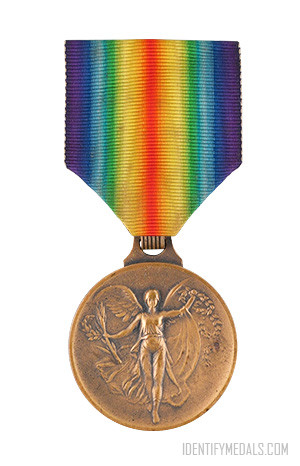
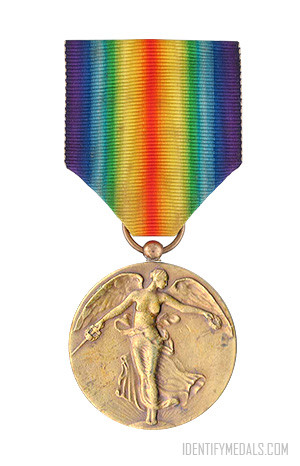
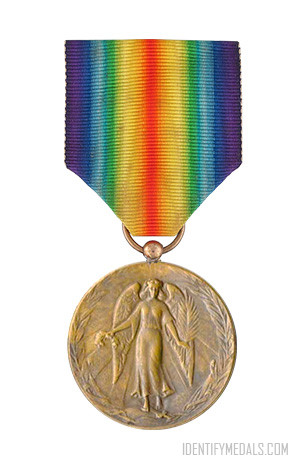
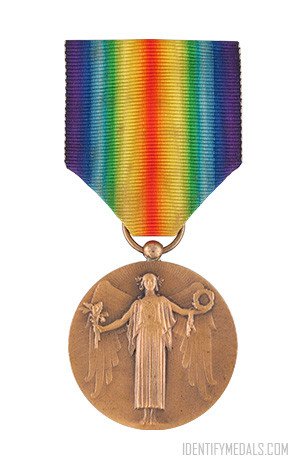
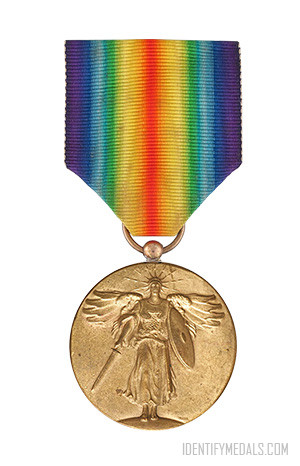
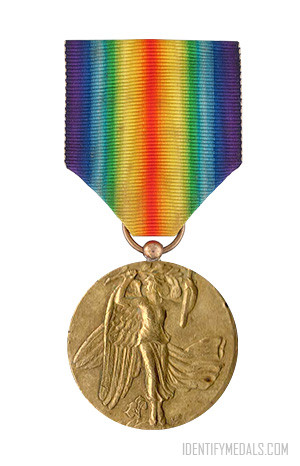
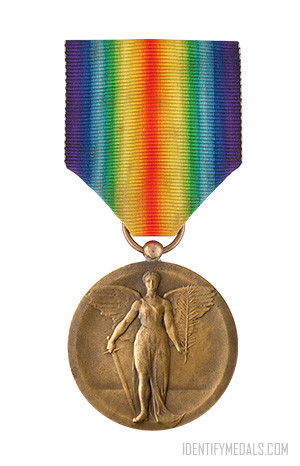
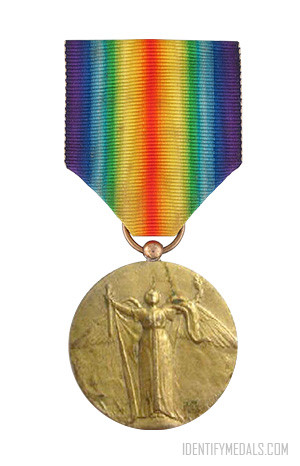
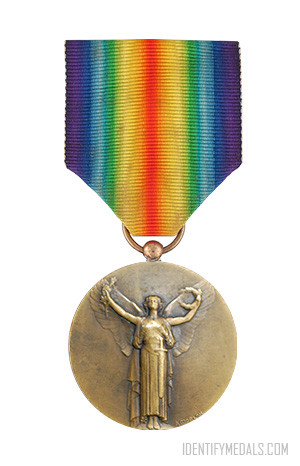
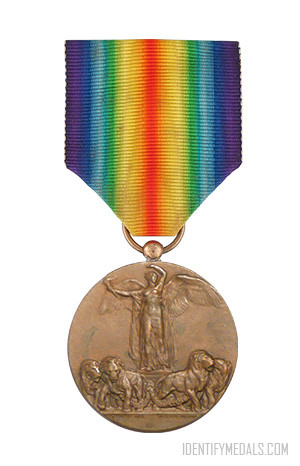
Although each country designed its own version of the Inter-Allied Victory Medal, all of them shared some common elements, such as a winged victory figure on the obverse and a similar ribbon with rainbow colors symbolizing unity among the Allies. Here are the versions for all countries:

Find an Inter-Allied Victory Medal Online

Right Now on eBay 
Clicking a link to eBay may result in a referral commission being paid if a purchase is made.
Loading...