The Medalje voor de Anglo-Boere Oorlog

The Medalje voor de Anglo-Boere Oorlog is a retrospective South African military campaign medal instituted on 21 December 1920.

The Medalje voor de Anglo-Boere Oorlog, a South African military campaign medal, was established on December 21, 1920. It was intended as a retrospective honor for Boer veteran officers and men who fought in the 1899–1902 Second Boer War.

Originally designated as the De Zuidafrikaanse Republiek- en Oranje Vrijstaat Oorlogsmedalje (the South African Republic and Orange Free State War Medal), and commonly known as the Anglo-Boere-Oorlog Medalje, it was instituted via Government Notice no. 2307 on December 21, 1920.

Published in the Union of South Africa Government Gazette on December 24, 1920, the medal was created to provide recognition to Boer veteran officers and men who served in the combat forces of the South African Republic and the Orange Free State during the Second Boer War from October 11, 1899, to May 31, 1902. These individuals remained in service of the Republican forces until May 31, 1902, without surrendering, taking parole, or swearing allegiance before that date.

The Medalje voor de Anglo-Boere Oorlog Design

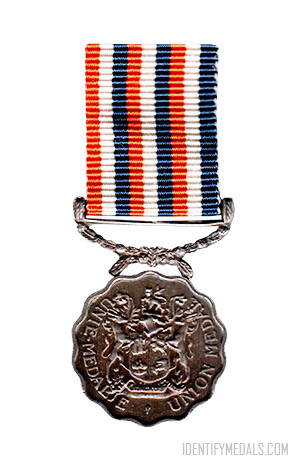
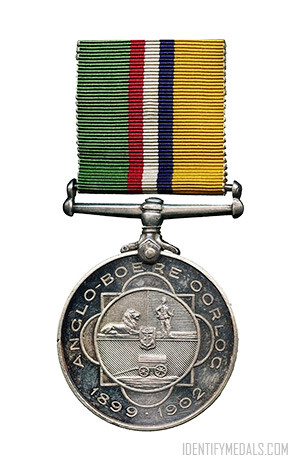
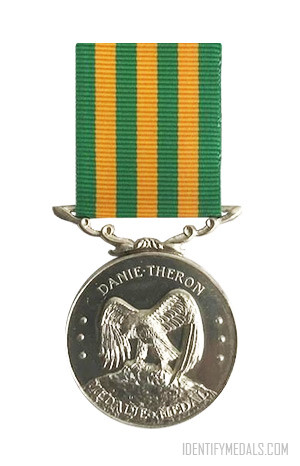
The medal is crafted in silver and measures 1+7⁄16 inches (37 millimeters) in diameter and 1⁄8 inch (3 millimeters) in thickness at the raised rim. It is attached to a fixed bar suspender using claws and a pin inserted through the upper edge. The recipient’s rank, initials, and surname are impressed in block capitals on the rim.

Both sides of the medal feature an ornamental frame encircled by the inscription “ANGLO-BOERE OORLOG” above and the years “1899 • 1902” below. One side displays the coat of arms of the South African Republic at the center of the frame, while the other side features the coat of arms of the Orange Free State. This design allows recipients to wear the medal to display the coat of arms of the state under which they served.

The ribbon, measuring 1+1⁄4 inches (32 millimeters) wide, combines the colors of the two former Republics.
The Dekoratie voor Trouwe Dienst

The Dekoratie voor Trouwe Dienst is a South African military decoration established in 1920 for Boer officers of the Second Boer War.

The Dekoratie voor Trouwe Dienst, abbreviated as DTD, is a military decoration in South Africa. Established in 1920, it serves as a retrospective honor for Boer officers who served during the Second Boer War from 1899 to 1902.

Neither the South African Republic (Transvaal) nor the Orange Free State had their own official honors systems. Hence, the decoration was created to provide Boer veteran officers, serving within the Union Defence Forces, with recognition parallel to their compatriots who fought on the British side during the conflict.

Throughout the Second Boer War, Republican commanders were directed to record the names of individuals within their ranks who displayed exceptional valor on the battlefield. These names were to be submitted to the War Council for verification and publication in the Staats Courant (Government Gazette) with the intention of awarding a medal post-war. However, as the Republican forces were defeated, the proposed medal never came to fruition.

It was later, in 1920, that King George V instituted the Dekoratie voor Trouwe Dienst, alongside the Medalje voor de Anglo-Boere Oorlog and the Lint voor Verwonding.

The Dekoratie voor Trouwe Dienst Design

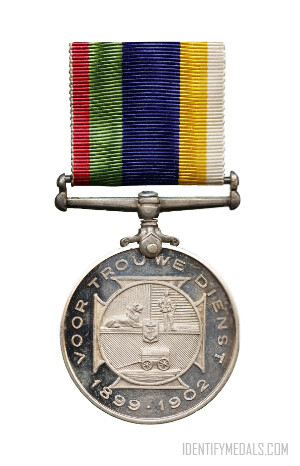
The decoration, crafted in silver, takes the form of a disk measuring 1+7⁄16 inches (37 millimeters) in diameter and 1⁄8 inch (3 millimeters) in thickness at the raised rim. It is attached to a fixed bar suspender using claws and a pin inserted through the upper edge of the medal. The recipient’s rank and name are impressed on the rim.

Both sides of the medal feature an encircled coat of arms on a cross pattée, surrounded by the inscription “VOOR TROUWE DIENST” above and the years “1899 • 1902” below. The coat of arms of the South African Republic is depicted on one side of the cross, while that of the Orange Free State is shown on the other. This design allows recipients to wear the medal to display the coat of arms of the state under which they served.

The ribbon measures 1+1⁄4 inches (32 millimeters) wide and combines the colors of the two former Republics. While officially designated as red, green, white, blue, and orange, the orange hue appears as yellow on the actual ribbons.
The Order of Mendi for Bravery

The Order of Mendi for Bravery is a South African order created to award citizens who have performed acts of bravery to save lives or property.

The Order of Mendi for Bravery is a civilian honor in South Africa bestowed upon individuals who have displayed acts of bravery in endeavors to rescue lives or property. Authorized by the President of South Africa, this recognition is conferred upon South African citizens for their courageous actions, regardless of the location of the incident. Established on November 30, 2003, initially known as the Mendi Decoration for Bravery, it was later designated as an order on October 22, 2004.

The order pays homage to the SS Mendi, a troopship tragically sunk in 1917 following a collision, resulting in the loss of over 600 black South African troops. Despite being a civilian distinction, it has been presented to military units, including those involved in the rescue operations during the 1991 MTS Oceanos disaster and the 2000 Mozambican floods.

The Order of Mendi has three classes:

  • Gold (OMBG), for conspicuous bravery;
  • Silver (OMBS), for exceptional bravery; and
  • Bronze (OMBB), for outstanding bravery.

The Order of Mendi for Bravery Design

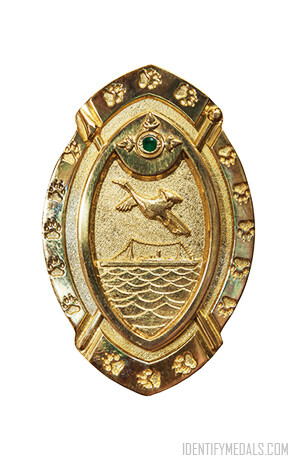
The insignia of the order is designed in the shape of a traditional African shield, oval in form. Its front side features an image of the SS Mendi, accompanied by a blue crane flying overhead. Above this depiction, a green emerald is sealed, encircled by depictions of the bitter aloe on three sides. Crossed assegai and knobkierrie adorn the background of the shield, while lion pawprints decorate the border.

The reverse side showcases the Coat of Arms of South Africa. Alongside the neck badge, the award includes a miniature medallion and a lapel rosette.

More South African Orders

The Order of the Companions of O. R. Tambo

The Order of the Companions of O.R. Tambo is a South African order created to award heads of state and senior diplomats for friendship to SA.

The Order of the Companions of O. R. Tambo (SCOT/GCOT/COT) is a distinguished South African accolade. Established on December 6, 2002, it is conferred by the President of South Africa upon foreign citizens who have advanced South African interests and aspirations through cooperation, solidarity, and support.

Named in honor of the late Oliver Tambo, who served as the president-in-exile of the African National Congress for numerous years, the order pays tribute to his enduring legacy and commitment to the advancement of South Africa’s ideals.

There are currently three classes of appointment. In descending order of precedence, they are:

  • Supreme Companion of OR Tambo in gold, for heads of state and, in special cases, heads of government (SCOT)
  • Grand Companion of OR Tambo in silver, for heads of government, ministers of state, supreme court judges, presidents of legislatures, secretaries of state, ambassadors, commanders-in-chief (GCOT)
  • Companion of OR Tambo in bronze, for legislators, envoys, senior military officers (COT)

The Order of the Companions of O. R. Tambo Design

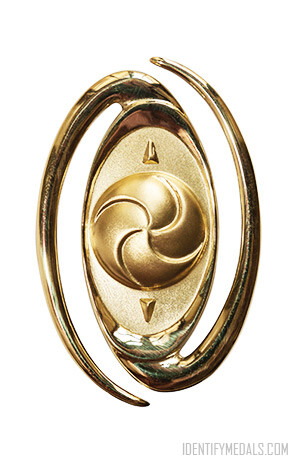
The insignia of the order is oval-shaped and features a symbol reminiscent of the Taijitu, flanked by two arrowheads and framed by two mole snakes. This symbolizes the convergence of diverse spiritual energies, while the snakes represent unity and assistance. On the reverse side, the South African coat of arms is prominently displayed.

The ribbon, worn around the neck, is white and adorned with recurring grey symbols down the center. All three classes of the order are worn in this manner.

In addition to the badge, recipients are presented with a carved wooden walking stick. The walking stick is embellished with a serpent winding around the shaft and a spoon-shaped head displaying the order’s emblem and the national coat of arms. This walking stick serves as a symbol of support, solidarity, and a commitment to stand by the recipient in return.

More South African Orders

The Order of Mapungubwe

The Order of Mapungubwe is a South African order created to award citizens who have served the interests of the country internationally.

The Order of the Mapungubwe is a prestigious South African civilian accolade order established in 2002. It honors South African citizens whose accomplishments resonate on an international scale and contribute to the advancement of South Africa’s interests.

Regarded as South Africa’s most esteemed honor, the order derives its name from the ancient civilization of Mapungubwe, situated in present-day South Africa. Established on December 6, 2002, its inaugural recipient in the highest class was the esteemed former president, Nelson Mandela.

The order (which originally had three classes) was enlarged to four in 2004. These are:

  • Platinum (OMP), for exceptional and unique achievements;
  • Gold (OMG), for exceptional achievements;
  • Silver (OMS), for excellent achievements; and
  • Bronze (OMB), for outstanding achievements.

The Order of Mapungubwe Design

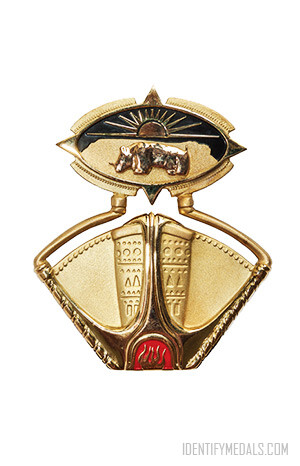
The insignia of the order consists of a horizontal oval positioned above an inverted trapezium. Within the oval frame, a golden rhinoceros is depicted against the backdrop of the sun rising above Mapungubwe Hill. The convex upper edge of the trapezium features a decorative beadwork pattern, while the sides are adorned with sceptres.

At the center is an intricate crucible from which molten gold cascades down into a red furnace. On the reverse side, the South African coat of arms is prominently featured.

The ribbon, worn around the neck, is crafted in gold and embellished with a line of cream-colored bead-like dots along each edge. In the center, recurring cream-colored rhinoceros silhouettes add a distinctive touch to the design. All four classes of the order are worn in this manner

More South African Orders

The Order of Luthuli

The Order of Luthuli is a South African order created to award citizens or contributions to democracy, human rights, and justice.

The Order of Luthuli is a South African order established in 2003 and conferred by the President of South Africa in recognition of outstanding contributions to the fight for democracy, human rights, nation-building, justice, peace, and conflict resolution.

Named after Chief Albert Luthuli, a prominent leader of the African National Congress and South Africa’s first Nobel Peace Prize laureate, the order pays homage to his legacy and commitment to advancing social justice and equality.

The Order of Luthuli has three classes:

  • Gold (OLG), for exceptional contributions,
  • Silver (OLS), for excellent contributions,
  • Bronze (OLB), for outstanding contribution.

The Order of Luthuli Design

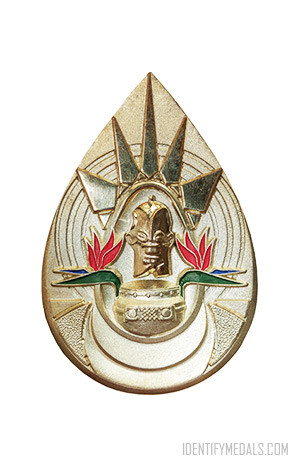
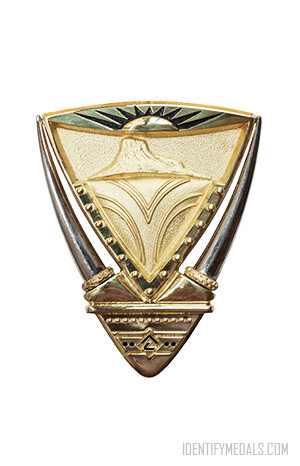
The emblem of the order features an equilateral triangle, with a flintstone positioned above a clay pot. The flintstone symbolizes the rising sun over Isandhlwana and the national flag, flanked by two animal horns emerging from the clay pot, bearing the initials AL. Isandhlwana represents peace and tranquility, while the leopard-skin bands around the bases of the horns represent Chief Luthuli’s headdress. On the reverse side, the South African coat of arms is prominently displayed.

The ribbon, worn around the neck, is adorned with a golden hue and is embellished with cream-colored AL monograms along each edge. In the center, recurring cream-colored outlines of the flintstone, depicting the national flag, add a distinctive element to the design. All three classes of the order are worn in this manner.

More South African Orders

The Order of Ikhamanga

The Order of Ikhamanga is a South African order created to award citizens who have excelled in the arts, literature, music, sport, and more.

The Order of the Ikhamanga (abbreviated as OIG/OIS/OIB) is a South African order established in 2003 to recognize and honor outstanding achievements in the fields of arts, culture, literature, music, journalism, and sport.

Named after the Xhosa word for the strelitzia flower, a symbol of endurance and resilience, the order celebrates individuals who have made significant contributions to the enrichment and advancement of South African society through their talent, creativity, and dedication.

The order has three classes:

  • Gold (OIG), for exceptional achievement,
  • Silver (OIS), for excellent achievement,
  • Bronze (OIB), for outstanding achievement.

The Order of Ikhamanga Design

The oval-shaped emblem features various symbolic elements, including a rising sun, a “Lydenburg head”, two strelitzia flowers, a drum, three circles, and two roadways. Each of these elements carries significance: the head symbolizes the arts, the sun represents glory, the circles signify sport, and the roads symbolize the journey towards excellence. The reverse side of the badge displays the South African coat of arms.

The ribbon, worn around the neck, is adorned with a golden hue and is embellished with four cream-colored lines along each edge. In the center, a recurring pattern of stylized dancing figures adds a dynamic touch to the design.

Designed by Charles Peter Gareth Smart, a graphic designer based in Pretoria, South Africa, the Order of Ikhamanga embodies the nation’s cultural richness and celebrates excellence across various fields of endeavor.

More South African Orders

The Order of The Baobab

The Order of The Baobab is a South African order created to award citizens for services to democracy, human rights, arts, and sciences.

The Order of the Baobab (abbreviated as SCOB/GCOB/COB) is a South African order established in 2002 to honor and recognize outstanding contributions made by South African citizens in various fields, including democracy, human rights, arts and sciences, and community service.

The order is named after the baobab tree, an iconic symbol of resilience, strength, and longevity in African culture. It embodies the values of endurance and steadfastness, reflecting the qualities sought in recipients of the award.

The Order of the Baobab Grades

The Order of the Baobab is divided into three grades to distinguish the level of achievement and impact of the recipients’ contributions:

  1. Gold (GCOB): This highest grade is awarded to individuals who have made exceptional and distinguished contributions to the advancement of democracy, the promotion of human rights, the enrichment of arts and sciences, or the improvement of communities. Recipients of the Gold Order of the Baobab are recognized as trailblazers and leaders in their respective fields, whose efforts have had a profound and lasting impact on South African society.

  2. Silver (SCOB): The Silver grade is bestowed upon individuals who have demonstrated significant achievements and contributions in their chosen areas of endeavor. These recipients have made notable contributions to the advancement of democracy, the promotion of human rights, the development of arts and sciences, or the enhancement of community welfare. Their efforts have made a meaningful difference and have inspired others to follow in their footsteps.

  3. Bronze (COB): The Bronze grade is awarded to individuals who have shown dedication, commitment, and service in their respective fields. While their contributions may be more modest in scope compared to Gold and Silver recipients, Bronze Order of the Baobab recipients are valued for their dedication to the principles of democracy, human rights, arts and sciences, and community service. Their efforts contribute to the overall betterment of South African society and serve as examples of citizenship and civic responsibility.

The Order of the Baobab Design

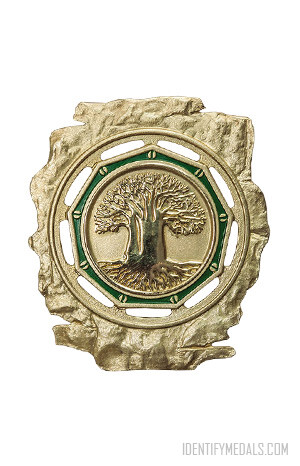
The inspiration behind this Order stems from the Baobab, an African tree renowned for its significance and symbolism in indigenous cultures. The name “Baobab” is steeped in the legends and mysteries of Africa, often described for its vitality, magical properties, and deep-rooted symbolism. Its remarkable endurance and resilience as it ages reflect the enduring and exceptional service honored by this Order, which contributes to the ongoing growth and prosperity of South Africa.

The Baobab holds a pivotal role in African agroforestry systems, offering a multitude of resources essential for daily life. Its bark provides materials for cloth and rope, while its fruits serve as food and fuel, among other valuable products. The tree’s iconic, expansive root system supports its imposing stature, making it a focal point for important gatherings and a symbol of protection in traditional African societies.

The components are:

  • The Baobab (Adansonia digitata), renowned for its extensive roots and remarkable longevity, serves as a central motif in the design. It not only offers shade and serves as a gathering place but also plays a vital role in supporting the communities where it grows.
  • The nonagon shape, representing a nine-sided polygon, symbolizes the diverse range of potential contributions and services toward building a prosperous and advancing nation. Additionally, it reflects the nine provinces of our country.
  • The exterior organic holding shape features a textured finish reminiscent of Baobab bark, often utilized in the crafting of mats and hats, embodying the rich cultural heritage and practical utility found within South African traditions.

More South African Orders

Decoration for Meritorious Services (South Africa)

The Decoration for Meritorious Services was conferred until 1987 by the Government of the Republic of South Africa for political services.

The Decoration for Meritorious Services was an award granted until 1987 by the Government of the Republic of South Africa, typically in recognition of one’s political contributions to the nation. Appointments to this honor were made by the State President of South Africa.

Recipients of this distinction were entitled to use ‘DMS’ (or in Afrikaans, ‘DVD’) after their name. In 1986, it was succeeded by the Order for Meritorious Service.

Since June 1, 1994, this honor has been categorized as a Commonwealth distinction.

Decoration for Meritorious Services Design

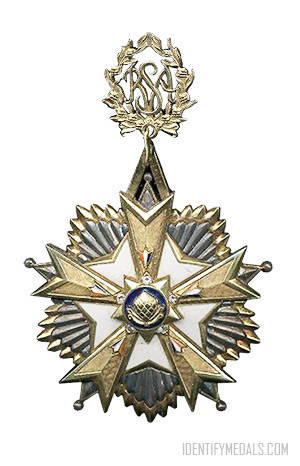
The design featured a five-armed gold Maltese cross, with a golden protea flower at the center of a five-pointed diamond-studded star, all set against a multi-rayed silver and gold plaque on the obverse side. This decoration was worn suspended from a neck ribbon.

Find This Medal Online

Right Now on eBay 
Clicking a link to eBay may result in a referral commission being paid if a purchase is made.
Loading...

The Order of Good Hope

The Order of Good Hope is a dormant order of merit of the Republic of South Africa. It was founded in 1973 by the government.

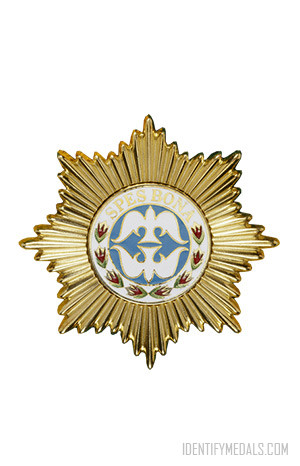
The Order of Good Hope, also known as the Order of the Cape of Good Hope, is an inactive order of merit originating from the Republic of South Africa. Founded in 1973 by the South African government of that time, its purpose was to recognize individuals who had made significant contributions to fostering international relations and raising awareness about South Africa’s interests. However, the order was abolished in 2002.

The Order of Good Hope was bestowed upon foreign citizens, and between 1980 and 1988, it was briefly extended to South Africans as well, primarily for their efforts in promoting international relations during a time when South Africa was increasingly isolated due to its apartheid policies.

The Order of Hope Classes

Originally, the order was divided into five classes:

  1. Grand Collar – Exclusively for heads of state.
  2. Grand Cross – Reserved for heads of government, ministers of state, judges, presidents of legislatures, secretaries of state, ambassadors, commanders-in-chief, and others.
  3. Grand Officer – Intended for legislators, envoys, senior military officers, and similar roles.
  4. Commander – Designated for chargés d’affaires, consuls-general, colonels, and comparable positions.
  5. Officer – Awarded to consuls, lower-ranking military officers, and others.

The order underwent reorganization in 1988, resulting in the following structure:

  1. Grand Cross – Recognizing excellent meritorious service, primarily for heads of state, and on special occasions, heads of government.
  2. Grand Officer – Reserved for outstanding meritorious service, encompassing heads of government, ministers of state, judges, presidents of legislatures, secretaries of state, ambassadors, commanders-in-chief, and others.
  3. Commander – Acknowledging exceptionally meritorious service by legislators, envoys, senior military officers, and similar roles.
  4. Officer – Commending meritorious service performed by chargés d’affaires, consuls-general, colonels, and comparable positions.
  5. Member – Honoring exceptional service rendered by consuls, lower-ranking military officers, and others.

The Order of Hope Design

President Nelson Mandela had expressed his intent to reform the Order, as the newly established South African government viewed it as a relic of apartheid. One key concern was that the order’s insignia was deemed too European in design, featuring rays, colors, an anchor, and a Latin motto. Additionally, the cost of the insignia for each initiate amounted to approximately 11,000 rand. Consequently, the Order of the Companions of O. R. Tambo was established in its stead.

Find This Medal Online

Right Now on eBay 
Clicking a link to eBay may result in a referral commission being paid if a purchase is made.
Loading...