The South African Honoris Crux Medal

The South African Honoris Crux Medal was a military honor established by the Union of South Africa in 1952. It remained in use until 1975.

The Honoris Crux (Cross of Honor) of 1952, identified by the post-nominal letters HC, was a military honor established by the Union of South Africa in 1952.

It remained in use from 1952 to 1975 and was bestowed upon members of the South African Defence Force for acts of gallantry in combat against the enemy. However, it was phased out on July 1, 1975, when it was succeeded by a new series of four Honoris Crux decorations, each in a different class.

The Honoris Crux of 1952 recognized acts of gallantry in combat against the enemy. A Bar could be added for subsequent acts of bravery.
Only five decorations were conferred, with the first awarded in 1973 and the others in 1974 and 1975. All recipients were helicopter pilots and flight engineers of the South African Air Force, with Captain A.P. (Aap) Möller receiving the first decoration. Notably, no bars were ever added to the decoration.

The South African Honoris Crux Medal Design

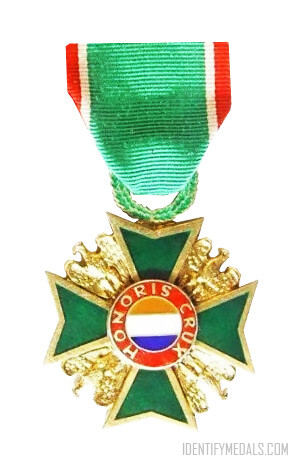
The Honoris Crux of 1952 is a silver-gilt Maltese cross designed to fit within a 45-millimeter diameter circle. The cross features arms adorned with green enamel and four eagles positioned between the arms, all facing towards their right. At the center, there is a roundel divided horizontally into enameled orange, white, and blue bands, symbolizing the national flag. Encircling this roundel is a red ring inscribed with “HONORIS CRUX.” The cross is suspended from a laurel wreath, forming a circular ribbon hanger, with the leaves depicted in green enamel.

The reverse side displays the pre-1994 South African coat of arms, with the decoration number stamped at the bottom of the rim. Prior to South Africa becoming a republic in 1961, specimens featured Queen Elizabeth’s royal cipher (E II R) above the coat of arms. However, the royal cipher was removed in 1961 without relocating the coat of arms to the center of the decoration.

The ribbon measures 32 millimeters in width and features a pattern consisting of a 3-millimeter-wide red band, followed by a 2-millimeter-wide white band, a 22-millimeter-wide dark green band, another 2-millimeter-wide white band, and finally, another 3-millimeter-wide red band.
The Van Riebeeck Decoration

The Van Riebeeck Decoration is a South African military honor for acts of bravery, established by the Union of South Africa in 1952.

The Van Riebeeck Decoration, designated by the post-nominal letters DVR, is a South African military honor for acts of bravery, established by the Union of South Africa in 1952. It was conferred upon officers for distinguished service in combat against an adversary.

The Van Riebeeck Decoration was established by Queen Elizabeth II on April 6, 1952, coinciding with the Tercentenary Van Riebeeck Festival. Originally, the logical post-nominal letters would have been VRD. However, these letters were already assigned to the Decoration for Officers of the Royal Naval Volunteer Reserve, which had also been conferred upon South Africans. Therefore, the letters DVR were selected instead.

Only two decorations were ever awarded, both in 1972.

The Van Riebeeck Decoration Design

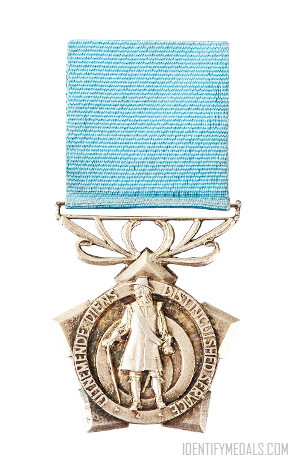
Crafted in silver-gilt, the Van Riebeeck Decoration takes the form of the five-pointed outline of the Castle of Good Hope, fitting within a 38-millimeter diameter circle. The suspension features a cluster of eight protea leaves. In relief, the statue of Jan van Riebeeck, located in the Heerengracht in Cape Town, is depicted against a backdrop of three rings representing Van Riebeeck’s ships. The outer ring is inscribed “UITNEMENDE DIENS” on the left and “DISTINGUISHED SERVICE” on the right.

The reverse side displays the pre-1994 South African Coat of Arms. Versions produced before May 31, 1961, bore Queen Elizabeth II’s royal cipher (E II R) above the coat of arms, which was subsequently removed from subsequent awards.

Measuring 32 millimeters wide, the ribbon is sky blue in color.

The Star of South Africa Medal

The Star of South Africa Medal was a military honor established by the Union of South Africa to recognize exceptional merit.

The Star of South Africa, denoted by the post-nominal letters SSA, was a military honor established by the Union of South Africa between 1952 and 1975 to recognize exceptional merit. It was conferred upon general and flag officers of the South African Defence Force for their exceptionally meritorious service. However, it was discontinued on July 1, 1975, coinciding with the introduction of a new set of orders, decorations, and medals.

The Star of South Africa was granted to general and flag officers in recognition of their remarkable service. Essentially, it replaced the Commander of the Order of the British Empire (CBE), which had been awarded to senior South African officers during World War II.

The Star of South Africa Medal Design

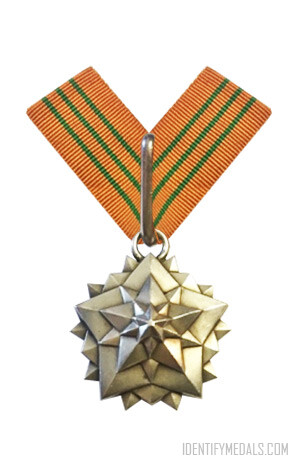
The Star of South Africa was crafted in silver and comprised eight five-pointed stars of various sizes, arranged in layers to fit within a 50-millimeter diameter circle.

On the reverse side, the decoration displayed the pre-1994 South African coat of arms. Specimens awarded before South Africa’s republic status on May 31, 1961, featured Queen Elizabeth’s royal cipher (E II R) above the coat of arms.

The decoration was worn around the neck on an orange ribbon, measuring 44 millimeters in width. It featured three green bands in the center, each 3 millimeters wide and spaced 6 millimeters apart.

The Louw Wepener Decoration

The Louw Wepener Decoration is a military honor established by the Union of South Africa in 1952 to recognize acts of remarkable bravery.

The Louw Wepener Decoration, denoted by the post-nominal letters LWD, is a military honor established by the Union of South Africa in 1952 to recognize acts of remarkable bravery and heroism displayed by members of the South African Defence Force. However, it was discontinued on July 1, 1975, with the introduction of a new series of decorations and medals.

The Louw Wepener Decoration was granted to individuals of all ranks for displaying remarkable courage or heroism in situations of great peril, primarily outside of combat contexts. It could be accompanied by a Bar for additional acts of bravery. The decoration was established in tribute to Louw Wepener, who lost his life in 1865 while leading his troops in an assault on a Basotho stronghold during the Basuto Wars of 1858 to 1865.

Only seven decorations were conferred, with the first awarded in 1961 and the last in 1974. No bars were ever added to the decoration.

The Louw Wepener Decoration Design

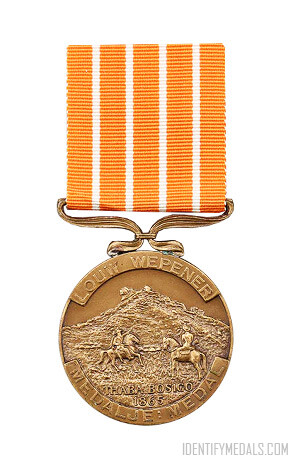
The Louw Wepener Decoration features a 38-millimeter medallion depicting the Thaba Bosigo mountain peak, with two horsemen positioned at its base. Below the riders, the inscription “THABA BOSIGO, 1865” is displayed, while around the circumference, the words “LOUW WEPENER” appear at the top and “DECORATION • DEKORASIE” at the bottom.

On the reverse side, the decoration showcases the pre-1994 South African coat of arms, with the decoration number impressed at the bottom of the rim. Specimens awarded before South Africa’s republic status on May 31, 1961, featured Queen Elizabeth’s royal cipher (E II R) above the coat of arms.

The ribbon measures 1+3⁄8 inches (35 millimeters) in width and is orange, adorned with five white bands spaced 1⁄8 inch (3.2 millimeters) apart.

The Castle of Good Hope Decoration

The Castle of Good Hope Decoration was established in 1952 and designated as a military honor for acts of bravery.

The Castle of Good Hope Decoration, established by the Union of South Africa on April 6, 1952, was designated as a military honor for acts of bravery.

Despite its establishment, it was never conferred. The decoration was intended to recognize members of the South African Defence Force for exceptional acts of valor, conspicuous bravery, daring deeds, self-sacrifice, or extraordinary devotion to duty in the face of the enemy. A Bar could be added for subsequent acts of similar bravery.

This decoration held the highest rank among South African honors, decorations, and medals from 1952 to 2003. Queen Elizabeth II formally approved it on January 26, 1953, as a South African equivalent to the Victoria Cross (VC), which South African servicemen had previously been eligible for.

The Castle of Good Hope Decoration Design

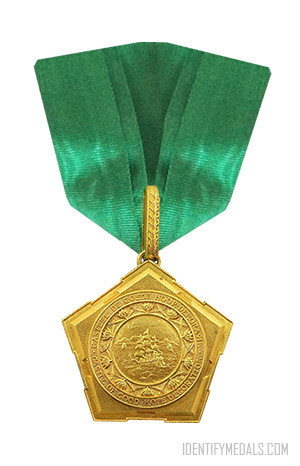
The Castle of Good Hope Decoration featured a gold pentagon representing the silhouette of the historic Castle of Good Hope in Cape Town, South Africa’s oldest military structure. Its obverse side depicted Van Riebeeck’s three ships arriving at Table Bay in 1652, encircled by a double ring. The inner ring was adorned with a wreath of proteas, while the outer ring bore the inscriptions “CASTEEL DE GOEDE HOOP DEKORASIE” at the top and “CASTLE OF GOOD HOPE DECORATION” at the bottom.

The reverse side showcased the pre-2000 South African coat of arms with Queen Elizabeth’s royal cipher (E II R) positioned above it. Only one decoration of this design was produced.

The bar, made of gold, featured a miniature replica of the Castle of Good Hope embossed in its center.

Measuring 44 millimeters in width, the ribbon was green. Originally designed to be worn around the neck, a decision was made in 1991 to modify it into a chest decoration, anticipating the need for a new specimen without the royal cipher if it were to be awarded. However, this alteration never became necessary.

The Medalje vir Troue Diens Medal for Loyal Service

The Medalje vir Troue Diens Medal for Loyal Service is eligible to all ranks who have demonstrated impeccable character and conduct.

The Medalje vir Troue Diens – Medal for Loyal Service was established by the President of the Republic of South Africa on April 16, 2003, and became effective on April 27, 2003. It is eligible for presentation to all ranks who have demonstrated impeccable character and conduct, and have completed ten years of qualifying service.

The medal is eligible for presentation to all ranks of the South African National Defence Force and any Auxiliary Service of the South African National Defence Force, provided their character and conduct have been impeccable. Additionally, recipients must have completed ten years of qualifying service, regardless of whether it was continuous, starting from April 27, 2003, onwards. Posthumous awards of both the medal and its bars are permissible.

Qualifying service encompasses prior service in the constituent permanent or part-time forces of the SANDF, as well as other former uniformed institutions like the Police forces and Prisons services of South Africa, the Republics of Transkei, Bophuthatswana, Venda, and Ciskei, and the Self-Governing Territories.

About The Union Defence Forces (UDF)

Established in 1912 as the Union Defence Forces (UDF), the military entity underwent a renaming to become the South African Defence Force (SADF) in 1958. Subsequently, on April 27, 1994, it merged with six other distinct forces to form the South African National Defence Force (SANDF).

The Medalje vir Troue Diens Medal for Loyal Service Design

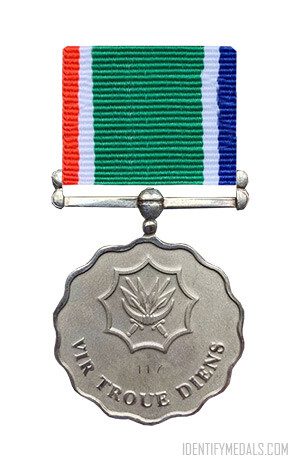
The Medalje vir Troue Diens – Medal for Loyal Service is circular and made of nickel-silver, with a diameter of 38 millimeters and a raised, evenly scalloped edge. Its obverse side features the coat of arms of the Republic of South Africa in relief.

On the reverse side, the medal displays the emblem of the South African National Defence Force at the top. Below, the words “VIR TROUE DIENS” are inscribed in relief around the lower perimeter, with the medal number impressed between the emblem and the inscription. The medal is attached to a plain nickel-silver suspender fixed to the upper rim.

The ribbon is 32 millimeters wide and colored national flag green. It features a 3 millimeter wide national flag red band and a 3 millimeter wide white band on the left edge, as well as a 3 millimeter wide white band and a 3 millimeter wide national flag blue band on the right edge.

The Tshumelo Ikatelaho General Service Medal

The Tshumelo Ikatelaho General Service Medal is granted to all ranks who have taken part in military campaigns or operations with the UDF.

The Tshumelo Ikatelaho – General Service Medal was established by the President of the Republic of South Africa on April 16, 2003, becoming effective on April 27, 2003. It is granted to all ranks who have taken part in military campaigns or operations that, although not meeting the criteria for specific campaign medals, merit recognition through a general service medal. The title of the medal is bilingual, presented in both Tshivenda and English.

The medal is eligible for all ranks of the South African National Defence Force, Auxiliary Service of the South African National Defence Force, and Armed Forces associated with or aiding the South African National Defence Force.

Those who have participated, whether directly or in support, in military campaigns or operations, whether they are belligerent or not, for one day or longer, in accordance with the regulations outlined in the Defence Act, qualify. These operations, while not individually meriting specific campaign medals, are deemed significant enough to warrant the presentation of a general service medal.

About The Union Defence Forces (UDF)

Established in 1912 as the Union Defence Forces (UDF), the military entity underwent a renaming to become the South African Defence Force (SADF) in 1958. Subsequently, on April 27, 1994, it merged with six other distinct forces to form the South African National Defence Force (SANDF).

The Tshumelo Ikatelaho General Service Medal Design

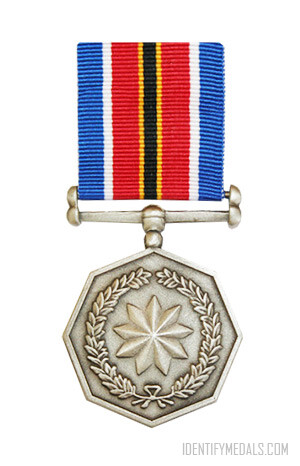
The Tshumelo Ikatelaho – General Service Medal is a 38-millimeter bronze medal, octagonal in shape, featuring a faceted nine-pointed star encircled by a laurel wreath. The star symbolizes the nine Provinces of the Republic of South Africa.

On the reverse side, the medal displays the coat of arms of the Republic of South Africa in raised relief. It is affixed to a plain nickel-silver suspender fixed to the upper rim of the medal, with the medal number stamped below the coat of arms.

The ribbon measures 32 millimeters in width and consists of a national flag blue band measuring 5 millimeters, followed by a 2 millimeter white band, a national flag red band measuring 6 millimeters, and a 1½ millimeter gold band. These bands are repeated in reverse order and separated by a 3 millimeter black band in the center.

The iPhrothiya yeGolide Golden Protea Medal

The iPhrothiya yeGolide Golden Protea Medal is a South African bestowed upon individuals who have demonstrated outstanding leadership.

The iPhrothiya yeGolide – Golden Protea, denoted by the post-nominal letters PG, was established by the President of the Republic of South Africa on April 16, 2003, becoming effective on April 27, 2003. It is bestowed upon individuals of all ranks who have demonstrated outstanding leadership, exceptional meritorious service, and unwavering dedication to duty. This prestigious decoration stands as South Africa’s highest military honor for meritorious conduct.

The decoration is granted to members of the South African National Defence Force, its Auxiliary Services, and affiliated Armed Forces who exhibit outstanding leadership, exceptional meritorious service, and unwavering dedication to duty. It holds precedence within a trio of military decorations for merit, accompanied by the iPhrothiya yeSiliva – Silver Protea and the iPhrothiya yeBhronzi – Bronze Protea.

About The Union Defence Forces (UDF)

Established in 1912 as the Union Defence Forces (UDF), the military entity underwent a renaming to become the South African Defence Force (SADF) in 1958. Subsequently, on April 27, 1994, it merged with six other distinct forces to form the South African National Defence Force (SANDF).

The iPhrothiya yeGolide Golden Protea Medal Design

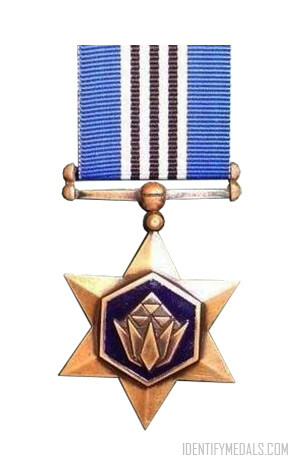
The iPhrothiya yeGolide – Golden Protea features a six-pointed star showcasing a stylized protea, the national flower of South Africa, positioned within a blue hexagon at its center.

On the reverse side, the decoration displays the coat of arms of South Africa in raised relief. It is attached to a plain silver-gilt suspender fixed to the upper point of the star, with the medal number stamped or engraved below the coat of arms.

The ribbon measures 32 millimeters in width and is colored national flag blue, with a 2 millimeter wide gold band flanked by 2 millimeter wide black bands positioned at its center.

The Nkwe ya Gauta Golden Leopard Medal

The Nkwe ya Gauta Golden Leopard Medal is a South Africa military honor awarded for acts of bravery. It was established in 2003.

The Nkwe ya Gauta, also known by its post-nominal letters NG or Golden Leopard, is a South African military honor awarded for acts of bravery. Established in 2003, it superseded the Honoris Crux Gold (HCG) and stands as South Africa’s foremost military decoration for acts of courage.

The title of this decoration is bilingual, being presented in both Sesotho and English. It stands as the highest tier within a trilogy of military decorations for bravery, accompanied by the Nkwe ya Selefera – Silver Leopard and the Nkwe ya Boronse – Bronze Leopard.

The Nkwe ya Gauta – Golden Leopard is granted to members of the South African National Defence Force, its Auxiliary Services, and any affiliated Armed Forces who display exceptional bravery during military operations, whether through singular acts or sustained valor.

About The Union Defence Forces (UDF)

Established in 1912 as the Union Defence Forces (UDF), the military entity underwent a renaming to become the South African Defence Force (SADF) in 1958. Subsequently, on April 27, 1994, it merged with six other distinct forces to form the South African National Defence Force (SANDF).

The Nkwe ya Gauta Golden Leopard Medal Design

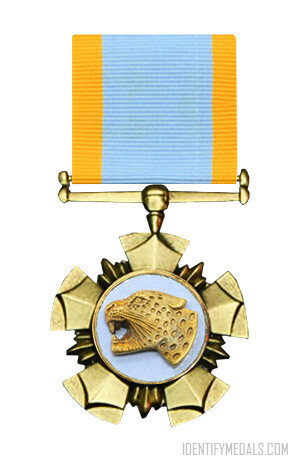
The Nkwe ya Gauta – Golden Leopard features a five-armed cross pattée made of 9 carat gold, measuring 38 millimeters in diameter. The cross’s arms are faceted per chevron and embowed throughout, with the extremities also embowed and separated by three short rays. At the center of the obverse side lies a 19-millimeter light blue enamel roundel adorned with a golden leopard’s head.

On the reverse side, the decoration showcases the relief of the coat of arms of South Africa. It is affixed to a plain gold suspender fixed to the upper arm of the decoration, with the medal number either impressed or engraved below the coat of arms.

The ribbon accompanying the decoration is 32 millimeters wide, with 6 millimeters wide gold edges. Its sky blue color symbolizes the feathers of the blue crane, historically presented by Xhosa kings to courageous warriors.

The Lint voor Wonden Award

The Lint voor Wonden Medal was instituted on 21 December 1920 as a retrospective award for Boer veteran officers and men.

The Lint voor Verwonding, or Wound Riband, is a military campaign decoration in South Africa. Established on December 21, 1920, it was a retrospective honor for Boer veteran officers and soldiers of the 1899–1902 Second Boer War who had sustained injuries in combat.

The Lint voor Wonden, also known as Lint voor Verwonding, was officially designated as Lint voor Verwonding Opgedaan Gedurende de Anglo-Boere Oorlog, 1899–1902 (Riband for Wounds Sustained During the Anglo-Boer War, 1899–1902). It was instituted through Government Notice no. 2307 on December 21, 1920, and published in the Union of South Africa Government Gazette on December 24, 1920.

This honor was retroactively conferred upon Boer veteran officers and soldiers who were wounded in action while serving in the combat forces of the South African Republic and the Orange Free State during the Second Boer War, spanning from October 11, 1899, to May 31, 1902.

The Lint voor Wonden Award Design

The Lint voor Wonden or Lint voor Verwonding was accompanied by a certificate upon issuance. The initial version of this certificate was simple and unadorned, filled out by hand with details such as the recipient’s rank, name, and the Republican Force they served with. Additionally, the recipient’s file number was included in the top left corner of the document.

In a later version, the certificate featured a full-color reproduction of the riband. While the Republican Force was pre-printed on this version, it did not include space for the recipient’s file number.

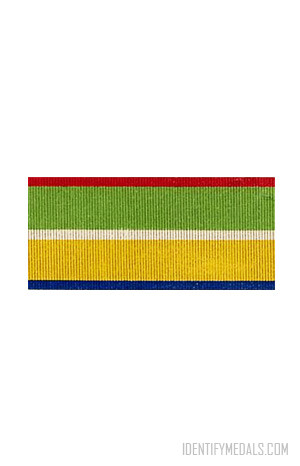
The riband itself measured 1+1⁄2 inches (38 millimeters).