The Purple Heart

The Purple Heart is a military decoration from the United States awarded to those wounded or killed while serving with the U.S. military.

The Purple Heart is a military decoration from the United States awarded in the name of the president to those wounded or killed while serving, on or after April 5, 1917, with the U.S. military. 

The Purple Heart is the oldest military award still given to U.S. military members. The Purple Heart differs from most other decorations in that an individual is not “recommended” for the decoration; rather he or she is entitled to it upon meeting specific criteria.

Criteria: [For] “Being wounded or killed in any action against an enemy of the United States or as a result of an act of any such enemy or opposing armed forces”

The Establishment of the Purple Heart (1782)

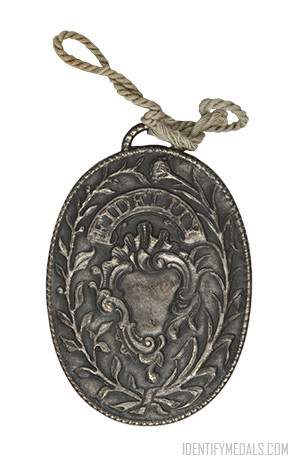
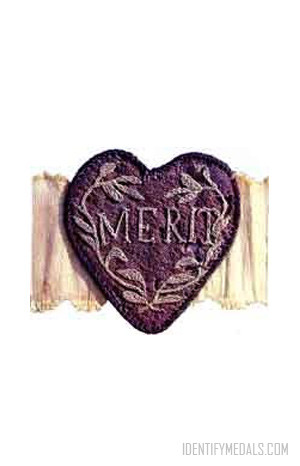
The original Purple Heart was established by George Washington on August 7, 1782. The (then called) Badge of Military Merit was only awarded to three Revolutionary War soldiers by Gen. George Washington himself. From then on, as its legend grew, so did its appearance. 

On October 10, 1927, Army Chief of Staff General Charles Pelot Summerall directed that a draft bill be sent to Congress “to revive the Badge of Military Merit“. A number of private interests sought to have the medal re-instituted in the Army and on January 7, 1931, Summerall’s successor, General Douglas MacArthur, confidentially reopened work on a new design, involving the Washington Commission of Fine Arts.

The Purple Heart Revived (1932)

By Executive Order of the President of the United States, the Purple Heart was revived on the 200th Anniversary of George Washington’s birth, out of respect to his memory and military achievements, by War Department General Order No. 3, dated February 22, 1932. The first Purple Heart was awarded to MacArthur. During the early period of American involvement in World War II (December 7, 1941 – September 22, 1943), the Purple Heart was awarded both for wounds received in action against the enemy and for meritorious performance of duty. 

After the award was re-authorized in 1932 some U.S. Army wounded from conflicts prior to the first World War applied for, and were awarded, the Purple Heart: “…veterans of the Civil War and Indian Wars, as well as the Spanish–American War, China Relief Expedition (Boxer Rebellion), and Philippine Insurrection” also were awarded the Purple Heart.

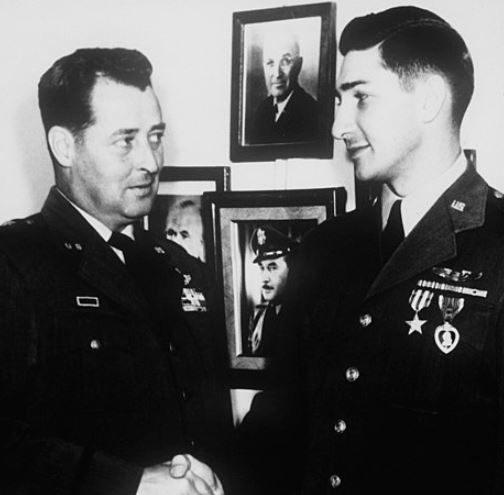
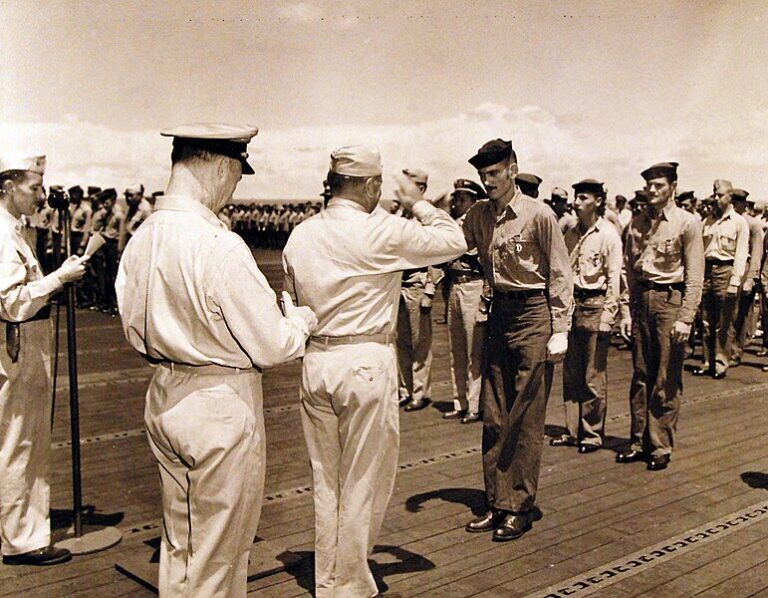
Rear Admiral Ralph Davidson presenting the Purple Heart to personnel onboard a carrier in July 7, 1944. Image courtesy of the National Archives.

The Purple Heart Medal Design

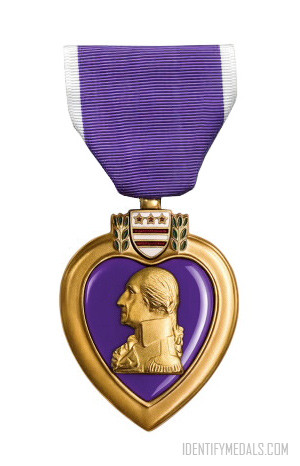
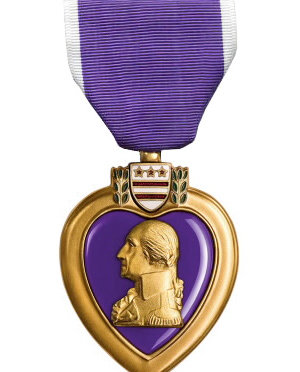
Elizabeth Will, an Army heraldic specialist in the Office of the Quartermaster General, was named to redesign the newly revived medal, which became known as the Purple Heart. Using general specifications provided to her, Will created the design sketch for the present medal of the Purple Heart. The new design, which exhibits a bust and profile of George Washington, was issued on the bicentennial of Washington’s birth. Will’s obituary, in the edition of February 8, 1975 of The Washington Post newspaper, reflects her many contributions to military heraldry. The Commission of Fine Arts solicited plaster models from three leading sculptors for the medal, selecting that of John R. Sinnock of the Philadelphia Mint in May 1931.

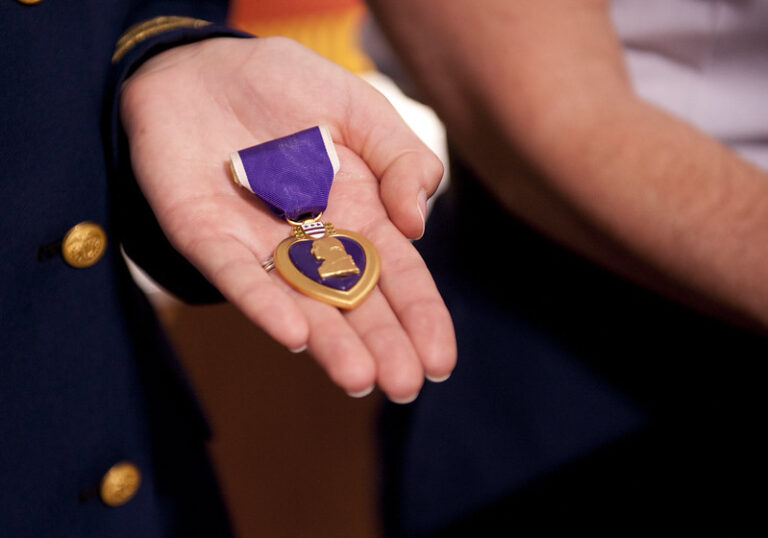
The Purple Heart award is a heart-shaped medal within a gold border, 1 38 inches (35 mm) wide, containing a profile of General George Washington. On the obverse and above the heart appears a shield of the coat of arms of George Washington (a white shield with two red bars and three red stars in chief) between sprays of green leaves. The reverse consists of a raised bronze heart with the words FOR MILITARY MERIT below the coat of arms and leaves.

The ribbon is 1 38 inches (35 mm) wide and consists of the following stripes: 18 inch (3.2 mm) white 67101; 1 18 inches (29 mm) purple 67115; and 18 inch (3.2 mm) white 67101. Additional awards of the Purple Heart are denoted by oak leaf clusters in the Army and Air Force, and additional awards of the Purple Heart Medal are denoted by ​516 inch stars in the Navy, Marine Corps, and Coast Guard.

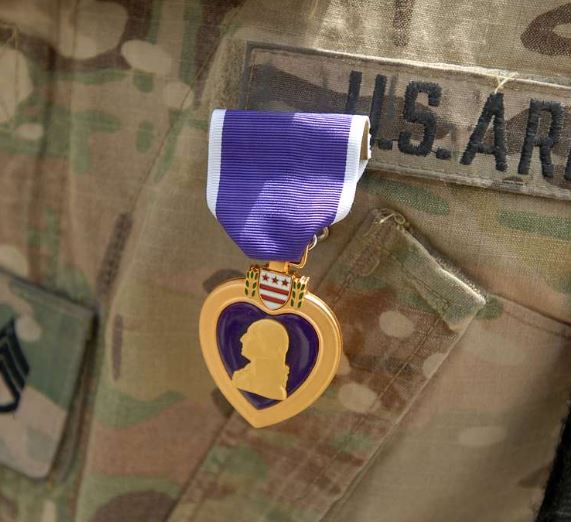
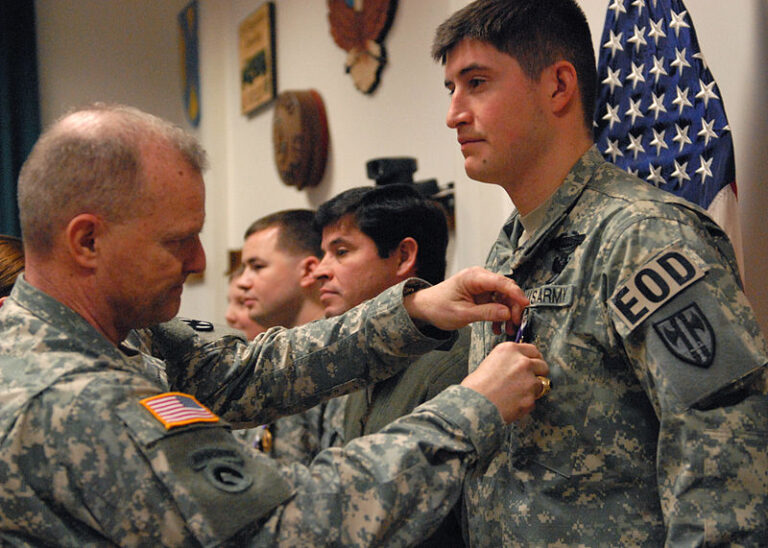
A soldier is awarded the Purple Heart during a ceremony on Coleman Barracks.
A soldier is awarded the Purple Heart during a ceremony on Coleman Barracks. Image courtesy of Wikipedia.

More About the Purple Heart

Do you want to learn more about this prestiguous American award? Here are some details that explore the history of the medal, its design,a nd symbolism:

Related Medals and Awards

The Purple Heart has a long history. So, it’s no surprise there were previous versions or medals that served as inspiration to establishing the 1932 version. These include:

Find This Medal

Right Now on eBay 
Clicking a link to eBay may result in a referral commission being paid if a purchase is made.
Loading...

The Cross for Loyalty to the Assassinated President Venustiano Carranza

The Cross for Loyalty to Carranza is a medal issued during 1910 and 1920 when control of Mexico’s government was attempted by several parties. 

The Cross for Loyalty to the Assassinated President Venustiano Carranza is a medal issued during the early years of the twentieth century, between 1910 and 1920 when control of Mexico’s government was attempted by several parties.

The United States involvement in the Mexican Revolution was varied and seemingly contradictory, first supporting and then repudiating Mexican regimes during the period 1910-1920. For both economic and political reasons, the U.S. government generally supported those who occupied the seats of power, whether they held that power legitimately or not.

When Francisco I. Madero was elected president in October 1911, the U.S. president was a lame duck. The U.S. Ambassador to Mexico, Henry Lane Wilson was initially sympathetic to the new regime, but quickly came into conflict with it. Ambassador Wilson conspired with General Victoriano Huerta to oust Madero.

The United States government under newly inaugurated president Woodrow Wilson refused to recognize Huerta’s government and sent troops to occupy Veracruz. President Wilson’s government recognized the government of Venustiano Carranza in 1915.

The Cross for Loyalty to the Assassinated President Venustiano Carranza Design

The Cross for Loyalty is typically designed in the shape of a cross, which is a common motif for many military medals and decorations. At the center of the cross, there is usually a circular medallion. This medallion features a depiction of President Venustiano Carranza. The image of Carranza may vary in detail but typically includes his profile or bust.

Around the outer edge of the central medallion, there may be an inscription. This inscription may include Carranza’s name, title, and dates of birth and death, as well as the words “Por la Lealtad” (For Loyalty) or similar phrases. The cross often has arms that radiate outward from the central medallion, creating a cross-like shape. These arms are usually plain but may sometimes feature decorative elements or symbols.

The medal is typically suspended from a ribbon that allows it to be worn around the neck or pinned to a uniform. The ribbon’s color and design may vary but often incorporate the national colors of Mexico, which are green, white, and red.

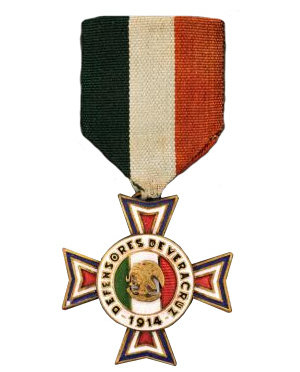
The Cross for the Defenders of Veracruz

The Cross for the Defenders of Veracruz is a medal issued 1910-1920 when control of Mexico’s government was attempted by several parties. 

The Cross for the Defenders of Veracruz is a medal issued during the early years of the twentieth century, between 1910 and 1920 when control of Mexico’s government was attempted by several parties.

The United States involvement in the Mexican Revolution was varied and seemingly contradictory, first supporting and then repudiating Mexican regimes during the period 1910-1920. For both economic and political reasons, the U.S. government generally supported those who occupied the seats of power, whether they held that power legitimately or not.

When Francisco I. Madero was elected president in October 1911, the U.S. president was a lame duck. The U.S. Ambassador to Mexico, Henry Lane Wilson was initially sympathetic to the new regime, but quickly came into conflict with it. Ambassador Wilson conspired with General Victoriano Huerta to oust Madero.

The United States government under newly inaugurated president Woodrow Wilson refused to recognize Huerta’s government and sent troops to occupy Veracruz. President Wilson’s government recognized the government of Venustiano Carranza in 1915.

The Cross for the Defenders of Veracruz Design

Like many Mexican military decorations, the Cross for the Defenders of Veracruz is typically designed in the shape of a cross. The cross shape is a common motif for such awards. At the center of the cross, there is usually a circular medallion. This medallion often features the image of a Mexican soldier or a patriotic symbol associated with the defense of Veracruz. The image may vary in detail but generally represents the valor and dedication of those who defended the city.

Around the outer edge of the central medallion, there may be an inscription. This inscription typically includes the words “Defensores de Veracruz” (Defenders of Veracruz) or similar phrases, highlighting the purpose and significance of the decoration. The cross often has arms that radiate outward from the central medallion, creating a cross-like shape. These arms are usually plain but may sometimes feature decorative elements or symbols.

The medal is typically suspended from a ribbon that allows it to be worn around the neck or pinned to a uniform. The ribbon’s color and design may vary but often incorporate patriotic colors, such as green, white, and red, which are the national colors of Mexico. At the top of the medal, there is a small ring or loop through which a ribbon or chain is threaded to allow for wearing or display.

The Cross for Revolutionary Merit 1913-14

The Cross of Revolutionary Merit is a medal issued during 1910 and 1920 when control of Mexico’s government was attempted by several parties. 

The Cross of Revolutionary Merit is a medal issued during the early years of the twentieth century, between 1910 and 1920 when control of Mexico’s government was attempted by several parties.

The United States involvement in the Mexican Revolution was varied and seemingly contradictory, first supporting and then repudiating Mexican regimes during the period 1910-1920. For both economic and political reasons, the U.S. government generally supported those who occupied the seats of power, whether they held that power legitimately or not.

When Francisco I. Madero was elected president in October 1911, the U.S. president was a lame duck. The U.S. Ambassador to Mexico, Henry Lane Wilson was initially sympathetic to the new regime, but quickly came into conflict with it. Ambassador Wilson conspired with General Victoriano Huerta to oust Madero.

The United States government under newly inaugurated president Woodrow Wilson refused to recognize Huerta’s government and sent troops to occupy Veracruz. President Wilson’s government recognized the government of Venustiano Carranza in 1915.

The Cross for Revolutionary Merit 1910-11

The Cross of Revolutionary Merit is a medal issued during 1910 and 1920 when control of Mexico’s government was attempted by several parties. 

The Cross of Revolutionary Merit is a medal issued during the early years of the twentieth century, between 1910 and 1920 when control of Mexico’s government was attempted by several parties.

The United States involvement in the Mexican Revolution was varied and seemingly contradictory, first supporting and then repudiating Mexican regimes during the period 1910-1920. For both economic and political reasons, the U.S. government generally supported those who occupied the seats of power, whether they held that power legitimately or not.

When Francisco I. Madero was elected president in October 1911, the U.S. president was a lame duck. The U.S. Ambassador to Mexico, Henry Lane Wilson was initially sympathetic to the new regime, but quickly came into conflict with it. Ambassador Wilson conspired with General Victoriano Huerta to oust Madero.

The United States government under newly inaugurated president Woodrow Wilson refused to recognize Huerta’s government and sent troops to occupy Veracruz. President Wilson’s government recognized the government of Venustiano Carranza in 1915.

The Medal of Freedom (1945)

The Medal of Freedom was a decoration established by President Harry S. Truman to honor civilians whose actions aided in the war efforts.

The Medal of Freedom was a decoration established by President Harry S. Truman to honor civilians whose actions aided in the war efforts of the United States and its allies.

The medal was intended to be awarded by the Secretary of State, the Secretary of War, or the Secretary of the Navy, but Presidents Dwight D. Eisenhower and John F. Kennedy also authorized awards.

The original Executive Order 9586 establishing the medal specified “No more than one Medal of Freedom shall be awarded to any one person, but for a subsequent act or service justifying such an award a suitable device may be awarded to be worn with the medal” and bronze, silver, and gold palm devices were produced and awarded.

The Medal of Freedom (1945) Design

The medal is a bronze disc whose obverse features the profile of the Statue of Freedom of the US Capitol Building, with the word “FREEDOM” in capital letters in an arc at the bottom of the disc.

The reverse features the Liberty Bell surrounded by the words “UNITED STATES OF AMERICA” in capital letters. The medal is suspended on a red ribbon with four thin white stripes.

The Presidential Medal of Freedom

The Presidential Medal of Freedom is an award bestowed by the President of the United States. It is the highest civilian award of the USA.

The Presidential Medal of Freedom is an award bestowed by the President of the United States and is—along with the Congressional Gold Medal—the highest civilian award of the United States.

The medal recognizes those people who have made “an especially meritorious contribution to the security or national interests of the United States, world peace, cultural or other significant public or private endeavors”. The award is not limited to U.S. citizens and, while it is a civilian award, it can also be awarded to military personnel and worn on the uniform.

President John F. Kennedy established the current decoration in 1963 through Executive Order 11085, with unique and distinctive insignia, vastly expanded purpose, and far higher prestige. It was the first U.S. civilian neck decoration and, in the grade of Awarded With Distinction, is the only U.S. sash and star decoration.

The Executive Order calls for the medal to be awarded annually on or around July 4, and at other convenient times as chosen by the president, but it has not been awarded every year (e.g., 2001, 2010). Recipients are selected by the president, either on the president’s own initiative or based on recommendations.

The medal may be awarded to an individual more than once.

The Presidential Medal of Freedom Design

The badge of the Presidential Medal of Freedom is in the form of a golden star with white enamel, with a red enamel pentagon behind it; the central disc bears thirteen gold stars on a blue enamel background (taken from the Great Seal of the United States) within a golden ring. Golden North American bald eagles with spread wings stand between the points of the star. It is worn around the neck on a blue ribbon with white edge stripes.

A special rarely given grade of the medal, known as the Presidential Medal of Freedom with Distinction, has a larger execution of the same medal design worn as a star on the left chest along with a sash over the right shoulder, with its rosette resting on the left hip.

Both medals may also be worn in miniature form on a ribbon on the left chest, with a silver North American bald eagle with spread wings on the ribbon, or a golden North American bald eagle for a medal awarded With Distinction.

In addition, the medal is accompanied by a service ribbon for wear on military service uniform, a miniature medal pendant for wear on mess dress or civilian formal wear, and a lapel badge for wear on civilian clothes (all shown in the accompanying photograph of the full presentation set).

Find This Medal Online

Right Now on eBay 
Clicking a link to eBay may result in a referral commission being paid if a purchase is made.
Loading...

The Congressional Gold Medal

The Congressional Gold Medal is an award bestowed by the Congress and one of the three highest civilian awards in the United States. 

Institution: 1776
Country: United States
 

The Congressional Gold Medal is an award bestowed by the United States Congress and one of the three highest civilian awards in the United States. Alongside the Presidential Medal of Freedom, it’s the oldest and highest American civilian award.

The medal is awarded to persons “who have performed an achievement that has an impact on American history and culture that is likely to be recognized as a major achievement in the recipient’s field long after the achievement.”

The tradition within the U.S. Congress of awarding gold medals as a form of recognition originated during the American Revolution, initially bestowed upon military personnel. Over time, this practice expanded to include individuals from various professions and, in the late 20th century, even groups. 

At the time of writing this, there have been 184 Congressional Gold Medals awarded.

How the Congressional Gold Medal is Awarded

There are no permanent statutory provisions for the creation of Congressional Gold Medals. When one has been deemed appropriate, Congress has, by legislative action, provided for the creation of a medal on an ad hoc basis.

Since the American Revolution, Congress has commissioned gold medals as its highest expression of national appreciation for distinguished achievements and contributions. The medal was first awarded in 1776 by the Second Continental Congress to General George Washington.

Although the first recipients were military figures who participated in the American Revolution, the War of 1812 and the Mexican–American War, Congress broadened the scope of the medal to include actors, authors, entertainers, musicians, pioneers in aeronautics and space, explorers, lifesavers, notables in science and medicine, athletes, humanitarians, public servants, and foreign recipients.

The medal is normally awarded to persons, but in 1979 the American Red Cross became the first organization to be honored with a gold medal. U.S. citizenship is not a requirement.

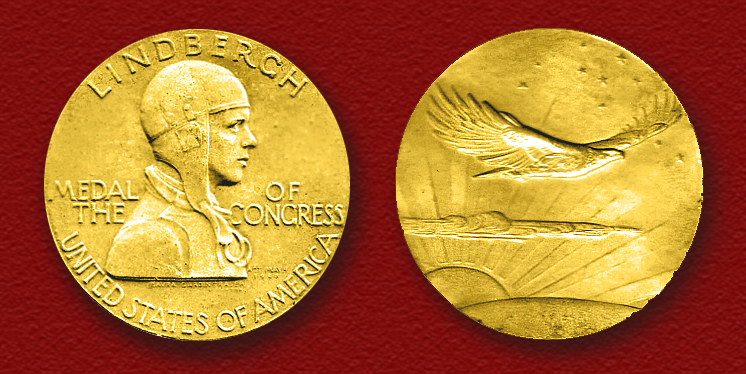
Medal awarded to Charles A. Lindbergh in 1930
Medal awarded to Charles A. Lindbergh in 1930. Image courtesy of Wikipedia.

The Congressional Gold Medal Design

A Congressional Gold Medal is designed by the United States Mint to commemorate the person and achievement for which the medal is awarded specifically. Medals are therefore different in appearance, and there is no standard design.

Congressional Gold Medals are considered non-portable, meaning that they are not meant to be worn on a uniform or other clothing but rather displayed. In rare instances, miniature versions have been made or converted for wear on clothing suspended from a ribbon.

Often, bronze versions of the medals are struck for sale by the U.S. Mint, and may be available in both larger and smaller sizes.

Find This Medal Online

Right Now on eBay 
Clicking a link to eBay may result in a referral commission being paid if a purchase is made.
Loading...

The Dewey Medal

The Dewey Medal is a military decoration of the United States Navy established by the United States Congress during the Spanish–American War.

The Dewey Medal is a military decoration of the United States Navy established by the United States Congress on June 3, 1898 to recognize the leadership of Admiral of the Navy George Dewey and the Sailors and Marines under his command during the Spanish–American War, as well as United States Marine Corps who participated in the Battle of Manila Bay.

To be awarded the Dewey Medal, a service member must have served on one of the following naval vessels on May 1, 1898: USS Baltimore, USS Boston, USS Concord, USRC McCulloch, USS Olympia,USS Petrel and USS Raleigh.

The Dewey Medal was a one-time only decoration and there were no devices or campaign stars authorized to the medal. It was recognized as being given for active military duty; but because it recognized a single battle in a single campaign, the Dewey Medal was actually a commemorative medal.

The Dewey Medal Design

The medal consists of a circular medallion, struck by Tiffany & Co, upon which rests an image of Admiral George Dewey (out of modesty, the man himself wore it with the medal’s reverse which depicted a sailor sitting on a gun displayed).

The Dewey medal was designed by celebrated artist Daniel Chester French, the same artist who sculpted the statue of a seated Lincoln in Washington’s Lincoln Memorial.

The obverse depicts a bust of Commodore George Dewey. On the reverse is included the name of the vessel on which the recipient served. The name of the recipient is engraved on the medal’s lower rim.

The medal is suspended from a blue and yellow ribbon.

The Sampson Medal

The Sampson Medal is a commemorative medal of the United States Navy for operations in the waters of the West Indies and Cuba.

The Sampson Medal is a commemorative medal of the United States Navy authorized by an Act of Congress in 1901 for service in the Spanish–American War to those personnel who served on ships in the fleet of Rear Admiral William T. Sampson during combat operations in the waters of the West Indies and Cuba.

The resolution authorized the Secretary of the Navy to have produced bronze medals to commemorate naval engagements in the West Indies and on the shores of Cuba during the Spanish–American War.

The Sampson Medal was also known as the Medal Commemorating Naval Engagements in the West Indies or West Indies Naval Campaign Medal.

The Sampson Medal Design

The Sampson medal was designed by Charles E. Barber (obvser) and George T. Morgan (reverse).

The obverse depicts a bust of Admiral Sampson. The reverse shows a Navy officer, Sailor, and Marine standing upon a block identifying the action for which the medal was awarded.

Suspending the ribbon of the medal is a brooch pin with the name of the recipient’s ship. The recipient’s name is engraved on the lower rim of the medal.

47 engagements or skirmishes campaign clasps or engagement bars were authorized for wear on the ribbon, showing the battles and the ship name which had participated.