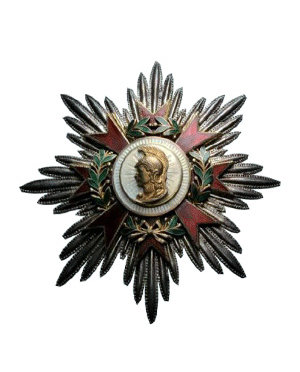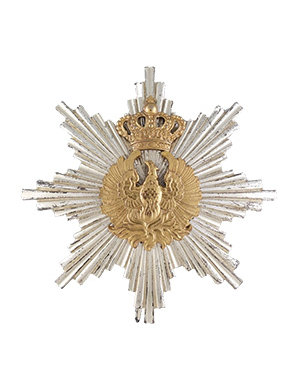
The Order of the Phoenix

  • Time Period: Pre-WW1
  • Year of Institution: 13 May 1926
  • Country: Greece

The Order of the Phoenix (or Τάγμα του Φοίνικος) is an order of Greece established on May 13, 1926, by the republican government of the Second Hellenic Republic to replace the defunct Royal Order of George I.

The honor is bestowed by the Greek government to Greek citizens who have excelled in the arts and literature, science, public administration, shipping, commerce, and industry. It is also awarded to foreigners who have helped raise Greece’s international prestige.

The order was retained after the restoration of the monarchy in 1935 and continues to be awarded by the current Third Republic.

The Order has five classes:

  • GRE Order of the Phoenix - Grand Cross BAR.png Grand Cross (‘Μεγαλόσταυρος’) – wears the badge of the Order on a sash on the right shoulder, and the star of the Order on the left chest;
  • GRE Order of the Phoenix - Grand Commander BAR.png Grand Commander (‘Ανώτερος Ταξιάρχης’) – wears the badge of the Order on a necklet, and the star of the Order on the left chest;
  • GRE Order of the Phoenix - Commander BAR.png Commander (‘Ταξιάρχης’) – wears the badge of the Order on a necklet;
  • GRE Order of the Phoenix - Gold Cross BAR.png Officer or Gold Cross (‘Χρυσούς Σταυρός’) – wears the badge on a ribbon on the left chest;
  • GRE Order of the Phoenix - Silver Cross BAR.png Member or Silver Cross (‘Αργυρούς Σταυρός’) – wears the badge on a ribbon on the left chest.

The Order of the Phoenix Design

The badge of the Order is a white-enameled cross, in silver for the Silver Cross class, in gold for the higher classes, with the Phoenix (symbolizing the rebirth of the Hellenic nation) at the center. A five-pointed star is at the upper arm of the cross.

The first version of the Order (1926–1935) featured the letters “E-T-T-A” in Byzantine uncial on each arm of the cross, the initials of the motto Εκ της τέφρας μου αναγεννώμαι (“From my ashes I am reborn”). During the Monarchy (1935–1974) the letters were removed and the badge was topped by a crown, while the badge’s reverse side featured the monogram of the reigning monarch. The current version (since 1975) omits the crown, while the reverse features the Greek National Emblem with the words ΕΛΛΗΝΙΚΗ ΔΗΜΟΚΡΑΤΙΑ (“Hellenic Republic”).

The star of the Order is a silver eight-pointed star with straight rays, with the phoenix at the centre; during the Monarchy it was topped by a crown. The ribbon of the Order is orange with black edges. Crossed swords on the insignia indicate that the award was given in the military division of the Order.

The Distinguished Flying Cross (United States)

The Distinguished Flying Cross is an American military decoration for operations by heroism or extraordinary achievement.

The Distinguished Flying Cross is an American military decoration awarded to any officer or enlisted member of the United States Armed Forces who distinguishes himself in support of operations by “heroism or extraordinary achievement while participating in an aerial flight, subsequent to November 11, 1918.”

The first award of the Distinguished Flying Cross was made by President Calvin Coolidge on May 2, 1927, to ten aviators of the U.S. Army Air Corps 🔗 who had participated in the Army Pan American Flight which took place from December 21, 1926, to May 2, 1927. Two of the airmen died in a mid-air collision trying to land at Buenos Aires on February 26, 1927, and received their awards posthumously.
Charles Lindbergh 🔗 received the first presentation of the actual medal about a month later from Coolidge during the Washington, D.C. homecoming reception on June 11, 1927, from his trans-Atlantic flight.

The medal had hurriedly been struck and readied just for that occasion. The first Distinguished Flying Cross to be awarded to a Naval aviator was received by Commander Richard E. Byrd 🔗, USN for his trans-Atlantic flight from June 29 to July 1, 1927, from New York City to the coast of France. Byrd and his pilot Machinist Floyd Bennett 🔗 had already received the Medal of Honor for their historic flight to the North Pole on May 9, 1926.

During World War II, the medal’s award criteria varied widely depending on the theater of operations, aerial combat, and the missions accomplished. In the Pacific, commissioned officers were often awarded the DFC, while enlisted men were given the Air Medal. In Europe, some crews received it for performances throughout a tour of duty, and different criteria were used elsewhere.

The Distinguished Flying Cross in World War II

During World War II, the Distinguished Flying Cross (DFC) was awarded to numerous individuals for their exceptional actions and achievements in aerial combat and aviation operations. Here are a few examples of people who received the DFC for their actions during this time:

  • Lieutenant Colonel Jimmy Doolittle 🔗: Jimmy Doolittle, an American aviator and Air Force general, was awarded the Distinguished Flying Cross for leading the famous Doolittle Raid in April 1942. This daring mission involved the first U.S. air raid on the Japanese mainland, boosting American morale after the devastating attack on Pearl Harbor.

  • Lieutenant Richard I. Bong 🔗: Richard I. Bong, a U.S. Army Air Forces pilot, was awarded the DFC multiple times during World War II. Bong became one of the most successful American fighter aces, achieving 40 confirmed aerial victories. His exceptional skills and bravery earned him the distinction of being the highest-scoring American ace of the war.

  • Lieutenant Colonel John C. Meyer 🔗: John C. Meyer, a fighter pilot in the U.S. Army Air Forces, earned the DFC for his courageous actions during the air campaign in Europe. He was recognized for his exceptional leadership and flying skills, notably during the Battle of the Bulge, where he achieved aerial victories against German aircraft.

  • Lieutenant Colonel Robert M. Hanson 🔗: Robert M. Hanson, a Marine Corps aviator, was awarded the Distinguished Flying Cross for his extraordinary actions as a dive-bomber pilot in the Pacific Theater. He demonstrated exceptional accuracy and bravery in attacking enemy targets, notably during the Battle of Guadalcanal.

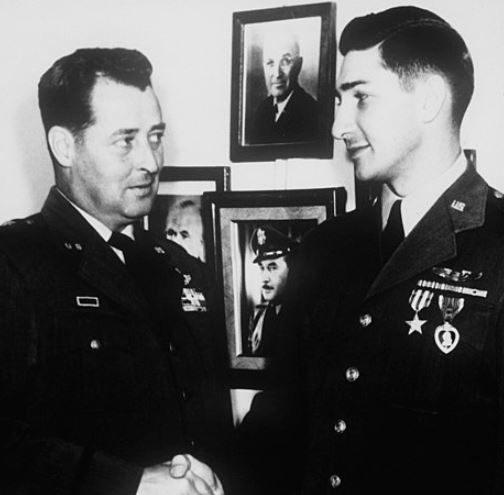
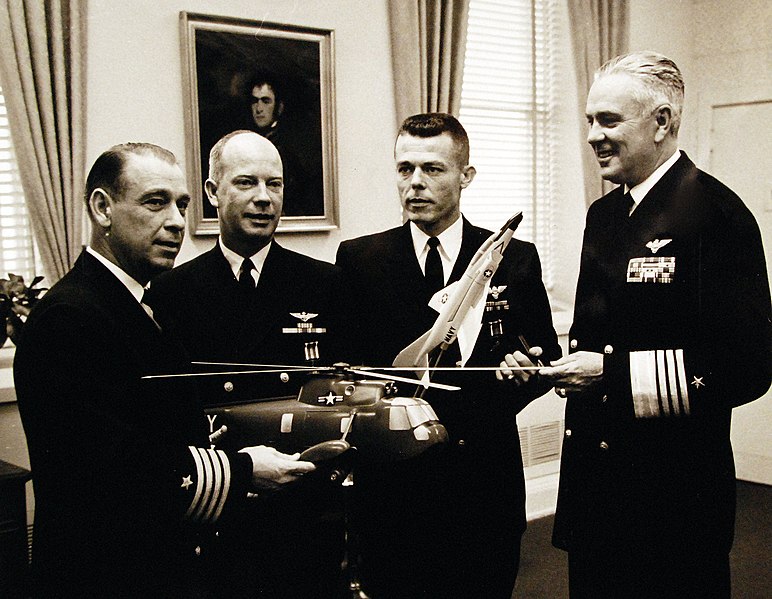
Three Naval Aviators were presented Distinguished Flying Crosses by Chief of Naval Operations Admiral George W. Anderson, USN, (right), in Pentagon ceremonies.
Three Naval Aviators were presented Distinguished Flying Crosses by Chief of Naval Operations Admiral George W. Anderson, USN, (right), in Pentagon ceremonies. Image courtesy of Wikipedia.

The Distinguished Flying Cross Design

The Distinguished Flying Cross is a bronze cross pattee designed by Elizabeth Will and Arthur E. DuBois.

On the obverse is superimposed a four-bladed propeller, 1 11/16 inches in width. Five rays extend from the reentrant angles, forming a one-inch square. The reverse is blank; it is suitable for engraving the recipient’s name and rank. The cross is suspended from a rectangular bar.

The suspension and service ribbon of the medal is 1 3/8 inches wide and consists of the following stripes: 3/32 inch Ultramarine Blue 67118; 9/64 inch White 67101; 11/32 inch Ultramarine Blue 67118; 3/64 inch White 67101; center stripe 3/32 inch Old Glory Red 67156; 3/64 inch White 67101; 11/32 inch Ultramarine Blue 67118; 9/64 inch White 67101; 3/32 inch Ultramarine Blue 67118.

Additional awards of the Distinguished Flying Cross are shown with bronze or silver Oak Leaf Clusters for the Army and Air Force, and gold and silver ​516 Inch Stars for the Navy, Marine Corps, and Coast Guard. The Air Force, Navy, and Marine Corps may authorize the “V” device for wear on the DFC to denote valor in combat; Navy and Marine Corps, Combat “V”.

Fin da Distinguished Flying Cross Design

Right Now on eBay 
Clicking a link to eBay may result in a referral commission being paid if a purchase is made.
Loading...

The Purple Heart

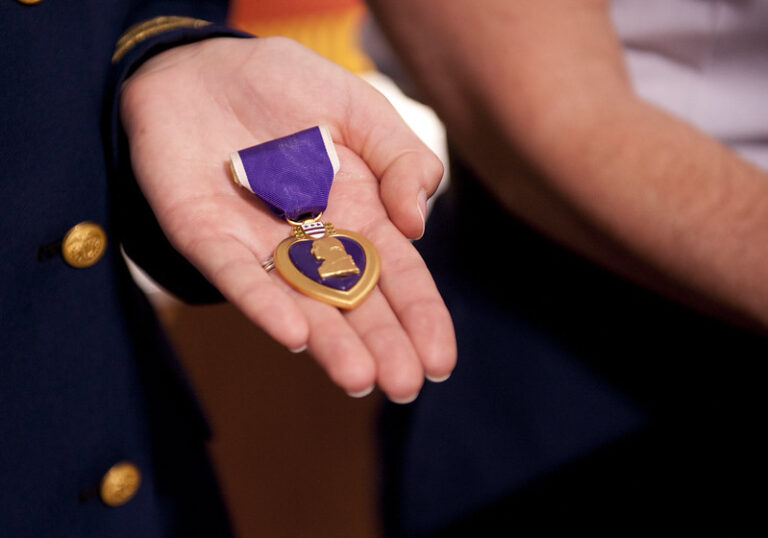
The Purple Heart is a military decoration from the United States awarded to those wounded or killed while serving with the U.S. military.

The Purple Heart is a military decoration from the United States awarded in the name of the president to those wounded or killed while serving, on or after April 5, 1917, with the U.S. military. 

The Purple Heart is the oldest military award still given to U.S. military members. The Purple Heart differs from most other decorations in that an individual is not “recommended” for the decoration; rather he or she is entitled to it upon meeting specific criteria.

Criteria: [For] “Being wounded or killed in any action against an enemy of the United States or as a result of an act of any such enemy or opposing armed forces”

The Establishment of the Purple Heart (1782)

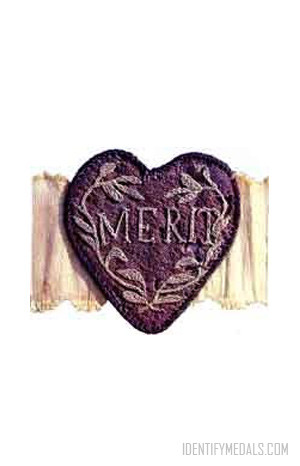
The original Purple Heart was established by George Washington on August 7, 1782. The (then called) Badge of Military Merit was only awarded to three Revolutionary War soldiers by Gen. George Washington himself. From then on, as its legend grew, so did its appearance. 

On October 10, 1927, Army Chief of Staff General Charles Pelot Summerall directed that a draft bill be sent to Congress “to revive the Badge of Military Merit“. A number of private interests sought to have the medal re-instituted in the Army and on January 7, 1931, Summerall’s successor, General Douglas MacArthur, confidentially reopened work on a new design, involving the Washington Commission of Fine Arts.

The Purple Heart Revived (1932)

By Executive Order of the President of the United States, the Purple Heart was revived on the 200th Anniversary of George Washington’s birth, out of respect to his memory and military achievements, by War Department General Order No. 3, dated February 22, 1932. The first Purple Heart was awarded to MacArthur. During the early period of American involvement in World War II (December 7, 1941 – September 22, 1943), the Purple Heart was awarded both for wounds received in action against the enemy and for meritorious performance of duty. 

After the award was re-authorized in 1932 some U.S. Army wounded from conflicts prior to the first World War applied for, and were awarded, the Purple Heart: “…veterans of the Civil War and Indian Wars, as well as the Spanish–American War, China Relief Expedition (Boxer Rebellion), and Philippine Insurrection” also were awarded the Purple Heart.

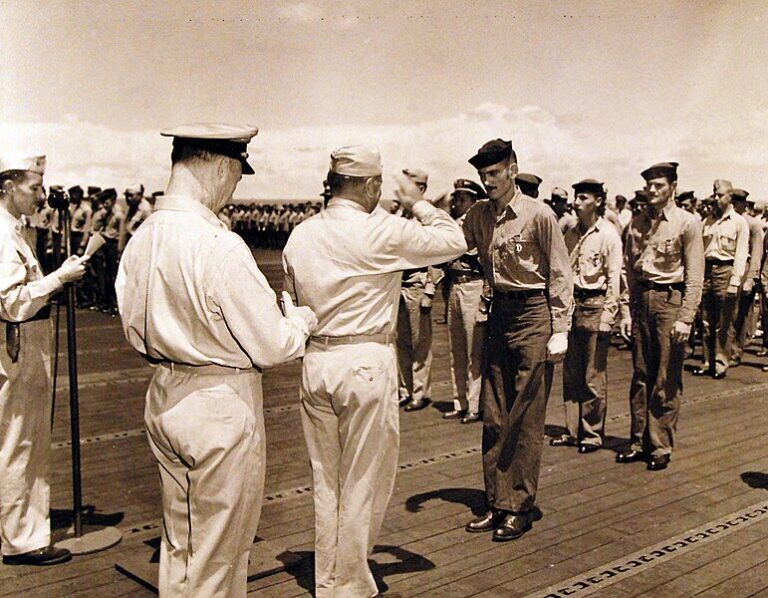
Rear Admiral Ralph Davidson presenting the Purple Heart to personnel onboard a carrier in July 7, 1944. Image courtesy of the National Archives.

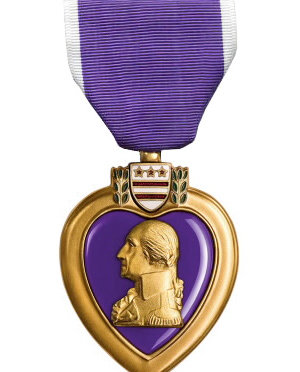
The Purple Heart Medal Design

Elizabeth Will, an Army heraldic specialist in the Office of the Quartermaster General, was named to redesign the newly revived medal, which became known as the Purple Heart. Using general specifications provided to her, Will created the design sketch for the present medal of the Purple Heart. The new design, which exhibits a bust and profile of George Washington, was issued on the bicentennial of Washington’s birth. Will’s obituary, in the edition of February 8, 1975 of The Washington Post newspaper, reflects her many contributions to military heraldry. The Commission of Fine Arts solicited plaster models from three leading sculptors for the medal, selecting that of John R. Sinnock of the Philadelphia Mint in May 1931.

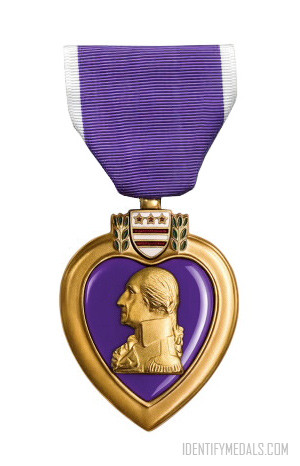
The Purple Heart award is a heart-shaped medal within a gold border, 1 38 inches (35 mm) wide, containing a profile of General George Washington. On the obverse and above the heart appears a shield of the coat of arms of George Washington (a white shield with two red bars and three red stars in chief) between sprays of green leaves. The reverse consists of a raised bronze heart with the words FOR MILITARY MERIT below the coat of arms and leaves.

The ribbon is 1 38 inches (35 mm) wide and consists of the following stripes: 18 inch (3.2 mm) white 67101; 1 18 inches (29 mm) purple 67115; and 18 inch (3.2 mm) white 67101. Additional awards of the Purple Heart are denoted by oak leaf clusters in the Army and Air Force, and additional awards of the Purple Heart Medal are denoted by ​516 inch stars in the Navy, Marine Corps, and Coast Guard.

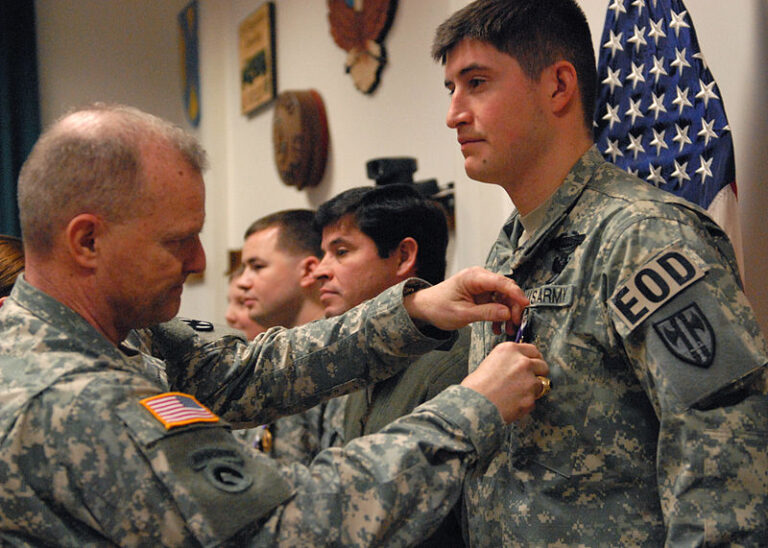
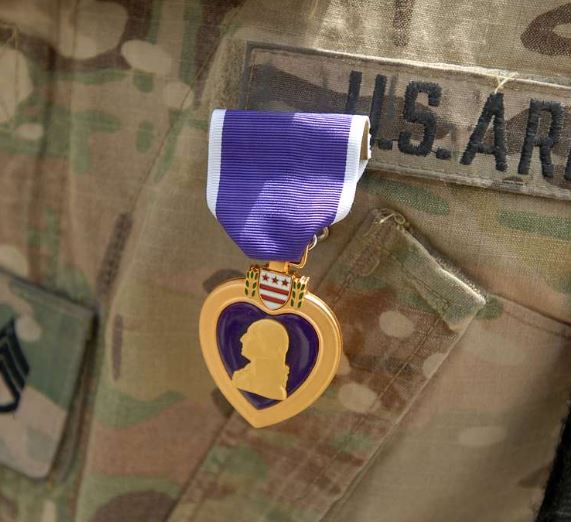
A soldier is awarded the Purple Heart during a ceremony on Coleman Barracks.
A soldier is awarded the Purple Heart during a ceremony on Coleman Barracks. Image courtesy of Wikipedia.

More About the Purple Heart

Do you want to learn more about this prestiguous American award? Here are some details that explore the history of the medal, its design,a nd symbolism:

Related Medals and Awards

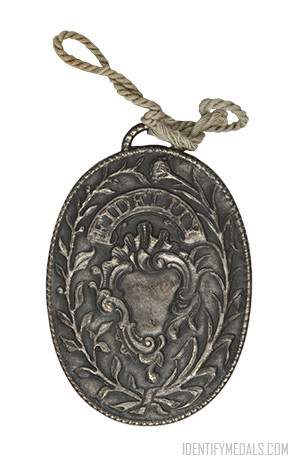
The Purple Heart has a long history. So, it’s no surprise there were previous versions or medals that served as inspiration to establishing the 1932 version. These include:

Find This Medal

Right Now on eBay 
Clicking a link to eBay may result in a referral commission being paid if a purchase is made.
Loading...

The George Cross (Great Britain)

The George Cross is the second highest award of the UK honors system and it’s awarded for acts of the greatest heroism or courage.

The George Cross (also known as GC) is the second highest award of the United Kingdom honors system and it’s awarded “for acts of the greatest heroism or for most conspicuous courage in circumstance of extreme danger“, not in the presence of the enemy, to members of the British armed forces and to British civilians.

The medal may be awarded to a person of any military rank in any service and to civilians including police, emergency services and merchant seamen. Many of the awards have been personally presented by the British monarch to both recipients and in the case of posthumous awards to next of kin. These investitures are usually held at Buckingham Palace.

The George Cross was instituted on 24 September 1940 by King George VI. At this time, during the height of the Blitz, there was a strong desire to reward the many acts of civilian courage. The existing awards open to civilians were not judged suitable to meet the new situation, therefore it was decided that the George Cross and the George Medal would be instituted to recognize both civilian gallantry in the face of enemy action and brave deeds more generally.

Posthumous awards have been allowed since it was instituted.

The George Cross Criteria

The George Cross is awarded for acts of the greatest heroism or the most conspicuous courage in circumstances of extreme danger. It is intended to recognize acts that exemplify selfless bravery

It can be awarded to both military personnel and civilians and is the highest gallantry award for civilians, as well as for military personnel in situations where military honors would not typically be granted. The GC may also be awarded posthumously.

The cross has been awarded to several foreigners for their acts of exceptional bravery. Examples include:

  1. Malta: Awarded to the entire island of Malta in 1942 for the collective bravery of its citizens during sustained aerial bombardment in World War II.
  2. Rustum Sohrabji Ghandhi: An Indian naval officer awarded in 1952 for his gallantry during a rescue operation.
  3. Michael Pratt: An Australian police officer awarded in 1978 for his actions during a bank robbery.

The George Cross Design

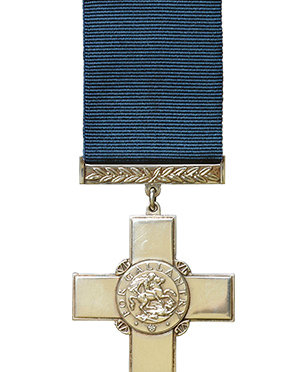
The medal was designed by Percy Metcalfe. The Warrant for the GC (along with that of the George Medal), dated 24 September 1940, was published in The London Gazette on 31 January 1941.

It measures 48 mm in height, with a maximum width of 45 mm. The obverse is a plain silver cross with circular medallion in the center depicting the effigy of St. George and the Dragon, surrounded by the words “FOR GALLANTRY“. In the angle of each limb is the Royal Cypher GVI.

The reverse is plain, with a center engraved with the name of recipient and date of award. The cross is attached by ring to bar ornamented with laurel leaves, through which the ribbon passes.

Find a George Cross

Right Now on eBay 
Clicking a link to eBay may result in a referral commission being paid if a purchase is made.
Loading...

The Decoration for Heroic Valor

The Decoration of Heroic Valor (or Condecoración al Valor Heroico in Spanish) is a Mexican award given to military personnel for exceptional acts of heroism at risk of their own life. The medal may be awarded in both war and peace.

There are three classes:

  • 1st class – solid red ribbon
  • 2nd class – five equal stripes, three red and two white
  • 3rd class – white ribbon with medium width red edges

The Decoration for Heroic Valor Design

The medal is a gilt-edged red-enameled “Lancer Cross” (equilateral cross whose arms resemble lance heads) resting on a gilt “star” of multiple rays that resembles a square with points at the cardinal points.

The oval red central medallion has the number 12, or 3 according to class, surrounded by a white band inscribed Valor Heroico in gold, wit the word Valor in the upper part and Heroico on the bottom, separated by a dash. Between the cross’ arms, and covering the space between them, are four aces that coincide with the square where the inscription is written. The remaining aces augment in longitude towards the center.

The plaque is slightly convex in the exterior part. It has a ring for hanging it and a sixteen-side star in the reverse with the legend Creada en 1926 (Created in 1926) en highlighted uppercase letters.

The medal is suspended from a red and white ribbon (three vertical bands o 10 millimeters each) according to class, with a gilt bar at top inscribed Mexico.

The Order of the Aztec Eagle

The Order of the Aztec Eagle is the highest Mexican order awarded to foreigners in the country and forms part of the Mexican Honours System.

The Order of the Aztec Eagle (or Orden Mexicana del Águila Azteca in Spanish) is the highest Mexican order awarded to foreigners in the country and forms part of the Mexican Honours System. It’s awarded for services to the Mexican nation or to humanity, and it’s reciprocally given to Mexican public service providers living abroad.

The order was created by decree on December 29, 1933 by President Abelardo L. Rodríguez although it is based on the temporal Aztec Eagle decoration, which was created on September 30, 1932. This award had a light blue ribbon and was given as a thank you to foreigners, in particular to ministers from the Chilean Foreign Issues Office.

It corresponds to similar distinctions given to Mexican citizens such as the Miguel Hidalgo Order or the Belisario Domínguez Medal of Honor. It is given by the office of the foreign minister on the instructions of a Council established for this purpose headed by the President.

The Order of the Aztec Eagle Design

There is some design similarity of the order with the coat of arms of Mexico, particularly the golden eagle holding a rattlesnake, which is associated with the Aztec civilization.

Prior to the 2011 reform, the classes were, in descending order:

  1. MEX Order of the Aztec Eagle 1Class BAR.png Collar (“Collar”), awarded to heads of state;
  2. MEX Order of the Aztec Eagle 2Class BAR.png Grand Cross (“Cruz”), awarded to prime ministers and heads of government
  3. MEX Order of the Aztec Eagle 3Class BAR.png Sash (“Banda”), awarded to government ministers, secretaries and ambassadors
  4. MEX Order of the Aztec Eagle 4Class BAR.png Medal (“Medalla”), awarded to government undersecretaries, plenipotentiary ministers, as well to those whose category is tantamount to the previous;
  5. MEX Order of the Aztec Eagle 5Class BAR.png Placard (“Placa”), awarded to ad hoc business representatives, colonels and lieutenant colonels, captains of a ship, equivalent servants of embassies in Mexico), as well to those whose category is tantamount to the previous;
  6. MEX Order of the Aztec Eagle 5Class BAR.png Venera (a type of insignia), awarded to ad interim business representatives and other members of diplomatic missions;
  7. MEX Order of the Aztec Eagle 5Class BAR.png Insignia proper, awarded under the Council’s discretion; and
  8. MEX Order of the Aztec Eagle 5Class BAR.png Honorable Mention (“Mención Honorífica”).

Since the reform of March 2011, the classes are :

  1. MEX Orden del Aguila Azteca 2011 Collar BAR.svg Collar (“Collar”), awarded to heads of state;
  2. MEX Orden del Aguila Azteca 2011 Banda Especial BAR.svg Sash of Special Category (“Banda en Categoría Especial”), awarded to prime ministers and heads of government, hereditary princes(ses), consorts of heads of state, or to people whose category is tantamount to the previous;
  3. MEX Orden del Aguila Azteca 2011 Banda BAR.svg Sash (“Banda”), awarded to government ministers, secretaries, members of royal families, ambassadors, or individuals whose category is tantamount to the previous;
  4. MEX Orden del Aguila Azteca 2011 Placa BAR.svg Plaque (“Placa”), awarded to government undersecretaries, plenipotentiary ministers, consuls general, brigadier generals, rear admirals, as well to those whose category is tantamount to the previous;
  5. MEX Orden del Aguila Azteca 2011 Venera BAR.svg Venera (a type of insignia), awarded to ad hoc business representatives, colonels and lieutenant colonels, captains of a ship, equivalent servants of embassies in Mexico, as well to those whose category is tantamount to the previous;
  6. MEX Orden del Aguila Azteca 2011 Insignia BAR.svg Insignia, awarded to ad interim business representatives and other members of diplomatic missions; captain, navy lieutenant, as well to those whose category is tantamount to the previous and to those cases the Council considers pertinent.

All grades except the collar may be awarded, under the Council’s discretion, to distinguished foreigners.

The Congressional Gold Medal

The Congressional Gold Medal is an award bestowed by the Congress and one of the three highest civilian awards in the United States. 

Institution: 1776
Country: United States
 

The Congressional Gold Medal is an award bestowed by the United States Congress and one of the three highest civilian awards in the United States. Alongside the Presidential Medal of Freedom, it’s the oldest and highest American civilian award.

The medal is awarded to persons “who have performed an achievement that has an impact on American history and culture that is likely to be recognized as a major achievement in the recipient’s field long after the achievement.”

The tradition within the U.S. Congress of awarding gold medals as a form of recognition originated during the American Revolution, initially bestowed upon military personnel. Over time, this practice expanded to include individuals from various professions and, in the late 20th century, even groups. 

At the time of writing this, there have been 184 Congressional Gold Medals awarded.

How the Congressional Gold Medal is Awarded

There are no permanent statutory provisions for the creation of Congressional Gold Medals. When one has been deemed appropriate, Congress has, by legislative action, provided for the creation of a medal on an ad hoc basis.

Since the American Revolution, Congress has commissioned gold medals as its highest expression of national appreciation for distinguished achievements and contributions. The medal was first awarded in 1776 by the Second Continental Congress to General George Washington.

Although the first recipients were military figures who participated in the American Revolution, the War of 1812 and the Mexican–American War, Congress broadened the scope of the medal to include actors, authors, entertainers, musicians, pioneers in aeronautics and space, explorers, lifesavers, notables in science and medicine, athletes, humanitarians, public servants, and foreign recipients.

The medal is normally awarded to persons, but in 1979 the American Red Cross became the first organization to be honored with a gold medal. U.S. citizenship is not a requirement.

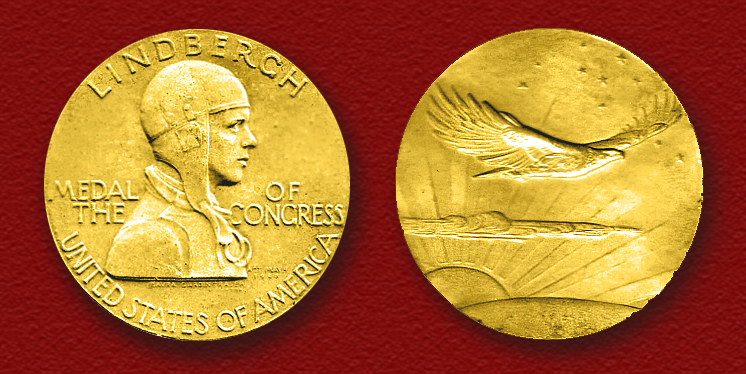
Medal awarded to Charles A. Lindbergh in 1930
Medal awarded to Charles A. Lindbergh in 1930. Image courtesy of Wikipedia.

The Congressional Gold Medal Design

A Congressional Gold Medal is designed by the United States Mint to commemorate the person and achievement for which the medal is awarded specifically. Medals are therefore different in appearance, and there is no standard design.

Congressional Gold Medals are considered non-portable, meaning that they are not meant to be worn on a uniform or other clothing but rather displayed. In rare instances, miniature versions have been made or converted for wear on clothing suspended from a ribbon.

Often, bronze versions of the medals are struck for sale by the U.S. Mint, and may be available in both larger and smaller sizes.

Find This Medal Online

Right Now on eBay 
Clicking a link to eBay may result in a referral commission being paid if a purchase is made.
Loading...

The Order of the Spanish Republic

The Order of the Spanish Republic (Orden de la República) was founded in 1932 in the Second Spanish Republic for civil and military merit.

The Order of the Spanish Republic (or Orden de la República Española) was founded in 1932 in the Second Spanish Republic for civil and military merit to the state. It replaced the orders of merit of the former Spanish Monarchy and had the mural crown instead of the royal one.

After the military defeat of the Spanish Republic, Gen. Francisco Franco abolished all Republican Orders and instituted new ones.

The Spanish Republican government in exile issued one order which was a simple medal with a ribbon in the Spanish republican colors.

The Order of the Spanish Republic Design

The order had the usual five degrees. There was a special collar for heads of state and two medals were attached to this order of merit.

The ribbon was red with a white border.

The Order of Civil Merit

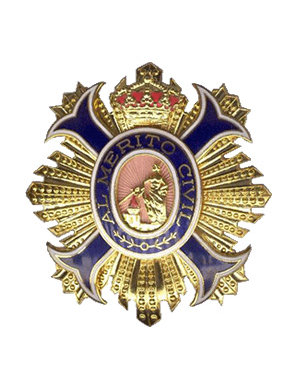
The Order of Civil Merit (or Orden del Mérito Civil) was established by King Alfonso XIII of Spain in 1926 to recognize “the civic virtue of officers in the service of the Nation, as well as extraordinary service by Spanish and foreign citizens for the benefit of Spain.”

At the origin, it consisted of four categories: Grand Cross, Commander by Number, Commander, Knight, and Silver Cross (lower rank).

The Provisional Government of the Republic, by decree of 24 July 1931, abolished this order and other orders of the State, except that of Isabel the Catholic, and wanted to replace them with the creation of the Order of the Republic. Saved this interregnum, by Decree of 7 November 1942 restores the Order of Civil Merit, with his previous features, privileges and seniority, with the following categories: Grand Cross, Cordon (designation of the Grand Cross when given to women), Commander of Number, Commander, Officer, Knight, Knot (name of degree Knight when given to women) and Silver Cross, approving its rules by decree of 3 February 1945.

By Royal Decree 2396/1998 of 6 November 1998, published in the Boletín Oficial del Estado 279 of 21 November 1998 (and subsequent correction published in the BOE 40 of 16 February 1999), the approval of the new regulations proceeded, bringing together in one legal text all regulations which were scattered. The current regulation makes a detailed discussion of the merits to be considered for grant, of formal requirements to be met by proposals for entry and promotion within the Order, stating the legitimate authorities to do them, and reporting procedures that can be instructed in order to determine the suitability of granting.

The Order of Civil Merit Design

The Order of Civil Merit comes in seven classes as follows:

  • Collar (Collar) – Order’s Collar.
  • Grand Cross (Gran Cruz) – Sash and Plaque (Golden Order’s Star).
  • Commander by Number (Encomienda de Número) – Plaque (Silver Order’s Star).
  • Commander (Encomienda) – Golden order’s star on a necklet.
  • Officer’s Cross (Cruz de Oficial) – Golden order’s cross hanging from a ribbon.
  • Knight’s Cross (Cruz) – Silver order’s cross hanging from a ribbon.
  • Silver Cross (Cruz de Plata) – Simpler silver cross hanging from a ribbon.

The War Cross (Spain)

The War Cross (or Cruz de Guerra) is a high military award of Spain to recognise battlefield bravery.

The decoration aims to prize those who have realized actions or facts of great efficiency, or they have given excellent services, both with valor during a continued period, inside one armed conflicts or of military operations involving or could involve resort to force, and carrying military abilities or remarkable command skills.

The medal was established in 1938 (BOE. Núm. 526) and has four different types:

  • Gran Cruz
  • Cruz de Guerra para Jefes
  • Cruz de Guerra para oficiales y suboficiales
  • Cruz de Guerra para Cabos y Soldados

The Spanish War Cross is modified by the Royal Decree 1 Royal Decree 1040/2003, 1 August (Spanish Official Gazette No. 177) that reduced the categories to one, Cruz (Cross) establishing an insignia with a new design.