The Royal Order of Cambodia

The Royal Order of Cambodia (Ordre Royal du Cambodge) was a colonial chivalric order in French Cambodia and is still in use in the present day.

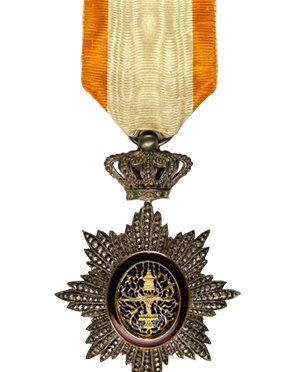
The Royal Order of Cambodia (គ្រឿងឥស្សរិយយសព្រះរាជាណាចក្រកម្ពុជា; or Ordre royal du Cambodge) was a French colonial chivalric order in French Cambodia and is still in use in present-day Cambodia.

For French appointments, the recipient had to be at least 29 years old and enter the Order first as a knight, to be promoted to a higher grade after a certain period. In 1948 France ceased granting the order. Formally it remained a French colonial policy, but it was now only granted by the King of Cambodia.

On September 1, 1950 the (colonial) French medal system was reformed. The Order of the Star of Anjouan and the Order of the Black Star were formalized as French Overseas Orders. In 1955, Cambodia became independent. The order was approved by King Norodom Sihanouk during his government and also granted during his exile in Beijing. Even after the restoration of the Khmer dynasty, it remained the highest Cambodian distinction.

The Royal Order of Cambodia Design

The medal of the order comes in many different forms, as a slightly elongated silver or gold star surmounted by a Cambodian crown and with an image of the king’s crown and coat of arms in gold on a violet-blue background and surrounded by a red circle. The reverse of the medal is left rough. To promote the order if it was awarded by the French, the Cambodian crown was replaced with a European one surmounted by a small cross, and in the early years, the order was even awarded without any crown.

The central image on the star of the order is the same as the medal, though the crown is missing and the rays are usually smooth. The star is elongated, with the vertical rays longer than the horizontal rays. The regalia of Knights is in silver, whilst those of the higher grades are gold. The medal and star are equally for civilians and soldiers. The ribbon of the order was originally green with a red border, changing in 1899 to white with an orange border (in the same year the French government changed the colours of the ribbons of all five colonial orders), before reverting to the original black ribbon when it became a purely Cambodian order again.
The Order of Public Health

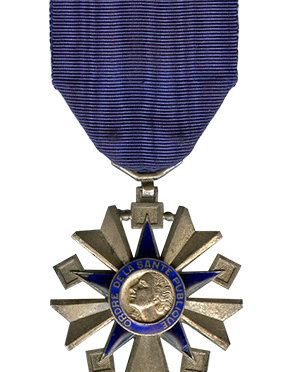
The Order of Public Health (or Ordre de la Santé publique) was a French order of merit, created by presidential decree of President Albert Lebrun on 18 February 1938 and amended on 22 May 1954, and awarded for services to the public health and protection of children.

The Order had three classes, and was only awarded to people who was minimum 30 years old.

  • Commander (40 awards)
  • Officer (170 awards)
  • Knight (806 awards)

The Medal of the French Family

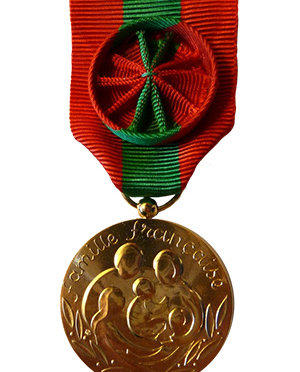
The Medal of the French Family (or Médaille de la Famille française) is a decoration awarded by the government of France to honor those who have successfully raised several children with dignity.

The decoration was created by a decree of May 26, 1920, under the name Médaille d’honneur de la famille française (Medal of Honour of the French Family) with the aim of honoring mothers of large families.

The text of the decree underwent several changes before being completely reformed by a decree of October 28, 1982, which renamed the decoration Médaille de la Famille française (Medal of the French Family). The reform opened the award of the decoration to fathers or anyone else who had raised several children in an appropriate way: for example, the Catholic priest Père Mayotte was granted the award in recognition of his raising the six children of his housekeeper, a widow who died suddenly.

Recommendations or applications for the award must be deposited at the local town hall. An inquiry into the family is then conducted. If the inquiry reports positively, the final decision on whether to grant the award belongs to the prefect of the department.

The Medal of the French Family Design

Three classes of this medal exist: bronze for those raising four or five children, silver for parents of six or seven children, and gold for those with eight or more children.

A bronze medal is also granted to widowed mothers of three children whose husbands have been killed in action. The recipient’s eldest child must be at least sixteen years old. The medal is decorated with the words “Famille Française” (“French Family”) and a modernistic image of a couple and their children. The words “République Française” (“French Republic”) are inscribed on the reverse side.

The ribbon is divided vertically into three equal parts, the outer two being red and the inner green. Recipients of silver and gold medals are also granted a rosette in the same colours.

The War Cross for Foreign Operational Theaters

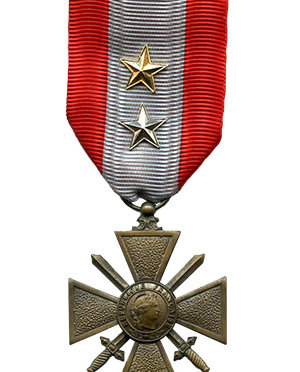
The War Cross for Foreign Operational Theaters or TOE is a French military award denoting citations earned in combat in foreign countries.

The War Cross for Foreign Operational Theaters (or Croix de guerre des théâtres d’opérations extérieurs), also called the Croix de Guerre TOE for short, is a French military award denoting citations earned in combat in foreign countries.

The Armistice of November 11, 1918 ended the war between France and Germany, but French soldiers continued fighting in theaters outside metropolitan France. Combat operations continued in Syria, Palestine, Constantinople, Morocco, French West Africa and French Equatorial Africa.

A law was passed on April 30, 1921 establishing the new Croix de guerre for “Théâtres d’opérations extérieurs” (TOE). It was intended to commemorate the individual citations awarded during operations carried out since November 11, 1918 or that would occur in the future, for war service directly related to an expeditionary force used outside of the borders of France.

The War Cross for Foreign Operational Theaters Design

The Croix de guerre des théâtres d’opérations extérieures is a bronze 37 mm wide cross pattée, between the arms, two crossed swords pointing upward.

It was designed by the sculptor Albert Bartholome. On the obverse in a circular medallion, the effigy of the Republic wearing a cap decorated with a laurel wreath, surrounded by a ring bearing the legend: “RÉPUBLIQUE FRANÇAISE”. On the reverse, in the circular medallion the inscription: “THÉÂTRES D’OPÉRATIONS EXTÉRIEURS”.

The cross is suspended by a ring through the suspension loop to a 38 mm wide grey silk moiré ribbon with 10 mm wide red edge stripes. The Croix de guerre TOE is worn on the left side of the chest and when in the presence of other medals of France, is located immediately after the Croix de guerre 1939 – 1945.

The Order of Maritime Merit

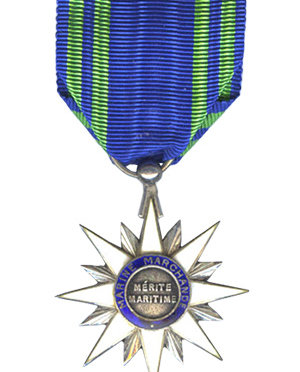
The Ordre du Mérite Maritime (or Order of Maritime Merit in French) is a French order established on 9 February 1930 for services rendered by the seafarers to distinguish the risks involved and the services rendered by seamen.

Stressed over the importance of the economic role of the Merchant Navy to the country. The order was reorganized in 1948, and again by decree on 17 January 2002.

The order can be awarded to merchant marine crew, civilian administrators, and the crews of lifeboats and rescues, naval military personnel and individuals who have distinguished themselves in maritime field.

The Order of Merit has 3 degrees:

  • Commandeur (commander)
  • Officier (officer)
  • Chevalier (knight)

The Order of Arts and Letters

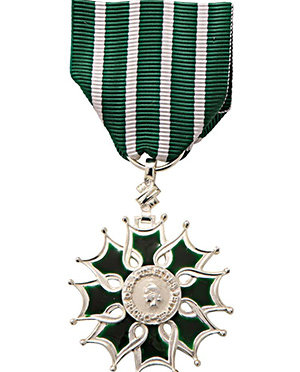
The Order of Arts and Letters (or Ordre des Arts et des Lettres in French) is an Order of France, established on 2 May 1957 by the Minister of Culture. Its purpose is the recognition of significant contributions to the arts, literature, or the propagation of these fields.

French government guidelines stipulate that citizens of France must be at least thirty years old, respect French civil law, and must have, “significantly contributed to the enrichment of the French cultural inheritance” to be considered for award. Membership is not, however, limited to French nationals; recipients include numerous foreign luminaries. Foreign recipients are admitted into the Order, “without condition of age“.

The Order has three grades:

  • Commandeur (Commander) — medallion worn on necklet; up to twenty recipients a year.
  • Officier (Officer) — medallion worn on ribbon with rosette on left breast; up to sixty recipients a year.
  • Chevalier (Knight) — medallion worn on ribbon on left breast; up to 200 recipients a year.

The Order of Arts and Letters Design

The medal of the Order is an eight-point, green-enameled asterisk, in gilt for Commanders and Officers and in silver for Knights; the obverse central disc has the letters “A” and “L” on a white enameled background, surrounded by a golden ring emblazoned with the phrase “République Française“.

The reverse central disc features the head of Marianne on a golden background, surrounded by a golden ring bearing the words “Ordre des Arts et des Lettres“. The Commander’s badge is topped by a gilt twisted ring.

The ribbon of the Order is green with four white stripes.

The U-boat War Badge (Nazi Germany)

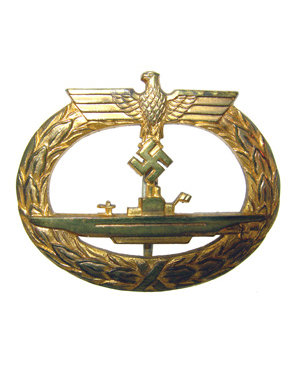
The U-boat War Badge (or U-Boot-Kriegsabzeichen) was a German war badge that was awarded to U-boat (submarine) crew members in WW2.

The U-boat War Badge (or U-Boot-Kriegsabzeichen in German) was a German war badge that was awarded to U-boat (submarine) crew members during World War I and World War II.

The original U-boat War Badge was originally instituted during WW1 on February 1, 1918, to recognize U-boat crews who had completed three war patrols. On October 13, 1939, the U-boat War Badge was reinstituted and bestowed in two classes:

  • U-Boat War Badge: For the completion of two or more war patrols. Completing two war patrols could be equally dangerous as the U-boat has to endure constant attacks by Allied aircraft and warships. The other occasion when this badge was awarded was having been wounded during a patrol or killed in action.
  • U-boat War Badge with Diamonds: It was instituted by Großadmiral Karl Dönitz after he had received from Grand Admiral Erich Raeder a special solid gold version of the U-boat War Badge in which the wreath as well as the swastika were inlaid with diamonds.

This second version of the badge was a special issue award given to U-boat commanders who had received the Knight’s Cross of the Iron Cross with Oak Leaves. Made of gold plate over silver and manufactured by Schwerin u. Sohn and Gebr. Godet & Co., it was the same as the basic pattern but with nine small diamonds inlaid in the swastika. 

This award was more of a personal award by Dönitz, and approximately 30 were awarded, including the original one to Admiral Dönitz.

The U-Boat War Badge Design

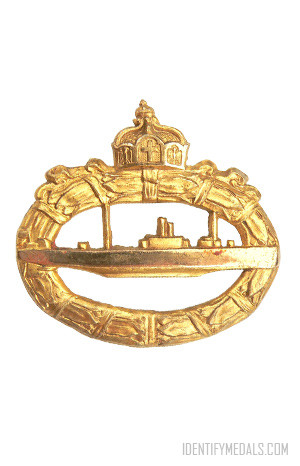
The badge was worn on the lower left side of the uniform and was oval shaped resembling a wreath of laurel leaves. A submarine lay across the center and the German State Crown was inlaid at the top center of the wreath.

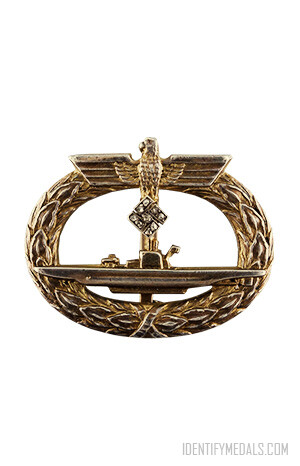
The 1939 version was very similar to the original badge with the exception of the imperial crown being replaced with a German Eagle above a swastika, and a more modernized submarine now facing towards the left was used.

The new version was first made of bronze metal, with later ones made of zinc with a “gold wash”.

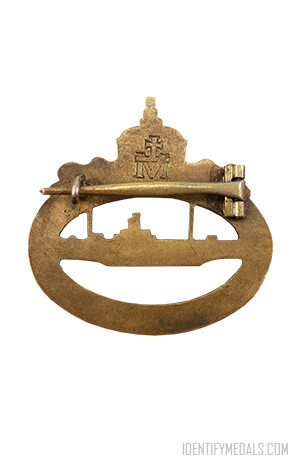
Imperial U-Boat Badge, reverse.
Imperial U-Boat Badge, reverse. The "M" is an original maker mark but the manufacturer is unknown.
The U-boat War Badge - German WW1 Medals & Badges
The WW1 U-boat War Badge - Obverse.
U-Boat Badge with diamonds, reverse.
German WW2 U-Boat Badge with diamonds. 1939 version, obverse.

Find an U-Boat War Badge

Right Now on eBay 
Clicking a link to eBay may result in a referral commission being paid if a purchase is made.
Loading...

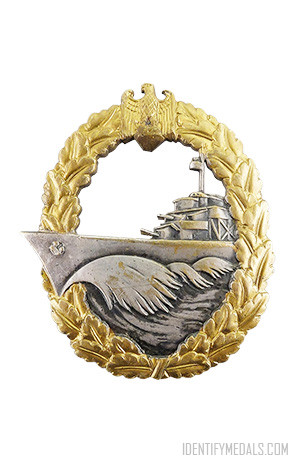
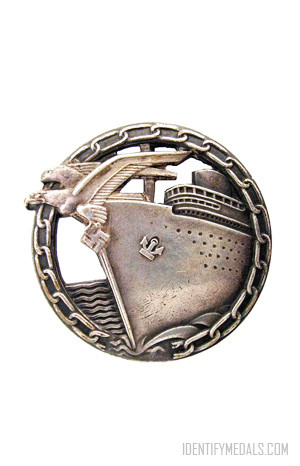
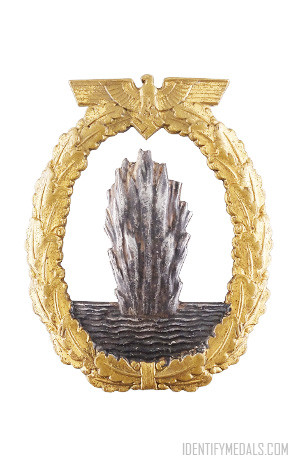
More Naval War Badges

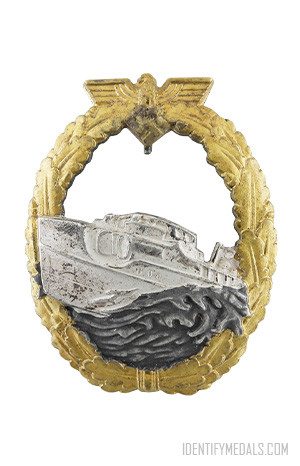
The Naval War Badges (Kriegsmarine) badges were awarded to sailors, officers, and personnel of the Kriegsmarine who demonstrated exceptional skill, bravery, and dedication in naval warfare. Explore the complete collection below:

The Eastern Front Medal Winterschlacht im Osten

The Eastern Front Medal was a World War II German military decoration awarded to those who served during the winter campaign.

The Eastern Front Medal (or Medaille „Winterschlacht im Osten 1941/42“) was a World War II German military decoration awarded to both German and Axis personnel. It was awarded to those who served on the German Eastern Front during the winter campaign period of 15 November 1941 to 15 April 1942.

The medal was instituted on 26 May 1942 and was commonly known as the Ostmedaille (East Medal) or Russian Front Medal.

The medal was wryly called the Frozen Meat Medal or the “Order of the Frozen Flesh” (or Gefrierfleischorden in German) by Heer, Luftwaffe and Waffen-SS personnel to whom it was awarded. Armed service personnel qualified for the badge after a minimum of 14 days served in active combat; 30 combat sorties for Luftwaffe members; 60 days of continuous service in a combat zone; being wounded or suffering a “frozen limb”, severe enough to warrant the issue of a Wound Badge.

The medal could be awarded posthumously. It was officially decommissioned by Oberkommando der Wehrmacht on 4 September 1944.

The Eastern Front Medal Design

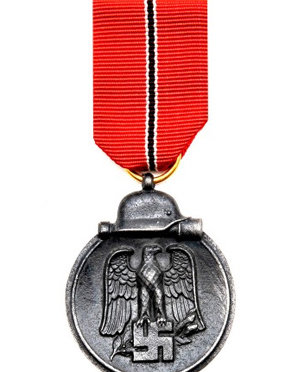
The medal measures 3.6 cm (1.4 in) in diameter, and is generally made of zinc. The medal was given a gun-metal coloured coating.

The concave obverse side features a national socialist eagle grasping a swastika with laurel behind.

The reverse features the text in capital letters: “WINTERSCHLACHT IM OSTEN 1941/42” (“Winter Battle in the East 1941/42”) featuring a crossed sword and branch below the text. A helmet and stick grenade below the medal loop as well as outer ring were finished in a polished silver effect.

The ribbon featured a central white-black-white (white for snow, black for the fallen soldiers) stripe with red (for blood) either side. The medal and ribbon were presented in a paper packet with the name of the medal on the front and the maker name on the reverse.

Buy an Eastern Front Medal

Note: As an eBay partner, I earn from qualifying purchases. This is all done automatically when you use a link and at no extra cost to you.

Right Now on eBay 
Clicking a link to eBay may result in a referral commission being paid if a purchase is made.
Loading...

The War Merit Cross (With Swords)

The War Merit Cross was a decoration of Nazi Germany during the Second World War awarded to military personnel and civilians.

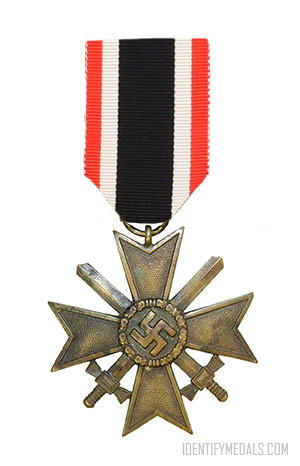
The War Merit Cross (or Kriegsverdienstkreuz in German) was a decoration of of Nazi Germany awarded to military personnel and civilians during the Second World War. It was created by Adolf Hitler in October 1939 as a successor to the non-combatant Iron Cross which was used in earlier wars.

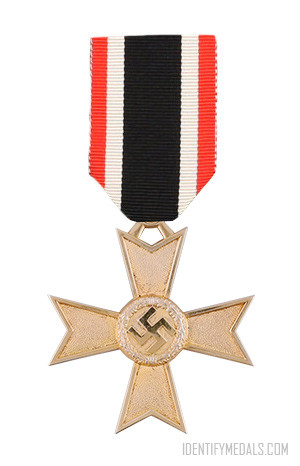
The award had four variantswith swords given to soldiers for exceptional service “not in direct connection with combat”, without swords given to civilians for meritorious service in “furtherance of the war effort”, the Knights Cross of the War Merit Cross, and the rare Knight’s Cross of the War Merit Cross in Gold

The War Merit Cross 2nd Class with Swords was presented to Military Personnel for bravery not necessarily in the face of the enemy, and in reality there was a gray area in which individuals received the medal when perhaps the non-combatant grade would have been appropriate.  A total of 6,134,950 were issued.

By the end of the war the War Merit Cross was issued in four degrees and had a related civil decoration. It was reissued in 1957 by the Bundeswehr in a de-Nazified version for veterans.

The War Merit Cross With Swords Design

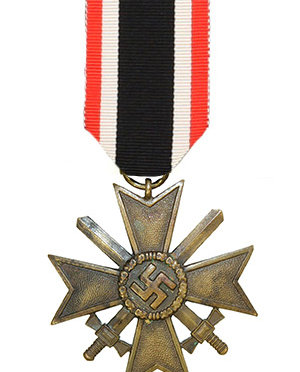
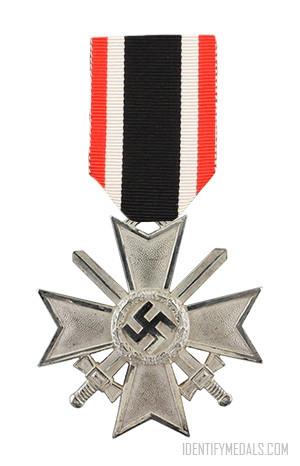
The medal consists of a bronze plated Maltese Cross. The obverse has pebbled arms, with a central wreathed mobile swastika and crossed swords piercing the centrepiece. The reverse has a block hinge and a banjo-style pinback. The War Merit Cross measures 48.51 mm (w) x 48.48 mm (h) and weighs 17.6 grams.

Materials

War Merit Cross with Swords was constructed from a wide range of materials, from zinc with a bronzed wash to a few very rare bronze pieces. As the war progressed, the quality of the materials decreased, and as a result late war crosses lose their bronze wash with the passing of time, yielding a gray appearance.

Ribbon

The ribbon of the War Merit Cross with Swords was in red-white-black-white-red (the colors being reversed from the ribbon of the World War II version of the Iron Cross). The ribbon for the War Merit Medal was similar, but with a narrow vertical red strip in the center of the black field.

Classes

The War Merit Cross without Swords 1st Class was a pin-backed medal worn on the pocket of the tunic. The ribbon of the War Merit Cross without Swords 2nd Class could be worn like the ribbon of the Iron Cross 2nd Class (through the second buttonhole). Combat soldiers tended to hold the War Merit Cross in low regard, referring to its wearers as being in ‘Iron Cross Training’.

Order of Wear

The War Merit Cross with Swords was a neck decoration and worn the same way as the Knights Cross of the Iron Cross.

Medal Variations

The War Merit Cross came in several variations, each with specific criteria and significance:

  1. War Merit Cross 2nd Class: Awarded with swords for bravery in combat or without swords for meritorious service in a non-combat role. This was worn as a ribbon on the uniform.

  2. War Merit Cross 1st Class: A higher distinction, awarded with or without swords, worn as a pin on the chest.

  3. Knights Cross of the War Merit Cross: The highest grade, also with or without swords, for exceptional service.

Find this Medal Online

Right Now on eBay 
Clicking a link to eBay may result in a referral commission being paid if a purchase is made.
Loading...

The War Merit Cross (Without Swords)

The War Merit Cross was a decoration of Nazi Germany during the Second World War awarded to military personnel and civilians.

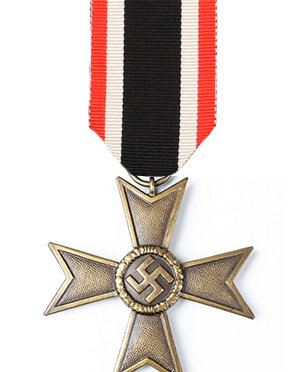
The War Merit Cross (or Kriegsverdienstkreuz in German) was a decoration of Nazi Germany awarded to military personnel and civilians during the Second World War. It was created by Adolf Hitler in October 1939 as a successor to the non-combatant Iron Cross which was used in earlier wars.

The award had four variantswith swords given to soldiers for exceptional service “not in direct connection with combat”, without swords given to civilians for meritorious service in “furtherance of the war effort”, the Knights Cross of the War Merit Cross, and the rare Knight’s Cross of the War Merit Cross in Gold

The War Merit Cross 2nd Class without swords was presented to those whose actions were deemed to be in the furtherance of the war effort but not directly involved in military operations, for example teachers, industrialists, or Military personnel on occupation duty or POW camp guards. A total of 1,591,5673 medals were issued.

By the end of the war the War Merit Cross was issued in four degrees and had a related civil decoration. It was reissued in 1957 by the Bundeswehr in a de-Nazified version for veterans.n

The War Merit Cross Without Swords Design

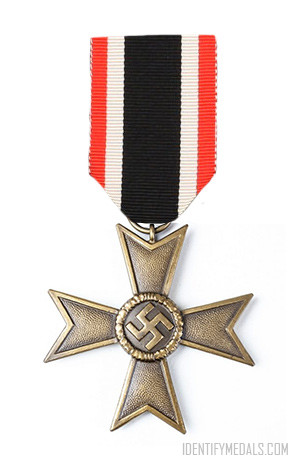
The medal consists of a bronze plated Maltese Cross. The obverse has pebbled arms, with a central wreathed mobile swastika and crossed swords piercing the centrepiece. The reverse has a block hinge and a banjo-style pinback. The War Merit Cross measures 48.51 mm (w) x 48.48 mm (h) and weighs 17.6 grams.

Materials

The War Merit Cross without Swords was constructed from a wide range of materials, from zinc with a bronzed wash to a few very rare bronze pieces. As the war progressed, the quality of the materials decreased, and as a result late war crosses lose their bronze wash with the passing of time, yielding a gray appearance.

Ribbon

The ribbon of the War Merit Cross without Swords was in red-white-black-white-red (the colors being reversed from the ribbon of the World War II version of the Iron Cross). The ribbon for the War Merit Medal was similar, but with a narrow vertical red strip in the center of the black field.

Classes

The War Merit Cross without Swords 1st Class was a pin-backed medal worn on the pocket of the tunic. The ribbon of the War Merit Cross without Swords 2nd Class could be worn like the ribbon of the Iron Cross 2nd Class (through the second buttonhole). 

Order of Wear

The War Merit Cross without Swords was a neck decoration and worn the same way as the Knights Cross of the Iron Cross.

Medal Variations

Find this Medal Online