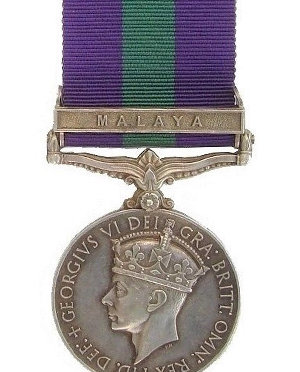
The General Service Medal (1918)

The General Service Medal recognizes service in minor Army and Royal Air Force operations for which no separate medal was possible.

The General Service Medal (also known as 1918 GSM) recognizes service in minor Army and Royal Air Force operations for which no separate medal was possible. Local forces such as police qualified for many of the clasps, as could units of the Indian Army prior to 1947.

The General Service Medal was equivalent to the 1915 Naval General Service Medal. Both these medals were replaced by the GSM in 1962.

The General Service Medal 1918 Design

The 1918 General Service Medal is a circular silver medal. The obverse bears the crowned effigy of the reigning monarch. The reverse shows a standing winged figure of Victory in a Corinthian helmet and carrying a trident, also bestowing a wreath on the emblems of the Army (the sword) and the RAF (the wings).

A bronze oak leaf emblem is worn on the ribbon of the medal to signify a mention in dispatches for a campaign for which the General Service Medal was awarded.

Eighteen clasps were approved for the 1918 General Service Medal. They consist of small metal bars into which the name of the relevant campaign or theatre of operations was molded. The clasps were: South Persia, Kurdistan, Iraq, NW Persia, Southern Desert Iraq, North Kurdistan, Palestine, S.E. Asia 1945–46, Bomb and Mine Clearance 1945–49 and 1949-56, Palestine 1945–48, Berlin Airlift, Malaya, Canal Zone, Cyprus, Near East, Arabian Peninsula and Bruinei.

The 1918 General Service Medal was never awarded without a clasp.
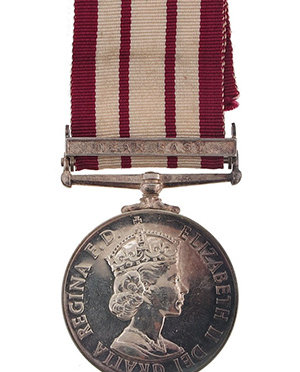
The Naval General Service Medal (1915)

The Naval General Service Medal is a British military medal instituted in 1915 to recognize service by the Royal Navy and Royal Marines.

The Naval General Service Medal (also known as 1915 NGSM) is a British military medal instituted in 1915 to recognize service by the Royal Navy and Royal Marines in minor campaigns that would not otherwise earn a specific campaign medal. The Army/Air Force equivalent was the General Service Medal (1918). Both these medals were replaced by the General Service Medal in 1962.

The Naval General Service Medal Design

The medal is made of silver and measures 36 millimeters (1.4 in) in diameter. The obverse bears the image of one of three successive Sovereigns, King George VKing George VI and Queen Elizabeth IIThe reverse shows a mounted figure of Britannia in a chariot pulled by two sea-horses, her left hand resting on a union shield.

The 32 millimeters (1.3 in) wide ribbon is crimson-colored with three white stripes. From 1920 a bronze oak leaf emblem was also worn on the ribbon of the medal to signify a mention in dispatches for a campaign for which the NGSM was awarded.

The 1915 NGSM was never awarded without a clasp. These are the seventeen clasps that were authorized: Persian Gulf 1909–1914, Iraq 1919–1920, N.W. Persia 1920, Palestine 1936–39, S.E. Asia 1945-46, Minesweeping 1945–51, Palestine 1945–48, Malaya, Yangtze 1949, Bomb and Mine Clearance 1945–46, Bomb and Mine Clearance 1945–53, B & M Clearance Mediterranean, Canal Zone, Cyprus, Near East, Arabian Peninsula and Brunei.

The Medal for the Fascist Campaign 1919-1922

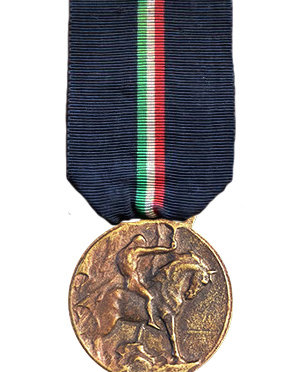
The Fascist Campaign Medal was an Italian award distributed to all who participated in the Fascist Campaign of 1919-1922.

The Fascist Campaign Medal (also Medal for the Fascist Campaign 1919-1922, or “Medaglia per le campagne fasciste 1919-1922″ in Italian) is an Italian award distributed to all who participated in the Fascist Campaign of 1919-1922.

This period marks the rise of Fascism in Italy, culminating in the March on Rome, which brought Benito Mussolini and his Fascist Party to power. The medal honors those who supported the movement during its early, tumultuous years, recognizing their contributions to the establishment of the Fascist regime. The design typically features Fascist symbols and inscriptions commemorating the campaign and its significance in Italian history.

The Fascist Campaign Medal Design

The dimensions of the Medal for the Fascist Campaign 1919-1922 are 3,5 x 14 cm. The medal shows a dramatic equestrian scene on the obverse, and joined hands and inscription “Per L’Italia, Ora e Sempre” (For Italy, Now and Always) on its reverse.

The Commemorative Medal Marcia su Roma

The Commemorative Medal Marcia su Roma was designed by sculptor Eugenio Baroni and produced by FM Lorioli & Castelli-Milano.

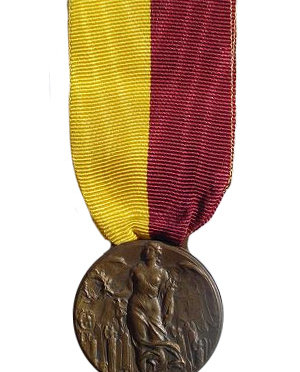
The Commemorative Medal Marcia su Roma (or Medaglia commemorativa della Marcia su Roma in Italian) was designed by sculptor Eugenio Baroni and produced by FM Lorioli & Castelli-Milano.

The medal was awarded in gold to Benito Mussolini, to the quadrumviris and to the administrative secretary of the PNF Giovanni Marinelli; in silver to the 19 commanders of the columns of the teams organized to converge on Rome; and in bronze to all members of the National Fascist Party that had participated in the march between 27 October and 1 November 1922.

Through Royal Decree No. 273 of January 31, 1926, it was also authorized for members of the Volunteer Militia for National Security. A second provision, given on 1 November 1928, granted its use to those soldiers who on 28 October 1922 did not provide effective service in the Armed Forces of the State.

The full right to use the banner of all members of the FF.AA., was granted by Royal Decree No. 1179 of July 15, 1938.

The Commemorative Medal Marcia su Roma Design

The ribbon colors of the Commemorative Medal Marcia su Roma are those of the city of Rome. It was coined made by Mussolini on the occasion of first Anniversary and distributed to all participants in this event that brought fascism to power in november 1, 1922.

The medal consists of a disk with a total diameter of 34 mm. and cambretta attachment. The obverse of the Commemorative Medal Marcia su Roma medal shows a winged victory holding a crown of oak with his right hand and holding a lictorian beam with his left hand. Behind the figure there are legionary signs, fasces and Roman daggers.

The reverse of the medal shows in the center an empty quadrangular space where the recipient could have his name engraved. At the base of the square space is the abbreviation FM Lorioli & Castelli Milano et EB Mod. Rip. Ris (incense). The square space is delimited by four lictor beams. Circularly the edge is bordered by a double circle in which the legends Marcia Su Roma are engraved on the top, and 27 October-1 November 1922 , at the bottom. Among the legends there are two small stars.

The American Defense Service Medal

The American Defense Service Medal is a United States Armed Forces military award established by President Franklin D. Roosevelt in 1941.

The American Defense Service Medal is a United States Armed Forces military award established by President Franklin D. Roosevelt on June 28, 1941 (Executive Order 8808). The medal recognizes military service members who served on active duty between the dates of September 8, 1939 and December 7, 1941. There is a similar medal, called the American Campaign Medal, that was established in 1942 for operations during World War II

Members of the United States Army and the Army Reserve and Army National Guard could receive this medal for any length of service provided that they were on orders to active duty for at least twelve months or longer and had passed their initial physical examinations. The Navy excluded reservists that had been on duty for less than ten dates.

The American Defense Service Medal Authorized Devices

There are several devices authorized for the American Defense Service Medal. These include:

  • Foreign Service Clasp: For military service (Army) outside the continental limits of the U.S., including in Alaska. It’s a bronze bar 18 inch (3.2 mm) wide and 1+12 in (38 mm) long and has the words FOREIGN SERVICE inscribed.
  • Base Clasp: For service (Navy and Marine Crops) outside the continental limits of the U.S., including Alaska or Hawaii.
  • Fleet Clasp: For service (Coast Guard) on the high seas while regularly attached to any vessels of the Atlantic, Pacific, or Asiatic fleets or of Naval Transport Service and those operating directly under the Chief of Naval Operations. It’s a bronze bar 18 inch (3.2 mm) wide and 1+12 in (38 mm) long with the inscribed words FLEET.
  • Sea Clasp: For all other vessels and aircraft (Coast Guard) not qualifying for the Fleet Clasp but that conducted patrols at sea regularly.
  • “A” Device: For members of the Navy that served duty in actual or potential belligerent contact with Axis Powers between June 22 and December 7, 1941 in the Atlantic Ocean. The device could also be worn on the medal’s uniform ribbon.
  • Service star: Worn in lieu of clasps when wearing the medal as a ribbon on a military uniform.

The American Defense Service Medal Design

The service ribbon design was approved by the Secretary of War and the Secretary of Navy on January 7, 1942. The medal was designed by Mr. Lee Lawrie, a civilian sculptor from Easton, Maryland, and the model approved by the Commission of Fine Arts on May of the same year.

A similar medal, known as the American Campaign Medal, was established in 1942, for service in the American Theater during the World War II era.

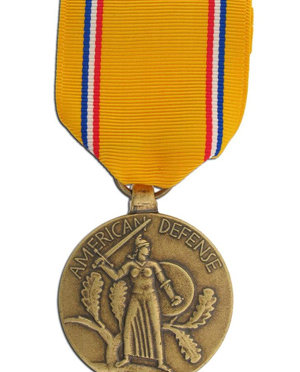
The bronze medal measures 1 1/4 inches in width. On the obverse is a female Grecian figure symbolic of defense, holding in her sinister hand an ancient war shield in reverse and her dexter hand brandishing a sword above her head, and standing upon a conventionalized oak branch with four leaves. Around the top is the lettering “AMERICAN DEFENSE”. The reverse is the wording “FOR SERVICE DURING THE LIMITED EMERGENCY PROCLAIMED BY THE PRESIDENT ON SEPTEMBER 8, 1939 OR DURING THE UNLIMITED EMERGENCY PROCLAIMED BY THE PRESIDENT ON MAY 27, 1941” above a seven-leafed spray of laurel.

Buy an American Defense Service Medal 

Note: As an eBay partner, I earn from qualifying purchases. This is all done automatically when you use a link and at no extra cost to you.

Right Now on eBay 
Clicking a link to eBay may result in a referral commission being paid if a purchase is made.
Loading...

The West Wall Medal

The West Wall Medal was a decoration of Nazi Germany given to those who designed and built the fortifications on Germany’s western borders.

The West Wall Medal (or Deutsches Schutzwall-Ehrenzeichen in German) was a political decoration of Nazi Germany instituted on 2 August 1939.

The medal was given to those who designed and built the fortifications on Germany’s western borders, known as the West Wall or, in English, the Siegfried Line. It was also goven to the troops who served there between 15 June 1938 to 31 March 1939.

A total of 622,064 medals were awarded until 31 January 1941. In 1944, the medal was again re-instituted after the allied invasion and awarded to those who took part in the fortification of the western borders. By the end of the war, it had been awarded to over 800,000 men.

The West Wall Medal Design

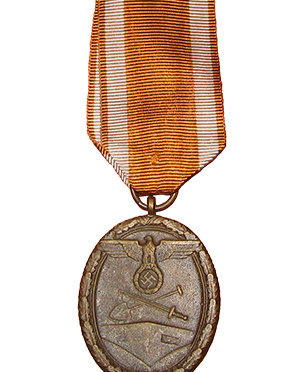
The West Wall Medal is struck in bronze and of oval shape. It features on the obverse (from bottom to top) a bunker, a crossed sword and shovel, and the German Eagle. On the reverse it bore the inscription “Für Arbeit zum Schutze Deutschlands” (For Work on the Defenses of Germany).

The medal was designed by Professor Richard Klein, of Munich. The ribbon is golden brown with a white stripe towards each edge.

The Order of the German Eagle

The Order of the German Eagle, instituted by Hitler in 1937, was predominantly given to foreign diplomats during the German Nazi regime.

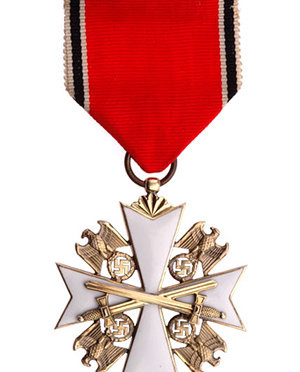
The Order of the German Eagle (or Verdienstorden vom Deutschen Adler, in German) was an award predominantly given to foreign diplomats during the German Nazi regime.

The Order was instituted on 1 May 1937 by Adolf Hitler and ceased to be awarded after the collapse of Nazi Germany at the end of World War II. This diplomatic and honorary award was given to prominent foreigners, particularly diplomats, who were considered sympathetic to Nazism.

In addition to awards to non-Germans, the Reich Foreign Minister and the Reich Protector of Bohemia and Moravia received a ‘Special Degree’ (Sonderstufe), with identical insignia to the Grand Cross of the Order.

The Order of the German Eagle Classes

From 1937 to 1943 the order was presented in six classes:

  1. Grand Cross of the Order of the German Eagle with star (Grosskreuz des Deutschen Adlerordens)
  2. Order of the German Eagle with Star (Deutscher Adlerorden mit Stern)
  3. Order of the German Eagle 1st Class (Deutscher Adlerorden, Erste Stufe)
  4. Order of the German Eagle 2nd Class (Deutscher Adlerorden, Zweite Stufe)
  5. Order of the German Eagle 3rd Class (Deutscher Adlerorden, Dritte Stufe)
  6. German Medal of Merit (Deutsche Verdienstmedaille)

A unique Grand Cross of the Order of the German Eagle in Gold with Diamonds (Grosskreuz des Deutschen Adlerordens in Gold und Brillanten) was also awarded to Benito Mussolini on 25 September 1937.

The Order of the German Eagle Design

The Cross is based on the Maltese Cross, with German Eagles at each corner carrying a swastika. The Order also featured crossed swords for military recipients.

The overall appearance and name of the Order was an imitation of the Prussian Order of the Black Eagle and Order of the Red Eagle.

The cross was suspended from a 46 mm red ribbon with black, red, and white stripes. In the first two classes, the award also came in the form of a silver or gold eight-pointed star accompanied by a white Maltese Cross and gold eagles centered.

Buy an Order of the German Eagle

Note: As an eBay partner, I earn from qualifying purchases. This is all done automatically when you use a link and at no extra cost to you.

Right Now on eBay 
Clicking a link to eBay may result in a referral commission being paid if a purchase is made.
Loading...

The German Cross (Nazi-Germany)

The German Cross (Deutsches Kreuz) was instituted by Adolf Hitler on 28 September 1941 and awarded in gold and silver.

The German Cross (or Deutsches Kreuz in German) was instituted by Adolf Hitler on 28 September 1941 and awarded in gold and silver.

The German Cross in Gold (ranked higher than the Iron Cross First Class but below the Knight’s Cross of the Iron Cross), was awarded for repeated acts of bravery or achievement in combat. The German Cross in Silver (ranked higher than the War Merit Cross First Class with Swords but below the Knight’s Cross of the War Merit Cross with Swords) was awarded for distinguished non-combat war service.

The German Cross Classes

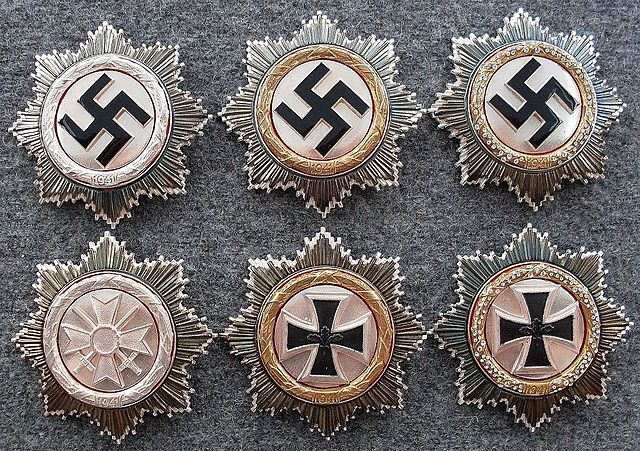
The German Cross was available in two versions: gold and silver, distinguished by the color of the laurel wreath surrounding the swastika.

  • The Gold German Cross: The gold version was conferred upon military personnel for repeated acts of bravery in combat or for exceptional military leadership, typically requiring 6–8 such acts.
  • The Silver German Cross: The silver version was awarded for multiple distinguished services to the war effort and served as a continuation of the War Merit Cross with swords. When a recipient was awarded both versions, only the gold version was authorized for wear.

The German Cross Design

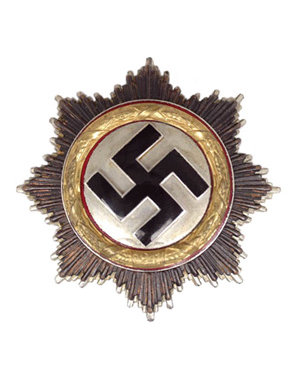
The order consists of a star badge with a swastika (in German a Hakenkreuz or “hooked cross”, hence the medal’s name). The German Cross has a diameter of 6.5 cm and was worn on the right-hand side of the tunic. If a recipient had been awarded both the silver and gold divisions, the gold division should be worn only.

In 1957 alternative de-nazified replacement versions of the German Cross were authorized for wear by the Federal Republic of Germany. These medals replaced the swastika with a representation of the Iron Cross for the gold division, and the War Merit Cross with Swords for the silver division.

Colonel Hans von Luck called the German Cross “Hitler’s fried egg“, in response to its gaudiness.

German Cross in Silver, Gold, and with Diamonds. Post-war denazified versions shown below.

Find a German Cross 

Note: As an eBay partner, I earn from qualifying purchases. This is all done automatically when you use a link and at no extra cost to you.

Right Now on eBay 
Clicking a link to eBay may result in a referral commission being paid if a purchase is made.
Loading...

The Anschluss Commemorative Medal

The Anschluss Commemorative Medal was a decoration of Nazi Germany instituted on 1 May 1938 and awarded during the interwar period. 

The Anschluss Commemorative Medal (or Die Medaille zur Erinnerung an den 13. März 1938 in German) was a decoration of Nazi Germany instituted on 1 May 1938 and awarded during the interwar period.

The medal commemorated the annexation of Austria to the German Reich, or Anschluss. The move was the first in Hitler’s quest for Lebensraum, and it strengthened German flanks while weakening those of Czechoslovakia.

The medal, known as the “Anschluss medal“, was awarded to all those Austrians who contributed to or participated in the annexation as well as the members of the Austrian National Socialism movement. It was also awarded to German State officials and members of the German Wehrmacht and SS who marched into Austria.

The Anschluss Commemorative Medal Design

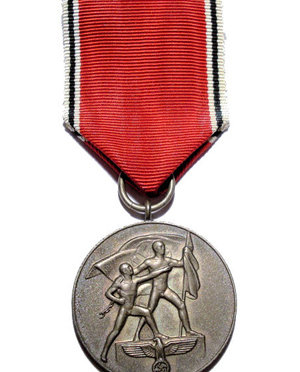
The Anschluss Commemorative medal is round, highly detailed, die-struck and based on the 1938 Party Day Badge and designed by Professor Richard Klein.

On the obverse of the medal, symbolic of Austrian adhesion to the German realm, a man holding the Nazi flag stands on a dais bearing the emblem of the “Third Reich”; he assists onto the dais a second man, on whose right hand a broken shackle still may be seen. On the reverse is the inscription “13. März 1938” (13 March 1938), the date of the Anschluss; the date is surrounded by the words, “Ein Volk, Ein Reich, Ein Führer” (“One People, One Empire, One Leader”).

The Anschluss Commemorative Medal was awarded until 31 December 1940, and a total of 318,689 medals were awarded.

The Order of Liberation

The Order of Liberation (or “Ordre de la Libération” in French) is a high honor Order awarded to heroes of the Liberation of France during World War II. It is second only after the Légion d’Honneur (Legion of Honour). The Order of Liberation was established by General de Gaulle in order n° 7, signed in Brazzaville on November 16, 1940 to “reward people, of the military or civilian communities, who will have distinguished themselves in the task of liberating France and her Empire”.

Very few people, military units and communes were ever awarded it, and only for their deeds during World War II. There were no restrictions as to age, sex, rank, origin or nationality; nor about the nature of the deeds, other than their exceptional quality.

The Order has a single rank, the title of Compagnon de la Libération (“Companion of the Liberation”). General de Gaulle, founder of the Order, was the only Grand Maître (“Grand Master”) of the Order.

The Order of Liberation Design

The medal of the Order or Croix de la Libération (“Cross of Liberation”), measures 31 mm wide by 33 mm high and is made of a rectangular bronze shield bearing a 60 mm high vertical gladius on its obverse.

On the blade of the gladius: a black enamelled Cross of Lorraine. On the reverse, a relief inscription in bold letters and in Latin reads, on four rows, “PATRIAM SERVANDO VICTORIAM TULIT” (“By serving the Fatherland, he/she achieved Victory”).

A total of 1061 Crosses of Liberation were awarded: 1038 to individuals, 18 to units of the Army, Air Force and Navy and five to cities: Nantes, Grenoble, Paris, Vassieux-en-Vercors, and l’Île de Sein.