The Naval Cross (Portugal)

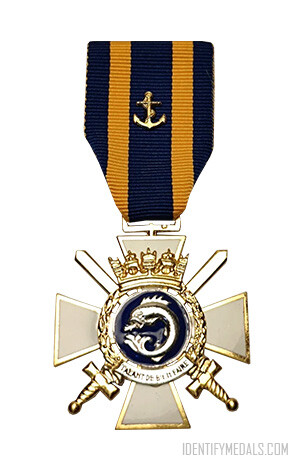
The Naval Cross Medal is a Portuguese military decoration created in 1985 and awarded for contributions to the Portuguese Navy.

The Naval Cross Medal is a Portuguese military decoration established on October 11, 1985. It is awarded to military personnel and civilians, both national and foreign, who demonstrate exceptional technical-professional competence, extraordinary performance, and significant personal qualities. Recipients of this medal contribute substantially to the efficiency, prestige, and mission fulfillment of the Portuguese Navy.

One of the first three branch-specific medals created in 1985, the Naval Cross Medal preceded the Medal of the Cross of Saint George, introduced in 2000 by the General Staff of the Armed Forces, and the Medal of National Defense, introduced by the Ministry of Defense in 2002.

The Naval Cross Medal is awarded according to the recipient’s rank and the nature of their contributions. General officers and captains of the sea and war receive the 1st Class (MPCN). Frigate captains and lieutenant captains are eligible for the 2nd Class (MSCN). The 3rd Class (MTCN) is designated for other officers and sergeant majors, while the 4th Class (MQCN) is for other sergeants and enlisted personnel.
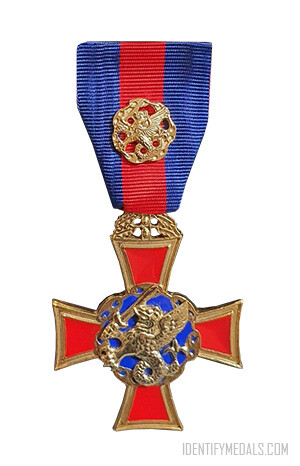
The St George’s Cross (Portugal)

The St George’s Cross is a Portuguese military medal created in 2000 and awarded for extraordinary performance and personal qualities.

The Medal of the Cross of Saint George is a Portuguese military decoration, established on December 22, 2000. It is awarded to military personnel and civilians, both national and foreign, who demonstrate exceptional technical-professional competence, extraordinary performance, and significant personal qualities. Recipients of this medal contribute substantially to the efficiency, prestige, and mission fulfillment of the General Staff of the Armed Forces (EMGFA).

The Medal of the Cross of Saint George was the penultimate of five specialized medals created to recognize services to the General Staff of the Armed Forces. It was established after the three branch-specific medals created in 1985 and before the Ministry of National Defense’s private medal, which was introduced in 2002.

The Medal of the Cross of Saint George is awarded according to the following criteria:

  • 1st Class (MPCSJ): General officers and captains or colonels.
  • 2nd Class (MSCSJ): Frigate captains or lieutenant colonels and lieutenant captains or majors.
  • 3rd Class (MTCSJ): Other officers and sergeant majors.
  • 4th Class (MQCSJ): Other sergeants and enlisted personnel.
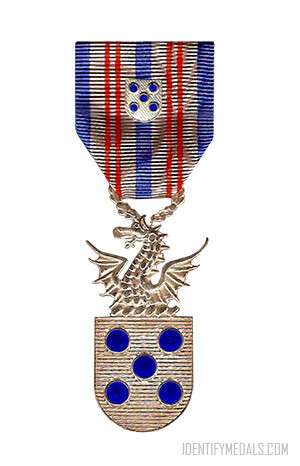
The St George’s Cross Design

The insignia of the Medal of the Cross of Saint George is designed to reflect the esteemed service and contributions of its recipients. Each class features a distinct design, symbolizing the level of achievement and rank of the awardee.

  • 1st Class (MPCSJ): This class features an elaborate medal adorned with intricate details, typically worn on a neck ribbon or sash. The design includes elements such as gold accents and the national coat of arms, symbolizing high honor and leadership.
  • 2nd Class (MSCSJ): Similar to the 1st Class but slightly less elaborate, this medal is also worn on a neck ribbon. It maintains prestigious design elements to denote significant contribution and command.
  • 3rd Class (MTCSJ): A medal worn on a neck ribbon, reflecting the commendable service of officers and sergeant majors. The design is simpler than the higher classes but retains important symbols of military excellence.
  • 4th Class (MQCSJ): The most basic design, worn on a chest ribbon. It recognizes the valuable contributions of sergeants and enlisted personnel, featuring essential elements like the national emblem.

The National Defense Medal (Portugal)

The National Defense Medal is a Portuguese military medal created in 2002 and awarded to military and civilian personnel for high competence.

The National Defense Medal is a Portuguese military decoration established on December 27, 2002. It is awarded in four classes to honor military and civilian personnel, both national and foreign, who demonstrate exceptional technical-professional competence, extraordinary performance, and significant personal qualities. These individuals contribute substantially to the efficiency, prestige, and mission fulfillment of the Ministry of National Defense.

The medal was the latest addition among five specialized medals created to recognize services to the Ministry of National Defense. It followed the creation of three branch-specific medals in 1985 and the General Staff of the Armed Forces’ private medal, the Cross of Saint George, which was established two years earlier.

The National Defense Medal is awarded according to the following criteria:

  • 1st Class (MPDN): General officers and captains or colonels.
  • 2nd Class (MSDN): Frigate captains or lieutenant colonels and lieutenant captains or majors.
  • 3rd Class (MTDN): Other officers and sergeant majors.
  • 4th Class (MQDN): Other sergeants and enlisted personnel.
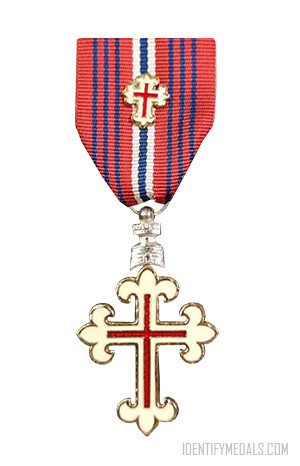
The National Defense Medal Design

The insignia of the National Defense Medal is designed to reflect the distinguished service and contributions of its recipients. The medal’s design varies according to its class, symbolizing the level of achievement and rank of the awardee.

  • 1st Class (MPDN): Features an ornate medal with intricate details, typically worn on a neck ribbon or sash. The design includes elements such as gold accents and the national coat of arms, signifying high honor and leadership.
  • 2nd Class (MSDN): Similar to the 1st Class but slightly less elaborate, worn on a neck ribbon. It maintains the prestigious design elements to denote significant contribution and command.
  • 3rd Class (MTDN): A medal worn on a neck ribbon, reflecting the commendable service of officers and sergeant majors. The design is simpler than the higher classes but retains important symbols of military excellence.
  • 4th Class (MQDN): The most basic design, worn on a chest ribbon. It recognizes the valuable contributions of sergeants and enlisted personnel, featuring essential elements like the national emblem.

The Medal of Military Merit (Portugal)

The Medal of Military Merit is a military medal created in 1946 and awarded to individuals with exceptional qualities and virtues.

The Medal of Military Merit (or Medalha de Mérito Militar in Portuguese) is a prestigious Portuguese military decoration established on 28 May 1946.

It is awarded to individuals who demonstrate exceptional military qualities and virtues. The Medal of Military Merit can also be awarded to foreign military personnel.

The Medal of Military Merit is divided into several classes, each corresponding to specific military ranks:

  • Grand Cross of the Military Merit Medal (GCMM): Awarded exclusively to General Officers.
  • First Class (MPMM): Awarded to General Officers, Colonels, or Sea Captains.
  • Second Class (MSMM): Awarded to Lieutenant Colonels, Frigate Captains, Majors, or Captain-Lieutenants.
  • Third Class (MTMM): Awarded to Captains, First Lieutenants, other lower-ranking officers, and Sergeant-Majors.
  • Fourth Class (MQMM): Awarded to other sergeants and enlisted ranks.

The Medal of Military Merit Design

The insignia of the Medal of Military Merit is a testament to the distinguished service of its recipients. The medal itself is designed to reflect the honor and prestige associated with military excellence. Each class of the medal features a distinct design that corresponds to the recipient’s rank.

  • Medal for Military Merit GCMM Grand Cross (GCMM): The highest class, featuring an elaborate and ornate design, often with gold elements. It includes a sash worn over the shoulder and a star badge displayed on the chest.
  • Medal for Military Merit MPMM First Class (MPMM): Characterized by a prominent medal worn on a ribbon around the neck, with an accompanying chest star.
  • Medal for Military Merit MSMM Second Class (MSMM): Similar to the First Class, but with design elements that denote a slightly lower rank.
  • Medal for Military Merit MTMM Third Class (MTMM): Features a medal worn on a ribbon around the neck, typically without the additional chest star.
  • Medal for Military Merit MQMM Fourth Class (MQMM): The simplest design, worn on a ribbon pinned to the chest.
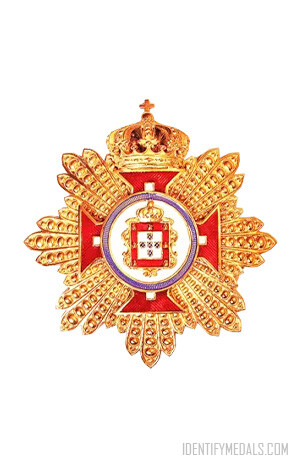
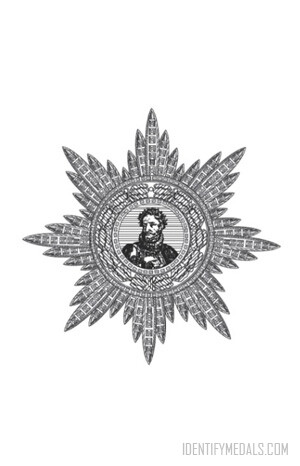
The Order of Merit of the Portuguese Royal House

The Order of Merit of the Portuguese Royal House is a dynastic order of knighthood conferred for outstanding Merit in the Monarchist Cause.

The Order of Merit of the Portuguese Royal House (or Ordem do Mérito da Casa Real Portuguesa or Ordem do Mérito da Causa Monárquica in Portuguese) is a dynastic order of knighthood awarded for extraordinary services to the Portuguese Royal House and outstanding merit in the Monarchist Cause.

Established by Duarte Pio, Duke of Braganza, on 12 April 1993, the Order recognizes exceptional contributions to the Monarchical Cause and services rendered to the Royal House between 1973 and 1993. The Head of the Portuguese Royal House serves as the Royal Patron, while Dr. José António da Cunha Coutinho, Baron of Nossa Senhora da Oliveira, is the Chancellor of the Order.

The Order of Merit of the Portuguese Royal House Ranks

The Order includes the following traditional ranks of Knighthood:

  • Grand Collar
  • Grand Cross
  • Commander
  • Knight/Dame
  • Medal of Honour

Previously, the Order also conferred the Medal of Dedication to the Monarchist Cause, Youth Medal of Dedication to the Monarchist Cause, and Youth Medal of Fidelity, but these were discontinued following a reform by the Grand Master.

The Order of Merit of the Portuguese Royal House Design

The sash of the Order is intricately designed, featuring the colors and emblematic elements associated with the Portuguese monarchy. The badge typically includes a cross or star, adorned with the emblem of the Royal House of Braganza, symbolizing loyalty and service to the monarchist cause.

Higher ranks such as the Grand Collar and Grand Cross include more elaborate insignia with gold and enamel details, and are worn with a sash over the shoulder or around the neck.

The Order of Camões

The Order of Camões was created in 1985 and integrated in 2021. It is awarded for relevant services to the language and its promotion.

The Order of Camões (or Ordem de Camões in Portuguese) is a distinguished Portuguese order of knighthood, originally established in 1985 and fully integrated into the Portuguese honors system on 30 June 2021.

Named in honor of Luís de Camões, Portugal’s national poet, this order celebrates significant contributions to the Portuguese language and its international promotion, as well as the strengthening of cultural relations among Portuguese-speaking communities.

Membership in the Order is conferred by the President of Portugal, either on their initiative, upon the recommendation of Ministers, or following a nomination by the Council of the Order.

The Order of Camões Grades

The Order of Camões is composed of several classes, listed in descending order of seniority:

  • Grand Collar (Grande-Colar – GColCa)
  • Grand Cross (Grã-Cruz – GCCa)
  • Grand Officer (Grande-Oficial – GOCa)
  • Commander (Comendador – ComCa)
  • Officer (Oficial – OCa)
  • Knight/Dame (Cavaleiro – CvCa / Dama – DmCa)
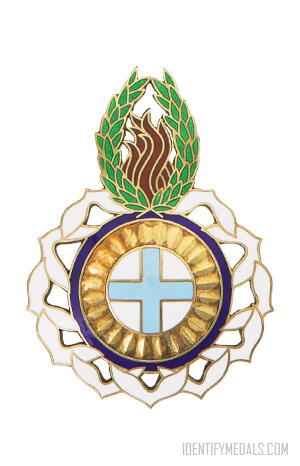
Additionally, the title of Honorary Member (Membro Honorário – MHCa) can be awarded to institutions and localities without specifying a grade. The Grand Collar is a special distinction reserved exclusively for heads of state.

The Order of Camões Design

The insignia of the Order of Camões reflects its dedication to the promotion of Portuguese culture and language.

The badge features elements that symbolize literary excellence and cultural heritage, often incorporating imagery related to Luís de Camões and his contributions to Portuguese literature. The design includes a distinctive cross or emblem, which varies in complexity and decoration according to the class of the order.

For the higher classes, such as the Grand Collar and Grand Cross, the insignia is more elaborate, often featuring intricate designs and additional symbols that highlight the esteemed nature of these awards.

The ribbon associated with the Order is typically adorned in colors and patterns that reflect the cultural and historical significance of Luís de Camões and the values the Order stands for.

The Order of Liberty (Portugal)

The Order of Liberty or Order of Freedom was established in 1976 and distinguishes relevant services to the cause of democracy and freedom.

The Order of Liberty (or Ordem da Liberdade in Portuguese) is a prestigious Portuguese civil order that honors significant contributions to democracy and freedom, particularly in defending the values of civilization and human dignity.

Established in 1976 following the Carnation Revolution of 1974, which overthrew the corporatist authoritarian Estado Novo regime of António de Oliveira Salazar and Marcello Caetano, this order reflects Portugal’s commitment to democratic principles.

The Grand Collar can be conferred by the President of Portugal to former heads of state and individuals whose extraordinary deeds are of particular relevance to Portugal. This includes political actions, acts of physical defense, or outstanding representation of Portugal internationally.

The Order of Liberty Grades

The Order of Liberty comprises six classes, listed in decreasing order of seniority:

  • Grand Collar (Grande-Colar – GColL)
  • Grand Cross (Grã-Cruz – GCL)
  • Grand Officer (Grande-Oficial – GOL)
  • Commander (Comendador – ComL)
  • Officer (Oficial – OL)
  • Knight/Dame (Cavaleiro – CvL / Dama – DmL)

Additionally, the title of Honorary Member (Membro Honorário – MHL) can be awarded to institutions and localities.

The Order of Liberty Design

The insignia of the Order of Liberty is characterized by a ribbon and badge design that reflects the values of freedom and democracy.

The badge typically features symbols and motifs that represent liberty and human dignity, often incorporating elements that signify the struggle and triumph over authoritarianism. The exact design details, including the colors and specific symbols, emphasize the Order’s dedication to the principles of freedom and the protection of human rights.

The Grand Collar, Grand Cross, and other higher classes often include more elaborate and intricate designs, befitting their seniority and the distinguished nature of their recipients.

The Order of Prince Henry

The Order of Prince Henry is a Portuguese order of knighthood established in 1960 to mark the 500th anniversary of Prince Henry’s death.

The Order of Prince Henry (or Ordem do Infante Dom Henrique in Portuguese) is a distinguished Portuguese order of knighthood established on 2 June 1960 to mark the 500th anniversary of Prince Henry the Navigator’s death. Prince Henry was a pivotal figure in the Age of Discovery. The Order underwent minor reforms in 1962 and 1980.

This five-tier order recognizes significant contributions to Portugal, particularly in the expansion of its culture, history, and values, with a focus on maritime history. Membership in each grade is limited by the Order’s constitution, and titles are awarded by the President of Portugal, who serves as the Grand Master.

The Order of Prince Henry Grades

The Order of Prince Henry consists of several classes, listed in decreasing order of seniority:

  • Grand Collar (Grande-Colar – GColIH)
  • Grand Cross (Grã-Cruz – GCIH)
  • Grand Officer (Grande-Oficial – GOIH)
  • Commander (Comendador – ComIH)
  • Officer (Oficial – OIH)
  • Knight/Dame (Cavaleiro – CvIH / Dama – DmIH)
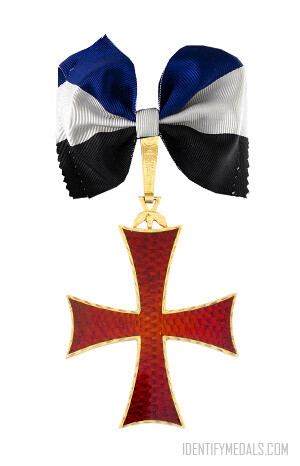
Additionally, there are a Silver Medal (Medalha de Prata – MedPIH) and a Gold Medal (Medalha de Ouro – MedOIH). The Grand Collar is a special distinction that can only be awarded to heads of state.

The Order of Prince Henry Design

The insignia of the Order features ribbons and medals characterized by equal stripes of blue, white, and black, either horizontal or vertical, along with a ruby-enameled golden cross pattée.

The stars of the Grand Officer and Grand Cross include the inscription “Talant de bien faire”.

The National Service Medals (Norway)

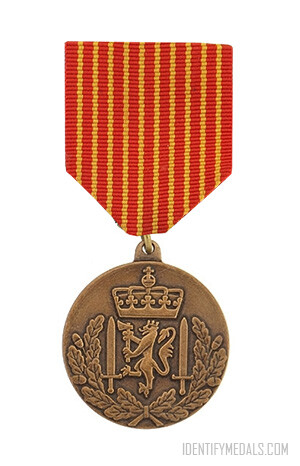
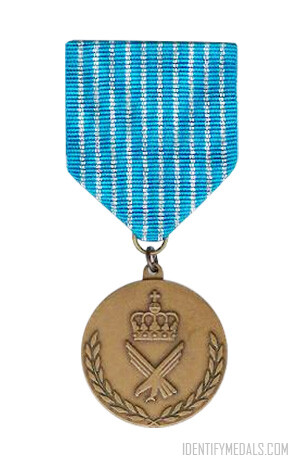
The National Service Medals were established on 1 May 1982 and are awarded in recognition of completed initial service in the armed forces.

The Norwegian National Service Medal (or Forsvarets vernedyktighetsmedaljer in Norwegian) is awarded to individuals upon the completion of their mandatory military service, which typically lasts one year, or six months for those in the Home Guard.

The Norwegian National Service Medal not only recognizes the completion of mandatory military service but also symbolizes the commitment and dedication of individuals to the defense and security of Norway.

The medal is available in four distinct versions, each representing a different branch of the Norwegian Armed Forces: the Army, the Air Force, the Navy, and the Home Guard.

The National Service Medal Design

The obverse design of the Norwegian National Service Medal varies slightly depending on the branch of service it represents. The reverse features the branch’s name along with the armed forces motto, “for fred og frihet” (in Bokmål) or “for fred og fridom” (in Nynorsk), which translates to “for peace and freedom.”

The Norwegian National Service Medal is uniquely designed to represent the distinct branches of the Norwegian Armed Forces. Each version of the medal comes with a distinct ribbon that corresponds to the specific branch of service, too. These ribbons are worn as part of the medal’s insignia and serve to identify the branch in which the recipient served.

The National Service Medals - Awards from Norway

Army Version

The Army version of the National Service Medal features the crest of the Norwegian Army on the obverse. This emblem is a symbol of the strength, discipline, and commitment required of those who serve in the Army.

The reverse side of the medal includes the name of the Army along with the armed forces motto “for fred og frihet” (for peace and freedom), emphasizing the Army’s role in national defense and peacekeeping.

The ribbon for the Army version is designed in red and yellow.

Air Force Version

The Air Force version of the National Service Medal displays the crest of the Norwegian Air Force on the obverse. This crest signifies the advanced technology, skill, and strategic importance of the Air Force. The reverse side carries the Air Force’s name and the motto, reinforcing the branch’s dedication to protecting Norway’s airspace and contributing to international peace efforts.

The ribbon accompanying the Air Force medal is blue and silver, reflecting the sky and the innovative spirit of the Air Force.

The National Service Medals - Air Force version, obverse.
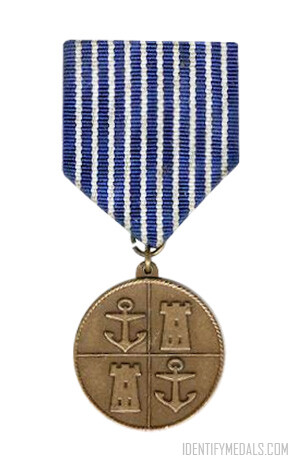
The National Service Medals - Navy version, obverse.

Navy Version

The Navy version of the National Service Medal is adorned with the crest of the Norwegian Navy on the obverse. This emblem represents the maritime heritage, bravery, and tactical expertise of naval personnel. The reverse side includes the name of the Navy and the armed forces motto, highlighting the Navy’s crucial role in securing Norway’s waters and participating in global maritime operations.

The Navy ribbon is designed with nautical colors: navy blue and white, symbolizing the sea and the naval tradition.

Home Guard Version

The Home Guard version of the National Service Medal features the crest of the Norwegian Home Guard on the obverse. This crest embodies the readiness, resilience, and community spirit of the Home Guard. The reverse side lists the Home Guard’s name and the motto, reflecting its mission to support and protect local communities in times of need.

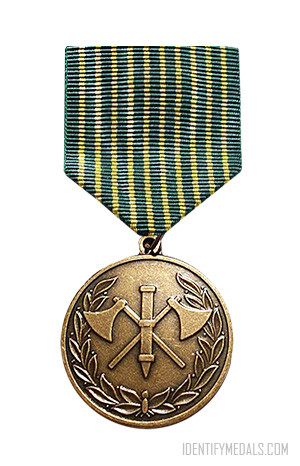
The ribbon for the Home Guard medal incorporates colors that are distinct to this branch: Green and yellow.

The National Service Medals - Home Guard version, obverse.

The Norwegian Police Service Medal

The Police Service Medal was established in 2002 and is a civil decoration for long service in the Norwegian Police Service.

The Police Service Medal (or Politimedaljen in Norwegian) is a distinguished Norwegian civil decoration awarded to recognize long and dedicated service within the Norwegian Police Service.

This medal highlights the commitment and professionalism of the personnel who have dedicated significant portions of their careers to maintaining law and order in Norway.

The Police Service Medal is awarded to individuals who have completed 25 years of service in the Norwegian Police Service. To further acknowledge prolonged dedication, a star is added to the ribbon for each additional five years of service, with a maximum of three stars, representing up to 40 years of exemplary service.

In the hierarchy of Norwegian decorations, the Police Service Medal ranks 41st. This placement underscores its importance in recognizing long-term commitment and service within the civil sector, particularly in law enforcement.

The Norwegian Police Service Medal Design

The medal is round and typically made of a high-quality metal, designed to endure and symbolize the enduring nature of the service it honors.

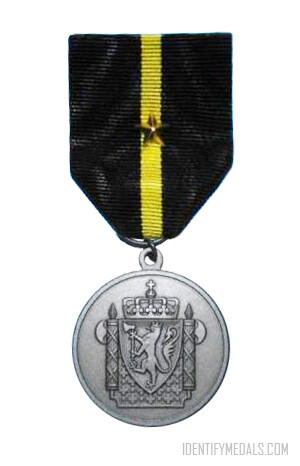
The obverse of the medal features the Norwegian Police Service emblem. This includes the traditional insignia, which often comprises symbols of justice and law enforcement, such as scales of justice or a lion, symbolizing strength and courage.

The reverse of the medal typically bears inscriptions that denote the nature of the award. This might include phrases like “For Long Service” or similar sentiments that recognize the commitment and dedication of the recipient.

The medal is suspended from a ribbon that is black with a central yellow line.

The Norwegian Police Service Medal Ribbons

Stars are added to the ribbons to represent years of service:

  • Ordinary (25 years)
  • One Star (30 years)
  • Two Stars (35 years)
  • Three Stars (40 years)