The Order of Om Ram Patta

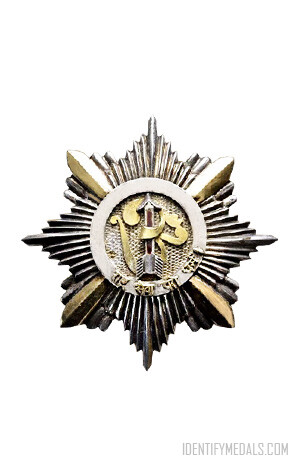
The Order of Om Ram Patta was established by King Tribhuvan in 1946 and bestowed upon both Nepalese and foreign nationals of Hindu faith.

The Order of Om Ram Patta was established by King Tribhuvan on October 31, 1946.

This honor is bestowed upon both Nepalese and foreign nationals who follow the Hindu faith and who set bright examples of national service.

The order includes three ranks:

  • The Sovereign (Parama-Pravitra-Om-Ram-Patta)
  • The Grand Master (Pravitra-Om-Ram-Patta)
  • Ordinary members (Om-Ram-Patta)

The Order of Om Ram Patta Design

The front side bears an inscription in Nepalese, which translates to: “NATIONAL SERVICE IS THE HIGHEST VIRTUE.

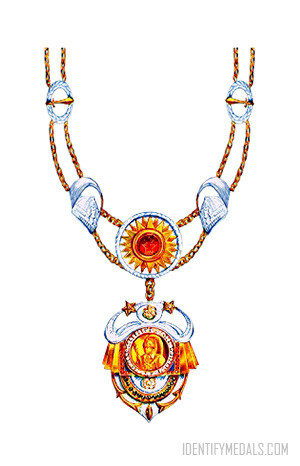
The Most Glorious Mahendra Chain

The Most Glorious Mahendra Chain was instituted in 1961 by the King Mahendra Bir Bikram Shah Dev and is a royal decoration of Nepal.

  • Time Period: Post-WW2
  • Institution: 26 February 1961
  • Country: Nepal

The Most Glorious Mahendra Chain (or महेन्द्र माला मानपदवी Mahendra Mala Manapadvi in Nepali) is a prestigious royal decoration of Nepal.

Established on February 26, 1961, by King Mahendra Bir Bikram Shah Dev. The decoration was named in his honor, reflecting the monarch’s desire to recognize and honor significant contributions to the nation.

The medal is intended to honor reigning sovereigns, reflecting their paramount role and contributions to the state. It symbolizes the highest level of respect and recognition from the Nepalese monarchy, awarded for exceptional service and dedication to the nation.

The decoration is awarded in a single class, the Chain, and is exclusively conferred upon reigning sovereigns, making it one of the highest and most exclusive honors in the Nepalese system of awards and decorations.

The Most Glorious Mahendra Chain Design

The chain includes elements symbolizing the country’s heritage, monarchy, and national pride.

The Most Glorious Mahendra Chain Awardees

Queen Elizabeth II of the United Kingdom

Queen Elizabeth II, the longest-reigning British monarch, was awarded the Most Glorious Mahendra Chain as a symbol of the strong diplomatic and cultural ties between Nepal and the United Kingdom. Her Majesty’s reign has seen significant global changes and she has been a figure of stability and continuity in the Commonwealth. The honor bestowed upon her by King Mahendra reflects the mutual respect and long-standing relationship between the two countries, emphasizing cooperation and goodwill.

King Birendra

King Birendra Bir Bikram Shah Dev was the King of Nepal from 1972 until his tragic assassination in 2001. He is remembered for his efforts to modernize Nepal, maintain its non-aligned foreign policy, and uphold the traditions of the monarchy while responding to the changing political landscape. King Birendra’s reign saw significant social and economic developments in Nepal. The Most Glorious Mahendra Chain was awarded to him to honor his leadership and commitment to the nation’s progress and stability.

Queen Aishwarya

Queen Aishwarya Rajya Lakshmi Devi Shah, the consort of King Birendra, was also a recipient of the Most Glorious Mahendra Chain. She played a significant role in the cultural and social spheres of Nepal, advocating for various charitable causes and supporting the arts. Her efforts to preserve and promote Nepalese culture and traditions were recognized through this prestigious award, reflecting her contributions to the nation’s cultural heritage.

King Gyanendra

King Gyanendra Bir Bikram Shah Dev, the younger brother of King Birendra, ascended to the throne following the royal massacre in 2001. His reign was marked by significant political turmoil, including the transition from a monarchy to a federal democratic republic. Despite these challenges, King Gyanendra’s contribution to Nepal’s history and his role during a critical period of transition were acknowledged with the Most Glorious Mahendra Chain, honoring his service and dedication to the country.

Queen Komal

Queen Komal Rajya Lakshmi Devi Shah, the consort of King Gyanendra, was awarded the Most Glorious Mahendra Chain in recognition of her role and contributions as the queen. She supported various social and humanitarian efforts, focusing on health, education, and welfare. Queen Komal’s commitment to improving the lives of Nepalese citizens and her support for cultural initiatives were significant aspects of her public life, making her a deserving recipient of this royal decoration.

The Armed Forces Service Medal

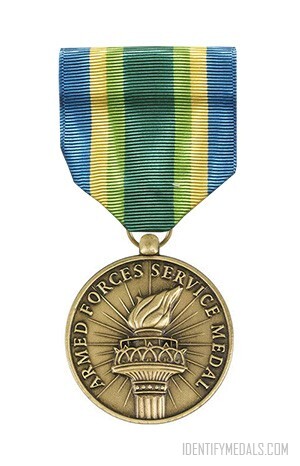
The Armed Forces Service Medal is a military award presented for significant activity for which no other U.S. medal is authorized.

The Armed Forces Service Medal (AFSM) is a prestigious military award within the United States military, established on January 11, 1996, by President Bill Clinton through Executive Order 12985.

This medal is designated as a deployed service award and is presented to service members who participate in “significant activity” operations that do not qualify for any other U.S. campaign or service medal. The AFSM recognizes the efforts and commitment of those who engage in important missions or operations, highlighting their contributions to national and international objectives where specific campaign medals are not applicable.

The Armed Forces Service Medal is the non-combat equivalent of the Armed Forces Expeditionary Medal, which is typically awarded for combat operations and associated combat support missions.

The Armed Forces Service Medal Design

The Armed Forces Service Medal is a round bronze medal measuring 1+1⁄4 inches (32 mm) in diameter.

The obverse of the medal features a half-torch, reminiscent of the Statue of Liberty’s torch, with rays emanating from behind it. The inscription “ARMED FORCES SERVICE MEDAL” encircles the top. The reverse side displays the eagle from the United States Department of Defense seal, with a laurel wreath below and the inscription “IN PURSUIT OF DEMOCRACY” at the top.

The suspension and ribbon of the medal are 1+3⁄8 inches (35 mm) wide and include several edge stripes from the outside to the center: 1⁄16 inch (1.6 mm) goldenlight, 1⁄8 inch (3.2 mm) jungle green, 1⁄8 inch (3.2 mm) green, 1⁄8 inch (3.2 mm) mosstone green, and 1⁄8 inch (3.2 mm) goldenlight. The center stripe is 1⁄4 inch (6.4 mm) wide in bluebird.

Find This Medal Online

Right Now on eBay 
Clicking a link to eBay may result in a referral commission being paid if a purchase is made.
Loading...

The Royal Life Guard’s 350th Anniversary Medal

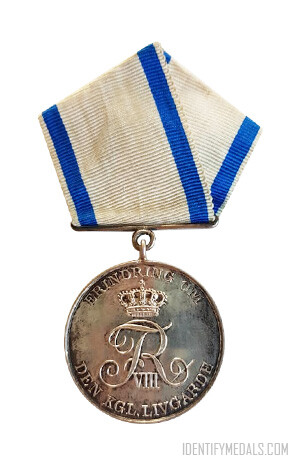
The Royal Life Guards Medal 350th anniversary medal was awarded to members of the mechanized infantry regiment of the Danish Army.

The Royal Life Guards 350th Anniversary Commemorative Medal was created in 2008 to celebrate the 350th anniversary of the Danish Royal Life Guards. This prestigious medal honors the long-standing history and distinguished service of the Royal Life Guards, who have been a vital part of Denmark’s military and royal protection since their establishment in 1658.

This commemorative medal was awarded to members of the Royal Life Guards, recognizing their dedication, loyalty, and service to the Danish monarchy. It serves as a token of appreciation for the guards’ unwavering commitment to protecting the royal family and the nation over three and a half centuries.

The Medal Design

The medal typically features symbols associated with the Royal Life Guards and Denmark, such as the Danish crown and the regiment’s emblem.

The reverse side often commemorates the anniversary with the years “1658-2008” prominently displayed.

The Peace Prize Medal (Denmark)

The Peace Prize Medal was established in 1995 by Queen Margrethe II and is awarded Danes who completed a tour of duty on a UN mission.

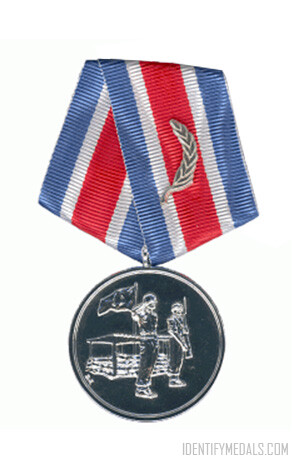
The Peace Prize Medal (or De Blå Beretters Fredsprismedalje in Danish) was established in 1995 by Queen Margrethe II. It is awarded to Danish individuals who have completed a UN mission tour and received a corresponding medal.

Unique among Danish medals, recipients can apply for it themselves. The medal honors the United Nations Department of Peacekeeping Operations personnel who received the 1988 Nobel Peace Prize. Those who served before 1988 can attach a silver laurel branch to the ribbon, marking their early contributions.

The Peace Prize Medal Design

The Peace Prize Medal features a distinguished design to honor Danish UN peacekeepers. The medal itself is typically circular, displaying relevant imagery such as the emblem of the United Nations or other peacekeeping symbols.

The obverse side often includes a representation of the Nobel Peace Prize, reflecting the 1988 award given to UN peacekeeping forces. The reverse side may carry inscriptions denoting the medal’s purpose and the recipient’s service details.

The ribbon is adorned with a silver laurel branch for those who served before 1988, symbolizing their early contributions to peacekeeping efforts.

The Rescue Preparedness Medal

The Rescue Preparedness Medal was instituted in 1994 by Queen Margrethe II for participation in international humanitarian operations.

The Rescue Preparedness Medal (or Redningsberedskabets Medalje in Danish) was established in 1994 by Queen Margrethe II.

It honors members of the Danish Emergency Management Agency who have participated in international humanitarian missions beyond Denmark’s borders.

Although the medal was instituted in 1994, it retroactively acknowledges contributions to international operations starting from April 1, 1991. This award recognizes the dedication and bravery of individuals engaged in global humanitarian efforts, highlighting Denmark’s commitment to international aid and emergency response.

The Badge of Honor of the League of Civil Defense

The Badge of Honor of the League of Civil Defense was instituted in 1956 by King Frederik IX and is awarded for noteworthy deeds.

Instituted in 1956 by King Frederik IX, the Badge of Honor of the League of Civil Defense (or Beredskabsforbundets Hæderstegn in Danish) recognizes individuals who have made significant contributions to civil defense over at least 15 years.

Awarded by the President of the Danish Civil Defense Association, the badge honors noteworthy service, volunteer efforts, and exceptional support for civil defense initiatives.

The idea for the medal originated in 1953 from the Association of Police Chiefs. The Civil Defense Association finalized the award, which was first bestowed on June 17, 1957. The association, originally named CivilforsvarsForbundet, rebranded in the mid-2000s, and in 2007, the medal’s name was updated to Beredskabsforbundets Hæderstegn.

The medal is awarded in three categories:

  1. Individuals with at least 15 years of exemplary service within civil defense.
  2. Those who have made significant contributions to civil defense initiatives, such as fire chiefs.
  3. Politicians and public figures who have notably supported civil defense.

Annually, up to 12 medals are awarded, ensuring the recognition of outstanding dedication to civil defense efforts.

The Badge of Honor Design

The medallion is suspended from a ribbon, the colors and patterns of which denote the specific award category.

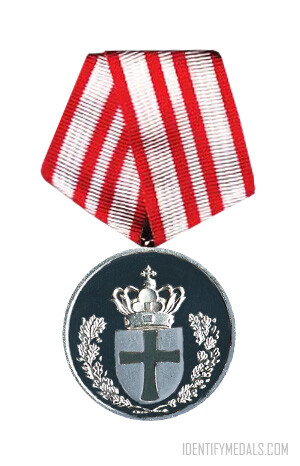
The Long Service Awards (Denmark)

The Danish Long Service Medals (Navy, Army, Air Force, and Department of Defense) may be awarded after 25 years of service.

Denmark’s primary governmental uniformed services offer long service medals for 25 years of service, with additional honors for extended service.

The awards include medals for the Navy, Army, Air Force, and other defense services, each instituted by Danish monarchs at various times. For instance:

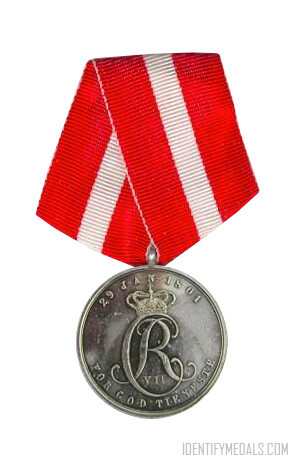
  • Navy: Established in 1801 for 25 years of service.
  • Army: Established in 1945 for 25 years of service.
  • Air Force: Established in 1953 for 25 years of service.
  • Department of Defense: Established in 1953 for 25 years of service.
  • Armed Forces Reserves: Established in 1978 for 25 years of service.
  • Home Guard: Established in 1988, awarded for 25, 40, 50, and 60 years of service.
  • Civil Defense: Established in 1963 for 25 years of service.
  • Municipal Fire Departments: Established in 1973 for 25 years of service.
  • Police: Established in 1959 for 25 years of service.

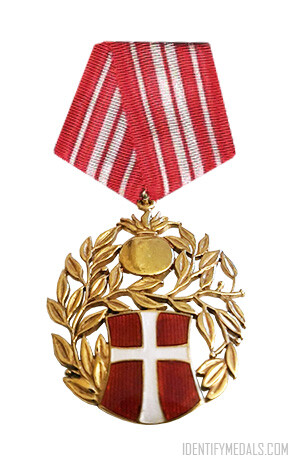
High-ranking officers may receive the Order of Dannebrog after 25 years, while the Medal of Merit can be awarded after 40 years of public service. These medals recognize dedication and commitment, providing official acknowledgment and benefits to long-serving personnel.

The Long Service Awards Design

The medal is round and features a profile of the reigning monarch on the obverse. The reverse side often includes an inscription indicating the years of service and the specific branch.

The ribbon color and pattern vary by  service branch, often incorporating the national colors of Denmark. For extended service, such as 40 years, additional elements like gold or silver oak leaves are added to the ribbon.

The Defense Medal for Bravery

The Defense Medal for Bravery was established in 1996 and is awarded for actions during combat or terrorist activities.

The Defense Medal for Bravery (or Forsvarets Medalje for Tapperhed in Danish) is a distinguished award that can be given to both civilian and military personnel for their actions during combat or terrorist activities.

Established on 30 October 1996, the medal was first awarded on 13 May 1997. It is presented as the personal property of the recipient and does not need to be returned upon their death. The medal can also be awarded posthumously. 

Following the deployment of Danish soldiers during the civil war in the former Yugoslavia, members of the UNPROFOR force exhibited acts of heroism. To honor their bravery, the Danish State and Armed Forces sought to create a new bravery decoration. This led to the establishment of the Defense Medal for Bravery in 1996 by Queen Margrethe II. The first presentation took place on 13 May 1997, where seven soldiers were honored at a parade at Kastellet.

The Defense Medal for Bravery Design

Multiple awards of the medal are indicated by silver oak leaves for the second award and gold oak leaves for the third.

The Valor Cross (Denmark)

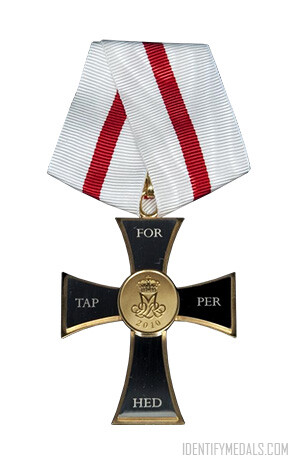
The Valor Cross or Tapperhedskorset was established in 2011 and is awarded for outstanding acts of courage in combat.

The Valor Cross (or Tapperhedskorset in Danish) is Denmark’s highest military decoration, established on 14 November 2011 and first awarded on 18 November 2011.

The Valor Cross is awarded for extraordinary courage demonstrated during combat, where the soldier acts selflessly in a clearly dangerous situation. The actions must either contribute significantly to accomplishing an important mission or save the lives of others. It is Denmark’s highest military honor, equivalent to the British Victoria Cross or the United States’ Medal of Honor.

Since its inception, the Valor Cross has been awarded only once. The first recipient, Sergeant Casper Westphalen Mathiesen of the Engineer Regiment in Skive, Denmark, was honored for his actions on 19 February 2010 while serving with ISAF in Afghanistan. During a firefight, Sergeant Mathiesen risked his life to protect a wounded comrade, successfully holding off the enemy and enabling his comrade to receive medical attention.

The Valor Cross Design

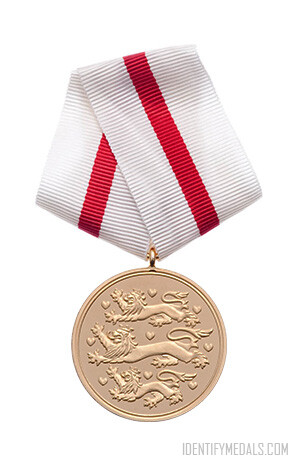
The Valor Cross is a silver cross pattée with a gilded edge, featuring a longer lower arm.

The obverse side displays a gold medallion at the center, adorned with the Queen’s monogram above the year 2010. Each arm of the cross carries three letters of the inscription “FOR TAPPERHED” (meaning “for valour”). The reverse side is engraved with the recipient’s name, rank, and the location and year of the honored event.

The cross is suspended from a white ribbon with a red center stripe. When worn as a ribbon bar, it resembles the Defence Medal for Bravery but includes a miniature of the gold medallion from the center of the cross.