The Distinguished Conduct Star (Philippines)

The Distinguished Conduct Star is the second highest military award of the Philippines and awarded for extraordinary acts of heroism.

The Distinguished Conduct Star stands as the Philippines’ second-highest military honor, ranking only below the Medal of Valor. President Manuel L. Quezon established this award in 1939, replacing the Philippine Constabulary Distinguished Conduct Star.

Criteria This decoration is bestowed upon individuals serving in any capacity within the Armed Forces of the Philippines who demonstrate extraordinary heroism not meeting the criteria for the Medal of Valor during military operations against an armed adversary. The act or acts of heroism must be exceptionally notable and involve a level of life-threatening risk that sets the individual apart from their peers. The Chief of Staff of the Armed Forces of the Philippines has the authority to confer this award.

The Distinguished Conduct Star Design

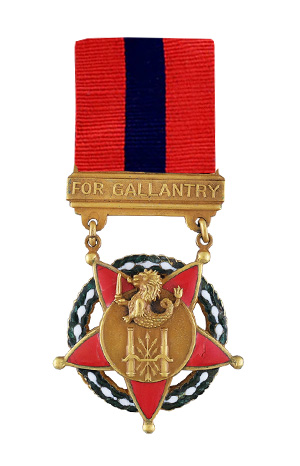
The medal features a red enameled, downward-pointing star with a central gold disc. Encased within the disc is a relief of a gold heraldic sea lion, grasping a dagger in its right hand, positioned atop the muzzles of two cannons flanking both sides. At the disc’s base lie two bows resting horizontally across arrows, placed between the breeches of the cannons. Vertically positioned spears point upward, overlaying the crossed arrows.

Affixed to a gold bar engraved with the phrase “For Gallantry,” the star is connected to the base of a wreath crafted from Sampaguita white flower buds and green leaves. The award is worn suspended from the neck by a red ribbon featuring a blue stripe at its center.
The Order of Lapu-Lapu

The Order of Lapu-Lapu is a national order of merit established in 2017 and conferred by the President of the Philippines.

The Order of Lapu-Lapu (or Orden ni Lapu-Lapu in Filipino) is a prestigious national honor bestowed by the President of the Philippines upon government officials, personnel, and private individuals. It recognizes exceptional contributions or remarkable service related to a specific campaign or advocacy initiated by the President.

Unlike awards included in the Honors Code of the Philippines, this presidential accolade is positioned below the Presidential Medal of Merit in terms of precedence.

The Order of Lapu-Lapu Ranks

According to Executive Order No. 17 signed by President Rodrigo Duterte, the Order of Lapu-Lapu originally consisted of three ranks: the Lapu-Lapu Medal, the Kalasag Medal, and the Kampilan Medal. However, this was expanded to four ranks with the issuance of Executive Order No. 35. The new ranks are as follows:

  1. Magalong Medal: Awarded to government officials, personnel, and private individuals who have demonstrated exceptional service or made outstanding contributions to the success of an activity aligned with a campaign or advocacy of the President.
  2. Kalasag Medal: Conferred upon government officials, personnel, and private individuals who lost their lives directly due to their involvement in an activity connected to a campaign or advocacy of the President.
  3. Kampilan Medal: Granted to government officials, personnel, and private individuals who sustained serious injuries, wounds, or significant property loss as a direct consequence of their participation in an activity related to a campaign or advocacy of the President.
  4. Kamagi Medal: Presented to government officials, personnel, and private individuals who actively participated in and made substantial contributions to an activity associated with a campaign or advocacy of the President but do not fall under any of the aforementioned ranks.

The Order of Lapu-Lapu Design

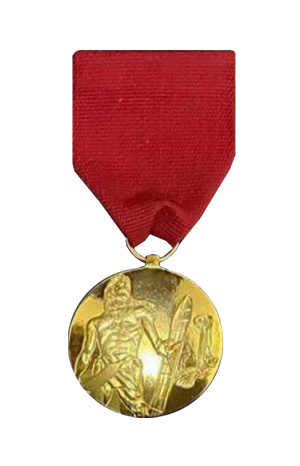
The medals for the Order of Lapu-Lapu are crafted by the Bangko Sentral ng Pilipinas using 99.9% silver, with specific ranks featuring selective gold plating.

The ribbon is fashioned from Philippine cotton, hand-woven by a cooperative foundation located in Bontoc, Mountain Province.

  1. Magalong Medal: Awarded to government officials, personnel, and private individuals who have demonstrated exceptional service or made outstanding contributions to the success of an activity aligned with a campaign or advocacy of the President.
  2. Kalasag Medal: Conferred upon government officials, personnel, and private individuals who lost their lives directly due to their involvement in an activity connected to a campaign or advocacy of the President.
  3. Kampilan Medal: Granted to government officials, personnel, and private individuals who sustained serious injuries, wounds, or significant property loss as a direct consequence of their participation in an activity related to a campaign or advocacy of the President.
  4. Kamagi Medal: Presented to government officials, personnel, and private individuals who actively participated in and made substantial contributions to an activity associated with a campaign or advocacy of the President but do not fall under any of the aforementioned ranks

The Philippines’s Presidential Medal of Merit

The Philippines’s Presidential Medal of Merit is an honor established in 2003 and given by the Republic of the Philippines.

The Presidential Medal of Merit (or Pampanguluhang Medalya ng Merito) is a distinction bestowed by the Republic of the Philippines. Originally named the Presidential Merit Award, it was rebranded as the Presidential Medal of Merit through Executive Order 236 on September 19, 2003.

The Presidential Medal of Merit is granted to individuals, whether Filipino or foreign, for various reasons. For instance:

  • a. Exceptional service to the President, the Administration, or cabinet members.
  • b. Achievement in international events or fields such as literature, sciences, arts, entertainment, and other civilian domains, contributing to national pride and artistic excellence.
  • c. Recognition of retiring cultural workers or artists who have served the government in official or advisory capacities, or foreign artists who have promoted Philippine culture.
  • d. Acts of merit that elevate the reputation of the Republic of the Philippines, including leading the Philippine delegation or materially contributing to the success of significant international conferences or events that bring honor and distinction to the country, such as Presidential visits abroad and major international gatherings held within the Philippines.

The Order of the Golden Heart

The Order of the Golden Heart is an order of the Philippines created in 1954 and awarded for distinguished services and aid.

The Order of the Golden Heart (or Orden ng Gintong Puso) is a distinguished order in the Philippines. Established initially as the Golden Heart Presidential Award through Executive Order 40-A on June 21, 1954, it was later elevated to the Order of the Golden Heart by Executive Order 236 on September 19, 2003.

This order aims to officially recognize individuals, whether Filipino or foreign citizens, who have provided exceptional services or significant financial or material assistance. Their contributions extend to the advancement of moral, social, and economic conditions among the Filipino populace, as well as their voluntary efforts in serving the Filipino community.

The Order of the Golden Heart Ranks

The Order of the Golden Heart consists of the following ranks:

  • Grand Collar (GCGH) (Maringal na Kuwintas): Bestowed upon a former or current head of State or government.
  • Grand Cross (GCrGH) (Maringal na Krus): Granted to a Crown Prince, Vice President, Senate President, Speaker of the House, Chief Justice, or an equivalent official. It may also be awarded to foreign ministers or other cabinet-level officials, as well as Ambassadors, Undersecretaries, Assistant Secretaries, or individuals of comparable rank.
  • Grand Officer (GOGH) (Maringal na Pinuno): Conferred upon Chargé d’affaires, Minister, Minister Counselor, Consul General, executive director, or individuals of similar rank.
  • Commander (CGH) (Komandante): Bestowed upon Chargé d’affaires a.i., Counselor, First Secretary, Consul General (in the consular section of an Embassy), Consular officer with a personal rank exceeding Second Secretary, Director, or individuals of comparable rank.
  • Officer (OGH) (Pinuno): Awarded to Second Secretaries, Consuls, assistant directors, or individuals of similar rank.
  • Member (MGH) (Kagawad): Conferred upon Third Secretaries, Vice Consuls, Attachés, Principal Assistants, or individuals of comparable rank.

The Order of the Golden Heart Design

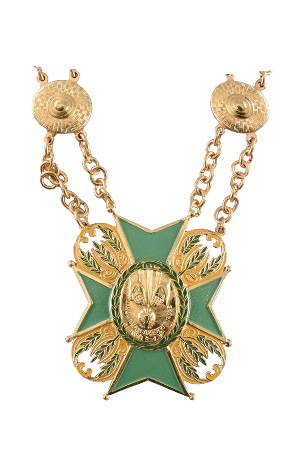
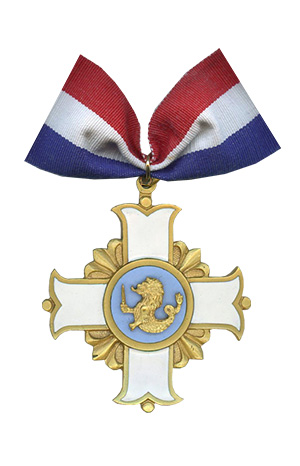
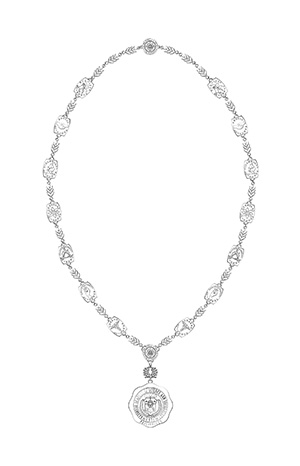
The badge and plaque consist of a green-enamelled Maltese cross, adorned with an oval golden medallion depicting open hands embracing a shining golden heart. Above this motif is the Latin motto “MANUM TUAM APERVIT INOPE,” and the entire medallion is encircled by a laurel crown in green. Between the laurel branches are golden laces and green leaves. Originally designed as a medal by Gilbert Perez, it was later adapted into the badge of the Order by Galo Ocampo.

The ribbon of the Order is red, while the original award featured a tricolor ribbon of blue, white, and red.

The Gawad Mabini Award

The National Living Treasures Award is conferred to artists for their contributions to the country’s intangible cultural heritage.

The Gawad Mabini Award (or Medalla de Premio Apolinario Mabini al servicios de Relaciones Exteriores in Spanish) is bestowed upon Filipinos who have demonstrated outstanding service in foreign affairs or have significantly advanced the interests and reputation of the Philippines on the global stage. Established through Presidential Decree No. 490, dated 1974, in homage to Apolinario Mabini, the inaugural Secretary of Foreign Affairs in the First Republic of the Philippines, its guidelines were formalized in 2003 under the Honors Code of the Philippines.

As outlined in the Implementing Rules and Regulations of the Honors Code, the Gawad Mabini is granted for various meritorious acts, including substantial contributions to the evacuation of Filipino nationals from perilous situations, exemplary provision of consular services, or safeguarding Philippine citizens abroad. It also recognizes outstanding performance in international negotiations or missions, along with other individual acts of merit that uphold the highest standards of the Foreign Service.

The Gawad Mabini Award Ranks

The Gawad Mabini comprises three distinct ranks:

  1. Grand Cross (GCrM) (Dakilang Kamanong) – Awarded to former or current Secretaries of Foreign Affairs, Chief of Mission, cabinet members, or other high-ranking officials who led Philippine delegations to significant international conferences at the ministerial level. Recipients of this rank are recognized for their substantial contributions to the public interest and welfare resulting from their participation in such conferences.

  2. Commander (CM) (Dakilang Kasugo) – Bestowed upon officers holding ranks ranging from career minister to foreign service officer class IV, or upon personnel from government agencies serving as Attaches in Foreign Service establishments. Recommendations for this rank are made by the Chief of Mission or the Principal Officer of the respective post served, or by the Secretary of Foreign Affairs for personnel based in the Home Office.

  3. Member (MM) (Kasugo) – Granted to staff officers or employees of the Department of Foreign Affairs (DFA). Recommendations for this rank are made by the Chief of Mission or the Principal Officer of the post served, or by the Secretary of Foreign Affairs for personnel in the Home Office.

The Gawad Mabini Award Design

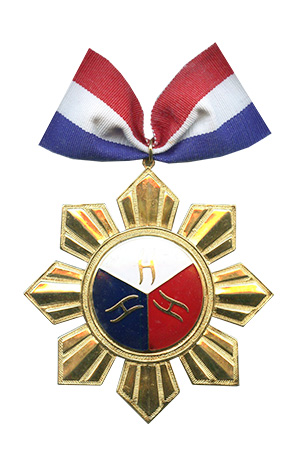
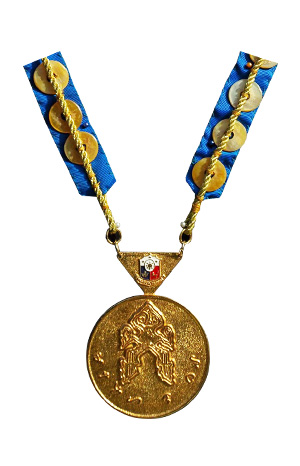
The emblem of the Gawad Mabini features a stylized Romanian Cross with a central red triangle adorned with stars at each corner, showcasing the likeness of Apolinario Mabini.

Encircling this central design are three stylized letter Ks. The medal for recipients of the Grand Cross is crafted from silver gilt, while for those awarded Commander and Member ranks, it is fashioned from gilded bronze or copper. The ribbon consists of three equal stripes in red, yellow, and blue, reminiscent of the colors found in the Philippine flag.

The National Living Treasures Award

The National Living Treasures Award is conferred to artists for their contributions to the country’s intangible cultural heritage.

The National Living Treasures Award, also known as the Gawad sa Manlilikha ng Bayan (GAMABA), is a recognition conferred by the Government of the Philippines upon individuals or groups of artists for their significant contributions to the nation’s intangible cultural heritage.

A recipient of this award, termed a National Living Treasure or Manlilikha ng Bayan, is described as “a Filipino citizen or group of Filipino citizens engaged in any traditional art uniquely Filipino, whose exceptional skills have attained a high level of technical and artistic excellence and have been transmitted to and widely practiced by present generations within their community with the same level of technical and artistic proficiency.”

The initiative began in 1988 with the establishment of the National Folk Artists Award by the Rotary Club of Makati-Ayala. However, this recognition ceased after 1992 when it was supplanted by the GAMABA Law. Notably, individuals recognized with the National Folk Artists Award from 1988 to 1992 are not formally acknowledged by the government, as the award was conferred by a private entity.

The National Living Treasures Award Eligibility

To qualify as a National Living Treasure, an individual must meet the following criteria:

  • Residency: Resides within an indigenous or traditional cultural community across the Philippines that has preserved its indigenous customs, beliefs, rituals, and traditions, or has amalgamated external influences while retaining its distinctiveness.
  • Artistic Tradition: Engages in a folk art tradition that has a documented history of at least 50 years.
  • Consistency: Demonstrates a consistent and prolonged commitment to producing works of exceptional and unique quality over a significant period.
  • Mastery: Exhibits a high level of expertise in utilizing the necessary tools and materials for their craft and enjoys a recognized reputation as a master and creator of works of outstanding technical prowess.
  • Transmission of Skills: Actively imparts, or intends to impart, their skills in the folk art to other members of the community, thereby ensuring the continuity of the community’s traditional art form.

The National Scientist of the Philippines Medal

The National Scientist of the Philippines Medal was introduced in 1978 and is the highest award accorded to Filipino scientists.

The Order of National Scientists of the Philippines, also referred to as ONS, stands as the highest distinction bestowed upon Filipino scientists by the Philippine government. Those recognized with this honor are recognized as National Scientists (Pambansang Alagad ng Agham).

Established on December 16, 1976, by President Ferdinand Marcos via Presidential Decree Nos. 1003 and 1003-A, which also gave rise to the National Academy of Science and Technology, the award carries significant prestige. According to the decree, a scientist is defined as someone who holds a doctoral degree in any scientific field and has showcased distinction through independent research or notable innovative accomplishments in various scientific domains, including agriculture, engineering, medical sciences, mathematics, and social sciences, as evidenced by published works in reputable scientific and technical journals. The status of the award was elevated to that of an order in 2003.

The National Scientist of the Philippines Medal Eligibility

The nomination and selection process fall under the jurisdiction of the National Academy of Science and Technology, comprised of Filipino scientists. Annually, the Academy recommends a maximum of 10 scientists to the President of the Philippines for the prestigious title of National Scientist.

Ultimately, it is the President who makes the final decision, based on the distinguished individual or collaborative achievements in science and technology demonstrated by the nominees.

The National Artist of the Philippines Medal

The National Artist of the Philippines Medal was established in 1972 and is bestowed on Philippine nationals for significant contributions.

The Order of National Artists of the Philippines (or Orden ng mga Pambansang Alagad ng Sining ng Pilipinas in Tagalog) is a prestigious distinction granted by the President of the Philippines to Filipino nationals who have significantly contributed to the advancement of Philippine art. These distinguished individuals, known as National Artists, were initially recognized through an Award, which was later elevated to the status of an order in 2003.

Administered by the Cultural Center of the Philippines and the National Commission for Culture and the Arts, this order was established under President Ferdinand Marcos’s Proclamation № 1001 dated April 2, 1972. The first recipient of this recognition was the renowned Filipino painter Fernando Amorsolo.

National Artists are those who have demonstrated exceptional achievement and impact in their respective artistic fields. Candidates for this honor must undergo a rigorous selection process, including recommendations from both the Cultural Center and the National Commission for Culture and the Arts, before being officially conferred the Award. Following a Presidential Proclamation, these individuals are designated as National Artists (Filipino: Gawad Pambansang Alagad ng Sining) and are welcomed into the Order.

The National Artist of the Philippines Medal Eligibility

Originally, the categories for recognizing National Artists encompassed various fields, including:

  • Music: including singing, composition, direction, and/or performance;
  • Dance: covering choreography, direction, and/or performance;
  • Theater: involving direction, performance, and/or production design;
  • Contemporary Arts: spanning painting, sculpture, printmaking, photography, installation art, mixed media works, illustration, graphic arts, performance art, and/or imaging;
  • Literature: comprising poetry, fiction, essay, playwriting, journalism, and/or literary criticism;
  • Film and Broadcasting/Broadcast Arts: encompassing direction, writing, production design, cinematography, editing, camera work, and/or performance; and
  • Architecture, Design, and Allied Arts: which includes architecture design, interior design, industrial arts design, landscape architecture, and fashion design.

The Outstanding Achievement Medal

The Outstanding Achievement Medal is a single grade decoration of the Philippines awarded by the Secretary of National Defense.

The Outstanding Achievement Medal is a singular-grade honor in the Philippines bestowed by the Secretary of National Defense to members of the Armed Forces of the Philippines and civilians alike. It may also be conferred upon civilians and military personnel from allied foreign nations.

The award is designated “…for distinguished or exceptional accomplishments or service in the promotion of science, or in socio-economic, technical, or military sectors associated with national defense, or for exemplary public service.

The Outstanding Achievement Medal Design

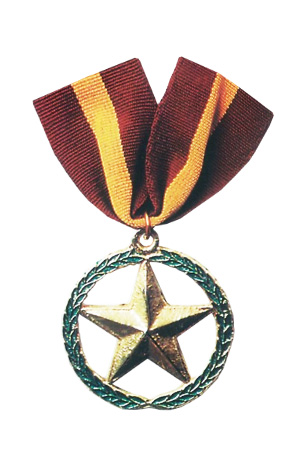
The medal features a gold star encircled by a gold wreath, symbolizing exceptional accomplishment and honor, respectively. It is worn suspended from a ribbon around the neck.

The ribbon itself is purple with a prominent gold stripe running through its center.

The Philippines Armed Forces Medal of Valor

The Philippines Armed Forces Medal of Valor was established in 1935 and is awarded for a conspicuous deed of personal bravery.

The Medal of Valor (or Medalya ng Kagitingan in Filipino) stands as the highest military honor bestowed by the Armed Forces of the Philippines, recognizing acts of exceptional bravery and selflessness that surpass the call of duty, setting the recipient apart from their comrades.

Defined within the Philippine Army Awards and Decorations reference material FC 1–0062, adapted from the Armed Forces of the Philippines Awards and Decorations Handbook, Second Edition published in 1997, this prestigious award is reserved for “heroism in combat” and holds paramount importance in the order of precedence of awards and decorations of the Armed Forces of the Philippines.

Conferred by the President of the Philippines, the Medal of Valor is presented to members of the Armed Forces of the Philippines and allied military personnel, including recognized guerrilla forces. Such is the esteem in which the medal is held that the President is required to salute both the medal and the individual adorned with it.

According to Philippine Republic Act No. 9049, recipients of the Medal of Valor are entitled to a lifetime monthly gratuity of ₱20,000, separate from any salary or pension provided by the government. President Rodrigo Duterte increased this monthly gratuity to ₱75,000 in 2016, underscoring the nation’s enduring gratitude for acts of extraordinary courage and sacrifice.

The Philippines Armed Forces Medal of Valor Design

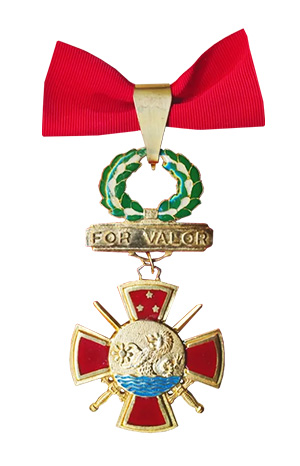
The medal features a disc adorned with a raised golden sea-lion clutching the eight-rayed Philippine sun, surrounded by water waves depicted as five blue ripples. Positioned atop a red cross with golden borders are crossed golden swords, with the uppermost section of the cross adorned with three golden stars arranged in a triangular pattern.

Connecting the medal to a sampaguita wreath, comprised of ten white buds and twenty-two green leaves, is a golden bar inscribed with the phrase “For Valor.” This wreath serves as a link to the crimson neck ribbon, adorned with eight golden stars arranged horizontally in two parallel lines. Similarly, the service ribbon, worn in lieu of the medal itself, features a crimson hue with eight golden stars, aligned horizontally in two parallel lines, with five stars on the top line and three on the bottom.

While some sources refer to the medal as the “Medal For Valor” due to the phrase embossed on the bar, others, including official Philippine government sources, identify it as the “Medal of Valor.”

Symbolically, the sea-lion represents the Office of the President of the Philippines, while the eight-rayed sun signifies the eight Philippine provinces that rebelled against Spanish rule. The blue ripples symbolize the Armed Forces of the Philippines, while the crossed swords represent conflict with the enemy in defense of the nation. The three stars correspond to Luzon, Visayas, and Mindanao, the three island groups of the Philippines, and the sampaguita wreath signifies the highest honor for courage and gallantry. The red coloration symbolizes bravery.