The Order of the Lion of Malawi

The Order of the Lion of Malawi is the highest state order and the second-highest honor bestowed by the government of Malawi.

  • Time Period: Post-WW2
  • Institution: July 1966
  • Country: Malawi

The Order of the Lion of Malawi is the highest state order and the second-highest honor bestowed by the government of Malawi. 

The Order was established by President Hastings Kamuzu Banda in 1967 and held the distinction of being the second-highest honor conferred by the government of the Republic of Malawi during Banda’s presidential tenure (1966-94). It comprised five classes along with a medal, recognizing individuals “For distinguished and outstanding services to the people of Malawi.”

Banda unveiled the inception of the order alongside several other new accolades in July 1966, concurrent with Malawi’s transition to a republic. This proclamation took place in Zomba, then the capital of Malawi.

Both Malawian civilians and military personnel, as well as foreign nationals, were eligible for consideration for the order. However, in 2008, following three years of review, the Malawian government opted to deactivate the Order of the Lion, though existing appointees retained the privilege of wearing the insignia corresponding to their grade.

Order of the Lion Design

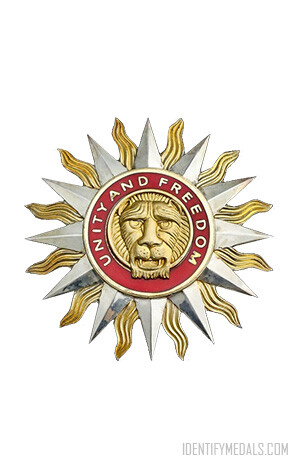
The insignia of the Order of the Lion takes the form of a cross, showcasing a central medallion depicting the visage of a lion, encircled by a red banner bearing the Malawian motto, “Unity and Freedom.” This design is consistent across the medals of higher grades within the order, where the lion medallion is overlaid onto a green enameled cross.

The ribbon of the order is adorned in red, flanked by two golden stripes running along each side.

Recipients of the Grand Commander and Grand Officer distinctions also receive a badge, which incorporates the lion medallion set against stars. The Grand Commander’s badge features twelve rays extending between the points of a twelve-pointed star, while the Grand Officer’s badge displays a ten-pointed star with alternating lengths, set atop an inverted pentagon.
The National Order of the Republic of Ivory Coast

The National Order of the Republic of Ivory Coast is the country’s highest state honor and awarded for high distinction.

  • Time Period: Post-WW2
  • Institution: 10 April 1961
  • Country: Ivory Coast

Established on April 10, 1961, the National Order of the Republic of Ivory Coast commemorates the independence of the country, formerly a French colony, achieved in 1960.

Serving as the nation’s premier state distinction, it is bestowed upon individuals who have demonstrated exceptional service to the state.

Notably, the prestigious collar of the Order is exclusively conferred upon foreign heads of state as a symbol of diplomatic recognition and honor.

The National Order of the Republic of Ivory Coast Design

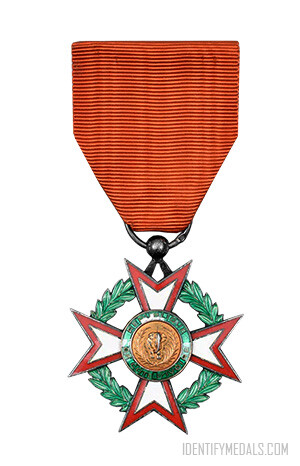
The Order’s medal features a white-enamelled cross of Malta, outlined in red, encircled by a wreath of laurel leaves in green. In the center of the cross lies a gold medallion depicting a frontal elephant, encircled by another laurel wreath, all set within a green-enamelled ring inscribed with “REPUBLIQUE DE COTE D’IVOIRE” (“Republic of Ivory Coast”) in gold.

Similarly, the plaque exhibits the identical design as the medal, with the cross positioned atop a silver radiating star.

The ribbon accompanying the order is a deep shade of orange.

The Order of Mono

The Order of Mono is the highest order of chivalry in Togo. It is conferred upon Togolese civilians and military personnel.

  • Time Period: Post-WW2
  • Institution: 2 September 1961
  • Country: Togo

Founded in Togo in 1961, the Order of Mono is awarded for distinguished service to the nation and contributions to the promotion of national unity, democracy, and development. It is named after the Mono River, which flows through Togo and forms part of its border with Benin.

The Order of Mono was established on September 2, 1961, by President Sylvanus Olympio. It has five grades:

  • Grand Cross
  • Grand Officer
  • Commander
  • Officer
  • Knight

Only a limited number of Togolese citizens can be appointed to, and hold, each grade at any one time. The grade of Knight is limited to 1000 Togolese, 500 for Officer, 100 for Commander, 50 for Grand Officer and 10 for Grand Cross. Honorary awards, given to foreign nationals, do not count towards these limits.

The Order of Mono Design

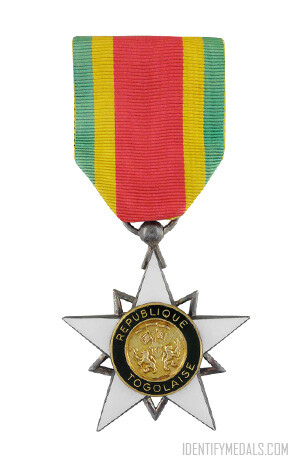
Crafted in silver gilt with white and green enamels. On the obverse side, a circular central medallion displays the arms of the Togolese Republic, encircled by a green enamel ring inscribed with “Republique Togolaise” (Togolese Republic).

The reverse side features a plain gilt surface with a circular central medallion bearing the inscription “Travail Liberté Patrie” (Work, Liberty, Country).

The Order of the Star of Ghana

The Order of the Star of Ghana is a Ghanaian award given to individuals who have helped the cause of the country.

  • Time Period: Post-WW2
  • Institution: 1 July 1960
  • Country: Ghana

The Order of the Star of Ghana is the second-highest honor conferred by the Government of Ghana upon individuals who have contributed significantly to the country.

Those bestowed with this award are honored during a state ceremony presided over by the President of the Republic.

Previously the highest national honor, the Order of the Star of Ghana was succeeded by the Grand Order of the Star and Eagles of Ghana on June 23, 2008.

The order has three grades:

  • Companion (CSG) – Honorary Division, Civil Division.
  • Officer (OSG) – Honorary Division, Civil Division, Military Division.
  • Member (MSG) – Honorary Division, Civil Division, Military Division, Police Division.

The Order of the Star of Ghana Design

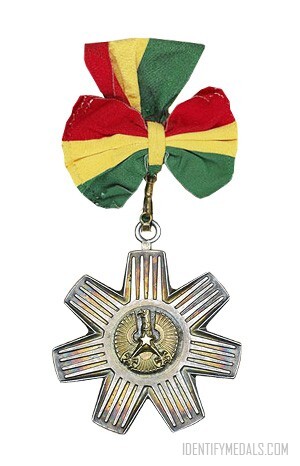
The badge comprises a star with seven bold points centered around an eagle and a five-pointed star.

The ribbon features three colors: green, yellow, and red.

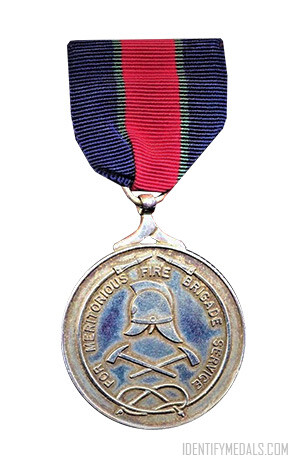
The Nigerian Fire Service Meritorious Service Medal

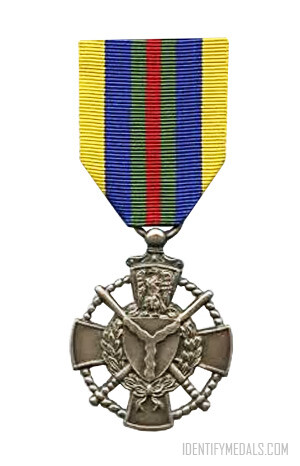
The Nigerian Fire Service Meritorious Service Medal is a decoration awarded to members of the fire service for long and devoted service.

The Nigerian Fire Service Meritorious Service Medal is a decoration awarded to members of the fire service for long and devoted service.

All the medals of the Nigerian Fire Services were instituted by a Warrant dated 28 February 1974. 

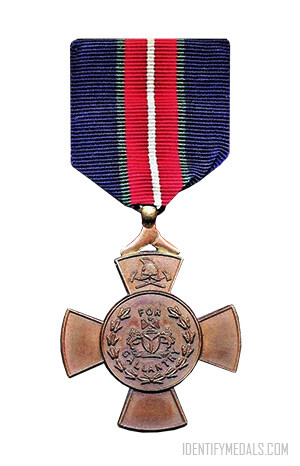
The Nigerian Fire Service Cross

The Nigerian Fire Service Cross is a Nigerian decoration awarded to members of the fire service for conspicuous acts of gallantry.

The Nigerian Fire Service Cross is a Nigerian decoration awarded to members of the fire service for conspicuous acts of gallantry in the course of duty. The award is available to Officers and Other Ranks.

All the medals of the Nigerian Fire Services were instituted by a Warrant dated 28 February 1974. 

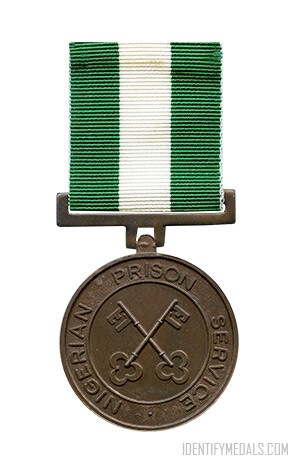
The Prisons Service Meritorious Service Medal

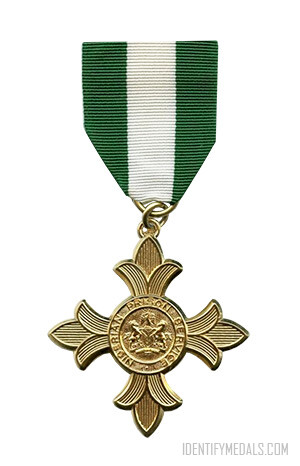
The Prisons Service Meritorious Service Medal is a decoration awarded to prison officers for long and devoted service.

The Prisons Service Meritorious Service Medal is a decoration awarded to members of the prison service for long and devoted service characterised by exceptional ability and exemplary record.

The Nigerian Correctional Service (NCoS), formerly referred to as the Nigerian Prison Service (NPS), is a governmental body in Nigeria responsible for managing prisons. Situated in Abuja, it operates under the jurisdiction of the Ministry of the Interior and the Civil Defence Immigration and Correctional Service. President Muhammadu Buhari officially changed its name from the Nigerian Prisons Service to the Nigerian Correctional Service on August 15, 2019, following the enactment of the Nigerian Correctional Service Act of 2019.

The Police Meritorious Service Medal (Nigeria)

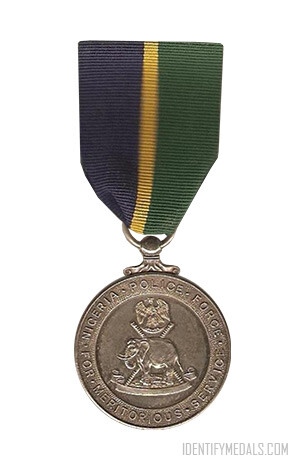
The Police Meritorious Service Medal is a Nigerian decoration awarded to members of the police force for long and devoted service.

The Police Meritorious Service Medal is a Nigerian decoration awarded to members of the police force for long and devoted service.

Awardees must also display exceptional ability and exemplary record.

The Nigeria Police Force serves as the primary law enforcement and leading security agency in Nigeria. Established by the 1999 constitution as the national police with exclusive jurisdiction across the nation, it boasts a staff strength of approximately 371,800 as of 2016.

Currently, the force is under the leadership of IGP (Inspector General) Kayode Egbetokun. Major reforms were implemented in 2020, signifying significant changes within the organization.

The Nigeria Police Star

The Nigeria Police Star is a decoration awarded to members of the police force for conspicuous acts of gallantry in the course of duty.

The Nigeria Police Star is a decoration awarded to members of the police force for conspicuous acts of gallantry in the course of duty.

The Nigeria Police Force serves as the primary law enforcement and leading security agency in Nigeria. Established by the 1999 constitution as the national police with exclusive jurisdiction across the nation, it boasts a staff strength of approximately 371,800 as of 2016. Plans are underway to expand the force to 650,000, including the addition of 280,000 new recruits to the existing 370,000.

Organized into 36 State commands and the Federal Capital Territory (FCT), it operates within 17 zones and 8 administrative units. Currently, the force is under the leadership of IGP (Inspector General) Kayode Egbetokun. Major reforms were implemented in 2020, signifying significant changes within the organization.

The Nigerian Prison Service Cross

The Nigerian Prison Service Medal is a decoration awarded to members of the prison service for conspicuous acts of gallantry.

The Nigerian Prison Service Cross is a decoration awarded to members of the prison service for conspicuous acts of gallantry in the course of duty.

The Nigerian Correctional Service (NCoS), formerly referred to as the Nigerian Prison Service (NPS), is a governmental body in Nigeria responsible for managing prisons. Situated in Abuja, it operates under the jurisdiction of the Ministry of the Interior and the Civil Defence Immigration and Correctional Service. President Muhammadu Buhari officially changed its name from the Nigerian Prisons Service to the Nigerian Correctional Service on August 15, 2019, following the enactment of the Nigerian Correctional Service Act of 2019.