The New Zealand Gallantry Star

The New Zealand Gallantry Star (or NZGS) was created in 1999 and is the second-level military decoration of the New Zealand armed forces.

The New Zealand Gallantry Star (NZGS) holds the position of the second-highest military decoration within the New Zealand armed forces.

Its establishment came through a Royal Warrant on September 20, 1999, marking a significant step toward replacing British gallantry awards with a distinctly New Zealand Gallantry system. This distinguished medal, which can also be awarded posthumously, is conferred in recognition of “acts of outstanding gallantry in situations of danger” that occur during war, warlike operational service, and even peacekeeping missions.

Bars, or additional recognitions, can be added to the NZGS to acknowledge further acts of gallantry deserving of this prestigious award. Those honored with the New Zealand Gallantry Star are entitled to use the postnominal letters “N.Z.G.S.”

This medal effectively replaced the Distinguished Service Order (when awarded for gallantry), the Distinguished Conduct Medal, and the Conspicuous Gallantry Medal, signifying a shift towards a more indigenous New Zealand system of recognizing gallantry.

The New Zealand Gallantry Star Design

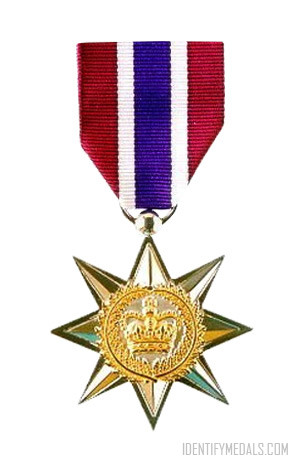
The New Zealand Gallantry Star measures 45mm in diameter.

The obverse is a faceted silver eight-pointed star of equal points surmounted by the Royal Crown and fern frond wreath emblem. The reverse has the inscription “FOR GALLANTRY – MO TE TOANGA“.

The suspension is a ring suspension.

Find This Medal

Right Now on eBay 
Clicking a link to eBay may result in a referral commission being paid if a purchase is made.
Loading...

The New Zealand Order of Merit

The New Zealand Order of Merit was an order of merit established by royal warrant on 30 May 1996 by Elizabeth II, Queen of New Zealand.

The New Zealand Order of Merit is a prestigious order of merit within New Zealand’s royal honors system. Queen Elizabeth II of New Zealand established it through a royal warrant on May 30, 1996.

This order is bestowed upon individuals who have provided commendable service to the Crown and the nation across various fields of endeavor. It recognizes outstanding contributions, talents, and merits, both in civil and military roles, symbolizing exceptional dedication to the people of New Zealand.

In terms of precedence, the New Zealand Order of Merit holds a position immediately following the Order of New Zealand in the hierarchy of honors.

The New Zealand Order of Merit Classes

The Sovereign of New Zealand serves as the titular head of the order, while the Chancellor of the order is the governor-general. Appointments to the order are made across five distinct levels:

  • Knight or Dame Grand Companion (GNZM)
  • Knight or Dame Companion (KNZM or DNZM)
  • Companion (CNZM)
  • Officer (ONZM)
  • Member (MNZM)

Between 2000 and 2009, the highest levels of the Order were known as Principal Companion (PCNZM) and Distinguished Companion (DCNZM), without the use of “Sir” or “Dame” titles.

The total number of Knights and Dames Grand Companion (including Principal Companions) is capped at 30 living individuals. Additionally, there are annual limits for new appointments, which stand at 15 Knights or Dames Companion, 40 Companions, 80 Officers, and 140 Members.

In addition to the five levels, the order features three distinct types of membership. Ordinary membership is exclusively available to citizens of New Zealand or a Commonwealth realm. “Additional” members, appointed for special occasions, do not count towards the numerical limits. Individuals who are not citizens of a Commonwealth realm may receive “Honorary” membership, and if they subsequently adopt citizenship from a Commonwealth realm, they become eligible for Additional membership.

The New Zealand Order of Merit Design

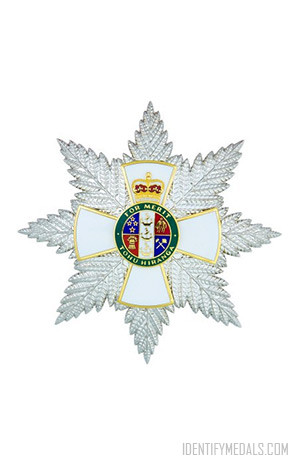
For the three highest classes of the Order, the badge is fashioned as a cross with gently curved edges, crafted from gold and white enamel. At its center, in the obverse, is the New Zealand coat of arms enclosed within a green enamel ring bearing the motto “For Merit Tohu Hiranga,” all crowned by a regal crown.

Officers and Members receive badges in similar designs, but in silver-gilt and silver, respectively.

The collar of the Order, an exclusive adornment worn solely by the Sovereign and Chancellor, consists of interconnected links featuring the central medallion of the order’s badge and “S”-shaped Koru designs. In the center of this arrangement is the New Zealand coat of arms. Dangling from the coat of arms is the order’s badge.

The star of the Order takes the form of an eight-pointed star, with each arm intricately designed to resemble a fern frond. At the heart of this star, the Order’s badge is prominently displayed. Grand Companions proudly wear a gold star, while Knight Companions don a silver one.
The wearing of these badges varies by class: Grand Companions wear theirs on a sash over the right shoulder, although the Governor-General often opts to wear it as a neck decoration instead of the Collar. Knight Companions and Companions don their badges on a neck ribbon (for men) or a bow on the left shoulder (for women), while Officers and Members wear theirs from a ribbon on the left lapel (for men) or a bow on the left shoulder (for women).

The ribbon and sash, on the other hand, are simple and unadorned, featuring a plain red ochre color.

Find This Medal

Right Now on eBay 
Clicking a link to eBay may result in a referral commission being paid if a purchase is made.
Loading...

The Order of New Zealand

The Order of New Zealand was created to recognize outstanding service and is the highest honor in the New Zealand royal honors system.

The Order of New Zealand represents the pinnacle of recognition within the New Zealand royal honors system. It was established on February 6, 1987, through a royal warrant, this prestigious order is designed to honor individuals who have demonstrated exceptional service to both the Crown and the people of New Zealand, whether in civil or military roles.

Appointments to the Order are made through a royal warrant under the monarch’s sign manual, following the prime minister’s advice. The order’s administration is overseen by a Secretary and Registrar, who holds the role of Clerk of the Executive Council.

The Order of New Zealand Classes

The Order of New Zealand consists of three classes categories of members:

  • Sovereign
  • Ordinary
  • Honorary

The ordinary membership is limited to 20 living members, although this number can be lower at any given time. Additional members may be appointed to commemorate significant royal, state, or national events, such as anniversaries or jubilees. Notable occasions for these appointments include the Treaty of Waitangi’s 150th anniversary in 1990, the Queen’s Golden Jubilee in 2002, the 20th anniversary of the Order’s institution in 2007, the Queen’s Diamond Jubilee in 2012, the Queen’s Platinum Jubilee in 2022, and the coronation of King Charles III in 2023. Additional members share the same status as ordinary members.

Honorary membership is extended to citizens of countries where the Sovereign is not the head of state. All members, regardless of category, are entitled to use the post-nominal letters “ONZ.”

The Order of New Zealand Design

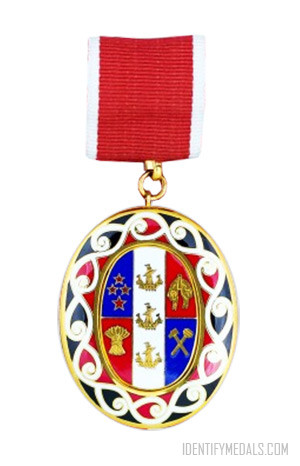
The insignia of the Order features an oval-shaped medallion adorned with the New Zealand coat of arms in brilliant gold and vibrant enamel colors. It is traditionally worn suspended from a white and ochre ribbon around the neck for men, while women wear it as a bow on their left shoulder.

The New Zealand Cross (1999)

The New Zealand Cross (1999) was instituted in 1999 and is New Zealand’s highest award for bravery, not in the face of the enemy.

The New Zealand Cross (NZC) stands as New Zealand’s highest honor for acts of extraordinary bravery, particularly in situations not involving combat. It was officially established through a Royal Warrant on September 20, 1999, as part of New Zealand’s efforts to create a distinct bravery award system, replacing British honors.

This prestigious medal, which can also be awarded posthumously, is bestowed in recognition of acts of immense bravery in situations of utmost peril. While primarily a civilian award, it is also conferred upon members of the armed forces who display remarkable courage in non-operational settings, as New Zealand’s gallantry awards are reserved for those involved in war or warlike operational service, including peacekeeping missions.

The addition of bars to the NZC acknowledges recipients’ repeated acts of bravery that warrant this distinguished award. Those honored with the New Zealand Cross are entitled to use the postnominal letters “NZC.” This medal took the place of the George Cross in recognizing acts of bravery within or deserving recognition from New Zealand. 

The Victoria Cross for New Zealand Design

The design of the New Zealand Cross draws inspiration from the original New Zealand Cross (1869), with the ribbon color altered to distinguish it from the Victoria Cross.

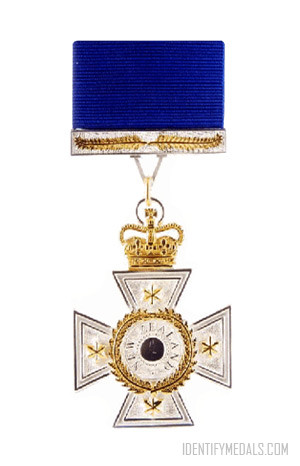
This distinctive decoration takes the form of a silver cross pattée, standing at 52 millimeters in height and 38 millimeters in width. Each of its arms is adorned with a gold six-pointed star, creating a striking visual contrast.

At the heart of the cross lies the inscription ‘New Zealand,’ encircled by a gracefully rendered gold fern wreath. Atop the cross, one finds the regal Saint Edward’s Crown in gold, affixed by a ring and a seriffed ‘V,’ which attaches it to a bar embellished with gold fern leaves, serving as a passage for the ribbon.

On the reverse side of the medal, the words “FOR BRAVERY – MO TE MAIA” are elegantly inscribed, symbolizing the valor and courage for which this distinguished award is granted.

Find This Medal

Right Now on eBay 
Clicking a link to eBay may result in a referral commission being paid if a purchase is made.
Loading...

The Victoria Cross for New Zealand

The Victoria Cross for New Zealand is a military decoration awarded members of the New Zealand Armed Forces for valor or gallantry.

The Victoria Cross for New Zealand (VC) is a prestigious military decoration presented for acts of valor or gallantry in the presence of the enemy, recognizing the courage of individuals within the New Zealand Armed Forces. This commendation is not bound by rank, encompassing all services and even civilians under military command.

Established in 1999, the Victoria Cross for New Zealand is part of New Zealand’s updated honors system, replacing several British awards with homegrown distinctions.

It draws its inspiration from the original British Victoria Cross, initially introduced by Queen Victoria in 1856 to acknowledge acts of valor during the Crimean War. Notably, the Victoria Cross for New Zealand has been awarded just once, on July 2, 2007, recognizing Lance Corporal Willie Apiata for his actions in 2004. The medal itself is crafted from gunmetal sourced from cannons seized by the British during 19th-century campaigns, possibly in Russia or China. Australia and Canada similarly feature their own versions of the Victoria Cross, serving as the highest accolades for gallantry within their respective military personnel.

The Victoria Cross for New Zealand Design

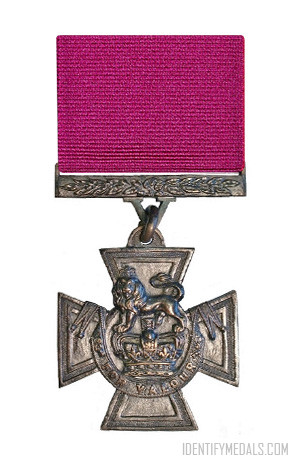
The Victoria Cross for New Zealand faithfully adheres to the original design of the Victoria Cross. This distinguished decoration takes the form of a cross pattée with straight edges, measuring approximately 36 millimetres (1.4 inches) in both width and height. At its center, the cross bears a crown, atop which rests a majestic lion, accompanied by the inscription “For Valour.”

The cross gracefully hangs from a ring, connected to a seriffed “V”-shaped bar adorned with laurel leaves, through which the crimson ribbon is threaded. On the reverse side of the suspension bar, one finds an engraved record of the recipient’s name, rank, number, and unit. The reverse of the medal features a circular panel at its center, displaying the date of the act for which it was bestowed.

The ribbon is crimson, measuring 38 millimetres (1.5 inches) in width.

Find This Medal

Right Now on eBay 
Clicking a link to eBay may result in a referral commission being paid if a purchase is made.
Loading...

Decoration for Meritorious Services (South Africa)

The Decoration for Meritorious Services was conferred until 1987 by the Government of the Republic of South Africa for political services.

The Decoration for Meritorious Services was an award granted until 1987 by the Government of the Republic of South Africa, typically in recognition of one’s political contributions to the nation. Appointments to this honor were made by the State President of South Africa.

Recipients of this distinction were entitled to use ‘DMS’ (or in Afrikaans, ‘DVD’) after their name. In 1986, it was succeeded by the Order for Meritorious Service.

Since June 1, 1994, this honor has been categorized as a Commonwealth distinction.

Decoration for Meritorious Services Design

The design featured a five-armed gold Maltese cross, with a golden protea flower at the center of a five-pointed diamond-studded star, all set against a multi-rayed silver and gold plaque on the obverse side. This decoration was worn suspended from a neck ribbon.

Find This Medal Online

Right Now on eBay 
Clicking a link to eBay may result in a referral commission being paid if a purchase is made.
Loading...

The Order of Good Hope

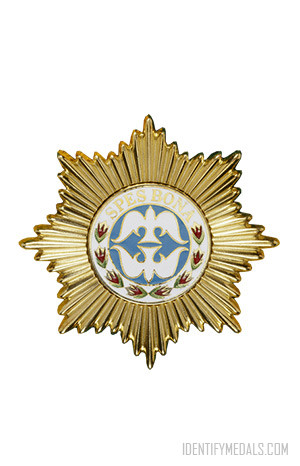
The Order of Good Hope is a dormant order of merit of the Republic of South Africa. It was founded in 1973 by the government.

The Order of Good Hope, also known as the Order of the Cape of Good Hope, is an inactive order of merit originating from the Republic of South Africa. Founded in 1973 by the South African government of that time, its purpose was to recognize individuals who had made significant contributions to fostering international relations and raising awareness about South Africa’s interests. However, the order was abolished in 2002.

The Order of Good Hope was bestowed upon foreign citizens, and between 1980 and 1988, it was briefly extended to South Africans as well, primarily for their efforts in promoting international relations during a time when South Africa was increasingly isolated due to its apartheid policies.

The Order of Hope Classes

Originally, the order was divided into five classes:

  1. Grand Collar – Exclusively for heads of state.
  2. Grand Cross – Reserved for heads of government, ministers of state, judges, presidents of legislatures, secretaries of state, ambassadors, commanders-in-chief, and others.
  3. Grand Officer – Intended for legislators, envoys, senior military officers, and similar roles.
  4. Commander – Designated for chargés d’affaires, consuls-general, colonels, and comparable positions.
  5. Officer – Awarded to consuls, lower-ranking military officers, and others.

The order underwent reorganization in 1988, resulting in the following structure:

  1. Grand Cross – Recognizing excellent meritorious service, primarily for heads of state, and on special occasions, heads of government.
  2. Grand Officer – Reserved for outstanding meritorious service, encompassing heads of government, ministers of state, judges, presidents of legislatures, secretaries of state, ambassadors, commanders-in-chief, and others.
  3. Commander – Acknowledging exceptionally meritorious service by legislators, envoys, senior military officers, and similar roles.
  4. Officer – Commending meritorious service performed by chargés d’affaires, consuls-general, colonels, and comparable positions.
  5. Member – Honoring exceptional service rendered by consuls, lower-ranking military officers, and others.

The Order of Hope Design

President Nelson Mandela had expressed his intent to reform the Order, as the newly established South African government viewed it as a relic of apartheid. One key concern was that the order’s insignia was deemed too European in design, featuring rays, colors, an anchor, and a Latin motto. Additionally, the cost of the insignia for each initiate amounted to approximately 11,000 rand. Consequently, the Order of the Companions of O. R. Tambo was established in its stead.

Find This Medal Online

Right Now on eBay 
Clicking a link to eBay may result in a referral commission being paid if a purchase is made.
Loading...

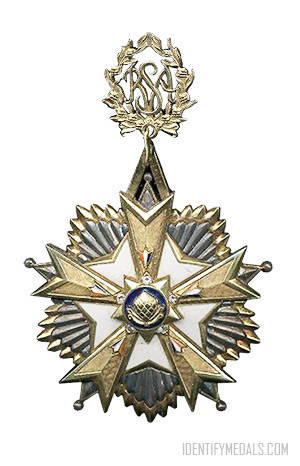
The Order of the Star of South Africa

The Order of the Star of South Africa is a South African National Order instituted by the Republic of South Africa and discontinued in 2002.

The Order of the Star of South Africa, a South African National Order, featured seven distinct decorations across both military and non-military categories. Established on July 1, 1975, by the Republic of South Africa, these decorations were awarded by the State President and, beginning in 1994, the President of South Africa. They were bestowed upon general and flag officers of the South African Defence Force in recognition of their outstanding contributions to national defense and security. This order replaced the 1952 Star of South Africa decoration and later included a civilian division in 1978.

The order drew its name from the Star of South Africa, the first significant diamond discovered in South Africa in 1869, along the banks of the Orange River. This discovery ignited the New Rush and led to the establishment of Kimberley.

Initially, the order exclusively recognized military merit, with two distinct classes:

  • The Star of South Africa, Gold (post-nominal letters SSA): Awarded for meritorious military service that enhanced the efficiency and readiness of the South African Defence Force, contributing significantly to national security.
  • The Star of South Africa, Silver (post-nominal letters SSAS): Recognizing exceptionally meritorious service of major military importance.

However, the order was discontinued on December 2, 2002, concluding its legacy of honoring those who played crucial roles in South Africa’s defense and security.

The Order of the Star of South Africa Design

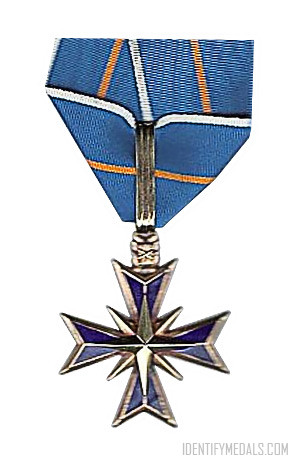
The order’s obverse side features a gold or silver Maltese cross adorned with blue enamel. Two four-pointed stars are layered atop one another and upon the cross, with a central diamond. The pre-1994 South African Coat of Arms is depicted on the reverse side. In the SSA and SSAS classes of both divisions, protea flowers are positioned between the cross’s arms.

Each class possesses its distinct ribbon, with the first three classes worn around the neck and the others on the chest. Within the military division, the SSA ribbon is a plain dark blue, while the SSAS ribbon combines dark blue with a white central band. Until 1988, the Star of South Africa, Gold also featured a gold neck chain for ceremonial events.

In the non-military division, the ribbons exhibit dark blue with various combinations of orange and white bands:

  • Orange edges for the SSA.
  • White edges for the SSAS.
  • White edges and an orange center band for the CSSA.
  • White edges and an orange center band flanked by two white bands for the OSSA.
  • White edges with three white center bands for the MSSA.

Recipients of the SSA and SSAS classes also wear eight-pointed breast stars, showcasing the decoration’s obverse.

Find This Medal Online

Right Now on eBay 
Clicking a link to eBay may result in a referral commission being paid if a purchase is made.
Loading...

The Woltemade Decoration for Bravery

The Woltemade Decoration for Bravery is a South African civil decoration for acts of bravery and was discontinued in 1961.

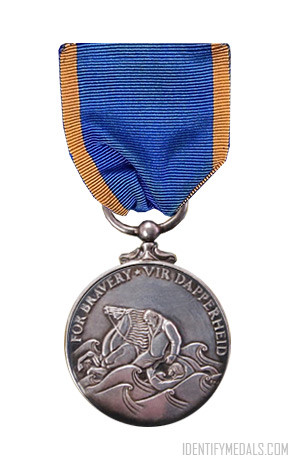
The Woltemade Decoration for Bravery is a South African civil decoration awarded for acts of bravery. It replaced the King’s Medal for Bravery, Silver and Queen’s Medal for Bravery. The award of which was discontinued in South Africa in 1961.

The Silver Woltemade Decoration for Bravery was established by the Republic of South Africa in 1970 through a Warrant dated May 20, 1970, as published in Government Gazette no. 2718 on May 29, 1970. Subsequently, the Warrant was modified twice, on November 11, 1971, and May 30, 1973, to broaden the criteria for eligibility for this decoration.

The decoration pays tribute to the heroic act of Wolraad Woltemade, an elderly employee of the Dutch East India Company. On June 1, 1773, he sacrificed his life to save shipwrecked sailors in Table Bay. During a powerful Northwestern gale, the ship De Jonge Thomas lost its anchor and was pushed ashore at the Salt River Mouth. Woltemade courageously rode his horse into the turbulent sea seven times, rescuing surviving sailors with each trip. Tragically, during his eighth rescue attempt, Woltemade and his exhausted horse were overwhelmed by panicked sailors and succumbed to the sea.

The Woltemade Decoration for Bravery Design

The decoration is crafted from silver, measuring 38 millimeters in diameter, featuring a raised rim and a sizable ring suspender.

On the obverse side, it showcases Wolraad Woltemade on his horse amidst the waves, with the words “FOR BRAVERY • VIR DAPPERHEID” encircling the upper perimeter. This design mirrors the one used on the earlier King’s and Queen’s Medals for Bravery, Silver.

The reverse side displays the South African Coat of Arms’ crest, where a lion holds four staves, symbolizing the four provinces of the Republic of South Africa. Surrounding the crest is a wreath of proteas, encircled by the inscriptions “REPUBLIEK VAN SUID-AFRIKA” above and “REPUBLIC OF SOUTH AFRICA” below.

The ribbon, 44 millimeters wide, is predominantly blue with 4 millimeters wide light orange edges. 

Find This Medal Online

Right Now on eBay 
Clicking a link to eBay may result in a referral commission being paid if a purchase is made.
Loading...

The Air Force Cross

The Air Force Cross is the United States Air Force and the United States Space Force’s second-highest military decoration.

The Air Force Cross is a prestigious military decoration awarded by the United States Air Force. It is presented to members of the U.S. Air Force who have demonstrated extraordinary heroism and valor in combat situations. Established in 1960, the Air Force Cross is the second-highest military award specifically for Air Force personnel, ranking below the U.S. Medal of Honor.

The Air Force Cross recognizes acts of exceptional courage and bravery performed by individuals while involved in military operations against an enemy force. It honors those who have displayed selflessness, dedication, and extraordinary leadership in the face of great danger. The recipients of the Air Force Cross have often risked their lives above and beyond the call of duty to protect their fellow servicemembers and achieve mission objectives.

The Air Force Cross Medal Criteria

The criteria for receiving the Air Force Cross are stringent, requiring evidence of extraordinary heroism that is not quite at the level required for the Medal of Honor. The actions for which the Air Force Cross is awarded must be of great significance and involve personal risk, demonstrating bravery and valor beyond what is expected in the normal course of duty.

Similar to other military awards, the Air Force Cross is usually accompanied by a citation that describes in detail the recipient’s heroic actions. These narratives serve to honor the individual’s extraordinary deeds and provide a lasting tribute to their courage and commitment to duty.

The Air Force Cross Medal Design

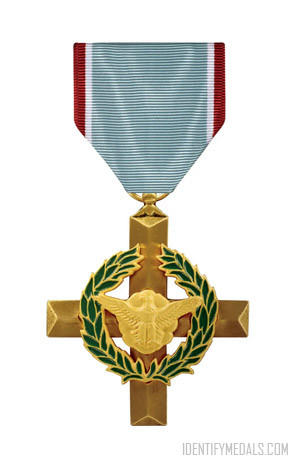
The Air Force Cross is composed of a bronze cross featuring an oxidized satin finish. Adorning the center of the cross, on the obverse, is a gold-plated American bald eagle, its wings displayed against a backdrop of clouds inspired by the crest of the Department of the Air Force Seal. The eagle is encompassed by a laurel wreath, delicately finished with green enamel. On the reverse side of the medal, there is no design, allowing for personalization through engraving. Recipients’ rank (abbreviated), first name, middle initial, last name, and branch of service can be engraved in capital letters.

The ribbon associated with the Air Force Cross, serving as both the decoration’s ribbon and service ribbon, displays a vibrant Brittany blue hue. The edges of the ribbon are adorned with a striking red border, while a slim white vertical stripe resides within the red edges. The ribbon closely resembles the one used for the Army’s Distinguished Service Cross, with the exception of a lighter blue center stripe. This subtle variation in color signifies the close connection between these distinguished awards.

Right Now on eBay 
Clicking a link to eBay may result in a referral commission being paid if a purchase is made.
Loading...