Order of Cultural Merit

The Order of Cultural Merit is a Brazilian honor established in 1991 and bestowed by the Ministry of Culture for contributions to culture.

The Order of Cultural Merit (or Ordem do Mérito Cultural in Portuguese) is a Brazilian honor established in 1991 and bestowed by the Ministry of Culture for contributions to Brazilian culture. The order can be given to national and foreign personalities and bodies, private and public.

The recipients of the Order of Cultural Merit are selected by a Council composed of the Minister of State for Culture (as Chancellor) and the Ministers of State for Education, Science, Technology and Innovation, and Foreign Affairs. 

Since 1995, over 500 personalities have been honored in the three classes of the Order of Cultural Merit (60 institutions have also received the medal without grade classes).

Classes of the Order of Cultural Merit

The Order of Cultural Merit has three ranks of merit:

  • Order of Cultural Merit - Grand Cross (Brazil) - ribbon bar.png Grand Cross (Grã-Cruz)
  • Order of Cultural Merit - Commander (Brazil) - ribbon bar.png Commander (Comendador)
  • Order of Cultural Merit - Knight (Brazil) - ribbon bar.png Knight (Cavaleiro)

The National Order of Cultural Merit Medal Design

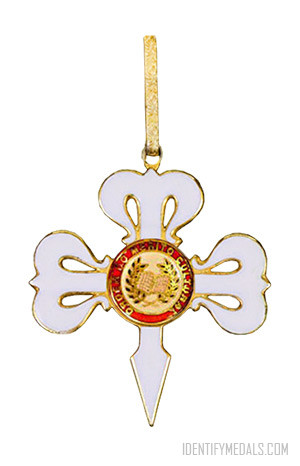
The insignia of the Order of Cultural Merit is a cross of St. James of the Sword enameled and profiled in white gold. In the center is an open book carved gold over a laurel wreath surrounded by the legend “Ordem do Mérito Cultural”.

The Grand Cross of the order is a purple band with the insignia on the loop and a gold glow under the banner. The commander’s insignia hangs on the center and the Knight’s has a ribbon with the insignia on the tip end. 
Order of Rio Branco

The Order of Rio Branco is a Brazilian award established in 1963 and named in honor of the Brazilian Baron of Rio Branco.

The Order of Rio Branco (or Ordem de Rio Branco in Portguese) is a Brazilian award established on 5 February 1963 and named in honor of Brazilian diplomat José Paranhos, Baron of Rio Branco.

The Order of Rio Branco is usually granted to personnel of the Brazilian Foreign Ministry or to foreigners for achievements in diplomacy.

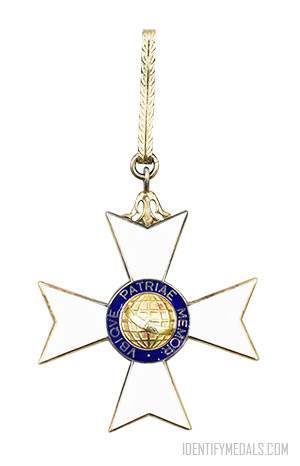
The Grand Master of the Order is the President of Bazil, and the order’s Chancellor is the Minister of Foreign Affairs. The motto of the order is “UBIQUE PATRIAE MEMOR”.

Classes of the Order of Rio Branco

The Order of Rio Branco has six ranks of merit:

  • BRA Ordem de Rio Branco Gra-Cruz BAR.svg Grand Cross (Grã-Cruz)
  • BRA Ordem de Rio Branco Grande Oficial BAR.svg Grand Officer (Grande-Oficial)
  • BRA Ordem de Rio Branco Comendador BAR.svg Commander (Comendador)
  • BRA Ordem de Rio Branco Oficial BAR.svg Officer (Oficial)
  • BRA Ordem de Rio Branco Cavaleiro BAR.svg Knight (Cavaleiro)
  • BRA Medalha do Merito de Rio Branco BAR.svg Medal 

The National Order of Rio Branco Medal Design

The ribbon of the Brazilian Order of Rio Branco is blue with white eddes.

Order of Defence Merit (Brazil)

The Order of Defence Merit is a Brazilian award established in 2002 and presented for exceptional military service.

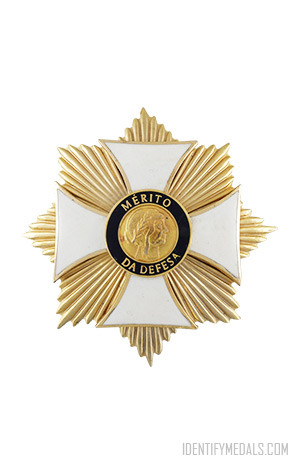
The Order of Defence Merit (or Ordem do Mérito da Defesa in Portuguese) is a Brazilian award established on 10 June 2002 and presented for exceptional military service and contributions to the country. The Order of Defence Merit was presented by presidential decree to replace the Order of Merit of the Armed Forces.

The award can be given to members of the Brazilian Military and friendly nations’ armies. In some cases, it’s also been awarded to civilians, institutions, and organizations.

In order of precedence, the Order of Defence Merit is the second-most important award in the country.

Classes of the Order of Defence Merit

The Order of Defence Merit has five grades:

  • BRA OMFA - OMD Gra-Cruz BAR.svg Grand Cross (Grã-Cruz)
  • BRA OMFA - OMD Grande-Oficial BAR.svg Grand Officer (Grande-Oficial)
  • BRA OMFA - OMD Comendador BAR.svg Commander (Comendador)
  • BRA OMFA - OMD Oficial BAR.svg Officer (Oficial)
  • BRA OMFA - OMD Cavaleiro BAR.svg Knight (Cavaleiro)

The National Order of Defence Merit Medal Design

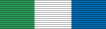
The ribbon of the Brazilian Order of Defence Merit has three equal bars in green, white, and blue.

National Order of Scientific Merit (Brazil)

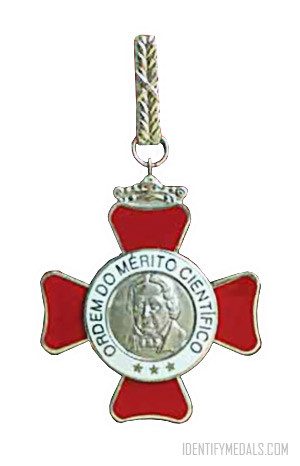
The National Order of Scientific Merit is a Bazilian honor bestowed upon personalities recognized for scientific and technical contributions.

The National Order of Scientific Merit (or Ordem Nacional do Mérito Científic in Portuguese) is a Bazilian honor bestowed upon personalities recognized for scientific and technical contributions. It was  instituted on March 16, 1993, by Decree no. 772 and updated on February 6, 2002, by Decree no. 4.115. 

The order can be awarded to Brazilian and foreign personalities that have helped the cause and development of science in Brazil. 

The honor is given by the Grand Master of the Order on 13 June of each year. The date celebrates the birth of José Bonifácio de Andrada e Silva, a Brazilian statesman, professor, and poet and one of the most important mentors of Brazil’s independence.

Classes of the National Order of Scientific Merit

The Order of Scientific Merit has just two grades:

  • National Order of Scientific Merit - Grand Cross (Brazil) - ribbon bar.png Grand Gross (Grã-cruz or GCOMNC)
  • National Order of Scientific Merit - Commander (Brazil) - ribbon bar.png Commander (Comendador or COMNC)

The National Order of Scientific Merit Medal Design

The ribbon of the Brazilian Order of Scientific Merit is red with white edges. 

National Order of Merit (Brazil)

The National Order of Merit is a Brazilian decoration awarded to those who have rendered services relevant to the nation of Brazil.

The National Order of Merit (or Ordem Nacional do Mérito in Portuguese) is a Brazilian decoration awarded to those who have rendered services relevant to the nation of Brazil (both Brazilian citizens over 25 years old and foreigners considered worthy of the distinction).

The Order of Merit was established on 4 September 1946 during the government of President Eurico Gaspar Dutra. The Grand Master of the order is the President of Brazil, and the necklace is always transferred to their successor.

Classes of the National Order of Merit

The Order of Merit has five grades. The number of awards is limited for each of them.

  • National Order of Merit - Grand Cross (Brazil) - ribbon bar.png Grand Cross: 45 awards at a time.
  • National Order of Merit - Grand Officer (Brazil) - ribbon bar.png Grand Officer: 150 awards at a time.
  • National Order of Merit - Commander (Brazil) - ribbon bar.png Commander: 350 awards at a time.
  • National Order of Merit - Officer (Brazil) - ribbon bar.png Officer: 650 awards at a time.
  • National Order of Merit - Knight (Brazil) - ribbon bar.png Knight: Unlimited awards at a time.

The National Order of Merit Medal Design

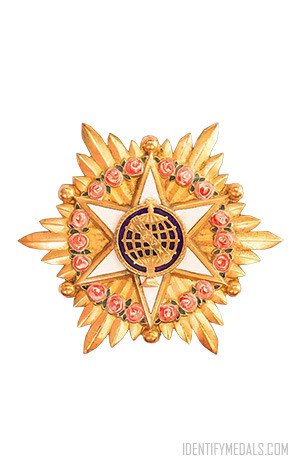
The Order of Merit’s insignia is a gold star with six beams, enameled in white with a wreath of roses. On the obverse, the center is an armillary sphere, also made of gold, in a blue field. The reverse reads the caption: “National Order of Merit“.

The design was inspired by the Imperial Order of the Rose, created by Jean-Baptiste Debret in 1829.

The necklace is made of two chains alternately ornamented with allegorical armillary and pink spheres. 

The Order of King Abdulaziz

The Order of King Abdulaziz is a Saudi Arabian order instituted by King Faisal on 20 March 1971 (and formerly called Great Chain of Badr).

The Order of King Abdulaziz is an Order of merit of Saudi Arabia named after Abdulaziz Al Saud, the founder of the modern Saudi state. The order was introduced by decree on 20 March 1971 by King Faisal, although the order had been awarded before – albeit unsystematically. Then, it was usually referred to as the Great Chain of Badr.

The order is awarded to both citizens of Saudi Arabia and foreigners that have shown meritorious service to the Kingdom. The nominations are made by the Council of Ministers, although it’s the King that confers awards himself when he determines it appropriate.

The number of Saudi conferments is limited annually. There can be no more than 20 grand sashes of the distinguished class. Up to 40, 60, 80 and 100 awards can be granted to members of the 1st, 2nd, 3rd and 4th classes, respectively.

The collar of the order is regarded as a distinct honor but confers the highest rank in the Order of Abdulaziz Al Saud.

Classes of the Order of King Abdulaziz

There are six classes to the Order of King Abdulaziz. These are:

  • Special Class: A sash with a pendant is worn on the right shoulder and a star on the left chest.
  • Distinguished First Class: The insignia is worn on a necklet, plus a golden star on the left chest.
  • First Class: Worn on a necklet, plus a silver star on the left chest.
  • Second Class: Worn on a necklet;
  • Third Class: A badge is worn on a ribbon with a rosette on the left chest;
  • Fourth Class: A badge is worn on a ribbon on the left chest.
The Order of King Abdulaziz Medal Design

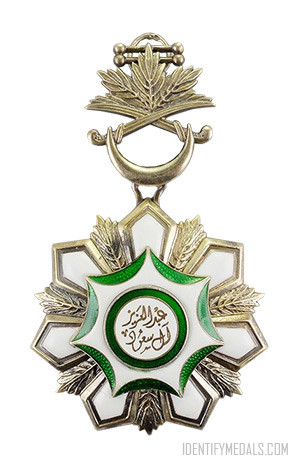
The Order of King Abdulaziz is a seven-pointed gold star with lozenge-shaped arms and white enamel panels with gold laurel branches. 

The suspension is a gold crescent with crossed swords and laurel spray. 

In the center, on the obverse, is a circular white enamel medallion with an inscription in gilt Arabic letters reading ‘Abdul-Aziz al-Saud’ and a gold-edged green enamel ring. 

The reverse is plain gold. 

Earlier versions of the Order of King Abdulaziz were typically produced by Bichay in Cairo, Egypt.

Medal of Bravery (Canada)

The Medal of Bravery (Médaille de la Bravoure in French) is a decoration given to Canadian citizens (civilians or members of the forces) for acts of bravery in hazardous circumstances. The medal is within the Canadian system of honors and is the third-highest award for bravery. It was created in 1972 and can be presented to both living and deceased individuals. Recipients the ability to use the post-nominal letters MB.

The Medal of Bravery Design

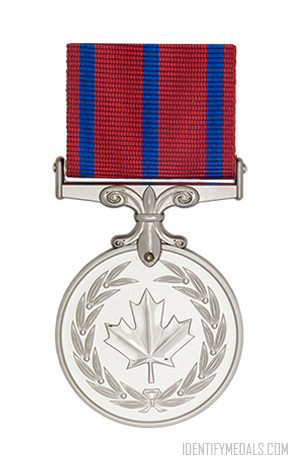
The Medal of Bravery is a silver medal measuring 31.8 millimetres (1.25 in) in diameter.

The obverse of the medal bears a maple leaf surrounded by a laurel wreath. On the reverse is the Royal Cypher of the reigning monarch, a St. Edward’s Crown, and the inscription BRAVERY • BRAVOURE. The name and rank of the recipient is engraved on the medal’s edge.

The insignia is worn on the left chest, on a 31.8mm wide red with three vertical blue stripes ribbon.

For men, the medal hungs from a bar, and for women, on a ribbon bow.

Individuals already possessing a Medal of Bravery can be awarded the decoration again (for subsequent acts of bravery), in which case a silver medal bar bearing a maple leaf is added on the original ribbon. 

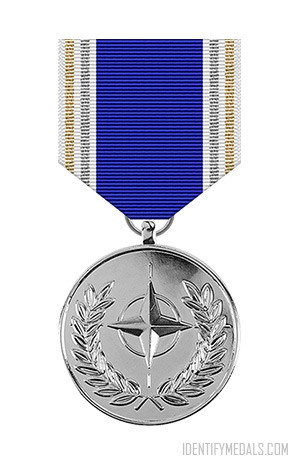
The NATO Medal

The NATO Medal is an international military decoration awarded to militaries under the authority of the North Atlantic Treaty Organization.

The NATO Medal is an international military decoration established in 1996 and awarded to various militaries under the authority of the North Atlantic Treaty Organization (NATO).

The medal was instituted to recognize individuals who had served in Former Yugoslavia in the Implementation Force (IFOR) as part of Operation Joint Endeavor. In 1999, a new ribbon was introduced for participants in Operation Allied Force in Kosovo and, later, further ribbons were established for each NATO operation as they became more common.

The NATO Medal Design

There are currently 14 versions of the NATO Medal:

  • One medal design for service in the former Yugoslavia, Kosovo, and North Macedonia.
  • Two medal designs for service during Article 5 operations (Eagle Assist, Active Endeavour).
  • Eight medal designs for Non-Article 5 NATO operations (International Security Assistance Force Afghanistan or ISAF, Resolute Support, Balkans, NATO Training Mission-Iraq or NTM-I, Africa, AMIS, OUP-Libya, and Pakistan).

NATO settled on three ribbon styles in early 2003. There is one for the NATO Meritorious Service Medal, one for Article 5 operations, and one for non-Article 5 operations.

Find NATO Medals Online

The Decoration of the President of Ukraine for Humanitarian Participation in the Anti-Terrorist Operation

The Decoration of the President of Ukraine for Humanitarian Participation in the Anti-Terrorist Operation (Відзнака Президента України «За гуманітарну участь в антитерористичній операції») was established in 2016.

The award is given for humanitarian participation in Anti-Terrorist Operation in Donetsk and Luhansk regions.

The Decorations of the President of Ukraine for Participation in the Anti-Terrorist Operation

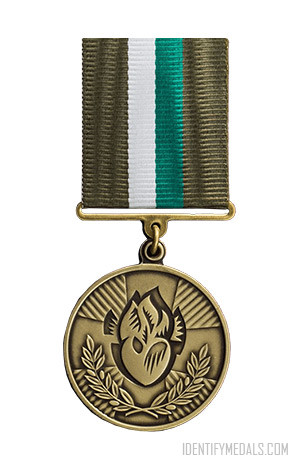
The Decoration of the President of Ukraine for Participation in the Anti-Terrorist Operation (Відзнака Президента України «За участь в антитерористичній операції») is a medal established in 2016. 

It is awarded to defenders of Ukraine’s sovereignty and territorial integrity in the framework of the Anti-Terrorist Operation in Donetsk and Luhansk regions.