The Order of Canada

The Order of Canada (CC) is a Canadian national order established in 1967 to recognize outstanding merit or distinguished service.

  • Time Period: Post-WW2
  • Institution: 17 April 1967
  • Country: Canada
  • Terms: C.C. – O.C. – C.M.

The Order of Canada (Ordre du Canada in French) is a Canadian national order and the second highest honor for merit after the Order of Merit. This award is considered the centerpiece of Canada’s honor system and is designed to exemplify the highest qualities that can enrich the lives of citizens and contemporaries.

The three-tiered order was established in 1967 to coincide with the centennial of the Canadian Confederation, and the first members were appointed 1 July 1967. The award was designed to recognize the outstanding merit or distinguished service of Canadians who make a major difference to Canada through lifelong contributions in every field of endeavor, as well as the efforts by non-Canadians who have made the world better by their actions – or those who exemplify the order’s motto, “desiderantes meliorem patriam” (They desire a better country“, a phrase taken from Hebrews 11:16).

The sovereign of the order is the reigning Canadian monarch. The Governor General administers the order on their behalf as Chancellor and Principal Companion. Thousands of people have been appointed to the Order of Canada, including scientists, musicians, politicians, artists, athletes, business people, film stars, and benefactors.

The Order of Canada Levels

The Order of Canada has three levels: Companion, Officer, and Member.

  • Companion: Awarded for outstanding achievement and merit of the highest degree. There can be a maximum of 15 Companions appointed each year (for a total of 150).
  • Officer: Awarded for the achievement of merit of a high degree, particularly in service to Canada or humanity as a whole. There can be a maximum of 46 Officers appointed each year.
  • Member: Awarded for distinguished service in or to a specific activity, field, locality, or group. There can be a maximum of 92 members appointed each year.

The Order of Canada Design

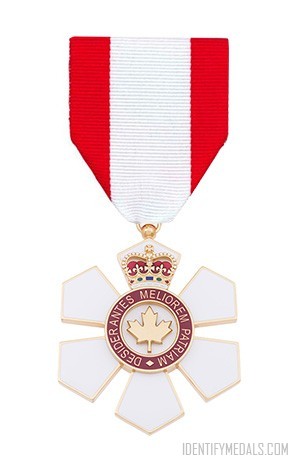
The badge of the Order is a stylized snowflake with six points and a red annulus at its center. The design of this insignia dates from 1967 and is credited to Bruce Beatty, C.M., S.O.M., C.D. 

On the obverse is a stylized maple leaf struck in fine silver, circumscribed with the motto of the Order, “Desiderantes meliorem patriam” (“They desire a better country”), surmounted by the Royal Crown (St. Edward’s Crown). The insignia is composed of three individual pieces: the snowflake, the annulus, and the maple leaf. The color is added to the badge by hand through a unique application of opaque and translucent viscous enamel. The reverse of the Order of Canada reads CANADA written within a circle as well as a serial number placed in a box below.

The ribbon of the Order of Canada is white, 38 mm wide, and has red edges (9 mm). If undressed, a maple leaf of red, gold, or silver is worn on the ribbon. There is also a miniature for wearing in evening dress.
The Cross of Valour (Canada)

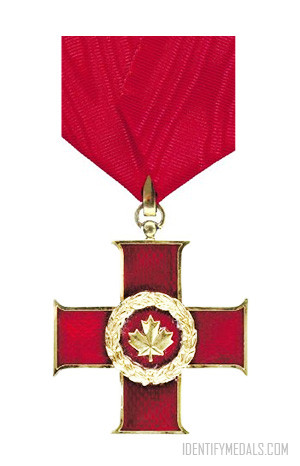
The Cross of Valour (CV) is a Canadian honor that recognizes acts of the most conspicuous courage in circumstances of extreme peril.

The Cross of Valour (CV) is a Canadian decoration and part of the Canadian system of honors. It’s the second highest award, surpassed only by the Victoria Cross and the highest honor available for Canadian civilians. The Cross of Valour was created in 1 May 1972 and recognizes acts of the most conspicuous courage in circumstances of extreme peril.

Both Canadians and foreigners, living and deceased can be awarded the medal and receive the ability to use the post-nominal letters CV

The Cross of Valour Design

The medal is a cross with four equal limbs. It’s rendered in gold, with the obverse enameled in red and edged with gold.

On the center obverse is a gold maple leaf surrounded by a gold laurel wreath. On the reverse is the Royal Cypher of the reigning Canadian sovereign and a crown above. The words VALOUR • VAILLANCE are etched below, extending along the upper edge of the two lateral arms of the cross. The recipient’s name and the date of the incident are engraved underneath the motto.

This medallion is worn suspended from a red ribbon around the neck (for men) and below the left shoulder suspended from a red ribbon fashioned into a bow (for women). A miniature cross may be worn on the ribbon bar in undress.

The ribbon is light crimson and measures 38 mm in width.

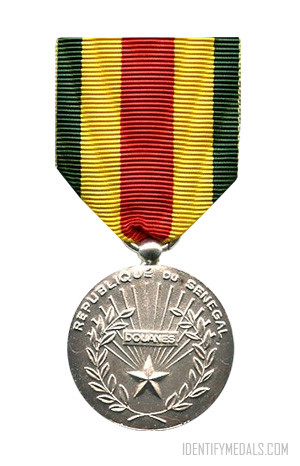
The Medal of Honor of the Customs Service

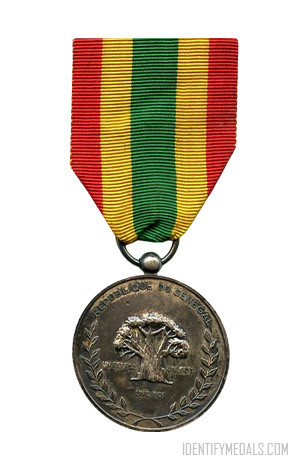
The Medal of Honor of the Customs Service is a Senegalese medal instituted by Law 66-038 from 13 January 1966. The medal is struck in silver.

The Medal of Honor of the Customs Service is a Senegalese medal instituted by Law 66-038 from 13 January 1966.

The medal is round and struck in silver. The ribbon has a set of green and yellow stripes and a central red stripe.

The Wound Medal (Senegal)

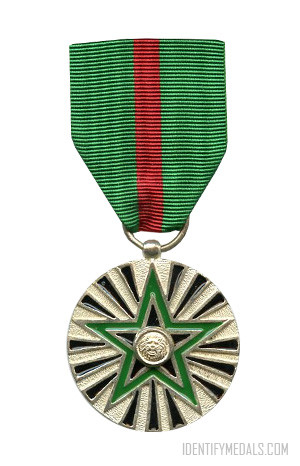
The Wound Medal is a Senegalese medal awarded for sustaining wounds in combat during the uprising in Casamance.

The Wound Medal is a Senegalese medal awarded for sustaining wounds in combat.

It was created in the 70s when Senegal was facing an uprising in Casamance (between Gambia & Guinea Bissau) in the southern part of the country. There is no decree for its institution.

The Wounded Medal Design

The medal measures 40 millimeters in diameter. The obverse bears the lion head and a green star. The reverse of the medal has the inscription “Blesse en Operation” (“Wounded in Operation“). 

The ribbon is green with a narrow red central stripe.

The Military Medal (Senegal)

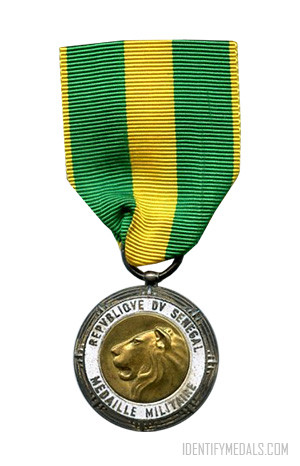
The Military Medal is a Senegalese medal established in 1964 and awarded for acts of valor or to NCOs for long and meritorious service.

The Military Medal is a Senegalese medal established on 28 April 1964 and awarded for acts of valor or to NCOs for long and meritorious service.

The Military Medal Design

The medal measures 30 millimeters in diameter. The obverse bears the inscription “Republique du Sénégal – Médaille Militaire” (“Republic of Senegal – Military Medal“). The reverse reads “Un Peuple-Un But-Une Foi” (“One Nation-One Goal-One Faith“).

The medal’s ribbon is maroon with a yellow-edged black central stripe.

The Cross of Military Valor (Senegal)

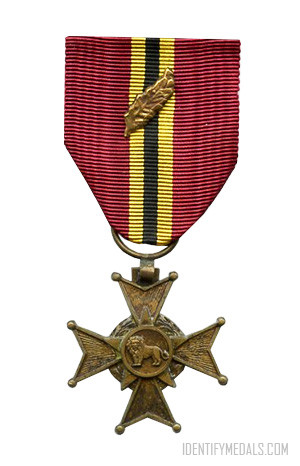
The Cross of Military Valor is a Senegalese medal established on 1st February 1968 and awarded for acts of valor in peace or war.

The Cross of Military Valor is a Senegalese medal established by Law 68-109 from 1 February 1968 and awarded to individuals and units in peace or in wartime.

The Cross of Military Valor Design

The Cross of Military Valor is a bronze cross patee with a central five-pointed star and a lion. 

The ribbon is red with two central yellow stripes and one black stripe.

The Order of Agricultural Merit

The Order of Agricultural Merit is a Senegalese medal established on 7 August 1982 and has three ranks: Commander, Officer and Chevalier.

The Order of Agricultural Merit is a Senegalese medal established on 7 August 1982.

The Order has three ranks:

  • Commander
  • Officer
  • Knight

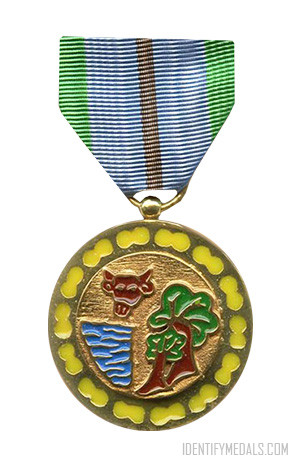
The ribbon is blue with a maroon central stripe and green edges.

The Order of Academic Palms

The Order of Academic Palms is a Senegalese medal established on 23 December 1974. It has three ranks: Commander, Officer and Chevalier.

The Order of Academic Palms is a Senegalese medal established on 23 December 1974 and awarded for contributions to national education and culture.

The Order has three ranks:

  • Commander
  • Officer
  • Chevalier.

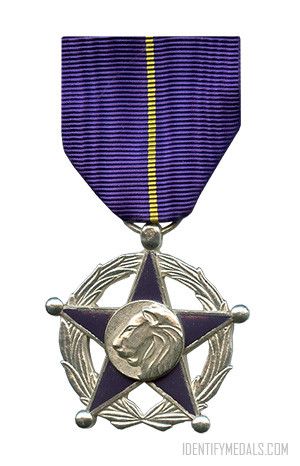
The ribbon is purple with a yellow central stripe.

The National Order of Merit (Senegal)

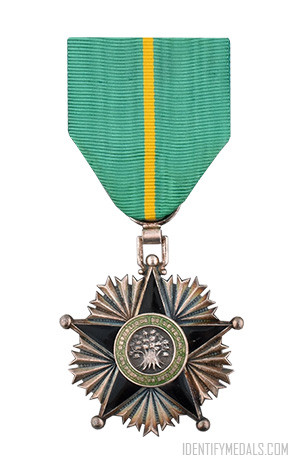
The National Order of Merit is an Order from Senegal instituted in 1960. It has a green ribbon with a narrow yellow central stripe.

The National Order of Merit is a Senegalese medal instituted on 22 October 1960 and awarded to national and foreign citizens, within military and civil spheres, for meritorious service to the Republic of Senegal.

The Order has the following five ranks:

  • Order of Merit - Grand Cross (Senegal) - ribbon bar.png Grand Cross
  • Order of Merit - Grand Officer (Senegal) - ribbon bar.png Grand Officer
  • Order of Merit - Commander (Senegal) - ribbon bar.png Commander
  • Order of Merit - Officer (Senegal) - ribbon bar.png Officer
  • Order of Merit - Knight (Senegal) - ribbon bar.png Knight

The ribbon of the National Order of Merit is green with a narrow yellow central stripe.