The Pro Memoria Medal

The Pro Memoria Medal is a Polish civil state decoration awarded by the head of the Office for War Veterans and Victims of Oppression.

The Pro Memoria Medal is a Polish civil state decoration awarded by the head of the Office for War Veterans and Victims of Oppression. It was created as a commemorative badge on the occasion of the 60th anniversary of the end of World War II.

Established 25 January 2005, the medal is awarded for outstanding contributions in perpetuating the memory of the people and deeds in the struggle for Polish independence during World War II. It was replaced on September 1, 2011 by the Pro Patria Medal.

The Pro Memoria Medal Design

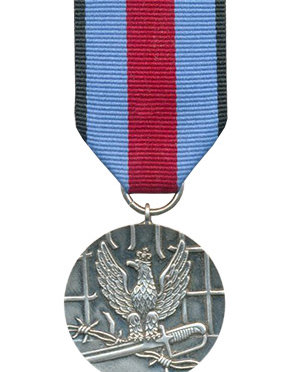
The medal is disc shaped struck in silver colored metal.

The obverse of the medal shows the Polish Eagle sitting on a sword crossed with barbed wire. In the background is a breached fence. On the reverse around the rim is the inscription “URZĄD DO SPRAW KOMBATANTÓW I OSÓB REPRESJONOWANYCH” (“Office for War Veterans and Victims of Oppression”). In the center is the inscription “PRO MEMORIA” over crossed oak and laurel branches, and the date: 8 MAJA 2005, the 60th anniversary of the end of World War II.

The medal is suspended from a ribbon in the colors blue, magenta, and black.
The Pro Patria Medal

The Pro Patria Medal is a Polish civil state decoration established in 2011 and awarded to War Veterans and Victims of Oppression.

The Pro Patria Medal is a civil state decoration of Poland established in 2011 and awarded by the Head of the Office for War Veterans and Victims of Oppression.

The medal is awarded by the Head of the Office for War Veterans and Victims of Oppression based upon an application with documentation from veterans and victims of oppression groups. Recommendations may also be made by departments of the Polish Government or Polish diplomatic missions and military attachés. The medal is awarded to mark special merit in strengthening and treasuring the memory of the Polish people’s fight for the independence of the Polish Republic during and following World War II.

The Pro Patria Medal Design

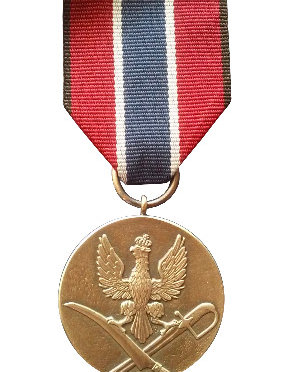
The medal is struck in silver metal and measures 36 mm in diameter.

The obverse depicts a crowned Polish Eagle sitting atop a saber crossed with a war scythe. The reverse bears a cross pattee above the three-line inscription PRO PATRIA 1768-1989, with a crossed laurel and oak spray below. The date 1768 represents the year of the Bar Confederation, the first rebellion to restore an independent Poland. Around the edge is the inscription “URZAD DO SPRAW KOMBATANTOW I OSOB REPRESJONOWANYCH” (“Office for War Veterans and Victims of Oppression”).

The medal hangs from a ring suspension, attached to a 38 mm crimson ribbon with a dark blue central stripe bordered by narrow white stripes. At the edges are narrow black stripes.

The Medal for Merit to Culture Gloria Artis

The Medal for Merit to Culture Gloria Artis is a decoration awarded for distinguished contributions to the Polish culture and heritage.

The Medal for Merit to Culture Gloria Artis (or Zasłużony Kulturze – Gloria Artis in Polish), also known as Gloria Artis Medal, is a departmental decoration of Poland in Arts awarded by the Ministry of Culture and National Heritage of the Republic of Poland to persons and organizations for distinguished contributions to, or protection of the Polish culture and national heritage.

The medal is awarded on the basis of the Act of 17 June 2005 amending the Act on organizing and conducting cultural activities and amending the Act on the education system. The award has three degrees:

  • 1st degree – Gold Medal for Merit to Culture Gloria Artis,
  • 2nd degree – Silver Medal for Merit to Culture Gloria Artis,
  • 3rd degree – Bronze Medal for Merit to Culture – Gloria Artis.

The minister awards the medal on his own initiative or at the request of other ministers or heads of central offices, rectors of universities, voivodship marshals, voivodes, statutory authorities of national social organizations or associations conducting statutory cultural activities, heads of diplomatic or consular posts of the Republic of Poland.

The Medal for Merit to Culture Gloria Artis Design

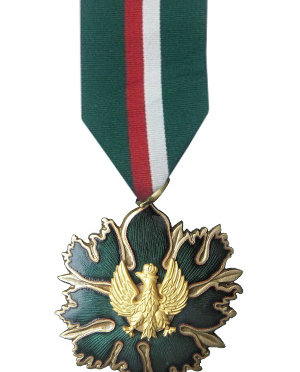
The medal was designed by Piotr Gawron. It’s made of gilded, silver-plated or bronze-patinated tombac and has the shape of a flower with irregular petals covered with green, blue or dark red enamel depending on the degree. The diameter of the Gold Medal badge is 70 mm, the Silver Medal is 55 mm, and the Bronze Medal is 40 mm.

On the obverse there is an image of a crowned eagle. On the reverse there is a woman’s head in a laurel wreath with a semi-circular inscription “GLORIA ARTIS” above.

The gold medal ribbon is 680 mm long and 50 mm wide, it is dark green in color with two vertical stripes – white and red 13 mm wide. The ribbon of the silver medal is 60 mm long and 35 mm wide, it is blue in color with two vertical stripes – white and red 5 mm wide. The ribbon of a bronze medal is 55 mm long and 35 mm wide, it is a maroon color with two vertical stripes – white and red 5 mm wide.

The Polish Army Medal

The Polish Army Medal was established to recognize service to the Polish Army by foreign civilians and military personnel.

The Polish Army Medal (or Medal Wojska Polskiego in Polish) was established by Poland on 3 September 1999 to recognize service to the Polish Army by foreign civilians and military personnel, who have made particular merit in the field of cooperation of the Polish Army with the armed forces of other countries.

The medal is presented by the Polish Minister of National Defence in three grades:

  • 1st degree – Gold Medal of the Polish Army.
  • 2nd degree – Silver Medal of the Polish Army.
  • 3rd degree – Bronze Medal of the Polish Army.

Most awards are presented to members of allied armed forces, but the medal is also awarded to civilians who contribute to promoting the history and traditions of the Polish Army outside of Poland.

The Polish Army Medal may be awarded to persons who:

  • Actively support the peaceful activities of the Polish Army in the international arena.
  • Contributed to the development of the defense potential of the Republic of Poland.
  • They have been particularly distinguished in the field of cooperation within multinational units, which include units of the Polish Army, including primarily in integrating commands, staffs and military units at all levels of command (management).
  • Contributed to the popularization of the history and tradition of the Polish Army on the international arena.

The Polish Army Medal Design

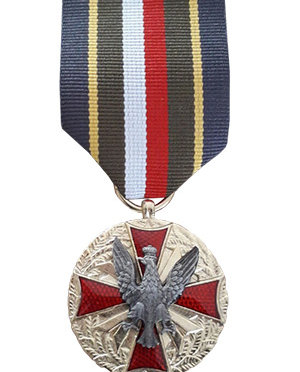
The badge of the Polish Army Medal is a round medal with a diameter of 36 mm, framed with a laurel wreath.

On the obverse of the medal there is a Maltese cross covered with red enamel. In the center of the cross there is a silver eagle with the sign of the Ministry of National Defense. There are bundles of rays between the arms of the cross. The wreath, the border of the cross, the bundles of rays and the reverse are gilded, silvered or patinated brown, depending on the grade of the medal. On the reverse side there is an embossed stylized inscription in two lines: “WOJSKO / POLSKIE”.

The medal badge is hung on a ribbon 65 mm long and 38 mm wide, in vertical stripes, symmetrically placed towards the center, in the colors from the edge: steel – 6 mm wide, gold – 2 mm wide and khaki – 6 mm wide. In the center of the ribbon is a vertical white and red strip 10 mm wide (white on the left).

The Medal of Merit for National Defense

The Medal of Merit for National Defense is a decoration of the Ministry of National Defense of Poland established 21 April 1966.

The Medal of Merit for National Defence (or Medal Za Zasługi dla Obronności Kraju in Polish) is a decoration of the Ministry of National Defence of Poland established 21 April 1966 and revised in 1991.

The medal recognizes the meritorious service of people who, through their work or activity, contributed to the development and strengthening of the country’s defense. The medal may also be awarded to a military unit, social organization, enterprise, plant or institution.

The medal has three grades:

  • Gold medal.
  • Silver medal.
  • Bronze medal.

The rules for awarding the medal were changed by the ordinance of the Minister of National Defence of April 19, 1991. According to this ordinance, the medal is awarded to people who:

  1. They showed bravery or courage in direct actions related to the country’s defense, or they achieved very good results in the implementation of defense tasks.
  2. Have special merits in the field of the development of modern military thought, military technology and defense potential, as well as in the field of military training and education.
  3. With their professional work or activity in social organizations, they significantly contributed to the development and strengthening of the country’s defense system.

Members of the Polish military and civilian employees are eligible for this medal. A silver medal may be awarded to a person awarded with a bronze medal, if at least three years have elapsed since it was awarded, and the gold medal may be awarded at least five years after the silver medal was awarded.

The Medal of Merit for National Defence Design

The badge of the medal was initially a round medal with a diameter of 38 mm, made of gilded, silver-plated or bronze and oxidized metal. On the obverse there was a drawing of Poland’s borders, and against it a stylized eagle. There was an inscription around the drawing: “FOR MERIT FOR COUNTRY DEFENSE”. On the reverse, there was a horizontal inscription: “MINISTERSTWO OBRONY NARODOWEJ”, surrounded by the inscription: “POLSKA RZECZPOSPOLITA LUDOWA” (“People’s Republic of Poland”).

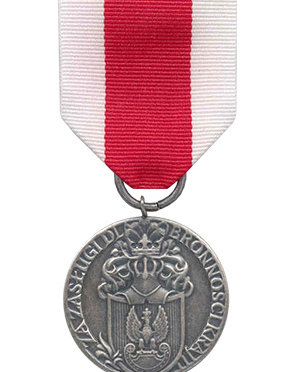
Since 1991, the medal’s badge has been a round gilded, silvered or patinated bronze medal with a diameter of 36 mm. The obverse features a crowned knight’s helmet, surrounded by acanthus leaves, and a shield underneath with a crowned military eagle. There is an inscription on the rim: “ZA ZASŁUGI DLA OBRONNOŚCI KRAJU”. On the reverse there is a horizontal inscription in two lines: “WOJSKO / POLSKIE”.

The ribbon of the medal in both versions is white, 38 mm wide, with a vertical red stripe 20 mm wide in the center.

The Medal of the Armed Forces in the Service of the Fatherland

The Medal of the Armed Forces in the Service of the Fatherland is a decoration awarded for long service and excellent work in the army.

The Medal of the Armed Forces in the Service of the Fatherland (or Medal Siły Zbrojne w Służbie Ojczyzny in Polish) is a military decoration of Poland awarded for long service and excellent work in the army.

The medal was first established on 26 May 1951, although the detailed rules and grades were revised 1991 and 1995. Until 1968, it was a state distinction awarded by the head of state; from 1968 it was a departmental award, granted by the Minister of Defence.

The medal continues to be presented as an award of the Ministry of Defence, as the Medal for Long Service is a state-awarded decoration, conferred on an individual basis to selected recipients only.

The Medal of the Armed Forces in the Service of the Fatherland Design

There are three grades, Gold, Silver and Bronze, awarded for 25, 15 and 5 years, respectively.

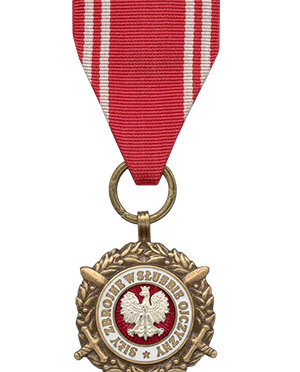
The medal, initially defined by the regulation of the Council of Ministers of August 11, 1951, was a round laurel wreath 34 mm in diameter, on which are attached two crossed swords, pointed upwards, protruding beyond the edge of the wreath. The wreath, swords, borders and inscriptions are gilded, silvered or bronze depending on the grade of the medal.

In the obverse, in the center of the wreath there is a round shield, red enameled, 16 mm in diameter (then 15 mm), with a silver-plated eagle without a crown over it. The shield is placed in a white enamel rim. On the rim there is the inscription “SIŁY ZBROJNE W SŁUŻBIE OJCZYZNY”. At the bottom of the wreath, there was a small oval red and enameled shield with a Roman numeral placed on it, the number of years of service for which it was conferred. The reverse is plain.

Despite the subsequent changes to the medal, the badge itself has not changed significantly. From 1960, the diameter of the eagle shield was determined to be 15 mm. According to the 1995 regulations, the badge is described in the same way, except that the shield has a silver-plated eagle in the pattern of the Polish coat of arms (in the crown). Moreover, there is no small shield with a Roman numeral representing the number of years of service.

The ribbon of the medal did not change; it is red, 35 mm wide, with two white vertical stripes 2 mm wide on the sides on each side of the ribbon.

The Warsaw Uprising Cross

The Warsaw Uprising Cross was a decoration established on July 3, 1981 in order to honor the participants of the Warsaw Uprising of 1944.

The Warsaw Uprising Cross (or Warszawski Krzyż Powstańczy in Polish) was a military decoration from Poland established by law on July 3, 1981 in order to honor the participants of the Warsaw Uprising of 1944.

The decoration was awarded to persons who took an active part in the Warsaw Uprising. In particular:

  • Soldiers of all the formations that fought in the Uprising.
  • Members of the Military Women’s Service, of the Health Care services of the Uprising and other auxiliary insurrectionist services.
  • Other persons who were somehow directly involved in the uprising.

The cross was awarded to Polish citizens as well as persons who, although they held non Polish citizenship at the time, also fought on the Polish side in the Uprising. The Cross could also have been awarded to foreigners if they took part in the Uprising or contributed to the fighting in some major way. Usually, the awards were made on the anniversary of the uprising or on the Victory Day (May 9) (anniversary of Nazi capitulation).

The first Warsaw Uprising Crosses were awarded on 1 August 1981 to 100 former soldiers of the Uprising, among others Gen. Jan Mazurkiewicz (Radosław) – commander of the Home Army, Gen. Franciszek Kamiński – commander of the Bataliony Chłopskie, Col. Maria Wittek – commander of Military Women’s Service, as well as Mieczysław Fogg and Lesław Bartelski.

On 16 October 1992, a law was passed which ended the awarding of the medal on 8 May 1999. The Cross could be awarded post posthumously.

The Warsaw Uprising Cross Design

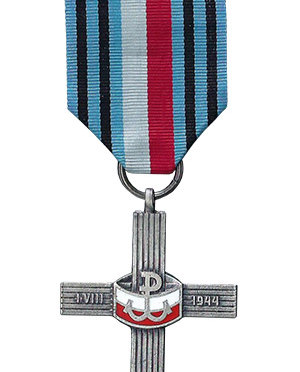
The badge of the Warsaw Uprising Cross is a silver-plated and oxidized isosceles straight cross measuring 42 by 42 mm.

On the obverse of the cross, in the middle, there is an enameled white and red band, on the background of which there is a symbol of Fighting Poland – a stylized anchor with the letter P, and on the horizontal arms the date 1 August – 1944.

On the reverse, on the horizontal arms, there is the inscription “POWSTAŃCOM WARSZAWY” and a laurel wreath in the center of the cross.

The ribbon of the award is 40 mm wide, in the center a white and red strip (national colors), 12 mm wide, on the sides on a navy blue background 14 mm wide, two black stripes (the colors of the ribbon refer to the colors of the Order of Virtuti Militari ribbon).

The Warsaw Uprising Cross was worn on the left side of the breast, in the order of the Greater Poland Uprising Cross , since 1992 it has been worn in the order of the current state decorations .

The badge was designed by the sculptor and medalist Edward Gorol .

The Auschwitz Cross

The Auschwitz Cross was a Polish decoration awarded to honor survivors of Nazi German concentration camps, including Auschwitz.

The Auschwitz Cross (or Krzyż Oświęcimski in Polish) was instituted on 14 March 1985. This Polish decoration was awarded to honor survivors of Nazi German concentration camps, including Auschwitz (Auschwitz is a German name for the Polish town Oświęcim, where the camps were built by Nazi Germans).

The Auschwitz Cross was awarded to Polish citizens, it could also be awarded to persons who were imprisoned as Polish citizens, and at the time of granting citizenship of another country, and in special cases also to citizens of other countries, imprisoned for political reasons, especially participants of the camp resistance movement. The cross could be awarded posthumously.

The Oświęcim Cross was awarded by the Council of State at the request of:

  • Union of Fighters for Freedom and Democracy – in relation to union members.
  • The President of the Office for Veterans – in relation to other persons.
  • The Minister of Foreign Affairs – in relation to Polish citizens permanently residing abroad and citizens of other countries.

The Auschwitz Cross Design

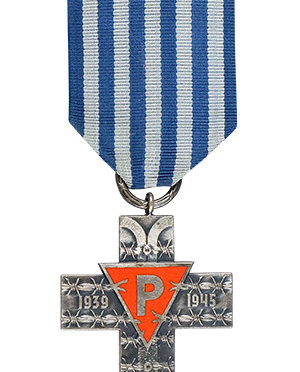
The award is a silver-plated Greek cross with wide arms, 42×42 mm.

The obverse shows barbed wire and camp poles; the year 1939 on the left, and 1945 on the right arm. In the center there is a red enameled triangle with the letter P, as worn by Polish nationals imprisoned in the camps.

The reverse bears the inscription “PRL / WIĘŹNIOM / HITLEROWSKICH / OBOZÓW KONCENTRACYJNYCH” (“People’s Republic of Poland to prisoners of Nazi concentration camps”).

The ribbon of the cross is 40 mm wide, with eleven vertical stripes in light gray and blue colors. The Oświęcim Cross, according to the seniority of Polish decorations , was worn on the left side of the breast after the Partisan Cross.

The Order of the Banner of Work

The Order of the Builders of People’s Poland was the highest civil decoration of Poland in the times of the People’s Republic of Poland.

The Order of the Banner of Work (or Order Sztandaru Pracy in Polish) was a governmental award in Poland during the 20th-century era of the People’s Republic of Poland, a former Marxist-Leninist state.

The order was established by the Sejm (a chamber of the Polish parliament) on 2 July 1949. It was given in recognition of “unique achievements for the Nation and the Country”. In 1960 the criteria for receiving this award were changed to “special achievements for building socialism in the People’s Republic of Poland”.

It was also awarded to institutions and was automatically awarded to miners after 20 years of dedicated labor. The Order of the Banner of Labor could be awarded to individuals and enterprises, institutions, territorial units for merits in the following areas:

  • Industry, agriculture, communication, construction, state trade, cooperatives, finance and other sectors of the national economy – by improving or improving working methods, rationalizing work or outstanding achievements in labor leadership,
  • Education, science, culture and art,
  • Increasing the country’s defense,
  • Increasing the health and physical culture of the nation,
  • Public service

The Order of the Banner of Work Design

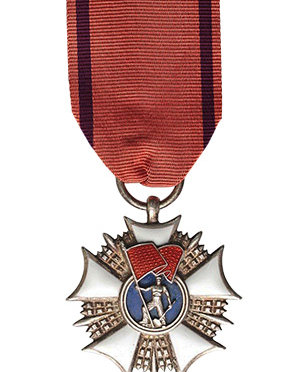
The badge of the Order of the Banner of Labor is a five-pointed star cross with a diameter of 43 mm.

On the obverse of the cross, the arms are enameled in white in the border, and there are bunches of rays between the arms. In the center of the cross there is a round sapphire-enameled shield with the figure of a worker holding a red banner in his right hand and a hammer in his left hand.

On the reverse, in the middle of the cross, on the round shield is the inscription PRL (until 1952 RP). The border of the arms of the cross, bunches of rays, the frame of the shield, the figure of a worker, the shafts and the border of the banner, the hammer and the reverse of the badge are gilded in class I, and silver in class II.

The ribbon of the order is 36 mm wide, it is red in color with narrow red stripes on the sides, 3 mm wide. There is a rosette on the ribbon in class I, which distinguishes it from class II.

The Order of the Builders of People’s Poland

The Order of the Builders of People’s Poland was the highest civil decoration of Poland in the times of the People’s Republic of Poland.

The Order of the Builders of People’s Poland (or Order Budowniczych Polski Ludowej in Polish) was the highest civil decoration of Poland in the times of the People’s Republic of Poland. Unofficially, it replaced Poland’s highest pre-war order, the Order of the White Eagle. The order was awarded to many leaders of worship, notable party members (including military personnel) and others.

The order was established by the Sejm on 2 July 1949 for “awarding unique achievements in the task of building People’s Poland”. It was awarded by the president of Poland until the office was abolished in 1952; from then it was awarded by the Polish Council of State. It had only one class. A person decorated with the order had the title of a Builder of People’s Poland (Budowniczy Polski Ludowej).

The Order was last awarded in 1985. Up to that time, about 310 individuals were awarded the Order, and 10 institutions and territorial units (for instance, cities and administrative entities – voivodeships). During the times of the People’s Republic, 7 recipients had their orders revoked. It was officially disestablished 2 years after the People’s Republic was replaced by the Third Republic.

The order could be awarded to Polish individuals, enterprises, and institutions that performed exceptional deeds in the fields of:

  • National economy, in particular through inventions, improving work organizations, and work inspiration and efficiency.
  • Education, science, culture and art.
  • National defense.
  • Health and sport.
  • Public service.

The Order of the Builders of People’s Poland Design

The medal was designed by Michał Bylina and Wojciech Jastrzębski.

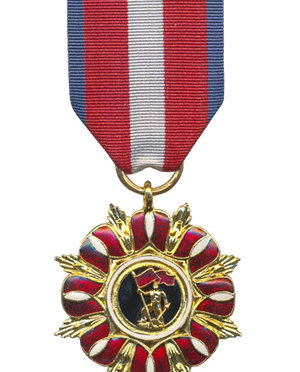
The Order has a golden rosette and measures 53 mm in diameter. The rosette has eight petals enameled with white (inner) and red (outer). Petals are separated by gold rays. In the center is a white-encircled blue medallion, which depicts a gold male figure carrying a hammer and a red banner. The reverse has a red enameled medallion with, in gold, the letters PRL, standing for Polska Rzeczpospolita Ludowa – People’s Republic of Poland (orders awarded before the state’s name changed in 1952 have the letters RP for Rzeczpospolita Polska).

The ribbon is 40 mm wide and is red-white-red with blue edges.