The Home Army Cross or Armia Krajowa Cross

The Home Army Cross is a military decoration that commemorates the efforts of the soldiers of the Polish Secret State between 1939 and 1945.

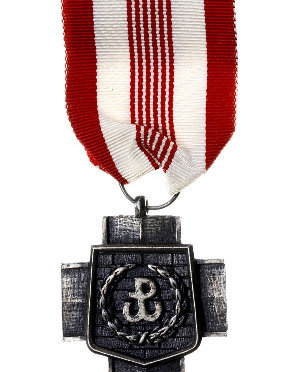
The Home Army Cross or Armia Krajowa Cross (Krzyż Armii Krajowej in Polish) is a military decoration from Poland that was introduced by General Tadeusz Bór-Komorowski on 1 August 1966 to commemorate the efforts of the soldiers of the Polish Secret State between 1939 and 1945.

The decoration was awarded to soldiers of the Home Army (Armia Krajowa) and of its predecessor organizations (Służba Zwycięstwu Polski, Związek Walki Zbrojnej). The first recipient (posthumous) was General Stefan Grot–Rowecki.

The award was supported by the Polish government in exile in London and was not recognized by the People’s Republic of Poland, which viewed members of the mostly anti-communist Armia Krajowa as enemies of the state. After the fall of communism, in 1992 it was recognized by the government of Poland and was awarded by the president of Poland until 8 May 1999.

The Home Army Cross Design

The medal measures 38 mm in diameter.

The reverse reads “1939 Armia Krajowa 1945″ (“1939 Home Army 1945”). The ribbon has stripes in red and white and measures 4.5cm high and 3.7 cm wide.

The Virtus et Fraternitas Medal

The Virtus et Fraternitas Medal was established on 9 November 2017 and awarded to those who provided aid and assistance to Polish citizens.

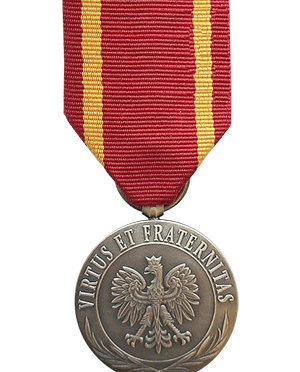
The Virtus et Fraternitas Medal (or Medal Virtus et Fraternitas) was established on 9 November 2017 awarded to those who provided aid and assistance to Polish citizens. It is also bestowed to honor individuals who voluntarily keep alive the memory of those who did not survive the war or the forced deportations, and found their graves abroad.

The medal is awarded by the President of Poland on recommendation of the director of the Pilecki Institute as a token of commemoration and gratitude. The medal was awarded for the first time on 19 June 2019.

The Virtus et Fraternitas Medal Design

The medal is round and struck in silver, and measures 36 mm in diameter.

On the obverse is inscribed “VIRTUS ET FRATERNITATIS” (“Virtue and Brotherhood”). In the center of the medal carved stylized image of the White Eagle. 

The Virtus et Fraternitas Medal is suspended from a purple ribbon, 36 mm wide. Symmetrically arranged along the edges of the ribbon are gold stripes each 4 mm wide, both 4 mm from the edge.

The Cross of Freedom and Solidarity

The Cross of Freedom and Solidarity was established in 2010 to honor killed, wounded or imprisoned members of the democratic opposition.

The Cross of Freedom and Solidarity (or Krzyż Wolności i Solidarności in Polish) was established on 5 August 2010, to honor members of the democratic opposition in Poland who between the years 1956 and 1989 were killed, seriously wounded or injured, arrested, imprisoned or interned for at least 30 days, who lost jobs or were expelled from school or university for at least 6 months as a result of their activities for the benefit of a free and democratic Poland.

Individuals who are found having collaborated with the communist regime may not be awarded.

The Cross of Freedom and Solidarity Design

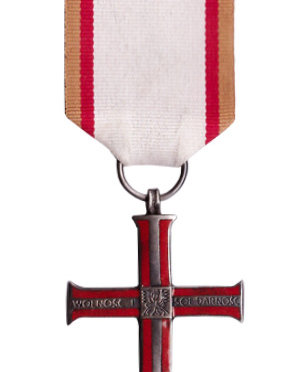
The cross is a red enameled Greek cross struck in silver, similar to that of the Order of the Cross of Independence and the Cross of Independence of 1930. The cross is 42 mm in diameter.

On the obverse, the inscription “WOLNOŚĆ I SOLIDARNOŚĆ” (“Freedom and Solidarity”) is written across the horizontal arms. In the center of the cross carved stylized image of the White Eagle. The reverse side of the cross is smooth.

The Cross of Freedom and Solidarity is suspended from a white ribbon, 38 mm wide. Symmetrically arranged along the edges of the ribbon are gold and crimson stripes each 3 mm wide.

The Medal for Long Marital Life

The Medal for The Medal for Long Marital Life was established in 1960 and awarded to couples who have been married for at least 50 years.

The Medal for Long Marital Life (or Medal Za Długoletnie Pożycie Małżeńskie in Polish) is a medal from Poland established on February 17, 1960 and awarded to couples who have been married for at least 50 years.

The medal is still awarded in cities across the country but ‘PRL’ has become ‘PR’ on the reverse. . In addition to having a 50-year-long marriage, couples should also have at least one child, either their own or adopted, to qualify for the medal.

The Medal for Long Marital Life Design

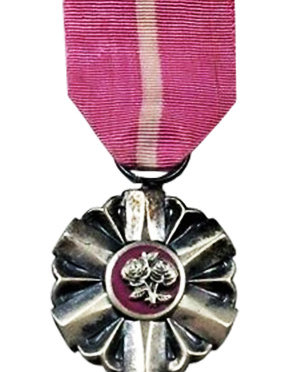
The medal is round, struck in silver, and has six rays. It measures 35mm in diameter.

The obverse has a pink enameled center with two roses with intertwined stems superimposed. The reverse has the letters PRL in the center. Surrounding this are the words: “ZA DLUGOLETNIE POZYCIE MALZENSKIE” in a circle.

The ribbon is 37mm wide with a 4mm wide white stripe in the centre of the ribbon.

The Order of Merit of the Republic of Poland

The Order of Merit of the Republic of Poland was created in 1974 and is awarded to persons who have rendered great service to the country.

  • Time Period: Post-WW2
  • Year of Institution: 10 April 1974
  • Country: Poland

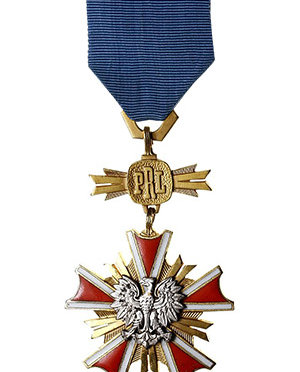
The Order of Merit of the Republic of Poland (or Order Zasługi Rzeczypospolitej Polskiej in Polish) is an order of merit of Poland created in 1974, awarded to persons who have rendered great service to the country. It is granted to foreigners or Poles resident abroad. As such it is sometimes referred to as a traditional “diplomatic order“.

The order was established by an act of 10 April 1974, as the Order of Merit of the Polish People’s Republic. It was awarded in five classes: Grand Cordon of the Order, Commandery with Star, Commandery, Gold Badge of the Order, and Silver Badge of the Order. It was awarded by the Polish Council of State.

Under the 1992 act, the order is awarded to foreigners or Poles resident abroad for distinguished contributions to international cooperation or cooperation between Poland and other countries. It is awarded by the President of Poland.

From 1974 to 1991 the Order was awarded in the following classes:

  •  st class – Grand Cordon of the Order of Merit of the People’s Republic of Poland
  • 2nd class – Commandery with Star of the Order of Merit of the People’s Republic of Poland
  • 3rd class – Commandery of the Order of Merit of the People’s Republic of Poland
  • 4th class – Gold Badge of the Order of Merit of the People’s Republic of Poland
  • 5th class – Silver Badge of the Order of Merit of the People’s Republic of Poland

Since 1992 the Order is awarded in the following classes:

  • 1st class – Grand Cross of the Order of Merit of the Republic of Poland
  • 2nd class – Commander’s Cross with Star of the Order of Merit of the Republic of Poland
  • 3rd class – Commander’s Cross of the Order of Merit of the Republic of Poland
  • 4th class – Officer’s Cross of the Order of Merit of the Republic of Poland
  • 5th class – Knight’s Cross of the Order of Merit of the Republic of Poland

The Order of Merit of the Republic of Poland Design

After the fall of communism in Poland in 1989, it was decided to retain the order, with necessary changes. The insignia was changed to the present ones by a presidential decree of 16 April 1991. The abbreviation “PRL” was changed to “RP,” the Eagle was given a crown in accordance with Poland’s new coat of arms, the date “1974” was removed from the reverse, and the color of the ribbon was changed from light cobalt blue to dark cobalt.

The Order of the Cross of Independence

The Order of the Cross of Independence was established in 2010 to honor those who had served voluntarily between the years of 1939 and 1956.

  • Time Period: Post-WW2
  • Year of Institution: 5 August 2010
  • Country: Poland

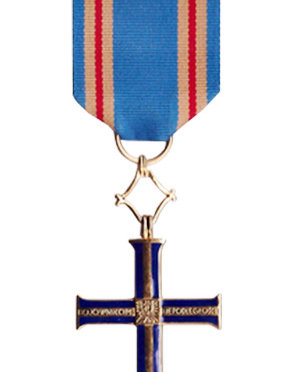
The Order of the Cross of Independence (or Order Krzyża Niepodległości in Polish) was established on 5 August 2010, to honor those who between the years of 1939-1956 voluntarily served with merit in defending the independence of the Polish State. It is fifth in the order of precedence of Polish awards and decorations.

At its establishment, it was declared to be a continuation of the Cross of Independence which was instituted on 29 October 1930.

The Order is divided into two classes:

  • The Order of the Cross of Independence First Class. Awarded to those who guided the struggle or fought with arms for independence and sovereignty of the motherland with an extraordinary sacrifice.
  • The Order of the Cross of Independence Second Class. Awarded to those who for a significant period of time or in circumstances of extreme danger defended the independence and sovereignty of the homeland, fighting for her recovery, or maintaining the functioning of institutions and traditions of the Polish Republic.

The Order of the Cross of Independence Design

First class

The first class cross of the Order of Independence is suspended by swords attached to a ribbon with a width of 45mm which is worn around the neck. The ribbon is blue with stripes of gold and red at the edges. The ribbon bar of the first class is denoted by a rosette at the center.

Second Class

The second class cross of the Order of the Cross of Independence is worn on the left breast suspended from a ribbon with a width of 40 mm, with colors identical to that of the first class. The ribbon bar of the second class is unadorned by any clasp or attachment.

The Order of the Military Cross (Poland)

The Order of the Military Cross (or Order Krzyża Wojskowego) is a Polish order established in 2006 and awarded for distinguished service.

  • Time Period: Post-WW2
  • Year of Institution: 18 October 2006
  • Country: Poland

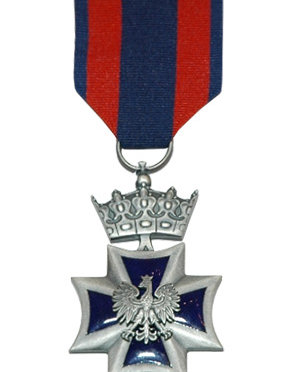
The Order of the Military Cross (or Order Krzyża Wojskowego in Polish) is a Polish order established on 18 October 2006 and awarded for “distinguished service, sacrifice, and courage in actions against terrorism in the country or during foreign deployments of the Armed Forces of the Republic of Poland in times of peace.”

The Military Cross was established by the Law of 14 June 2007, which amended the Act of 16 October 1992, concerning medals and decorations. This law saw the creation of the Military Cross along with the Military Cross of Merit, Navy Cross of Merit, Air Force Cross of Merit and the Medal for Long Service. The change was implemented on 9 October 2007.

According to the previously mentioned law, “The Military Cross has the distinction of being the reward for acts of bravery and courage made during operations against acts of terrorism in the country, or during the use of the Polish Armed Forces outside the country in time of peace.” In the order of precedence of Polish medals, it ranks behind the Cross of Valor and the Cross of Merit for Bravery.

The Order has three classes:

  1. Grand Cross (Krzyż Wielki)
  2. Commander’s Cross (Krzyż Komandorski)
  3. Knight’s Cross (Krzyż Kawalerski)

The Medal for Transforming the Non-Black Earth of the RSFSR

The Medal for Transforming the Non-Black Earth of the RSFSR was awarded for 3 years outstanding service in developing Soviet agriculture.

The Medal for Transforming the Non-Black Earth of the RSFSR (or Медаль «За преобразование Нечерноземья РСФСР», Medal «Za preobrazovanie Тechernozem’ja RSFSR» in Russian) was established on 30 September 1977 by decree of the Presidium of the Supreme Soviet of the USSR and awarded for 3 years outstanding service in developing Soviet agriculture.

The Medal “For Transforming the Non-Black Earth of the RSFSR” was awarded to workers, farmers, and employees who made an impact on the work of implementation of the long-term program for the development for agriculture of the non-black earth zone of the Russian Soviet Federative Socialist Republic, and who worked as a rule, for not less than three years in this field and that was located on state or collective farms, or worked in businesses, organizations or institutions whose activities were directly related to the transformation of the non-black earth.

The medal’s statute was amended on July 18, 1980 by decree of the Presidium of the Supreme Soviet of the USSR № 2523-X.

The Medal for Transforming the Non-Black Earth of the RSFSR Design

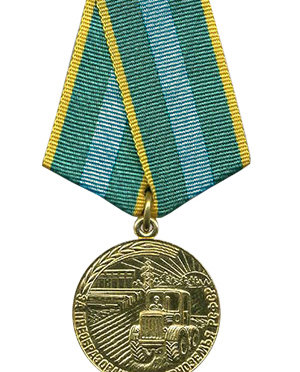
The medal was 32mm in diameter, circular, and made of tombac, with a raised rim on both sides. It was worn on the left side of the chest.

On the obverse, in the right half, the relief image of a tractor pulling a plow through a field below a rising Sun over a distant tree line; at left the relief images of barns, grain elevators, and power transmission towers; along the medal’s lower circumference, the relief inscription «За преобразование Нечерноземья РСФСР» (“For transforming the Non-Black Earth of the RSFSR”), along the upper left circumference, a panicle of wheat; the obverse had a raised rim.

On the reverse, at the center, the relief image of the hammer and sickle with wheat spikes below a relief five-pointed star emitting rays.

The Medal “For Transforming the Non-Black Earth of the RSFSR” was secured to a standard Soviet pentagonal mount by a ring through the medal suspension loop. The mount was covered by a 24 mm wide overlapping green silk moiré ribbon with 2 mm yellow edge stripes and a 6 mm central blue stripe.

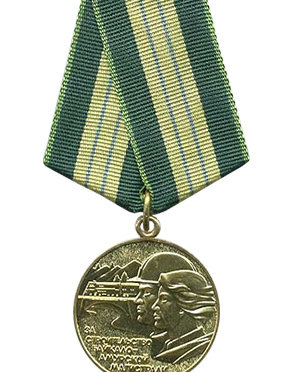
The Medal for Construction of the Baikal-Amur Railway

The Medal for Construction of the Baikal-Amur Railway was awarded to workers on the BAM for 2 years outstanding service.

The Medal for Construction of the Baikal-Amur Railway (or Медаль «За строительство Байкало-Амурской магистрали», Medal «Za stroitel’stvo Bajkalo-Amurskoj magistrali in Russian) was established on 8 October 1976 by decree of the Presidium of the Supreme Soviet of the USSR and awarded to workers on the Baikul-Amur Railway (BAM) for 2 years outstanding service between 1974 and 1984.

The medal recognized active participation in the construction of the Baikal-Amur Railway, a huge multi year project under the leadership of then-Soviet premier Leonid Brezhnev. The Medal “For Construction of the Baikal-Amur Railway” was awarded to active participants in the construction of the Baikal-Amur Railway, on the rail section Bam – Tynda – Berkakit, on the second rail section Taishet – Lena, in the production facilities, in the building of housing for the civilian workers, for good work in construction, for high-quality designs and survey work, for honest work at enterprises, institutions and organizations directly supporting the construction efforts and the workers. The medal was usually awarded to workers, engineering-technical workers, and employees who worked on the project in its construction, design, or for its maintenance for at least three years.

The medal’s statute was amended on July 18, 1980 by decree of the Presidium of the Supreme Soviet of the USSR № 2523-X.

The Medal for Construction of the Baikal-Amur Railway Design

The medal was 32 mm in diameter, circular, and made of brass, with a raised rim on both sides. It was worn on the left side of the chest.

On its obverse, in the background in the left half of the medal, the relief image of hills and a train going left across a bridge over a river, under the bridge, the relief inscription on five lines «За строительство Байкало-Амурской магистрали» (“For the construction of the Baikal-Amur Railway”), in the right half of the medal, the left profiles of a man and a woman, the man wearing a construction helmet, the woman being closer and slightly to the right.

On the reverse, the Sun over railroad tracks intersected by a ribbon bearing the inscription «БАМ» (“BAM”) framed by a laurel wreath with the hammer and sickle at the top.

The medal was secured to a standard Soviet pentagonal mount by a ring through the medal suspension loop. The mount was covered by a 24 mm wide overlapping silk moiré ribbon with 1 mm wide light green edge stripes, three 3 mm wide central yellow stripes separated by two 0,5 mm grey stripes, bordered by two 6 mm wide dark green stripes.

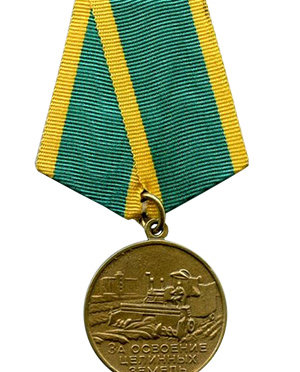
The Medal for the Development of Virgin Lands

The Medal for the Development of Virgin Lands was awarded to all Soviet workers who helped cultivate 36,000,000 hectares of land.

The Medal for the Development of Virgin Lands (or Медаль «За освоение целинных земель», Medal «Za osvoenie tselinnyh zemel» in Russian) was established on 20 October 1956 by decree of the Presidium of the Supreme Soviet of the USSR and awarded to all Soviet workers who helped cultivate 36,000,000 hectares of previously uncultivated lands (started in 1954 by Nikita Khrushchev) in Kazakhstan, Siberia, the Urals, the Volga area and the northern Caucasus for two solid years from 1954–56.

The medal was awarded to farmers, workers of state farms, MTS, construction and other organizations, the Party, government, labor and Komsomol workers for their good work in the development of virgin and fallow lands in Kazakhstan, Siberia, the Ural, the Volga and the North Caucasus for a period of usually at least two years. This Medal was also awarded to Yuri Gagarin right after his space flight (and it became a tradition to award the Medal to many Soviet cosmonauts after that).

The Medal for the Development of Virgin Lands Design

The medal was 32mm in diameter, circular with a raised rim on both sides. It was worn on the left side of the chest.

On its obverse, the image of a C-4 combine harvester in a field with a grain silo in the background on the horizon, at the bottom, the relief inscription on three rows «За освоение целинных земель» (“For the development of virgin lands”).

On the reverse at the bottom, the relief image of the hammer and sickle with sun rays radiating upwards towards a five-pointed star at the top, along the right circumference, ears of corn, along the left circumference, a panicle of wheat.

The medal was secured by a ring through the medal suspension loop to a standard Soviet pentagonal mount covered by an overlapping 24 mm dark green silk moiré ribbon with 3 mm wide yellow edge stripes.