The Order for Personal Courage (USSR)

The Order for Personal Courage was awarded to any USSR citizen showing outstanding courage and bravery during keeping of public order.

The Order for Personal Courage (or Орден «За личное мужество», Orden «Za lichnoe muzhestvo» in Russian) was established on 28 December 1988 and awarded to any USSR citizen showing outstanding courage and bravery during life-saving, keeping of public order and safeguard of State property, as well as for fighting crime, environmental catastrophes, and other exceptional events.

The order was first awarded on February 3, 1989, to a teacher of school No. 42 in the city of Ordzhonikidze (now Vladikavkaz) Natalia Vladimirovna Efimova. Her class was taken hostage and later freed in a police operation.

The Order for Personal Courage Design

The award was designed by Alexander Zhuk and represents a silver gilded silver star with the words «За личное мужество» (“For Personal Courage”) and CCCP (“USSR”) written on it.

Many medals were made but were mostly unissued.

The ribbon is red with three thin white lines on each side.

The Order of Labor Glory (USSR)

The Order of Labor Glory (or Орден Трудовой Славы) was established on 18 January 1974 and awarded for exceptional labor achievements.

The Order of Labor Glory (or Орден Трудовой Славы, Orden Trudovoj Slavy in Russian) was established on 18 January 1974 by the decision of the Praesidium of Supreme Soviet of the USSR and awarded for exceptional labor achievements.

It was divided in three classes (the highest being the 1st class), with a person initially received the third degree, and subsequently promoted to higher degrees for further achievements. It also gave a certain number of material benefits to their owners, such as an increased pension raises and free public transport.

In 1991, the following number of awards were made:

  • 1st class – 952
  • 2nd class – 50,000+
  • 3rd class – 650,000+

The Order of Labor Glory Design

The medal is struck in silvered bronze and enamels and measures 41 mm by 44 mm.

The obverse consists of an eight-pointed radiant star, bearing a raised depiction of a factory overlaid by a sickle and hammer, circumscribed by a Cyrillic inscription of “ТРУДОВАЯ СЛАВА” (“LABOUR GLORY”) on a cogwheel, topped by a five-pointed red enameled star, above a red enameled banner bearing a gilt inscription of “СССР”, flanked by wheat stalks. The reverse sometimes bears a raised maker’s mark.

The medal is mounted to a five-sided aluminum suspension with pinback. The ribbon is has a large grey stripe, and thinner yellow, red, and yellow stripes.

The Order of Maternal Glory (USSR)

The Order of Maternal Glory was established on 8 July 1944 and awarded to all mothers bearing and raising 9 children.

The Order of Maternal Glory (or Орден «Материнская слава», Orden «Materinskaja slava» in Russian) was established on 8 July 1944 and awarded to all mothers bearing and raising 9 children. It was awarded upon the first birthday of the last child, provided that eight other children (natural or adopted) remained alive. Children who had perished under heroic, military, or other respectful circumstances were also counted.

The order was divided into three classes: first, second and third class. It was conferred to:

  • First class: mothers bearing and raising nine children.
  • Second class: mothers bearing and raising eight children.
  • Third class: mothers bearing and raising seven children.

The award was created simultaneously with the Mother Heroine order and the Maternity Medal and it was situated in between them. The first decree for bestowing the award was issued on 6 December 1944, when the first class order was conferred to 21 women, the second class to 26 and the third class to 27. In total the order was awarded in the first class to 753,000 women, 1,508,000 received the second class award and 2,786,000 received the third class award.

The Order of Maternal Glory Design

The first class medals were made of silver in a convex egg-shape and measured 36 mm (1.4 in) high and 29 mm (1.1 in) wide.

The upper part of the medal contained a red enamel flag with the phrase “Материнская слава” (“Maternal Glory”) and the Roman number showing the order’s class. Below the flag, there was a white enamel shield with the CCCP (USSR) inscription. The upper part of the shield was decorated with a five-pointed star and the lower part with the hammer and sickle symbol. On the left side, there was a figure of a mother holding a son in her arms covered with roses on her lowest part. The lower part of the medal contains a flag and gilded lettering.

In second class medals, the flag’s enamel was dark-blue and there were not gilded parts while in the third class ones enamel disappeared from the flag, shield, and star. The back of the medals was in white enamel. First-class medals were suspended to a single light-blue fringe while second class had two light-blue fringes and third-class three of them.

The Honored Inventor of the USSR Medal

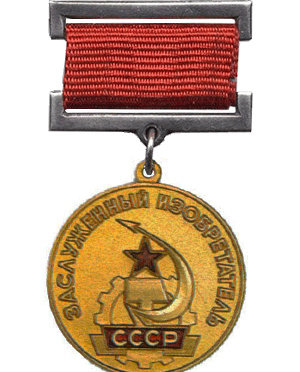
The Honored Inventor of the USSR Medal was established on December 28, 1981 and awarded for innovative proposals.

The Honored Inventor of the USSR Medal (or Заслуженный изобретатель СССР, Zaslužennyj izobretatel’ SSSR in Russian) was established on December 28, 1981, by Decree of the Presidium of the Supreme Soviet № 6277-X and awarded for innovative proposals in technology.

The Honorary Title was awarded to the authors of inventions, for opening new avenues in the development of engineering and technology, or that had a particularly important economic value. The Presidium of the Supreme Soviet of the USSR was the main conferring authority of the award based on recommendations from the State Committee for Inventions and Discoveries of the USSR and the Central Council of the All-Union Society of Inventors and Innovators.

The chest badge was worn on the right side of the chest and in the presence of other awards of the USSR, placed above them.

The Honored Inventor of the USSR Medal Design

The chest badge is circular, measures 30mm in diameter, and is struck in gold-plated tombac.

On its obverse, a red enameled five-pointed star over a hammer and sickle and gears, the upper tip of the sickle becoming a missile in flight arcs around the right side of the star to a point at its upper left. Following the left, top, and right medal circumference, the relief inscription Заслуженный изобретатель (“Honored Inventor”), near the bottom, a red enameled rectangle bearing the gilt inscription CCCP (“USSR”).

On the otherwise plain reverse, the relief inscription “Заслуженный изобретатель СССР – творец научно-технического прогресса” (“Honored inventor of the USSR – creator of scientific and technological progress”).

The medal was secured to a gilt tombac 24,5mm wide x 16mm high rectangular mount by a ring through the suspension loop. The mount was covered by a scarlet silk moiré ribbon. A gilt tombac laurel branch was affixed to the ribbon.

The Honored Navigator of the USSR Medal

The Honored Navigator of the USSR Medal was awarded to qualified civilian navigators for special merit in the development of modern aircraft.

The Honored Navigator of the USSR Medal (or Заслуженный штурман СССР, Zaslužennyj šturman SSSR in Russian) was established on 30 September 1965 and awarded to qualified civilian navigators 1st class for special merit in the development of modern aircraft, in the use of the most advanced navigating techniques, for the highest standards in education and training of flight personnel, for long-term trouble-free flying and for outstanding achievements in the use of aviation in the national economy.

The Presidium of the Supreme Soviet of the USSR was the main conferring authority of the award based on recommendations of the Minister for Civil Aviation of the USSR.

The chest badge “Honoured Navigator of the USSR” was worn on the right side of the chest and in the presence of other orders, placed over them.

The Honored Navigator of the USSR Medal Design

The medal is a polygon with raised edges struck in silver and nickel and measuring 27mm wide by 23mm high.

At the top of the obverse, the relief inscription in two lines covered to the left ЗАСЛУЖЕННЫЙ ШТУРМАН (“HONOURED NAVIGATOR”), in the center, the gilt tombac image of a jet transport aircraft climbing diagonally towards the right, at the bottom, the relief inscription СССР (“USSR”) superimposed over a laurel branch.

The badge was secured to a standard Soviet square mount by a silver-plated ring through the suspension loop. The mount was covered by a silk moiré red ribbon.

The Honored Pilot of the USSR Medal

The Honored Pilot of the USSR Medal was awarded for outstanding achievements in the use of aviation in the national economy.

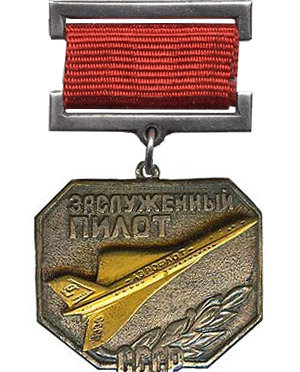
The Honored Pilot of the USSR Medal (or Заслуженный пилот СССР, Zaslužennyj pilot SSSR in Russian) was established on 30 September 1965 and awarded to qualified civilian pilots 1st class for special merit in the development of modern aircraft, in the use of the most advanced piloting techniques, for the highest standards in education and training of flight personnel, for long-term trouble-free flying and for outstanding achievements in the use of aviation in the national economy.

The Presidium of the Supreme Soviet of the USSR was the main conferring authority of the award based on recommendations of the Ministry for Civil Aviation of the USSR.

The chest badge “Honored Pilot of the USSR” was worn on the right side of the chest and in the presence of other orders, placed over them.

The Honored Pilot of the USSR Medal Design

The medal is a polygon with raised edges struck in silver and nickel and measuring 27mm wide by 23mm high.

At the top of the obverse, the relief inscription in two lines covered to the left ЗАСЛУЖЕННЫЙ ПИЛОТ (“HONOURED PILOT”), in the center, the gilt tombac image of a jet transport aircraft climbing diagonally towards the right, at the bottom, the relief inscription СССР (“USSR”) superimposed over a laurel branch.

The badge was secured to a standard Soviet square mount by a silver-plated ring through the suspension loop. The mount was covered by a silk moiré red ribbon.

The Honored Military Navigator of the USSR Medal

The Honored Military Navigator of the USSR Medal was awarded for outstanding achievements in the development of aviation technology.

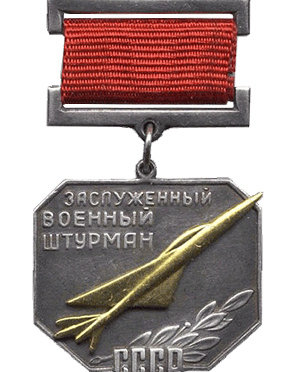
The Honored Military Navigator of the USSR Medal (or Заслуженный военный штурман СССР, Zaslužennyj voennyj šturman SSSR in Russian) was established on 26 January 1965 and awarded to members of military flying units, military agencies, military schools, military organizations, and other military or federal authorities, having qualified military navigators 1st class or military navigator-instructors 1st class, for outstanding achievements in the development of aviation technology, high performance in education and training of flight personnel and long-term trouble-free flight operations in military aviation.

The Presidium of the Supreme Soviet of the USSR was the main conferring authority of the award based on recommendations from the Ministry of Defence of the USSR.

The breast badge “Merited Military Navigator of the USSR” was worn on the right side of the chest and in the presence of other orders, placed over them.

The Honored Military Navigator of the USSR Medal Design

The medal is a polygon with raised edges struck in silver and nickel and measuring 27mm wide by 23mm high,

At the top of the obverse, the relief inscription in three lines covered to the left ЗАСЛУЖЕННЫЙ ВОЕННЫЙ ШТУРМАН (“MERITED MILITARY NAVIGATOR”), in the center, the gilt tombac image of a jet plane climbing diagonally towards the right its nose and tail slightly protruding over the edges, at the bottom, the relief inscription СССР (“USSR”) superimposed over a laurel branch.

The badge was secured to a standard Soviet square mount by a silver-plated ring through the suspension loop. The mount was covered by a silk moiré red ribbon.

The Honored Military Pilot of the USSR Medal

The Honored Military Pilot of the USSR Medal was awarded for outstanding achievements in the development of aviation technology and training.

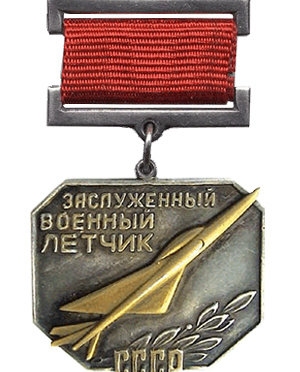
The Honored Military Pilot of the USSR Medal (or Заслуженный военный лётчик СССР, Zaslužennyj voennyj lëtčik SSSR in Russian) was established on 26 January 1965 and awarded to members of military flying units, military agencies, military schools, military organizations, and other military or federal authorities, having qualified military pilots 1st class or military pilot-instructors 1st class, for outstanding achievements in the development of aviation technology, high performance in education and training of flight personnel and long-term trouble-free flight operations in military aviation.

The Presidium of the Supreme Soviet of the USSR was the main conferring authority of the award based on recommendations from the Ministry of Defence of the USSR. The chest badge “Honored Military Pilot of the USSR” was worn on the right side of the chest and in the presence of other orders, placed over them.

The Honored Military Pilot of the USSR Medal Design

The medal is a polygon with raised edges struck in silver-and-nickel and measuring 27-millimetre-wide by 23-millimetre-high.

At the top of the obverse is the relief inscription in three lines covered to the left ЗАСЛУЖЕННЫЙ ВОЕННЫЙ ЛËТЧИК (“Honored MILITARY PILOT”), in the center, the gilt tombac image of a jet plane climbing diagonally towards the right its nose and tail slightly protruding over the edges, at the bottom, the relief inscription СССР (“USSR”) superimposed over a laurel branch.

The badge was secured to a standard Soviet square mount by a silver-plated ring through the suspension loop. The mount was covered by a silk moiré red ribbon.

The Pilot-Cosmonaut of the USSR Medal

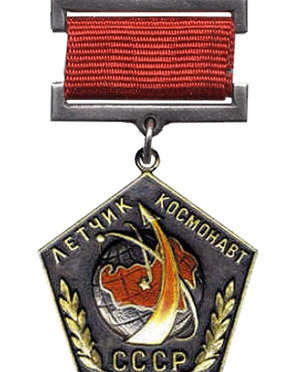
The Pilot-Cosmonaut of the USSR Medal was established on 14 April 1961 and awarded to all cosmonauts who flew for the Soviet Space Agency.

The Pilot-Cosmonaut of the USSR Medal (or Заслуженный военный лётчик СССР, Zaslužennyj voennyj lëtčik SSSR in Russian) was established on 14 April 1961 and awarded by the Presidium of the Supreme Soviet to all cosmonauts who flew for the Soviet Space Agency. Usually accompanying the distinction was the title of Hero of the Soviet Union, the highest title that could be awarded to a Soviet citizen for performing heroic deeds while in service of the state.

The award was given until the dissolution of the Soviet Union in 1991 where it was retained by the Law of the Russian Federation 2555-1 dated 20 March 1992 with a few slight amendments and renamed Pilot-Cosmonaut of the Russian Federation. The insignia of Pilot-Cosmonaut of the USSR is worn on the right side of the chest above orders and decorations.

The Pilot-Cosmonaut of the USSR Medal Design

The medal is a 25mm wide by 23.8mm high convex pentagon with a gilt silver rim.

In the center is an image of the terrestrial globe with the territory of the Soviet Union enameled in red. A gold star denotes Moscow as the point of origin of a gilt orbital path going around the globe once to reach a silver satellite at the upper left of the globe. A second orbital path, this time enameled in red, starts at the bottom center of the globe going up in an arc narrowing along the way to reach a gilt spacecraft above the globe.

Along the upper-left edge of the pentagon above the globe, the gilt relief inscription ЛЕТЧИК (“PILOT”), along the upper-right edge of the pentagon above the globe, the gilt relief inscription КОСМОНАВТ (“COSMONAUT”), along the bottom edge of the pentagon under the globe, the gilt inscription СССР (“USSR”), along the left and right lower edges of the pentagon, prominent gilt laurel branches. The reverse of the insignia is plain except for the award serial number.

The insignia is secured to a standard Russian square mount by a ring through the suspension loop. The award is secured to clothing with a threaded stud and nut behind the mount. The mount is covered by a silk moiré red ribbon.

The Honored Test Navigator of the USSR Medal

The Honored Test Navigator of the USSR Medal was established in 1958 and awarded to military and civilian test-navigators 1st class.

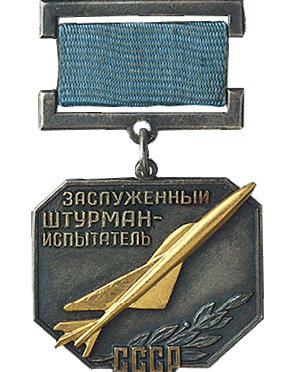
The Honored Test Navigator of the USSR Medal (or Заслуженный штурман-испытатель СССР, Zaslužennyj šturman-ispytatel’ SSSR in Russian) was established on 14 August 1958 and awarded to military and civilian test-navigators 1st class of the civilian aircraft industry and of the Ministry of Defence of the USSR, for multiple years of creative work in the field of testing and research of new aviation technologies.

Its statute was confirmed on August 22, 1988, by Decree of the Presidium of the Supreme Soviet № 9441-XI. The title ceased to be awarded following the December 1991 dissolution of the Soviet Union. The Presidium of the Supreme Soviet of the USSR was the main conferring authority of the award based on recommendations from the Ministry of Defence of the USSR (Министерство обороны СССР) or from the Ministry of Aviation Industry of the USSR (Министерство авиационной промышленности СССР).

The Honored Test Navigator of the USSR Medal Design

The badge is a silver and nickel polygon with raised edges and measures 27mm wide by 23mm high.

At the top of the obverse, the relief inscription in three lines covered to the left ЗАСЛУЖЕННЫЙ ШТУРМАН-ИСПЫТАТЕЛЬ (“MERITED TEST NAVIGATOR”), in the center, the gilt tombac image of a jet plane climbing diagonally towards the right its nose and tail slightly protruding over the edges, at the bottom, the relief inscription CCCP (“USSR”) superimposed over a laurel branch.

The badge was secured to a standard Soviet square mount by a silver-plated ring through the suspension loop. The mount was covered by a silk moiré blue ribbon. It was secured to clothing by a threaded stud and nut or by a pin attachment.