The Honored Test Pilot of the USSR Medal

The Honored Test Pilot of the USSR Medal was established on 14 August 1958 and awarded to military and civilian test-pilots 1st class.

The Honored Test Pilot of the USSR Medal (or Заслуженный лётчик-испытатель СССР, Zaslužennyj Lëtčik-Ispytatel’ SSSR in Russian) was established on 14 August 1958 and awarded to military and civilian test-pilots 1st class of the civilian aircraft industry and of the Ministry of Defence of the USSR, for multiple years of creative work in the field of testing and research of new aviation technologies.

The state award of the Soviet Union was established on August 14, 1958, by Decree of the Presidium of the Supreme Soviet № 2523-X to recognize courage and excellence of military and civilian test pilots in flight research and testing of aircraft. Its statute was confirmed on August 22, 1988, by Decree of the Presidium of the Supreme Soviet № 9441-XI. The title ceased to be awarded following the dissolution of the Soviet Union in 1991.

The Honored Test Pilot of the USSR Medal Design

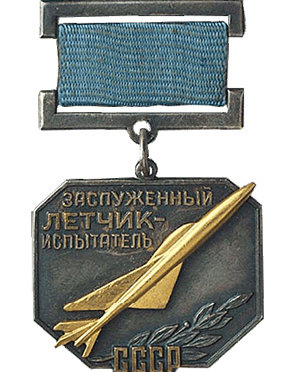
The badge is a silver and nickel polygon with raised edges and measures 27mm wide by 23mm high.

At the top of the obverse, the relief inscription in three lines covered to the left ЗАСЛУЖЕННЫЙ ЛËТЧИК-ИСПЫТАТЕЛЬ (“HONOURED TEST PILOT”), in the center, the gilt tombac image of a jet plane climbing diagonally towards the right its nose and tail slightly protruding over the edges, at the bottom, the relief inscription CCCP (“USSR”) superimposed over a laurel branch.

The badge was secured to a standard Soviet square mount by a silver-plated ring through the suspension loop. The mount was covered by a silk moiré blue ribbon. It was secured to clothing by a threaded stud and nut or by a pin attachment.
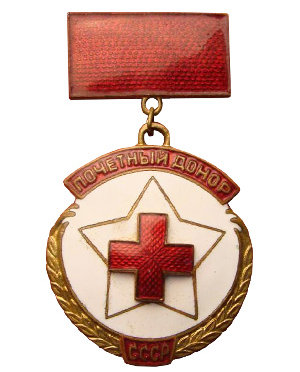
The Honored Blood Donor of the USSR Medal

The Honored Blood Donor of the USSR Medal was an honorary title established in the 1950s and awarded to Soviet blood donors.

The Honored Blood Donor of the USSR Medal was an honorary title established in the 1950s and awarded to Soviet blood donors. Not much is known about this medal.

The Honored Blood Donor of the USSR Medal Design

The medal is struck in brass and decorated with red and white enamels. The pendant portion is about 1.5″ in diameter.

The obverse features a round white badge with the outline of a star and a superimposed red cross in the center. The medal bears a gold wreath at the bottom.

The suspension device is made in red enamel.

The People’s Architect of the USSR Medal

The People’s Architect of the USSR Medal was established in 1967 and awarded for stunning results in urban planning or building design.

The People’s Architect of the USSR Medal (or Медаль Народный архитектор СССР, Narodnyj architektor SSSR in Russian) was established on 12 August 1967 by Leonid Brezhnev and awarded for stunning results either in urban planning or in the design of important buildings.

The honorary title was granted to architects of the Soviet Union and bestowed by the Presidium of the Supreme Soviet of the USSR owing proposals addressed by the State Construction Committee or by the Soviet Architects’ Union. The Supreme Soviet had the ability to refuse these designations.

A diploma was given to those who were appointed jointly with the medal and its concerning certificate. The title was bestowed to architects who had achieved stunning results in Soviet architecture’s development either applying their expertise and creativity to urban planning or to the design of important building compounds for civil, industrial, or rural use.

Following the Dissolution of the Soviet Union in 1990, the title of Meritorious Architect of the Russian Federation was created by a decree of the Russian presidency.

The People’s Architect of the USSR Medal Design

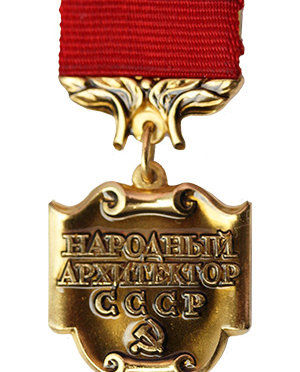
The medal was made of tombac and its shape was quadrangular with twisted corners. It measures 22.5 by 23.5 mm.

The central part is occupied by the inscription “Народный архитектор СССР” and, below, the hammer and sickle symbol. Both the symbol and inscription are embossed, with convex letters.

The medal is suspended to a single red silk fringe measuring 18 mm by 21 mm with an attached metallic buckle decorated with bay laurel leaves.

The People’s Teacher of the USSR Medal

The People’s Teacher of the USSR Medal was awarded for worthwhile contributions to the national education system and in teaching communism.

The People’s Teacher of the USSR Medal (or Народный учитель СССР, Narodnyj učitel’ SSSR in Russian) was established on 30 December 1977 and awarded for worthwhile contributions to the national education system and, mainly, in teaching communism to children and young people.

The title was conferred to teachers of Soviet secondary or vocational schools and also to civil servants employed by educational institutions, for worthwhile contributions to the national education system and mainly in teaching communism to children and young people. It was bestowed owing proposals addressed by the USSR Education Department or by the National Education Committee; together with the medal, a diploma of the Supreme Soviet’s presidency was given to the awarded people.

Following the Dissolution of the Soviet Union (1990) the title was modified in National Teacher of the Russian Federation.

The People’s Teacher of the USSR Medal Design

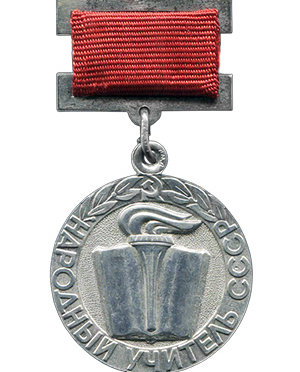
The medal is circular in shape and measures 30 mm in diameter.

The central part of the front side is occupied by an open book and a torch encircled by the inscription “Народный учитель СССР” (People’s Teacher of the USSR) and, above, two bay laurel branches and the hammer and sickle symbol. On the obverse is the inscription Народный учитель СССР — гордость советского общества (National Teacher of the USSR – Pride of sovietic society). Symbols and inscriptions are embossed, with convex letters.

The medal was suspended to a single red silk fringe measuring 18 mm by  21 mm and attached to the suit by a needle.

The People’s Painter of the USSR Medal

The People’s Painter of the USSR Medal was established on 16 July 1943 and awarded for exceptional achievements in visual arts.

The People’s Painter of the USSR Medal (or Медаль Народный художникin CCCP, Narodnyj chudožnik SSSR in Russian) was established on 16 July 1943 and awarded for exceptional achievements in visual arts as painting, sculpture, drawing, and photography.

The People’s Painter of the USSR Medal Design

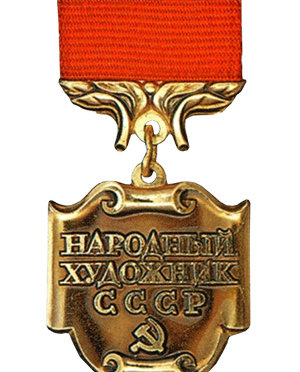
The medal is made of tombac and its shape was quadrangular with twisted corners. It measures 22.5 by 23.5 mm.

The central part is occupied by the inscription “Медаль Народный художник СССР” and, below, the hammer and sickle symbol. Both the symbol and inscription are embossed, with convex letters.

The medal is suspended to a single red silk fringe measuring 18 mm by 21 mm with an attached metallic buckle decorated with bay laurel leaves.

The People’s Doctor of the USSR Medal

The People’s Doctor of the USSR Medal was established in 1977 and awarded for worthwhile contributions to public health improvement. 

The People’s Doctor of the USSR Medal (or Медаль Народный врач СССР, Narodnyj vrač SSSR in Russian) was established on 25 October 1977 by Leonid Brezhnev and awarded for worthwhile contributions to public health improvement. The title was officialized on the n°44/1977 issue of Supreme Soviet’s official journal. Its regulation was later modified and completed by the Supreme Soviet’s decree of 22 August 1988.

The honorary title was conferred by the Supreme Soviet’s presidency on behalf of the Ministry of Health. A diploma of the Supreme Soviet’s presidency was given to those who were appointed People’s Doctor jointly with the medal and its concerning certificate. The title could be bestowed to individual medical doctors and nurses but also to health care structures as general hospitals, sanatoriums, maternity wards, or preventive medicine centers. The awarded people or structures were selected for their worthwhile contributions to public health improvement, for their peculiar skills and expertise, and for having proved abnegation and high moral qualities in their duties fulfillment.

Following the Dissolution of the Soviet Union in 1991, the title was replaced by that of Meritorious Doctor of the Russian Federation.

The People’s Doctor of the USSR Medal Design

The medal was made of tombac and its shape was quadrangular. It measures 22.5 by 23.5 mm.

The central part is occupied by the inscription “Медаль Народный врач СССР” on three lines and below, on the left, the Bowl of Hygieia medical symbol and, on the right, a bay laurel branch. Symbols and inscriptions were embossed, with convex letters.

The medal is suspended to a single red silk fringe measuring 18 mm by 21 mm with an attached metallic buckle decorated with the hammer and sickle symbol.

The Queen’s Gallantry Medal

The Queen’s Gallantry Medal (QGM) is a UK decoration awarded for exemplary acts of bravery by civilians, and by members of the Armed Forces.

The Queen’s Gallantry Medal (or QGM) is a United Kingdom decoration awarded for exemplary acts of bravery by civilians, and by members of the Armed Forces “not in the face of the enemy”, where the services were not so outstanding as to merit the George Cross or the George Medal.

The medal was instituted on 20 June 1974 to replace the Order of the British Empire for Gallantry and the British Empire Medal for Gallantry. The QGM ended the anomaly where the Order of the British Empire for Gallantry was awarded for lesser acts of bravery than the George Medal but took precedence over it in the Order of Wear.

The QGM has been awarded posthumously since 30 November 1977.

The Queen’s Gallantry Medal Design

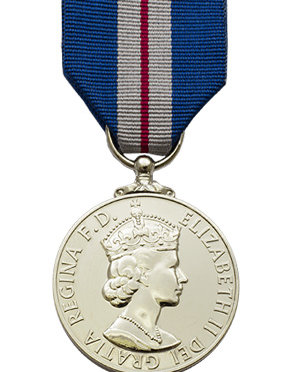
The medal is circular, struck in silver, and measures 36 millimeters in diameter.

The obverse shows the crowned effigy of the Queen, with the inscription “ELIZABETH II DEI GRATIA REGINA F.D.”. The reverse bears the image of a St Edward’s Crown above the words ‘The Queen’s Gallantry Medal’ in four lines, flanked by laurel sprigs.

The ribbon measures 32 mm wide and consists of three equal stripes of dark blue, pearl grey, and dark blue with a narrow rose pink stripe in the center. While awards to women generally have the ribbon fashioned into a bow, female recipients in the armed forces or civilian uniformed services have the medal presented with the ribbon in the same style as for male recipients.

The name of the recipient is impressed on the rim of the medal. If awarded to members of the Armed Forces, service number, rank, and unit are also included.

The Australian Operational Service Medal

The Australian Operational Service Medal is a campaign medal established on 22 May 2012 to recognize service by Australian Defence Force (ADF) personnel on designated hazardous operations.

The Australian Operational Service Medal is a campaign medal established on 22 May 2012 to recognize service by Australian Defence Force (ADF) personnel on designated hazardous operations. It replaces the Australian Active Service Medal and Australian Service Medal for future ADF operations.

The medal is issued to military personnel with a different ribbon for each designated operation. When issued to civilians, a standard ribbon is issued with clasps issued for each designated operation. It may also be awarded to civilians who serve alongside the ADF on designated operations under specific conditions.

The military version of the medal has a standard medal design, but ribbons vary depending on operation. An accumulated service device will be awarded for subsequent qualifying service by ADF members where they undertake further service on an operation for which they have already been awarded the Australian Operational Service Medal. The civilian version uses the same medal design as the military version but is awarded with a unique civilian ribbon and a clasp denoting the declared operation.

To date, three ribbons for ADF service have been announced: order Protection, Greater Middle East Operation, and Special Operations.

> Learn more at the Australian Government Site

The Australian Operational Service Medal Design

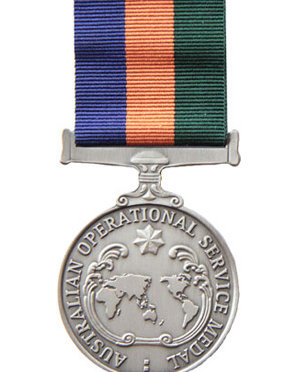
The medal is circular, struck in cupro-nickel, and finished in antique silver.

The obverse bears an old-world stylized world globe signifying global operations, interlinked with a Federation Star. The globe is surrounded by the words ‘AUSTRALIAN OPERATIONAL SERVICE MEDAL’.

The reverse bears a central horizontal stylized scroll with the words ‘Defending Australia and its national interests’, overlaying a wreath of mimosa, above which sits an hourglass motif signifying the ongoing vigilance and timely response of Defence.

The Border Protection ribbon has three equal stripes of dark blue, ochre, and dark green which denote the seas and sky, the deserts, and the forests and grasslands. The Greater Middle East Operation ribbon has three equal stripes of mid-green, black, and light blue, edged by two slim stripes of light sand. Sand represents the desert sands, green represents Australia and hope, black represents anti-piracy, and blue represents the maritime and air aspects. The Special Operations ribbon is 32 mm wide in black with a central stripe of red. Additional accumulated service is denoted by an 8 mm high Arabic numeral with an antique silver finish. The Civilian ribbon is green with central stripes of gold and purple. The purple represents Defence, and green and gold are Australia’s national colors.

The Australian General Service Medal for Korea

The Australian General Service Medal for Korea (or AGSMK) recognizes former defense force personnel who completed 30 days of service in operations in South Korea during the post-Armistice period, 28 July 1953 to 19 April 1956, including any location 161 km (100 mi) seaward from the coast of South Korea.

The medal was established by letters patent by Queen Elizabeth II on 24 November 2009 and further determination approved by the Governor General on 12 March 2010. The AGSMK was announced on 12 February 2010 by the Parliamentary Secretary for Defence Support, the Hon Dr Mike Kelly AM MP, following the recommendations of the 2005 Post-Armistice Korean Service Review.

The Australian General Service Medal for Korea Design

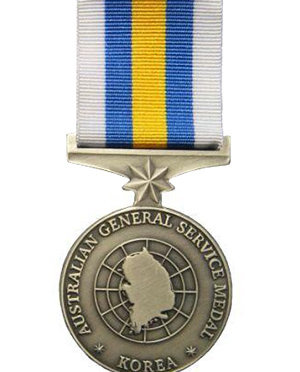
The medal is circular, struck in nickel-silver, and measures 38 mm in diameter. The design is ensigned with the Federation Star and has an antique silver finish with a raised polished outer edge.

The obverse has a central design of a relief map of South Korea superimposed over polar projection lines representing the United Nations and surrounded by the words “Australian General Service Medal Korea”. Centered on the reverse are the words “Post Armistice Service 1953–1956″ surrounded by Australian gum leaves and blossoms with two Federation Stars included in the bottom left and right-hand quadrants.

The ribbon measures 32 millimeters wide and has a central yellow stripe 8mm wide, flanked by 6mm stripes of blue, which in turn are flanked by 6mm stripes white. The ribbon colors are representative of the colors used for the Korea Medal and the United Nations Korea Medal. The ribbon bar consists of a strip of a full-sized ribbon with no emblem.

The Iraq Medal (Australia)

The Iraq Medal was instituted by Queen Elizabeth II on the advice of the Australian Prime Minister John Howard in 2004. The Iraq Medal is awarded to Australian Defence Force (ADF) personnel who served in or around Iraq (19 March 2003 – 25 November 2013).

ADF personnel is also recognized by the ‘IRAQ 2003’ clasp to the Australian Active Service Medal.

Members of the ADF who render service with the forces:

  • Operation Falconer – the ADF contribution to the United States-led military operations to remove the threat of Iraqi weapons of mass destruction that commenced on 18 March 2003 and ended on 30 April 2003, with 7 days service in the specified areas comprising the total land areas, territorial waters, inland waterways, and superjacent airspace boundaries of Iraq, Kuwait, Bahrain, Qatar, United Arab Emirates Oman, Saudi Arabia, Jordan Yemen, the Persian Gulf the Strait of Hormuz, the Gulf of Oman, those portions of the Arabian Sea bounded by 68 degrees East and 12 degrees North the Gulf of Aden, the Bab el Mandeb, the Red Sea, the Gulf of Suez and the Gulf of Aqaba; commenced on 1 May 2003 and ended on 22 July 2003, with 30 days service in the specified areas comprising the total land areas, territorial waters, inland waterways, and superjacent airspace boundaries of Iraq, Kuwait, Bahrain, Qatar, United Arab Emirates, Saudi Arabia north of 23 degrees North, the Persian Gulf and the Strait of Hormuz.
  • Operation Catalyst the ADF contribution to the United States-led coalition operations in Iraq to support the Australian effort to assist with the rehabilitation of Iraq and remove the threat of weapons of mass destruction that commenced on 16 July 2003 and ended on 31 July 2009, for 30 days service in the specified areas comprising the total land areas, territorial waters, inland waterways, and superjacent airspace boundaries of Iraq Kuwait, Bahrain, Qatar United Arab Emirates, Saudi Arabia north of 23 degrees North, the Persian Gulf and the Strait of Hormuz.
  • Operation Riverbank from 21 July 2008 personnel attached to the United Nations Assistance Mission for Iraq as part of Operation Riverbank. The operation ended on 25 November 2013.
  • Operation Kruger from 1 January 2009 personnel deployed on Operation KRUGER as part of the Security Detachment Iraq which protects the Australian embassy in Baghdad. The operation ended in late July 2011.

The Iraq Medal Design

The medal is circular and struck in nickel-silver.

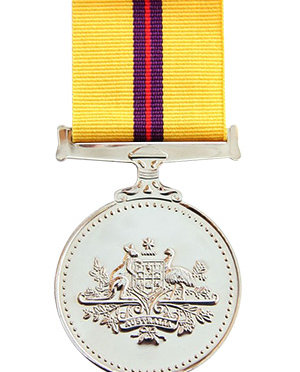
The obverse bears the Commonwealth Coat of Arms. The reverse has a processional lion, which is copied from a relief on the Gateway of the Temple of Ishtar in Babylon. In the Assyrian Empire, the lion was a dominant symbol of power. The lion stands on a narrow plinth, symbolizing balance, with the word ‘IRAQ’ inscribed underneath.

The ribbon is sand yellow representing the desert sands of Iraq, with central stripes of purple and red representing the ADF and the conflict in Iraq.