The Military Merit Decoration (Austria)

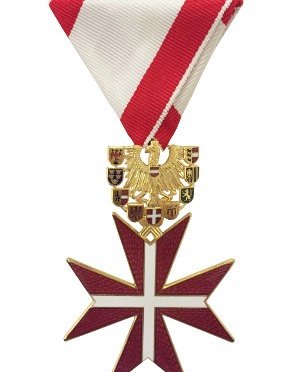
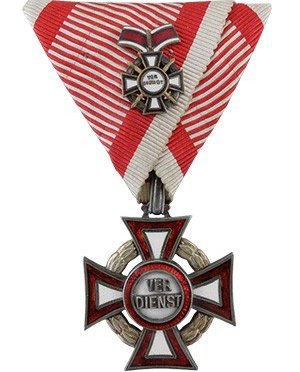
The Austrian Military Merit Decoration (or Militärverdienstzeichen in German) is an Austrian military decoration established on 13 November 1989 to honor the Military of Austria.

The decorations are awarded by the Federal President at the request of the Federal Minister of Defense and after a decision by the Ministerial Council. Ordinance of the Federal Ministry of Defense of November 13, 1989, Federal Law Gazette 551.

Holders of the Military Merit Decoration wear the badge on the left side of the chest.

The Decoration for Services to the Liberation of Austria Design

The badge is a silver-gilt breast star that is worn on the left chest, measuring 30.88 mm (w) x 31.40 mm (h) and weighing 14.3 grams. The cross is 60 mm wide and high and in white enamel, with a red border. Between the arms of the cross are gold crossed swords.

The obverse shows a central white enameled medallion with the Austrian eagle and the inscription “Verdienst” (“Merit” in German). The reverse is decorated with white enamels and has no inscription.

The suspension is a loop from which the ribbon (and sometimes a miniature decoration) is attached. The ribbon is white and red with diagonal lines.
The Decoration for Services to the Liberation of Austria

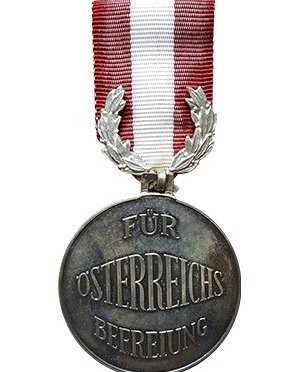
The Decoration for Services to the Liberation of Austria (or Ehrenzeichen für Verdienste um die Befreiung Österreichs in german) is an Austrian decoration created by federal law on 27 January 1976.

The award is a special distinction for men and women who actively resisted the Nazi regime contributing to Austria’s liberation from Nazi rule.

The President of Austria confers this honour when sent a proposal by the Federal Chancellor based on a report from the Committee on the Austrian Liberation Decoration of Honour.

The Decoration for Services to the Liberation of Austria Design

The medal is circular, silver-plated, and has a diameter of 42 mm.

The obverse reads the inscription “FOR AUSTRIA’S LIBERATION“. The text raised and doesn’t have a constant height, but is presented in a convex form. The reverse bears the federal eagle, also centrally positioned.

The suspension is a couple of silver crossed laurel branches. The ribbon is 27 mm wide and split red-white-red. The rosette has a diameter of 10 mm, is colored red-white-red and decorated with two silver-colored, crossed laurel branches. Instead of the rosette, a bar (stitch-like stitching) is provided for women.

The Austrian Decoration for Science and Art

The Austrian Decoration for Science and Art (or Österreichisches Ehrenzeichen für Wissenschaft und Kunst in German) is a state decoration of the Republic of Austria established in 1955 and part of its national honors system.

The award was established by the National Council as an honour for scientific or artistic achievements by Federal Law of May 1955. At the same time, the National Council also established the “Austrian Cross of Honour for Science and Art”, which is awarded as “Cross of Honour, First Class” (German: Ehrenkreuz 1. Klasse) and “Cross of Honour” (German: Ehrenkreuz). While not technically counted as lower classes of the Decoration for Science and Art, these crosses are nevertheless affiliated with it.

Divisions:

  • Decoration for Science and Art. Limited to a maximum of 72 at any one time (36 recipients for science and 36 for arts). In each of these two groups, there are 18 Austrian citizens and 18 foreign nationals.
  • Cross of Honour for Science and Art, First Class. There are no limits on the number of recipients.
  • Cross of Honour for Science and Art. There are no limits on the number of recipients.

Forfeiture of this honor became possible with Federal Law Gazette I No 128/2001. It allows the government to strip recipients of their honors if deemed unworthy. The best-known example of such a forfeiture is of the Nazi physician Heinrich Gross.

The Austrian Decoration for Science and Art Design

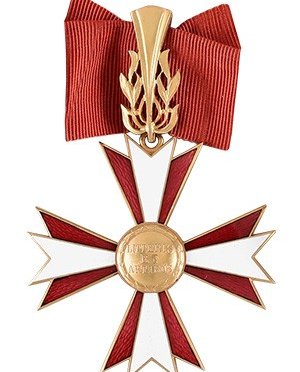
The award consists of a neck badge constructed of gilded bronze with multi-colored enamels, suspended on a loop. It measures 58.09 mm (w) x 59.33 mm (h) and weighs 31.1 grams.

The breast badge is constructed of gilded bronze with multi-colored enamels, consisting of a Maltese Cross.

Its obverse has red enameled arms, in turn, overlaid by a narrow Maltese Cross with white enameled arms, with a central gilt medallion bearing a raised inscription of “LITTERIS ET ARTIBUS” (“LETTERS AND ARTS”), inside f a laurel wreath. The reverse has a central raised medallion bearing the maker’s mark.

The ribbon is red.

The Decoration of Honor for Services to the Republic of Austria

The Decoration of Honour for Services to the Republic of Austria (or Ehrenzeichen für Verdienste um die Republik Österreich in German) is a national honor established by the National Council in 1952 and awarded by the Republic of Austria.

The decoration is conferred by the Republic of Austria to honor people (from Austria and abroad) who have rendered meritorious services to the country.

Recipients are selected by the government and made by the President, who automatically receives the Grand Star of the Decoration for Services to the Republic of Austria by being elected to the office and holds this honor for life.

The decoration is awarded in 15 grades and is Austria’s highest national honor. The grades are:

  1. AUT Honour for Services to the Republic of Austria - 1st Class BAR.png Grand Star 
  2. AUT Honour for Services to the Republic of Austria - 2nd Class BAR.png Grand Decoration of Honour in Gold with Sash 
  3. AUT Honour for Services to the Republic of Austria - 3rd Class BAR.png Grand Decoration of Honour in Silver with Sash 
  4. AUT Honour for Services to the Republic of Austria - 4th Class BAR.png Grand Decoration of Honour in Gold with Star
  5. AUT Honour for Services to the Republic of Austria - 5th Class BAR.png Grand Decoration of Honour in Silver with Star
  6. AUT Honour for Services to the Republic of Austria - 6th Class BAR.png Grand Decoration of Honour in Gold 
  7. AUT Honour for Services to the Republic of Austria - 7th Class BAR.png Grand Decoration of Honour in Silver 
  8. AUT Honour for Services to the Republic of Austria - 8th Class BAR.png Grand Decoration of Honour 
  9. AUT Honour for Services to the Republic of Austria - 9th Class BAR.png Decoration of Honour in Gold 
  10. AUT Honour for Services to the Republic of Austria - 10th Class BAR.png Decoration of Honour in Silver 
  11. AUT Honour for Services to the Republic of Austria - 11th Class BAR.png Decoration of Merit in Gold 
  12. AUT Honour for Services to the Republic of Austria - 12th Class BAR.png Decoration of Merit in Silver
  13. AUT Honour for Services to the Republic of Austria - Gold Medal BAR.png AUT Honour for Services to the Republic of Austria - Life Saving Medal BAR.png Gold Medal 
  14. AUT Honour for Services to the Republic of Austria - Silver Medal BAR.png Silver Medal
  15. AUT Honour for Services to the Republic of Austria - Bronze Medal BAR.png Bronze Medal (no longer awarded)

The Decoration of Honor for Services to the Republic of Austria Design

The badge of the Decoration is a Maltese Cross constructed of silvered bronze with multi-colored enamels. It measures 50.02 mm (w) x 50.25 (h).

The obverse has red and white enameled arms, and the reverse is plain. The six o’clock arm has an integral loop connecting to a suspension apparatus in the form of a silvered Republic-style Austrian national eagle surrounded by an enameled shield of the Austrian states, in turn with a suspension ring connecting to a period original neck ribbon.

The ribbon is red and white.

The Four Days of the Yser Commemorative Medal

The Four Days of the Yser Commemorative Medal (Médaille commémorative des “Quatre jours de l’Yser” / Herinneringsmedaille van de “Vierdaagse van de IJzer”) was established in 1967.

The Four Days of the Yser is a four-day international march organized since 1967 by the Order of the Horse Fishermen of Oostduinkerke, in order to honor the tradition of shrimping on horseback on the one hand and to emphasize the scenic attractions of the Westhoek, the western part of the Belgian coast.

Since 1972 it is organized by the Belgian Armed Forces to strengthen the bond between the Belgian Armed Forces and society, to commemorate the casualties of both World Wars, particularly those who fell on the battlefields of the Westhoek during the First World War, and to introduce the hikers to the historical and touristic values of the Westhoek.

The march was initially four times thirty-two kilometers long, but now currently has 8,16,24 and 32 km routes including detours for disabled access and pushchairs.

The Four Days of the Yser Commemorative Medal Design

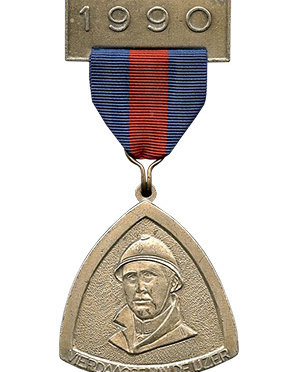
The medal is round or triangular (the shape of the medal can change every five years), and struck in silver or bronze.

The obverse bears the imprint of a World War I Belgian soldier.

The ribbon is dark blue with a large vertical scarlet stripe. Small metal bars are added to the ribbon when the bearer has completed the march more than one time.

The European March of Remembrance and Friendship Commemorative Medal

The European March of Remembrance and Friendship Commemorative Medal (Médaille commémorative de la “Marche Européenne du Souvenir et de l’Amitié” / Herinneringsmedaille van de “Europese Mars van de Herdenking en de Vriendschap”) was established in 1967 to commemorate the European March of Remembrance and Friendship, a four-day international march originally organized in 1967 by the 3rd Battalion of the Ardennes Chasseur Regiment in remembrance of the operations performed by the unit at the beginning of World War II in the Ardennes region.

The march is now organized on a yearly basis and also focusses on honoring the towns in the region regularly changing its course to do so. The march is divided into four legs of thirty-two kilometers each in the Ardennes region of Belgium as well as the Grand Duchy of Luxemburg.

The European March of Remembrance and Friendship Commemorative Medal Design

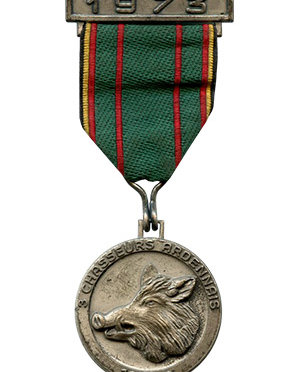
The medal is circular and struck in silver.

The obverse bears the relief left profile of a wild boar’s head surrounded by a 3mm wide ring along the entire medal’s circumference and bearing the relief inscription “3 CHASSEURS ARDENNAIS” in the upper half and “125 km” at the bottom. The reverse bears the relief inscription on four lines “MARCHE” “DU SOUVENIR” “ET DE L’AMITIE” “ARLON-VIELSALM“.

The ribbon is dark green with the national colors of Belgium in three narrow 1mm edge stripes and two narrow 1mm wide red stripes centered 1 cm apart on the green field. The medal hangs from a ribbon secured by a hook through a suspension loop at its top.

The Meritorious Service Medal

The Meritorious service medal for personnel of the Belgian Defence Forces and Foreign Armed Forces (Médaille du Mérite en faveur des membres du personnel de la défense et d’armées étrangères / Medaille van Verdienste ten gunste van de personeelsleden van defensie en van vreemde legers) is a military decoration of Belgium established on 23 February 2005.

The medal is awarded to members of the Belgian Armed Forces and civilians working for the Belgian Defence who show exemplary meritorious behavior in the completion of their duties or who have accomplished an exemplary meritorious act. It may also be awarded to foreign military and civilian members of a foreign Armed Force who have provided exceptional support to the Belgian Defence. The medal is awarded by the King based on a proposal from the Secretary of Defence, the Chief of Defence or an officer with the authority of Corps Commander or above, for award to a person who:

  • is more productive than most of their colleagues;
  • tries to achieve perfection in their daily work;
  • has on their own initiative achieved something to the benefit of the Belgian Armed Forces;
  • has not had any previous penal or disciplinary sanctions;
  • behaves in an exemplary manner; and
  • takes into account human and social issues in their work.

The Meritorious Service Medal Design

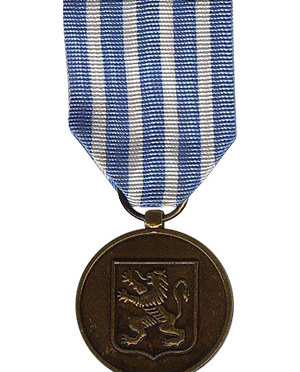
The medal is circular and struck from bronze.

The obverse bears the Escutcheon-only version of the Coat of arms of Belgium. The plain reverse usually bears the engraved name of the recipient and date of the award.

The ribbon is light blue with four vertical white stripes. The original Medal for Military Merit had the same design and hung from the same ribbon as the new one, only the statute differs. The medal is suspended to the ribbon by a ring though the suspension loop.

The Commemorative Medal for Operations in Defense of the Territory

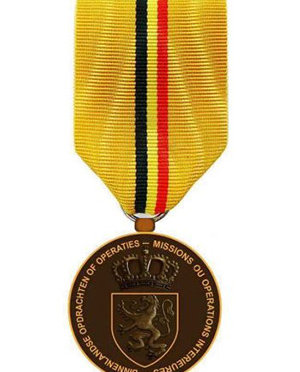
The Commemorative Medal for Missions or Operations regarding the operational defense of the territory (Médaille commémorative pour les missions ou opérations relatives à la défense opérationnelle du territoire / Herinneringsmedaille voor de opdrachten of operaties met betrekking tot de operationele verdediging van het grondgebied) is a military decoration of Belgium established on 28 March 2018 and is awarded to military and civilian members of the Belgian Armed Forces who participated in operations related to the defense of the Belgian territory or who provided specialized support to such operations for a minimum duration of 30 days.

In order to be eligible for the award, personnel must have shown exemplary behavior during the operation.

The Commemorative Medal for Operations in Defense of the Territory Design

The medal is circular and struck from bronze.

The obverse of the medal bears the Escutcheon-only version of the Coat of arms of Belgium under the royal crown and surrounded by the text “MISSIONS OU OPERATIONS INTERIEURES BINNENLANDSE OPDRACHTEN OF OPERATIES”. The reverse bears a laurel crown along the outer circumference. The blank area within the wreath may be used to engrave the recipients’ name and date of the award.

The ribbon is golden with three thin longitudinal stripes of black, yellow and red in the middle and adorned with an Arabic numeral that denotes the number of operations or missions the recipient has participated in.

The Commemorative Medal for Foreign Operations or Missions

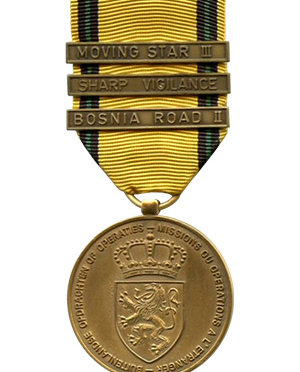
The Commemorative Medal for Foreign Operations or Missions (Médaille Commémorative pour Missions ou Opérations à l’Étranger / Herinneringsmedaille voor Buitenlandse Opdrachten of Operaties) is a military decoration of Belgium established on 13 April 1993 and awarded to military and civilian members of the Belgian Armed Forces who participated in operations or missions outside of the territory of Belgium.

The medal is awarded to those who participated in good standing, in humanitarian, peacekeeping, peace enforcement or international security operations or missions outside the territory of Belgium for a minimum duration of one month. The list of the operations for which the medal is awarded is included in a separate Ministerial Decree, which is amended on a regular basis. If a person participated in more than one such operation, they receive the medal for each of these operations, the number of awards being represented by the number displayed on the ribbon.

The Commemorative Medal for Foreign Operations or Missions Design

The medal is circular and is struck from bronze.

The obverse of the medal bears the Escutcheon-only version of the Coat of arms of Belgium under the royal crown and surrounded by the text “Missions ou opérations à l’étranger – Buitenlandse opdrachten of operaties”. The reverse bears a laurel crown along the outer circumference. The blank area within the wreath may be used to engrave the recipients’ name and date of the award.

The ribbon is golden with three thin longitudinal stripes of black, green, and black near the outer edges. The ribbon is adorned with an Arabic numeral that denotes the number of operations or missions the recipient has participated in.

The Medal for Services Rendered

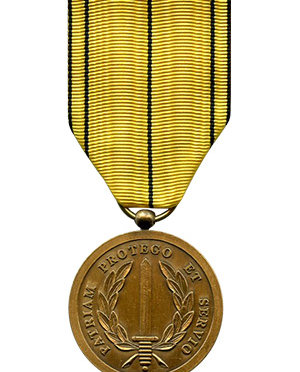
The Medal for Services Rendered (Médaille pour Services Rendus / Medaille voor Bewezen Diensten) is a Belgian military service medal that was proposed to be created on 18 April 1988 by ministerial decree.

It was intended to be awarded to members of the army, navy, air force and medical services of the Belgian Armed Forces for service rendered in particularly difficult circumstances over an extended time period. However, the creation of the medal was presented to the Council of State under the form of a ministerial decree and the Council ruled that the creation of such an award should be done by the King, thus via a Royal Decree.

Because a Royal Decree was never made, the medal was never officially created and has not or cannot be awarded.

The Medal for Services Rendered Design

The medal measures 36mm in diameter and is circular and struck in bronze.

The obverse bears a relief vertical broadsword pointing up superimposed over the base of a laurel wreath. Inscribed in relief along the medal circumference is, in Latin, “PATRIAM PROTEGO ET SERVIO” (“I PROTECT AND SERVE MY COUNTRY“). The reverse is smooth and plain.

The ribbon is 37 mm wide yellow silk moiré with five longitudinal black stripes. The black stripes are positioned as follows: one in the center, one on each edge, the last two are 4 mm from the edges. The width of the stripes varies according to the ribbon type. The type 1 ribbon has 2 mm edge stripes, 1 mm inner stripes and a 3 mm central stripe, the type 2 ribbon has five equal 1 mm stripes.

The medal hangs by a ring through a suspension loop.